September 24, 2015
Opinion:
¶ “The new Senate Democratic energy bill is a wonk’s dream” In anticipation of the pope’s visit to Washington, and to signal their support of Obama’s agenda at climate talks in Paris this December, Senate Democrats have released a new bill: the American Energy Innovation Act of 2015. It is astonishingly substantive. [Vox]

The author’s view of Senate Democrats. Painting by Elizabeth Thompson. Public domain, via Wikimedia Commons.
¶ “Shame upon them! The government’s nuclear lies exposed” There’s no doubt about it. The UK Government is spreading untruths about the price of renewable energy. Is it deliberate? One can only assume so owing to the consistency of the pattern. And, it’s always in the context of supporting nuclear power over renewable energy sources. [The Ecologist]
Science and Technology:
¶ The top microgrid electricity generation modality in the US will soon be solar PV, according to a new report from GTM Research. With the overall growth of microgrids in recent years, a slow shift from reliance on combined heat and power systems, or diesel generators, is taking place, with solar PV taking position as the top choice. [CleanTechnica]
World:
¶ PowerStream is Ontario’s second largest municipally owned electric utility. Recently, it has begun an experiment with the so-called internet of energy. Twenty homes will have solar panels and small battery systems installed. The systems will be tied together and operated as a single system using batteries and software in a network. [CleanTechnica]
¶ The Brazilian northeast region is not at risk of suffering power outages, due to its wind and thermal power facilities, the president of the federal energy planning authority EPE, Maurício Tolmasquim, said on Monday. Increasing renewable energy sources in the northeast region has been instrumental in dealing with the dry season. [SeeNews Renewables]
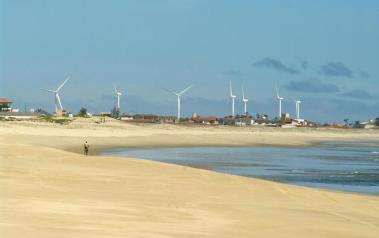
Wind farm in Brazil. Author: Otávio Nogueira. License: Creative Commons, Attribution 2.0 Generic
¶ The Australian renewable energy industry has more good news from the Liberal Party. Speaking to The Australian Financial Review, the Environment Minister (who kept his position in the leadership change), has reaffirmed that Australia’s new leadership structure will be more focused on supporting the country’s renewable energy. [CleanTechnica]
¶ Change continues for utilities. With this year’s release of Siemens’ Spectrum Power Microgrid Management System, Siemens hopes to give clients yet another option for controlling their energy resources while promising greater reliability, cost-efficiency and ways to manage the increased share of power generated by renewables. [energybiz]
¶ Expanding investments in wind and solar can free up Egypt’s carbon energy, reduce fiscal spending and create jobs, consultancy PWC said in a report. For Egypt, oil and gas reserves are a two-edged sword and developing renewable energy will ease pressure on government budgets, create jobs and attract investments. [gulfnews.com]
¶ Enel Green Power is close to completing the construction of the first facility in Italy to store electricity generated from a photovoltaic plant. The plant, which is being built in Catania, Sicily, will have a 1-MW/2-MWh storage system that can be connected to EGP’s 10 MWp Catania 1 photovoltaic plant. GE developed the system’s technology. [reNews]
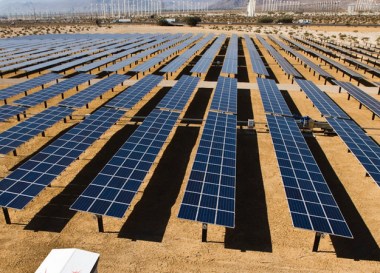
Italian Solar farm. (SPI Solar)
¶ Australian Capital Territory’s Minister for the Environment says a review of the Territory’s roof-top solar feed-in tariff initiative proves the program has been a success. “The ACT went from less than 1000 connections prior to the start of the scheme in 2009 to 10,175 FiT-supported connections with a capacity of 26.0 MW in operation today.” [Energy Matters]
¶ French oil and gas group Total SA intends to spend about $500 million (€ 445.8 million) per year on renewable energy developments, it said in an investor presentation on Wednesday. The group wants to build a profitable business by taking advantage of the rapidly growing renewables industry, it said as cited by Bloomberg. [SeeNews Renewables]
US:
¶ The US’ wind and solar power generation capacity grew by 3.4 GW in the first eight months of 2015, when 201 MW of biomass and 45 MW of geothermal plants were switched on as well. The Federal Energy Regulatory Commission says renewable energy accounted for 59% of all new power capacity in the US for the period. [SeeNews Renewables]
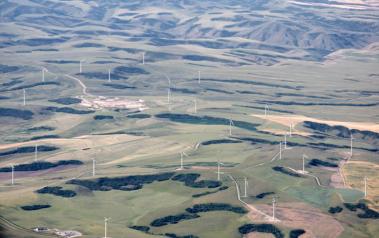
Wind farm in US. Author: Sam Beebe. License: Creative Commons, Attribution 2.0 Generic.
¶ The federal government is leasing wind farm sites off the coast of New Jersey. Fully developed, they could support at least 3.4 GW of commercial wind generation, which would be enough to meet the annual power consumption of about 1.2 million households, according to estimates by the DOE’s National Renewable Energy Laboratory. [Bulletin Leader]
¶ Yesterday, Hillary Clinton announced that she opposes the construction of the Keystone Pipeline. Today, she released her energy infrastructure plan. First item on the list: repairing and upgrading our existing pipelines. The words, “solar,” “wind,” and “alternative,” do not appear in the plan at all, and “renewable” shows up only twice. [AMERICAblog]
¶ The Vermont Public Service Department released the Public Review Draft of the 2015 Comprehensive Energy Plan. The plan emphasizes the importance of efficiency and conservation. Since the last CEP was published in 2011, Vermont has added more than 100 MW each of wind and solar PV, while power rates grew slower than inflation. [Vermont Biz]
Posted in nuclear power, renewable power, solar, wind | Leave a Comment »
Tags: nuclear, nuclear power, photovoltaic, renewable power, solar power, wind power
September 23, 2015
World:
¶ Research and consulting firm GlobalData highlighted the role the UK will play in the global offshore wind market. According to GlobalData’s predictions, the UK will see its installed offshore wind capacity increase from 4.5 GW in 2014 to 23.2 GW in 2025. In 2014, the UK accounted for 51.3% of global offshore wind energy capacity. [CleanTechnica]
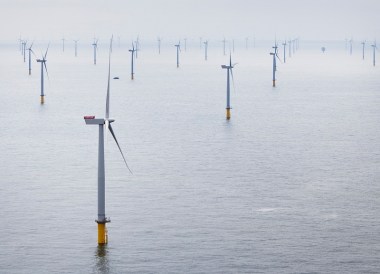
London Array – the world’s largest offshore wind farm (Siemens)
¶ West Australian energy minister Mike Nahan has delivered a damming critique of the regulators in his state, claiming that the “ban” on battery storage and electric vehicles for WA households was a case of “red tape gone mad.” The ban prevents any household with a battery storage device or EV from exporting back into the grid. [CleanTechnica]
¶ Scotland will offer more “clarity and certainty” for solar power projects by retaining the ‘grandfathering’ guarantee for solar under the Renewables Obligation’ in contrast to England and Wales. The guarantee ensures that the level of support for each unit of electricity will not change throughout the lifetime of a solar installation after it is built. [reNews]

Knitted graffiti at Lappeenranta University of Technology. Photo by Tommi Nummelin. CC BY SA 4.0.
¶ Energy Watch Group and Lappeenranta University of Technology, in Finland, have published the report which claims the International Energy Agency has been holding back global energy transition for years. EWG-LUT says the false predictions in the WEO reports have led to high investments in fossil and nuclear power sectors. [Greentech Lead]
¶ Siemens aims to achieve a net-zero carbon footprint by 2030, starting with a €100m investment over the next three years to reduce the energy footprint of its production facilities and buildings The German company plans to cut its carbon dioxide emissions – which currently total about 2.2m tonnes a year – in half by 2020. [reNews]
US:
¶ Climate-change denial has been compared to Big Tobacco’s 50-year-campaign to deny the dangers of cigarettes. It’s not widely known, but what ended the Big Tobacco campaign was actual prosecution under the RICO racketeering statute. Now, a group of scientists wants to use the RICO act against climate deceivers. [Red, Green, and Blue]
¶ InsideClimate News has a series about Exxon quietly studying fossil fuels and global warming. They found that in 1978, Exxon’s own scientists were telling the company that oil and gas use contribute to global warming that would play havoc on the planet’s climate. Exxon then funded politically motivated climate denialism. [CleanTechnica]
¶ Volkswagen is facing multiple investigations, including a criminal probe from the Department of Justice. These follow admission by VW that it deceived US regulators in exhaust emissions tests. A DOJ criminal investigation would be serious, as federal authorities can bring charges with severe penalties against a firm and individuals. [BBC]

VW Jetta, the “Green Car of the Year” at the 2009 Montreal International Auto Show. Photo by Bull-Doser. Released into the public domain by the author.
¶ Pope Francis is scheduled to address Congress. There’s a good chance he’ll dwell on two of his signature issues: global poverty and climate change. These issues are not especially popular with congressional Republicans. So perhaps it’s a bit surprising that, so far, only one of them has publicly expressed trepidation about the speech. [Grist]
¶ In recent months, Apple has poached Tesla’s top autonomous driving engineer, poached other Tesla engineers with $250,000 signing bonuses, hired a former Fiat Chrysler Automobiles executive, while hiring others for a new project. Now, the Wall Street Journal is reporting that Apple’s first electric car will hit the market in 2019. [CleanTechnica]
¶ With the opening of a 3.5-MW solar panel facility, North Adams, Massachusetts, now expects to be 100% solar powered. The thousands of panels supplementing electricity for the municipal and school buildings reside on a capped landfill about a mile from the city center, under a 20-year purchasing agreement with the developer. [The Beacon]
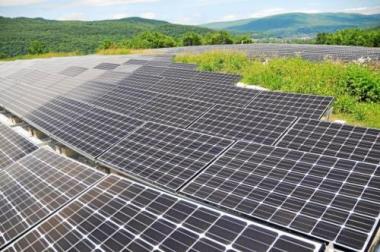
Photo by Scott Stafford, The Berkshire Eagle
¶ Nine well-known firms – Johnson & Johnson, Procter & Gamble, Goldman Sachs, Nike, Starbucks, Salesforce, Steelcase, Voya Financial, and Walmart – will use the annual Climate Week in New York to announce they have joined the global campaign RE100, which encourages businesses source 100% renewable power. [Business Green]
¶ North Carolina plans to file a lawsuit against the US EPA Clean Power Plan, which it believes will lead to higher costs for ratepayers. But at the same time, the state is taking a closer look at boosting the use of nuclear generation as a way to comply with the regulations, the state’s Department of Environmental Quality secretary said. [Argus Media]
Posted in nuclear power, renewable power, solar, wind | Leave a Comment »
Tags: nuclear, nuclear power, photovoltaic, renewable power, solar power, wind power
September 22, 2015
Science and Technology:
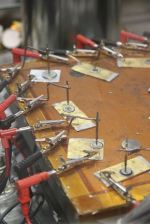
Prototype JBT ceramic batteries undergoing high-temperature testing.
¶ Solid-state battery technology may deliver up to three times more energy than equivalent-sized lithium-ion cell, while eliminating many of the durability and safety issues associated with conventional lithium-based energy sources. The technology employs ceramic electrolytes instead of volatile liquid or gel electrolytes. [IHS Electronics360]
¶ According to new research from Griffith University, in Queensland, Australia, harnessing the energy created from salinity gradients could provide a renewable source of power able to mitigate climate change impacts, reduce reliance on fossil fuels and improve processes within the desalination industry. [WaterWorld]
World:
¶ Yingli Green Energy Holdings has announced a partnership with Namene Energy International, a leading renewable energy projects developer in Africa, to work together to set up 100-MW of utility-scale and 50 MW of rooftop solar power projects in Ghana and other African countries. Each company will have a 50% share. [CleanTechnica]
¶ Canada’s clean energy sector employs more people than the oil sands, and the workforce grew another 14% last year. According to Clean Energy Canada’s latest Tracking the Energy Revolution, this sector attracted almost twice the number of investors than the fishing, forestry and agriculture sectors combined. [CleanTechnica]
¶ In 2017 the solar industry is expected to face, again, accelerating declines in prices and margins as manufacturing capacity additions are set to “dangerously” exceed demand, IHS projects. A cut to the federal solar investment tax credit in the US will lead to a drop in global demand in 2017 and new challenges to suppliers. [SeeNews Renewables]
¶ SunPower supplied a total of 41 MW to La Compagnie du Vent for the construction of four solar power plants under the French Ministry of Ecology, Sustainable Development and Energy national tender programme. A a dedication ceremony at one facility was attended by French President Francois Hollande. [reNews]
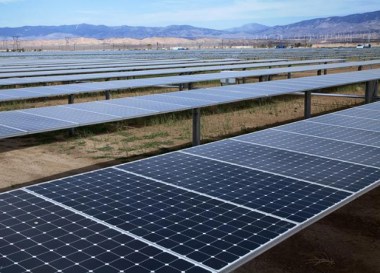
SunPower panels (SunPower)
¶ French utility EDF wants to expand into renewable energy beyond Europe, according to the company’s CEO. He said barely 5% of EDF’s assets were outside Europe, where there is little economic or demographic growth. EDF would remain in its key markets of France, Britain and Italy, would increase international operations. [Reuters]
¶ Major nations seem to be reducing fossil fuel subsidies but still have “ample scope” for deeper cuts in recent support of up to $200 billion a year, the Organisation for Economic Cooperation and Development says. The OECD nations are estimated to subsidize fossil fuels production $160 billion to $200 billion annually. [Times of Malta]
¶ A study released Monday in the science journal Philosophical Transactions says the Fukushima Disaster was preventable. It says, “Had the TEPCO modellers had any experience with tsunamis, they would have had immediately recognized that their ‘high’ resolution predictions were underestimating the hazard.” [Washington Post]
¶ Volkswagen AG plans to set aside €6.5 billion ($7.3 billion) in the third quarter to cover the costs of addressing irregularities in diesel engines installed in 11 million vehicles worldwide, as the scandal that started in the US widens. Germany, France, South Korea, and Italy have said they would look further into the issue. [Bloomberg]
US:
¶ Notre Dame officials said Monday that a plan to phase out coal-burning power plants over the next five years will ultimately pay for itself through lower energy costs. The announcement comes ahead of Pope Francis’ planned visit to the United States, and the move is part of Francis’ plea for bold action to curb climate change. [WISH-TV]

Photo from University of Notre Dame
¶ Tesla will drive down battery-pack-level costs by 70% (down to around $38/kWh) once the Gigafactory hits peak production via economies of scale, improved chemistry, supply chain optimization, and other factors, according to Jefferies analyst Dan Dolev. Model S battery cells could be brought to 88$/kWh. [CleanTechnica]
¶ With energy prices rising, solar projects stalling and discussions of how to reduce fossil fuel consumption happening on Beacon Hill, state Senator Marc Pacheco sees a part of the solution, and it is all around him: wind. He points out that wind power is cheap. “Once you pay for the capital investment, the fuel is free,” Pacheco said. [MassLive.com]
¶ Energy storage specialist Younicos said Monday it will install a 1-MW turnkey battery storage system at one of OCI Solar Power LLC’s sites in Texas. They system is planned to go live in early 2016 and would be the first integrated grid-scale solar-plus-storage project in the Electric Reliability Council of Texas market. [SeeNews Renewables]
¶ Discussing how US and China can collaborate on nuclear energy, smarter electricity use, and other clean technologies is a top agenda item as Chinese President Xi Jinping arrives in Seattle, almost a year after he and President Barack Obama announced their nations would cooperate to fight climate change. [Thegardenisland.com]
Posted in nuclear power, renewable power, solar, wind | 1 Comment »
Tags: nuclear, nuclear power, photovoltaic, renewable power, solar power, wind power
September 21, 2015
World:
¶ Greenpeace, working in collaboration with the German Aerospace Center, issued a report saying a 100% renewable power can be achieved by 2050. And not only is this transition possible, but it will create jobs and is cost-competitive, with the necessary investment more than covered by savings in future fuel costs. [Greenpeace International]
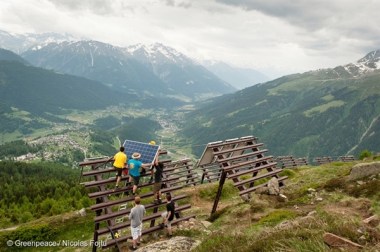
Greenpeace volunteers of Youth Solar (Jugendsolar) in cooperation with volunteers from the organisation ‘Solaragenten’, install a photovoltaic power plant on avalanche barriers in the ski resort of Bellwald.
¶ Britain can produce 85% of its power via renewable energy by 2030 provided it undergoes significant changes in energy production and use, according to the Greenpeace study. However, energy initiatives would be necessary in the areas of home heating and insulation to reduce energy use there by 60%. [The Guardian]
¶ In Australia, the Turnbull government is signalling a new approach to climate policy despite its pledge to stick with the “Direct Action” climate plan, abandoning Tony Abbott’s attempt to abolish two key renewable energy agencies and considering tougher “safeguards” to ensure the policy actually reduces emissions. [Business Green]
¶ UK Chancellor George Osborne has announced that the UK will guarantee a £2 billion deal under which China will invest in the Hinkley Point nuclear power station. EDF welcomed the news but did not say if it put the project back on track. EDF recently admitted the project, which was to be running by 2023, would be delayed. [BBC]
¶ Munich’s Oktoberfest is superlative: It’s got nearly 200 rides flashing their lights, clashing music blaring out from multiple speakers, shooting galleries offering plastic roses. Then there are the festival tents filled with traditional German Volksmusik and girls in Dierndls dancing atop the long tables. But it is all very green. [Deutsche Welle]

Most drinkers in beer tents don’t realize their waste is flushed away with reused grey water
¶ The 117-MW Tafila wind farm in southern Jordan has started commercial operation in line with all deadlines and contracts. The 38-turbine wind park is worth about $287 million. Construction of the wind farm began in the spring of 2014. Now that the facility is operational, it will be producing about 400 GWh annually. [SeeNews Renewables]
¶ The UK Green Investment Bank and John Laing Group have committed £48 million of equity to Estover Energy’s forthcoming £138 million renewable energy facility in Cramlington, Northumberland. The biomass combined heat and power plant will generate 213 GWh of electricity each year, enough to power 52,000 homes. [ChronicleLive]
¶ The world’s first smog-fighting urban sculpture has been constructed in the Dutch city of Rotterdam with the ability to suck in polluted air, remove particles and blow out fresh air through a series of vents. The entire system is run on renewable wind power, and can clean 30,000 cubic metres of air per hour. It can be easily moved. [Architecture AU]
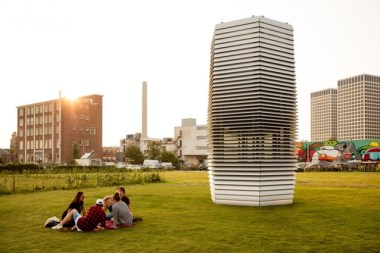
The Dutch city of Rotterdam is home to the world’s first “vacuum cleaner” structure that turns smog into fresh air. Image by Studio Roosegaarde
US:
¶ The University of Notre Dame, in South Bend, Indiana, plans to stop burning coal within five years and to cut its carbon footprint by more than half in the next 15 years in response to Pope Francis’ plea for bold action to curb climate change. Notre Dame may spend $113 million on renewable energy sources. [Diverse: Issues in Higher Education]
¶ LG Chem, one of the world’ s largest lithium-ion battery manufacturers, has supplied a 1-MW/2-MWh energy storage system for a solar power station in Cedartown, Georgia. A Southern Company and Electric Power Research Institute initiative, the project is evaluating the grid impacts of the energy storage system. [Energy Matters]
¶ NRG Energy Inc unveiled plans to separate its expensive clean-energy businesses, as part of a series of moves by the power producer to simplify its structure and cut down on expenses and debt. GreenCo will operate independently from NRG’s conventional generation and retail business beginning January 1, 2016. [Herald Current]
¶ In Vernon, Vermont, a town hit hard by the shutdown of Vermont Yankee, officials say a natural-gas plant may be in the works. The optimism in Vernon is carefully qualified because the plant is far from a sure bet, and it’s not yet been disclosed which sites are under consideration. Development costs are estimated at $750 million. [vtdigger.org]
Posted in nuclear power, renewable power, solar, wind | Leave a Comment »
Tags: nuclear, nuclear power, photovoltaic, renewable power, solar power, wind power
September 20, 2015
Opinion:
¶ “Governor Shumlin: A model for getting energy right” Powerful fossil fuel interests and their climate-denier allies in Congress prevent meaningful action and work to preserve the status quo. Here in Vermont, however, we are showing that progress can be made and that there is a model for energy that is good for our economy and our environment. [Vermont Biz]
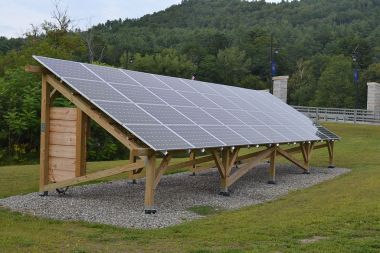
A solar array at the Vermont Law School. Photo by SayCheeeeeese. Public domain, CC0.
¶ “Recent hearings were the last gasps of the Yucca Mountain road show” The federal government’s long-winded campaign to mollify the nuclear power industry by adopting Yucca Mountain as the burial grounds for spent, highly radioactive fuel rods is running on fumes. The NRC conducted hearings, but only because of a court order. [Las Vegas Sun]
Science and Technology:
¶ It is not clear where the idea of a “global warming hiatus” originally came from, but over the last several years it has been a widely held idea. Now, two papers by different groups of researchers show there has not been any pause in global warming. NASA says 2015 will very likely break 2014’s record as the warmest ever recorded. [Morning Ticker]
World:
¶ Denmark is preparing what may be the biggest IPO in the nation’s history as it sets up the sale of state utility Dong Energy. The government is giving itself a maximum of 18 months. The company, which comprises units in oil, gas, wind parks and distribution networks, could be worth as much as $11 billion. [The Australian Financial Review]

On the table will be distribution systems and power generation, including by renewables, such as wind. Bloomberg
¶ Gearing up for its plan to provide 24×7 power to all, the Indian government has started the process of drafting National Electricity Plan for next five years which will outline sector’s projections, including generation. The committee in charge started by constituting 11 subcommittees to deal with different aspects of the sector. [Economic Times]
¶ The CEO of Reon Energy Limited, an energy systems provider in Pakistan, urges small and medium enterprises to tap the solar energy source to deal with persistent power cuts and rising electricity tariffs. There are over 3.2 million such businesses in Pakistan, accounting for 40% of the country’s employment. [The News International]
¶ Though renewable energy solutions alone cannot solve Pakistan’s power crisis, it can take the pressure off the traditional forms of energy generation. It can also create a localised mechanism for the production and delivery of energy. Large-scale operations already include a 100-MW solar project in the Cholistan desert. [The News on Sunday]
¶ The Dubai Electricity and Water Authority is seeking an Expression of Interest for the 800-MW phase three of the Mohammed Bin Rashid Al Maktoum Solar Park. The project, which is based on the Independent Power Producer model, is another project that will establish the leadership of Dubai and the UAE in clean energy production. [Gulf Today]
US:
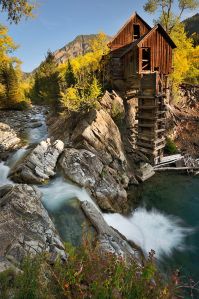
Apropos of no article. Crystal Mill, an 1892 wooden powerhouse in Crystal, Colorado. Photo by John Fowler. CC BY 2.0. Wikimedia Commons.
¶ It didn’t add up. VW diesel cars were spewing harmful exhaust when testers drove them on the road. In the lab, they were fine. Discrepancies in the European tests on the diesel models of the VW Passat, the VW Jetta and the BMW X5 last year gave Peter Mock an idea. He checked the cars. VW had a cheat device on them. [Bloomberg]
¶ Popularity of solar co-ops is growing in Maryland. Retrofit Baltimore, part of the nonprofit Civic Works, works with homeowners on making their homes more environmentally friendly. Allen said 150 homeowners from the Baltimore area joined Retrofit’s first solar co-op, but there is enough of a demand for another. [ABC2 News]
Posted in nuclear power, renewable power, solar, wind | 1 Comment »
Tags: nuclear, nuclear power, photovoltaic, renewable power, solar power, wind power
September 19, 2015
Opinion:
¶ “Hinkley Point must be stopped – even if you believe in nuclear” UK support for low-carbon energy technologies is running at £250 million a year. But the government wants to throw four times that amount, every year for 35 years, at the Hinkley C nuclear power station. Meanwhile, the cost of solar power keeps dropping. [The Ecologist]

Salisbury Cathedral took 46 years to build. Would Hinkley C be any quicker? Photo: Photo Phiend via Flickr. CC BY-NC-ND.
Science and Technology:
¶ The summer of 2015 is Earth’s hottest on record. The meteorological summer of June-July-August saw its highest globally averaged temperature since records began in 1880, according to NOAA. Those record highs occurred on the surface of both land and sea. Scientists had predicted a record-breaking summer based on modeling. [CNN]
World:
¶ Australian utility AGL Energy Limited has announced its Broken Hill Solar Plant, in the eastern state of New South Wales, has begun generating electricity and feeding it into the National Electricity Market. The plant is not fully completed yet, with the currently-installed 26 MW only representing half of the expected 53 MW. [CleanTechnica]
¶ Wind farm operators in Honduras, Nicaragua and Costa Rica, have decided to use the Condition Monitoring hardware and Remote Service of Bachmann Monitoring GmbH, of Rudolstadt/Jena, Germany. The order package consists of the hardware and monitoring contracts for 83 Gamesa turbines. [Windpower Engineering]
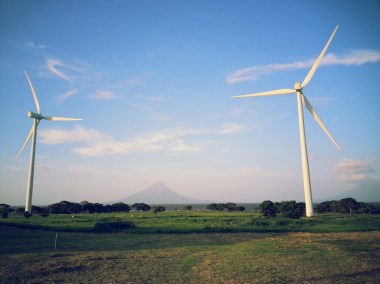
The CMS of Bachmann Monitoring GmbH are already in operation at the foot of the Concepcion volcano in the Southwest of Nicaragua.
¶ High electricity prices, limited connectivity to the national grid and frequent power outages all point to the need to innovate in Cambodia’s energy sector. Government officials and experts have agreed that solar power should have a prominent place in future plans. The country still has a long way to go, however. [The Cambodia Daily]
¶ One third of Irish households will be generating their own electricity within 10 years, the chief executive of ESB, the Irish retail electric provider, has predicted. Pat O’Doherty said that the company is witnessing a dramatic rise in the number of customers investing in new technologies to reduce their reliance on the national grid. [Irish Times]
¶ The Japanese government intends to make use of Tokyo 2020 as the venue to show off hydrogen fuel-cell technology to the rest of the world. This will be an expensive undertaking, but it will also be green, and a whole lot greener than Beijing 2008. The budget for the infrastructure could possibly exceed $300 million. [Ubergizmo]

Photo credit: Kawasaki Heavy Industries
US:
¶ For the first time since it was created 80 years ago, EPB, Chattanooga’s utility, may generate its own power. It will use solar PVs at a new community-based solar farm to produce power for about 125 homes. EPB and the TVA will partner on a 1.35-MW pilot program constructed on one of EPB’s service lots. [Chattanooga Times Free Press]
¶ The renewable energy technology that presents Hawaii the greatest potential for environmental impacts is utility-scale renewable energy, including wind and solar, according to the Hawaii Clean Energy final programmatic environmental impact statement by the US Department of Energy, released on Friday. [Pacific Business News]
¶ The Kaua‘i Island Utility Cooperative has signed an agreement with SolarCity to construct the nation’s first utility-scale photovoltaic array with a battery storage system. The new project will generate 52 MW to charge a system of batteries which KIUC will then be able to turn on and off, just like a conventional generator. [Hawaii Public Radio-HPR2]

Kaua’i is not all this rugged. Photo by Christopher Michel. CC BY 2.0
¶ The New York State Energy Research and Development Authority (NYSERDA) announced the second round of support for Solarize campaigns is now open. Under Andrew M. Cuomo’s NY-Sun Community Solar NY program, Solarize campaigns make solar easier and more affordable through community-driven initiatives. [RealEstateRama]
¶ The US DOE, collaborating with National Institute of Building Sciences, has officially defined zero energy buildings, which also are referred to as net zero or zero net energy buildings. The definition extends to communities, campuses, and portfolios. They published guidelines for measurement and implementation. [Energy Manager Today]
Posted in nuclear power, renewable power, solar, wind | Leave a Comment »
Tags: nuclear, nuclear power, photovoltaic, renewable power, solar power, wind power
September 18, 2015
Science and Technology:
¶ Toyota now collects more than 90% of the nickel-metal hydride batteries used in its hybrid cars, and is aiming for 100% collected. But what happens to the batteries after they’re collected? Some are recycled, but from an environmental perspective, it’s even better if they are reused. They have a second life in Yellowstone Park. [The Guardian]
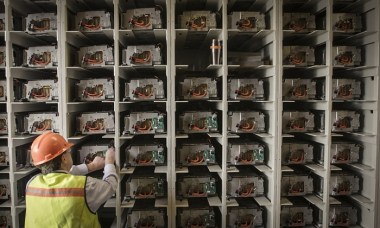
Reused Toyota Camry Hybrid battery packs store solar energy in a distributed energy system now online at the Lamar Buffalo Ranch field campus in the Yellowstone National Park. Photograph: Toyota
¶ A new line of solar modules from JA Solar eliminates the need for racking, allowing for direct mounting on rooftops, cutting installation time. The modules are made up of 60 “cell laminates” per unit, surrounded by a heavy-duty aluminum frame strong enough for them to be mounted directly to the roof, without any additional racking. [CleanTechnica]
World:
¶ India’s National Thermal Power Corporation had invited bids last May for ten separate 50-MW solar PV projects to be developed in phases in the Ghani Solar Park, Kurnool District of Andhra Pradesh. Bids were submitted last week, and the call has been oversubscribed by 10 times, with a total of 30 developers in the foray. [CleanTechnica]
¶ Utility-scale grid connected battery storage may reach 12 GW by 2024, while annual revenues could grow to $8.44 billion, according to a report from Frost & Sullivan. The US will be a leader, followed by China, Japan and Germany. Despite an overall positive outlook, there are significant market challenges to overcome. [pv magazine]
¶ The mayor of London, reminded cabinet ministers that 10,000 local jobs were dependent on this renewable power technology which had, in his view, “many, many attractions”. The warning from the high-profile Conservative came as the chief executive of Shell predicted solar would become the “backbone” of our energy system. [The Guardian]
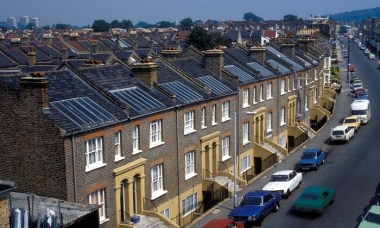
Solar panels on residential houses in East Dulwich, Southwark, South London. Photograph: Alamy
¶ Australia will be one of the first countries to get Tesla’s vaunted Powerwall battery storage system. Several companies are scrambling to sign up Australian households with solar rooftops. Tesla said that its 7-kWh home energy storage units, predicted to arrive in Australia in 2016, would be available by the end of the year. [The Guardian]
¶ With Canada’s federal government out for the count, it was the provinces who spearheaded the addition of a total 3.63 GW in renewable power generation in 2014 and a rate of investment in green energy that was 88% higher than in 2013, pushing Canada to sixth place ranking for renewables development, Clean Energy Canada says. [National Observer]
¶ The UK’s Green Investment Bank has stepped up efforts to boost the offshore wind power sector, joining forces with the Offshore Renewable Energy Catapult in an attempt to tackle faltering investor confidence in the market. The organizations will act in a three-year partnership to address technical and financial issues. [Business Green]
US:
¶ The Department of Transportation in Washington wrapped up a bid proposal for up to 800 electric buses in 12 different categories. BYD buses has been awarded the contract in 10 of those categories. The contract may be the biggest in US history. It includes buses from 30 to 60 feet in length for highway and intra-city applications. [CleanTechnica]

Electric bus. BYD photo.
¶ New solar energy funding has been announced along with a new DOE energy efficiency roadmap that aims to double energy efficiency in the US by 2030 through standards for utilities, vehicles, and consumer goods. Solar energy is already cost competitive in 14 US states. This may make it competitive in the rest of them. [CleanTechnica]
¶ Two extensive studies reveal that major US business identities have knowingly undermined the health, safety, and survival of real humans and other living things in regards to climate. One examines ExxonMobil’s actions, and the other implicates almost half the world’s 100 largest companies in obstructing climate change legislation. [CleanTechnica]
¶ Officials at the Pilgrim Nuclear Power Station are considering whether they can afford the multimillion-dollar safety improvements and other reforms required by federal officials. If not, they say, they might close the plant. The NRC downgraded the plant’s safety rating this month, listing Pilgrim as among the least safe in the country. [The Boston Globe]
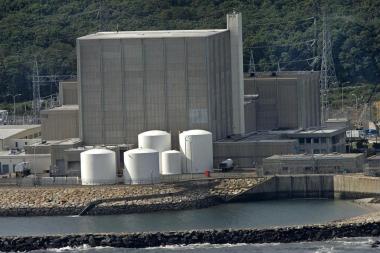
The Pilgrim nuclear power plant in Plymouth, Massachusetts. David L. Ryan / Globe Staff / File
¶ Sulphur Springs Valley Electric Cooperative and SunPower announced signing a 20-year power purchase agreement. SunPower will build a 20-MW solar PV plant in Cochise County, Arizona. Expected to be operational by the end of 2016, the plant should provide enough electricity for 4,500 homes, on an annual basis. [Your Renewable News]
¶ The mayor of Burlington, Vermont, and the president of the University of Vermont announced a partnership between the city and UVM develop 1 MW of solar energy projects on UVM campus properties. A request for proposals encourages a wide variety of projects, including roof-top installations and solar canopies over parking areas. [vtdigger.org]
¶ SunEdison announced it is supplying lithium-ion batteries for nine prototype homes in California that will be fully powered by renewable energy. The zero-net energy home project is part of a larger state-wide plan to have all new construction homes run 100% off renewables, such as photovoltaic roof panels, by 2020. [Computerworld]
Posted in nuclear power, renewable power, solar, wind | Leave a Comment »
Tags: nuclear, nuclear power, photovoltaic, renewable power, solar power, wind power
September 17, 2015
World:
¶ Offshore wind installation vessel Pacific Osprey has installed the 100th pile installation at Northland Power’s 600-MW Gemini offshore wind project. The 161 meter, six-legged jack-up is pushing on to complete work at the project, located in the Dutch North Sea. Two substations and the first transition pieces are already in place. [reNews]
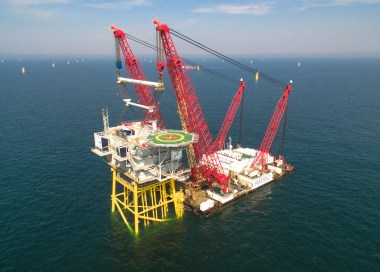
Substation lifted into place at Gemini (Rambiz)
¶ A report looks at whether coal from two sources would be sold at all without subsidies. It concludes that significant subsidies backing the production of coal in Australia and in the Powder River Basin in the US are “distorting the market, driving up emissions, and acting as a barrier to entry for cleaner energy sources.” [CleanTechnica]
¶ Israeli clean energy firm NewCO2Fuels Ltd is in final discussions to install and test technology for the conversion of carbon dioxide emissions into fuel at a large industrial coal-fired power plant. It will have two commercial reaction units able to turn around 160 tonnes carbon dioxide annually into fuel and oxygen. [SeeNews Renewables]
¶ Investment in renewable energy in Canada almost doubled last year as developers largely in Ontario and Quebec built solar, wind and hydropower projects, according to Clean Energy Canada. Spending on generation capacity rose 88% to C$10.9 billion ($8.3 billion), and the industry now employs about 27,000 people, the group says. [Bloomberg]
¶ Siemens AG has entered into an agreement to supply two wind turbines for Taiwan’s first offshore wind farm. Formosa I Wind Power Co (海洋風電公司) is to start operating two offshore wind turbines with a combined capacity of 8 MW in the third quarter of next year, with plans to add 30 units by the fourth quarter of 2019. [Taipei Times]
US:

Consumers Energy’s Cross Winds Energy Park opened in November 2014 in Tuscola County, in Michigan’s Thumb area. Photo by Consumers Energy Co.
¶ Consumers Energy Co plans to contract with Geronimo Energy to build a new 100-MW wind farm in Huron County in the Thumb area. The wind power facility is expected to push Consumers past its 10% renewable energy production requirement under Michigan’s 2008 energy law, which expires at the end of this year. [Crain’s Detroit Business]
¶ To highlight the plea by Pope Francis, spiritual leader of the world’s 1.2 billion Roman Catholics, that all people of good will respond to the moral imperative of solving climate change, faith leaders today hand-delivered “Laudato Si’,” the Pope’s first complete encyclical to the faithful, to all Catholic members of the US Congress. [CleanTechnica]
¶ The California legislature has passed SB 350, the Clean Energy and Pollution Reduction Act of 2015. The bill calls for energy efficiency in buildings to increase by 50% and for 50% of the state utilities’ power to come from renewable energy by 2030. Petroleum use was not covered by the bill in its final form. [Energy Manager Today]
¶ The first Colorado Climate Plan has been rolled out, focusing on seven key sectors and highlighting ways business and local governments can play a role. In 2013, the Colorado legislature passed a bill saying climate change “presents serious, diverse and ongoing issues for the state’s people, economy and environment.” [Denver Business Journal]
¶ San Diego County’s Board of Supervisors voted 4-0, to “add to the County’s Legislative Program support for legislation that would remove and relocate outside of the San Diego region the spent nuclear fuel stored at the decommissioned San Onofre Nuclear Generating Station.” San Diego says NO to spent nuclear fuel. [CleanTechnica]
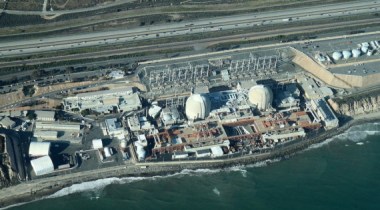
San Onofre Nuclear Generating Station by Jelson25 via Wikipedia (CC BY SA, 3.0 License)
¶ A 52-MW battery system being developed by SolarCity in Hawaii will be adjacent to one of Kauai Island Utility Cooperative’s existing 12-MW solar fields. Under a 20-year power purchase agreement with SolarCity, the co-op will pay 14.5¢ per kWh for battery-stored power, primarily during KIUC’s evening peak demand hours. [Electric Co-op Today]
¶ A scathing report commissioned by a power industry trade group is hammering Massachusetts Governor Charlie Baker’s plan to tap Canadian hydropower as “ill conceived” and warns the move could increase the already sky-high price of electricity in the state. The state’s electric utilities stand to lose money if the plan is put in place. [Boston Herald]
¶ Producers of motor fuels from plant waste say they have been left behind in President Barack Obama’s push to fight climate change. Executives from about two dozen companies that produce advanced biofuels say a proposal to reduce the amount of the cleaner-burning fuel refiners must use in gasoline is crimping investment. [Bloomberg]
Posted in nuclear power, renewable power, solar, wind | Leave a Comment »
Tags: nuclear, nuclear power, photovoltaic, renewable power, solar power, wind power
September 16, 2015
Science and Technology:
¶ Populations of marine mammals, birds, fish and reptiles have declined by 49% since 1970, a report says. The study says some species people rely on for food are faring even worse, noting a 74% drop in the populations of tuna and mackerel. In addition to human activity such as overfishing, the report also says climate change is having an impact. [BBC]

The report analysed more than 1,200 species of marine creatures in the past 45 years. Science Photo Library
¶ A relatively cheap and environmentally friendly battery that uses salt water and other commonly available materials to store electric energy has been awarded the Lemelson-MIT Prize. The head of the company making the battery, Aquion, said batteries capable of powering a typical single family home should cost between $1,000 and $3,000. [CNBC]
World:
¶ The point of “mass adoption” of household battery storage could arrive in Australia as soon as 2020, a new report from UBS has predicted, at which time the payback period for storage systems for solar households would be just five to six years. The UBS Utilities Sector report predicts storage system costs will fall at 20% per year. [CleanTechnica]
¶ Siemens has for some time been known to have its sights on developing the next generation of wind turbines, a class of platforms rated to 10 MW and above. But as a new €200 million manufacturing plant takes shape, the company’s management has begun speaking more openly on activities geared towards those objectives. [CleanTechnica]
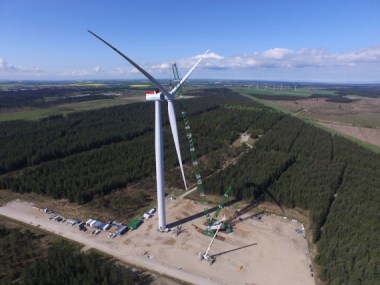
The prototype in Østerild, Denmark was installed only a few months after the product launch at EWEA Offshore trade show in Copenhagen.
¶ The attractiveness of the UK as a place to invest in renewables has fallen dramatically following Government moves to curb subsidies for clean technology, a report suggests. The latest quarterly assessment by EY has seen the UK drop out of the top 10 for places to invest in renewable energy for the first time. [Western Morning News]
¶ In Australia, in his media conference immediately after winning the Liberal leadership, Malcolm Turnbull had some words to say on the subject of technology: “We have to recognise that the disruption that we see driven by technology, the volatility in change is our friend if we are agile and smart enough to take advantage of it.” [The Fifth Estate]
¶ Parcels of farmland totaling 250 hectares near the crippled Fukushima Daiichi nuclear plant are returning to life and being covered with solar panels, amid government incentives to invest in renewable power. At least one village has set up its own tiny power company. The solar farms are scheduled to generate about 160 MW. [The Japan Times]
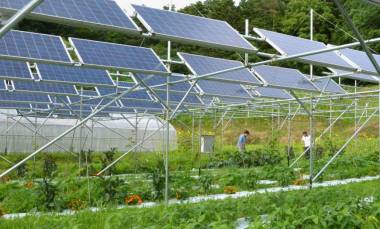
Solar panels installed in Minamisoma, Fukushima Prefecture. | Kyodo
US:
¶ Green Mountain Power’s Mary Powell was joined today by Congressman Peter Welch, Governor Peter Shumlin, Rutland Mayor Chris Louras, and community leaders to announce that Rutland, Vermont is the Solar Generation Capital of New England. More solar power is generated in Rutland per capita than in any other New England city. [Vermont Biz]
¶ The debate over rooftop solar is increasingly contentious, pitting solar PV companies against utilities in many states. Nowhere has the debate been more heated than in Arizona, where customers have flocked to rooftop solar as prices fell. Most recently, utility Salt River Project has introduced a demand charge for solar customers. [CleanTechnica]
¶ Coronal Group LLC and Panasonic Eco Solutions are building eight PV parks with a total capacity of 37 MW in North Carolina. The PV farms are expected to generate over 71 GWh each year, enough to provide annual needs of 4,500 local households. Panasonic will supervise, engineer, construct, and operate the project. [SeeNews Renewables]

Solar parking lot canopy. Author: Darin Dingler. License: Creative Commons. Attribution 2.0 Generic
¶ If the federal solar investment tax credit is not extended, the US could witness in 2017 the lowest annual level of solar installations since 2012, a new report predicts. The planned ITC cut at the end of 2016 is expected to result in a rush to complete projects, and a subsequent sharp drop in activity in 2017. [SeeNews Renewables]
¶ Thanks to EPA’s Clean Power Plan, the US returned as the number-one market for renewable energy in the latest Ernst & Young country attractiveness index. China is now second, after keeping the lead for many months. Its economic woes and grid constraints are overshadowing ambitious renewable energy targets. [SeeNews Renewables]
¶ State utility regulators have voted to review and possibly change a rule that small Montana wind-power projects say has hampered their development. A rule change could make it easier for these small projects to get contracts to supply NorthWestern Energy, the state’s major electric utility, and thus build their project. [KXLF Butte News]
Posted in nuclear power, renewable power, solar, wind | Leave a Comment »
Tags: nuclear, nuclear power, photovoltaic, renewable power, solar power, wind power
September 15, 2015
World:
¶ Costa Rica, Afghanistan, China, India and Albania are all embracing renewable energy sources. Five experts give their opinions on their futures. Costa Rica is well on its way to becoming the first developing country to have 100% renewable electricity. Hydro, wind and geothermal resources provide 98% of the power already. [The Guardian]

Afghanistan’s upland areas have decent wind potential and its rivers can be harvested by small-scale hydro plants. Photograph: Martin Wright
¶ The opening event for the K2 Wind project in southwestern Ontario took place on September 3. K2 Wind is expected to provide enough power each year for about 100,000 Ontario homes. The commissioning of K2 Wind also renders Canada one of only seven countries in the world to surpass 10 GW of installed wind energy capacity. [CleanTechnica]
¶ Malcolm Turnbull has replaced climate change doubter and coal industry booster Tony Abbott as Australian Prime Minister. This means that one of the world’s least enthusiastic backers of a new climate treaty has just been removed from the global stage. While Abbot’s views were not aligned with mainstream science, Turnbull’s are. [Mashable]
¶ Wind power in France has reached the 10,000 MW grid-connected capacity milestone, renewable energy association Syndicat des Energies Renouvelables says. Power from wind turbines installed in the country will be sufficient to supply over 6 million households or the entire population of the Ile-de-France region. [SeeNews Renewables]
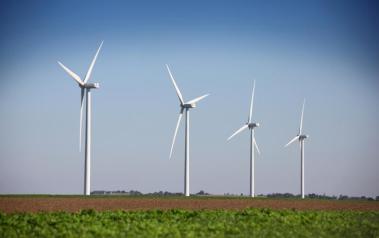
Alstom turbines in France. (c) Alstom.
¶ The Netaji Subhash Chandra Bose airport in Kolkata, India will have a utility-scale solar power project of 15 to 20 MW capacity. The project will cover over 55 acres and would meet 60% of the airport’s power needs. The project will be able to meet the entire daytime demand of the airport, with power coming from the grid at night. [CleanTechnica]
¶ Vestas is to supply 12 V100 2.0-MW turbines for HydroChina’s Phu Lac wind farm in the Tuy Phong district of southeastern Vietnam. The deal, which will be the largest Vestas-supplied wind park in Vietnam, includes a five-year AOM 4000 service contract and a Scada system for data-driven monitoring and preventive maintenance. [reNews]
¶ An Irish university has scooped €800,000 in EU Horizon 2020 funding to help improve the performance of Scottish developer Aquamarine Power’s Oyster wave energy converter. The project will see researchers at the Centre for Ocean Energy Research at Maynooth University in County Kildare develop automated for the device. [reNews]
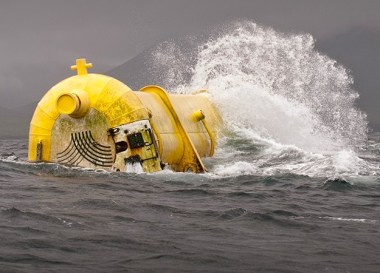
Aquamarine’s Oyster wave energy device (Aquamarine)
US:
¶ Second quarter data from the Energy Information Administration and the Solar Energy Industries Association came out this week and distributed solar continues its surging growth. Over 650 MW of new distributed solar capacity was grid connected between April and June. That is 10% of new power plant capacity in the country. [CleanTechnica]
¶ With a new 7.5-MW solar energy farm located on the city’s former Tequesquite Landfill now operational, Riverside, California’s solar generation has soared past the 20-MW mark, five years ahead of schedule. SunPower built the system as part of acompetitively priced 25-year power purchase agreement. [Your Renewable News]
¶ A church in Gastonia, North Carolina wants to turn a large tract of land it has into a solar farm. Enerparc, a renewable energy firm based in California, has applied for a state permit to build a 5-MW solar project. The company has secured an option to lease about 35 acres from Generation Church and install roughly 22,000 PV panels. [Gaston Gazette]
¶ Sempra US Gas & Power LP says it expects to begin construction of the 100-MW Mesquite Solar 2 plant in Arizona this autumn. The development is part of the company’s Mesquite Solar project, the 150-MW first phase of which was completed in 2013. With all three phases finalised by late 2016, the complex will total 400 MW. [SeeNews Renewables]
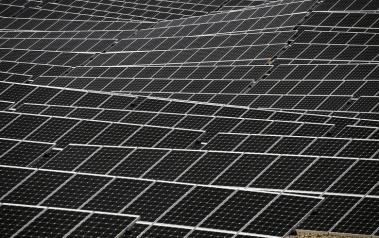
Solar PV plant. eatured Image: Gilles Paire/Shutterstock.com
¶ Growth in Vermont’s clean energy jobs is projected to double in the next six to 12 months after a year of outperforming other job sectors, according to a new state report. The growth has generated economic benefits in the form of more jobs and in plummeting utility costs, according to Governor Peter Shumlin, speaking in Williston. [BurlingtonFreePress.com]
¶ A proposal to convert turkey droppings into electricity in Clinton would be first in North Carolina to turn the bird waste into an energy-rich gas rather than burning the dung as a fuel. Prestage AgEnergy proposed a facility last week to generate steam for its own use and electricity for Duke Energy Progress, using turkey droppings. [News & Observer]
¶ Santa Rosa, California, is taking part in an innovative energy efficiency project that aims to improve the resiliency of the power grid. It will park a massive Tesla battery pack outside a wastewater treatment plant. The project is expected both to reduce energy costs at the sewage plant and to sell surplus electricity to the grid. [Santa Rosa Press Democrat]
¶ Hearings began on a proposal to close the Indian Point nuclear plant for part of each summer to protect fish during spawning season. About 30 witnesses are expected to testify. The Department of Environmental Conservation estimates that Indian Point’s water system kills more than 1 billion fish, eggs and larvae every year. [Times Herald-Record]
Posted in nuclear power, renewable power, solar, wind | Leave a Comment »
Tags: nuclear, nuclear power, photovoltaic, renewable power, solar power, wind power
September 14, 2015
Opinion:
¶ “End the nuclear ‘safety myth’” The International Atomic Energy Agency’s final report on the March 2011 triple meltdowns at Tokyo Electric Power Co’s Fukushima No 1 nuclear power plant puts the main blame on the assumption prevailing at the time that Japan’s “nuclear power plants were so safe that an accident of this magnitude was simply unthinkable.” [The Japan Times]
Science and Technology:
¶ The next two years could be the hottest on record globally, says research from the UK’s Met Office. It warns big changes could be under way in the climate system. The research shows that a major El Nino event is in play in the Pacific, which is expected to heat the world overall. But it also reveals that summers in Europe might get cooler for a while as the rest of the globe warms. [BBC]
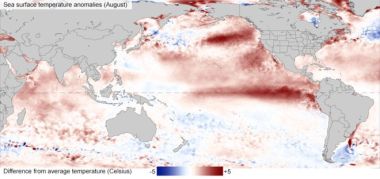
The El Nino phenomenon sees surface waters warm dramatically in the eastern Pacific.
World:
¶ Acciona Energia will soon begin construction of a 246.6 MW solar PV power plant in the Atacama Desert, Chile. The El Romero Solar power plant is expected to be operational by mid-2017, and will be the largest solar power plant in South America, costing $343 million. The project will cover 280 hectares, and will have over 777,000 crystalline solar PV modules. [CleanTechnica]
¶ Chinese industrial firm AVIC Heavy Machinery Co Ltd says it plans to construct 1,500 MW of wind farms along with 200 MW of PV parks in Inner Mongolia autonomous region. The projects will be realised through agreements with three local governments, each of which will get 500 MW of wind power. The solar capacity will be in to of those three areas. [SeeNews Renewables]
¶ A German company has designed an ingenious system to help ships become more energy efficient by using kites. SkySails’ calls its system “kite wind propulsion” for large cargo ships. It says the system provides much more power than sails, and even generates more power than traditional wind turbines. It delivers electrical power to the ship at a cost of about 6¢/kWh. [CNBC]

Copyright SkySails
¶ Energie Baden-Wuerttemberg AG will sell some of its assets to help transform Germany’s third-largest power supplier into a business centered on renewable energy and operating grids. Assets that may be divested include stakes in utilities in Austria, Hungary and Germany. Up until 2012, EnBW relied on nuclear reactors for more than half of its output. [Bloomberg]
¶ Global investment bank UBS has conducted the first in-depth analysis of the Labor Party’s proposed 50% renewable energy target for Australia by 2030, concluding that it will require around $80 billion in investment, but much of this would need to be spent anyway. UBS says that up to 20 GW of wind energy will need to be built by 2030, and 26 GW of solar. [RenewEconomy]
¶ EDF Energies Nouvelles subsidiary InnoWind has commissioned the 21.5-MW Chaba wind farm in Eastern Cape Province in South Africa. The project consists of seven 3.075-MW V112 Vestas turbines. Electricity generated by the wind farm will be sold through a 20-year power purchase agreement. A portion of the revenues will be used to support the local economy. [reNews]
¶ Vattenfall and Stadtwerke München have started inner-park array cabling at the 288-MW Sandbank offshore wind farm in the German North Sea. The developers said the first power cable has been installed between monopiles SB 28C and SB 29C. The inner park cables will transport electricity from the 72 wind power plants to the farm’s offshore substation. [reNews]
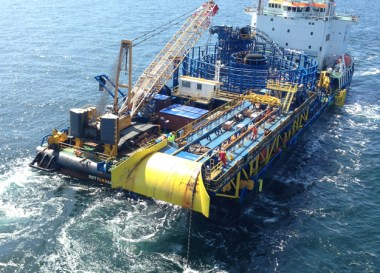
Image: VBMS’s Stemat Spirit is laying the cables at Sandbank (RWE)
US:
¶ Ohio needs to let its two-year freeze on renewable energy mandates expire to become more competitive, a report says. There are questions about what effects the freeze may have had. One question is what investments Ohio might be missing because of the state’s strict rules on wind power while companies want to use wind to power new facilities. [Toledo Blade]
¶ Community solar is growing and could account for as much as half of the small-scale solar-panel market by 2020, according to an April forecast by the Energy Department’s National Renewable Energy Laboratory in Golden, Colo. That would create a hefty new solar market in between individually owned rooftop arrays and large utility-scale projects. [Wall Street Journal]
¶ The Energy Information Administration projects lower domestic coal consumption and exports as well as a slight rise in coal imports will add to a 86 million short ton (9%) decline in production in 2015. Coal production is expected to decline in all coal-producing regions in 2015, with the largest decline (on a percentage basis) occurring in the Appalachian region. [World Coal]
Posted in nuclear power, renewable power, solar, wind | Leave a Comment »
Tags: nuclear, nuclear power, photovoltaic, renewable power, solar power, wind power
September 13, 2015
Opinion:
¶ “How Vermont became a clean-power powerhouse” David Blittersdorf built his first wind turbine to power the lights in his sugar shack in Pittsford, Vermont, where he boiled maple sap, at age 14. And the Burlington Electric Department’s journey toward becoming 100% renewable first took form at a local Dairy Queen. [Christian Science Monitor]
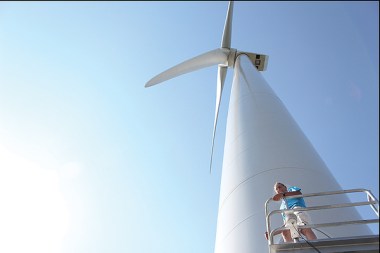
David Blittersdorf stands at one of the four wind turbines of the Georgia Mountain Community Wind project in northwest Vermont. Elodie Reed
¶ “Ohio supplies national solar boom, sees own capacity slip” Ohio is a cautionary tale of how smart government policy, like the federal investment tax credit, can help a young, cutting-edge industry like solar grow, attract investment and create jobs while bad government policy can stunt the growth of an industry. [Crain’s Cleveland Business]
World:
¶ Informal leadership consultations prepare for November-December’s 21st UNFCCC’s Conference of Parties. This weekend, delegations from 18 developed nations talked of climate financing, especially methodologies relating to goals for 2020, in the context of limiting average global warming to 2° Celsius. [CleanTechnica]
¶ In India, the Union minister for power, coal and new and renewable energy Piyush Goyal said replacing light bulbs with LEDs would lead to savings of up to ₹40,000 crore ($6 billion) for consumers. This would lead to a reduction in carbon dioxide emissions of about 60 million tonnes every year. [Times of India]
¶ Wave power is set to be trialled in the Western Australian port city of Bunbury. Thirty floating buoys will be tethered together and supported by weights that will be filled with water and dropped on the sea floor. The buoys will drift up and down with the current to create compressed air that is then converted to power. [ABC Online]
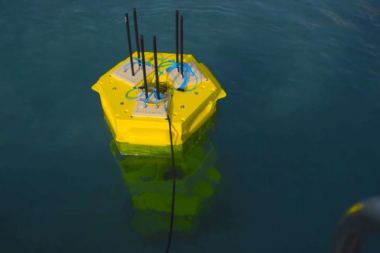
Stonehenge Metals photo
¶ Although he has no plans to return to national politics, former Prime Minister Junichiro Koizumi tells the electorate not to lose hope in the campaign against nuclear power. In an exclusive interview with The Asahi Shimbun in Tokyo, Koizumi called for a national movement to steer Japan away from nuclear plants. [Asahi Shimbun]
US:
¶ One of the world’s leading intelligent home climate control solution providers, tado° launched its Smart AC Control in the US in late August, making the intelligent air conditioner controller available through a number of major retailers. The Smart AC Control uses your phone’s location to adjust the air conditioner. [CleanTechnica]
¶ The Hydrogen House Project hosted a dedication ceremony for a major milestone in renewable hydrogen energy technologies. The house is located in Hopewell Township, New Jersey. It was the first commercially produced, fully-permitted and affordable, solar-hydrogen, on/off-grid residence in the world. [MercerMe]
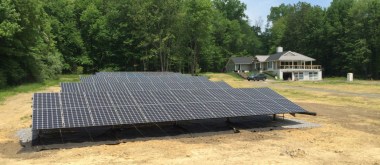
Hydrogen House
¶ NextEra Energy will be development partner for the Hale Community Wind Energy project that encompasses 122,312 leased acres with more than 350 landowners in the eastern half of Hale County, Texas. The project is envisioned to use a variety of 1.7, 1.79 and 2.0 MW GE turbines, in the first phase of 300 MW. [Plainview Daily Herald]
¶ Sioux City purchased four Leafs at a cost of about $7,000 each. It’s the largest municipal fleet of electric cars in Nebraska. The investment is part of the city’s strategy to move toward cleaner, more renewable forms of energy. Mayor Rod Koch was upbeat on the city’s drive to be green, which will include solar and wind power. [Sioux City Journal]
¶ An Alabama holding company plans to build two wood-burning power plants in the Athens area and one might become operational as soon as April. Together, the two plants in Franklin and Madison counties would consume about a million tons of wood each year and produce nearly 140 MW of electricity. [Online Athens]
Posted in nuclear power, renewable power, solar, wind | Leave a Comment »
Tags: nuclear, nuclear power, photovoltaic, renewable power, solar power, wind power
September 12, 2015
Science and Technology:
¶ A research team from the Lawrence Berkeley National Laboratory has figured out what to do with the carbon dioxide from industrial emissions: convert it into carbon monoxide, and then turn that into useful products such as plastics. Carbon recycling sure beats sequestration for a long term, sustainable solution. [CleanTechnica]
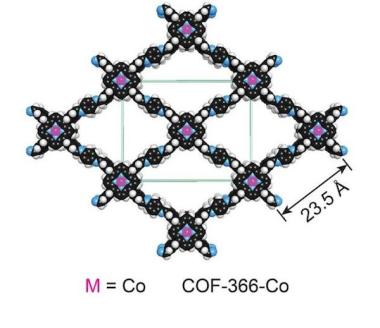
Carbon capture COFs
¶ Toyota is demonstrating its level of commitment to hydrogen fuel cell cars with a new initiative that partners private companies and public sectors to create a carbon-neutral hydrogen supply chain. “The overall environmental benefit of hydrogen is only as strong as the method used to produce it,” according to Toyota. [Hybrid Cars News]
World:
¶ GS EPS, a utility affiliate of GS Group, announced that it has completed Asia’s largest biomass power plant in South Korea’s South Chungcheong Province. The utility firm spent three years building the plant in Dangjin, some 110 kilometers south of Seoul, at a cost of 300 billion won ($254 million). [Korea Times]
¶ Preliminary work has started on two new windfarms in Northern Ireland, with the turbines expected to be up and running operational in early 2016. The renewable energy developments, which are costing Gaelectric in the region of £34 million, are being built near Pomeroy and Inishiative, and could power 14,000 homes. [Mid Ulster Mail]
¶ Geothermal power has never been hotter. It is a clean, reliable energy source that does not depend on imports or favorable weather conditions, and is generally cost-competitive with fossil fuels. There have been a number of developments for the industry very recently, with installations going forward around the world. [Blouin News Blogs]
¶ A National Lab Policy is needed to address the testing, standardisation and certification of renewable energy projects in India, according to the Union Minister of State for Coal, Power and New and Renewable Energy. A policy document should improve planning on equipment, infrastructure, and funding requirements. [Chandigarh Tribune]
¶ The more renewables a country deploys, the more efficient its energy use, according to a study of the eight countries that consume half of the world’s electricity. The researchers estimate that by combining investments in renewables and in energy efficiency, the world’s total energy demand can be reduced by 25% by 2030. [Truthdig]

Switching from open fires to modern cooking stoves in India would vastly increase energy efficiency. (Yogendra Joshi via Flickr)
¶ Representatives of the US DOE’s National Renewable Energy Laboratory have signed a memorandum of understanding with China’s State Grid Energy Research Institute, standing as the first-ever agreement between both parties. The deal is expected to facilitate discussions for potential R&D partnerships in the future. [PV-Tech]
¶ Renewable energy consultancy, SgurrEnergy, has been appointed by Huaneng Renewables, a Chinese-based renewable energy company and one of the top utility companies in China, to undertake technical offshore wind energy research assessing the general site conditions of offshore wind projects in China. [Windpower Engineering]
¶ German wind turbine manufacturer Senvion has commissioned 18 of its two-MW turbines with Martifer Renewables SA. The wind farm is in operation in Gizałki, about 90 kilometres south-east of Poznań, Poland. With an output of 36 MW, the 18 turbines will produce enough energy to supply 24,300 Polish households. [7thSpace Interactive]
¶ Nuclear fuel rods have been installed at a second reactor at the Sendai nuclear power plant in preparation for a planned restart in October. The fuel rods, bundled together into assemblies, began being loaded in the No 2 reactor on September 11, a day after the official restart of commercial operations at the No 1 reactor. [Asahi Shimbun]
US:
¶ Vestas has confirmed a 200-MW order for turbines at Xcel Energy’s Courtenay wind farm in North Dakota. The Danish manufacturer will supply 100 of its V100-2MW machines to the project. Delivery is expected to kick off in the third quarter of 2016 with commissioning planned for the fourth quarter of the same year. [reNews]
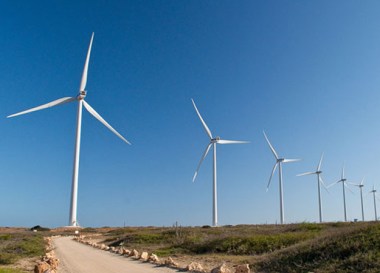
Vestas Image
¶ Bill McKibben, Naomi Klein, Rev. Lennox Yearwood and other activists are preparing to take matters on climate change into their own hands. They filled the Brooklyn Academy of Music late Thursday night, more than a thousand people rallying around a new plan to freeze fossil fuel production and put the industry out of business. [MSNBC]
¶ Regulators have identified almost 1,200 nautical square miles off the South Carolina coast with potential to be leased for the development of wind energy. The federal Bureau of Ocean and Energy Management is publishing maps in the Federal Register as the first step in seeking comment on the proposal. [PennEnergy]
Posted in nuclear power, renewable power, solar, wind | Leave a Comment »
Tags: nuclear, nuclear power, photovoltaic, renewable power, solar power, wind power
September 11, 2015
Science and Technology:
¶ In 2014, the Bullitt Center produced 60% more electricity than it used. This is in part because of an oversized 242-kW array of solar PVs on the roof which provide abundant power. Overall, it is the most energy-efficient office building in the United States by a wide margin, despite the cloudy weather in its home city of Seattle. [Mother Earth News]

The Bullitt Center, a state-of-the-art office building in Seattle, Washington, showcases solar’s vast potential, even in cloudy locales. Photo by Nic Lehoux
World:
¶ The Indian Government approved its new offshore wind energy policy to promote and streamline the process of implementing offshore projects. The Ministry of New & Renewable Energy will take responsibility for project implementation, while the National Institute of Wind Energy will oversee project sites allocation. [CleanTechnica]
¶ Kuwait has contracted with Spain’s TSK Group to set up a 50-MW solar PV power project, at a cost of $365 million. Completion is expected in 2017. When commissioned, the project will generate enough electricity to provide for needs of 100,000 homes. The energy saved will be equivalent to 12.5 million barrels of oil every year. [CleanTechnica]
¶ The French government is ending export subsidies for building coal plants abroad, as the country tries to clean up its environmental reputation before hosting landmark UN climate talks. Prime Minister Manuel Valls announced the immediate end to the coal credits, primarily used by French group Alstom, which has not responded publicly. [PennEnergy]
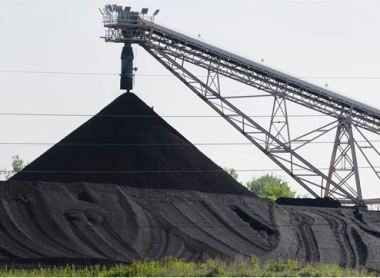
Coal storage.
¶ Siemens and Neoen Australia have signed a contract for the Hornsdale Wind Farm project located in the state of South Australia. Consisting of 32 Siemens direct drive wind turbines, this project will provide clean energy for more than 70,000 households. The agreement includes also a long-term service contract. [Renewable Energy Focus]
¶ More than 300 solar powered water pumps have been installed in Bangladesh under a World Bank assisted program, with more to come. Diesel powered irrigation pumps, an estimated 1.34 million of them, use about $900 million a year worth of diesel fuel. Aside from that cost, there’s also the environmental cost of emissions. [Energy Matters]
US:
¶ A WaterFX Hydro I subsidiary is building California’s first commercial-scale solar desalination plant and is issuing $10 million in preferred stock in the venture, through a direct public offering. The plant is fully solar-powered and is expected to be able to produce up to 1.6 billion gallons of water per year. [CleanTechnica]
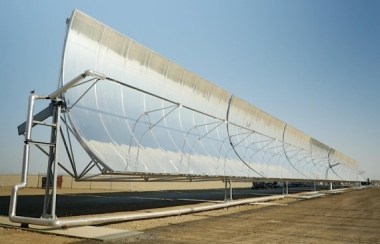
WaterFX photo.
¶ The International Energy Agency predicts US oil output next year will see the steepest fall since 1992 thanks to low oil prices. US oil production has increased to a record high in recent years as high prices made investment worthwhile. Prices halved over the past year as demand fell in line with slower economic growth. [BBC]
¶ Springfield, Missouri has a problem. Over half of the city’s students are in danger of going hungry. Next year, Springfield could be on its way to addressing the problem by using wasted heat from the Noble Hill Renewable Energy Center at the city landfill and harnessing it to run a 4-acre commercial greenhouse. [Lebanon Daily Record]
¶ Minnesota Power will offer a new energy option for customers by launching a community solar garden program that is expected to be generating power from the sun in late 2016. The initial solar garden will be built in two locations. A 40-kW array will go up in Duluth and a 1-MW array on a site in northeastern Minnesota. [Hometown Focus]
Windmatic 17S turbine
¶ Remote villages in Alaska typically rely on diesel generators to produce power for heating and electricity. Power costs run at about $0.65 per kWh or more. Now, they are turning to specially fitted wind turbines to reduce their power costs and make their lives more comfortable, helped by government grants. [Windpower Engineering]
¶ In the face of intense lobbying from the oil industry, Gov. Jerry Brown and legislative leaders on Wednesday dropped their attempt to pass a law mandating a 50% reduction in petroleum use in the state over the next 15 years. Despite the defeat, Brown vowed to implement the state’s existing low-carbon fuel standards. [Bakken.com]
¶ Amid a hostile legislative climate in Raleigh, innovative, sustainable design and construction are flourishing in Western North Carolina. The WNC Green Building Council was founded in 2001. Since then, and despite an unstable housing market, local interest has grown steadily, the council’s interim executive director says. [Mountain Xpress]
¶ Exelon Corp, which owns Illinois’ 11 nuclear reactors, says that it is delaying for a year its decision about whether to close nuclear plants in the Quad Cities and Byron. In a new release, the company said it plans to continue operating its Quad Cities and Byron plants for now. The Clinton station is still in danger of being closed. [Rockford Register Star]
Posted in nuclear power, renewable power, solar, wind | Leave a Comment »
Tags: nuclear, nuclear power, photovoltaic, renewable power, solar power, wind power
September 10, 2015
World:
¶ China’s Ministry of Environmental Protection revealed Sunday that the country’s major polluting emissions declined in the first half of 2015. Year-on-year figures showed that the emission of ammoniacal nitrogen by 3.18%, sulfur dioxide by 4.63%, and nitrogen oxide decreased by 8.8%, along with other reductions. [CleanTechnica]

A visit by Greenpeace at Feldheim in 2011. Uploaded by Energiequelle. CC BY 3.0
¶ Global renewable energy development company SunEdison has signed a memorandum of understanding to develop 2,000 MW of renewable energy projects in the Tamil Nadu state of India, with an investment of around ₹130 billion ($1.9 billion). The company will develop both wind and solar power plants. [Energy Business Review]
¶ The UK’s Renewable Energy Association is calling for removal of the Minimum Import Pricing for China-made solar modules coming to the EU, as it would soften the effects of subsidy cuts in the UK. The not-for-profit trade association said ending the MIP would help modules to cost parity with the rest of the world. [SeeNews Renewables]
¶ With the absence of coherent climate change policy from the Abbott government, Victoria, South Australia and the ACT are picking up the gauntlet. Unlike Abbott, these states can see the economic benefit of investing in the future. Renewable energy and other emerging technologies offer jobs and growth in a new economy. [Sourceable]
¶ With the installation of a 10-MW battery, the village of Feldheim near Berlin is now truly independent of electricity from outside. An array of 3,360 lithium-ion battery modules has been installed to at least allow the town to buffer excess electricity in order to bridge shortages without resorting to electricity from the grid at all. [Renewables International]
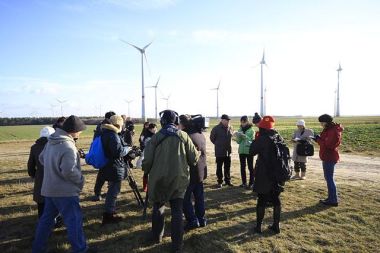
A visit by Greenpeace at Feldheim in 2011. Uploaded by Energiequelle. CC BY 3.0
¶ Primus Power, a flow battery startup that’s worked primarily with the US military to date, has raised a $25 million Series D round, led by a group of investors that wants to try its technology out at MW scale in Kazakhstan. The deal is for 25 MW/100 MWh of Primus’ zinc-bromide-based, single-tank energy storage systems. [Greentech Media]
¶ The Quaid-e-Azam Solar Power Park is a $130 million project on nearly 500 acres of land in a desert in Pakistan. When the entire project is complete in 2017, it could produce as much as 1,000 MW of electricity, equivalent to an average sized coal-fired power station, and enough to power about 320,000 households. [EcoWatch]
¶ A Japanese nuclear power plant started commercial operations on Thursday for the first time after two years of shutdown triggered by the Fukushima crisis. Utility Kyushu Electric Power said a reactor at Sendai, started normal operation following final inspections conducted by the Nuclear Regulation Authority on the day. [The Asian Age]
US:
¶ A new 28-mile transmission line costing $200 million will provide another path for power to cross between Oregon and Washington. Most importantly, it will bring added capacity to an area that has seen rapid growth in renewable resources and has become a hot spot for energy intensive data centers. [Transmission and Distribution World]
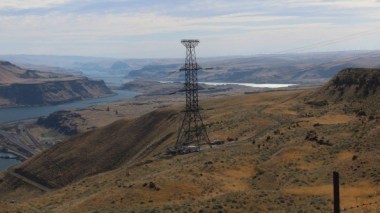
Big Eddy-Knight 500-kV transmission line
¶ California is about to make a historic move on climate change with a package of bills to be voted on this week. One calls for a 50% reduction in petroleum use in cars and trucks, a 50% increase in energy efficiency in buildings, and for 50% of the state’s utility power derived from renewable energy, all by 2030. [ThinkProgress]
¶ The US residential solar market grew 70% during the first half of 2015. With another 729 MW of utility-scale solar during the second quarter, the nation has installed more than 1 GW of PV for the last 7 quarters. According to the Solar Energy Industry Association’s latest report, US solar power capacity now exceeds 20 GW. [CleanTechnica]
¶ The Department of the Navy and Georgia Power Company are breaking ground on a large-scale solar facility at Naval Submarine Base Kings Bay. Approximately 136,000 solar photovoltaic panels will be installed on 258 acres and generate up to 42 MW when fully operational. Construction should be completed by the end of 2016. [Florida Times-Union]
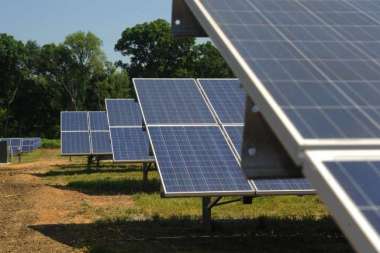
Georgia Power photo
¶ The Long Island Community Microgrid Project will use solar and energy storage to meet the East Hampton area’s growing electricity needs. Renewable energy will provide nearly 50% of the local electricity consumed and enable the utility to avoid investing hundreds of millions of dollars in new generation and transmission. [Huffington Post]
¶ The Hardwick Electric Department is the first utility in Vermont to reach the new cap on how much electricity it can buy from small renewable energy producers. The department surpassed the 15% maximum that the Legislature set to represent the maximum amount of net-metered energy a utility must buy from customers. [vtdigger.org]
¶ A broad coalition of Ohio business, health, community and environmental groups called Wednesday for Ohio lawmakers to reinstate mandatory targets for the use of renewable and advanced energy sources such as wind, solar and clean coal. A law to have the state get 25% of its power from renewables is on hold for two years. [News-Herald.com]
Posted in nuclear power, renewable power, solar, wind | Leave a Comment »
Tags: nuclear, nuclear power, photovoltaic, renewable power, solar power, wind power
September 9, 2015
Opinion:
¶ “Rural poor aren’t going to wait for centralised clean coal” Global coal is on the ropes. Prices of thermal coal have collapsed as demand evaporates, stocks have crashed, and companies are going to the wall. The World Coal Association is clinging to parts of the world with limited access to energy as a possible lifeline. [Business Green]
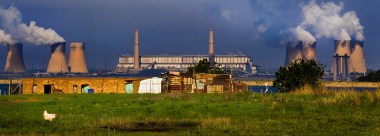
Coal buring power plant in the Highveld, in South Africa. Photo by Hein waschefort. CC BY-SA 3.0. Wikimedia Commons.
¶ “Maybe We Aren’t Quite So Doomed On Climate Change” The planet just experienced its hottest month ever. Sea levels are rising three times faster than previously estimated. American politicians and climate-change deniers are blocking progress. But there is encouraging news to report, and reasons for optimism. [Huffington Post]
World:
¶ Suzlon Energy’s chairman announced that his company is progressing well on a 600-MW pilot offshore wind project off the coast of Gujarat, India. Construction is expected to begin next year, and the project should be commissioned in three to five years. The company expects the cost to be ₹6,000 crore ($923 million). [CleanTechnica]
¶ Indian Railways may introduce 500 trains with solar panel fitted coaches. LiveMint reports that the ministry of new and renewable energy could subsidize the project cost. The national transporter had run a pilot project with a specially outfitted coach earlier this year to study the feasibility of such an initiative. [Greentech Lead]
¶ Dutch solar is booming right now. Parties involved have reported sales increases up to 100% in the first half of 2015 compared to 2014. This is primarily due to the fact that the Netherlands has a generous net metering system and the public has faith that these policies will not be adjusted to their disadvantage soon. [CleanTechnica]
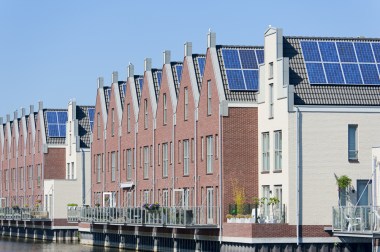
Image: rooftop solar in the Netherlands, via Shutterstock
¶ Two of Australia’s renewable energy agencies are planning a massive investment in solar power which could see the construction of up to 10 large-scale power plants. The Australian Renewable Energy Agency and the Clean Energy Finance Corporation announced a combined $350 million (Aus) investment. [ABC Online]
¶ The author of Australia’s landmark climate change review, Ross Garnaut, says the costs of renewable energy generation have been falling faster than those of nuclear power and South Australia could be better placed exploiting advantages in wind and solar than nuclear energy. He also expects a smaller role for gas. [InDaily]
¶ Nuclear regulators warned that Kansai Electric Power Co may not be allowed to extend the life span of its aging nuclear reactor at the Mihama plant, saying the utility has been slow to submit information required for a safety review. Current regulations allow the nuclear authority to grant a 20-year life span extension for a reactor. [The Japan Times]
¶ France’s oldest nuclear plant at Fessenheim in the country’s north-east will not be closed before the end of President Francois Hollande’s mandate in 2017, according to Energy and Environment Minister Segolene Royal. Though one of Hollande’s election promises was to close the plant, the law on nuclear power only caps nuclear capacity. [Reuters]
US:
¶ Movers and shakers within the snow-sports industry sent a letter to President Barack Obama on Tuesday expressing their unified support for global action on climate change. Three trade groups joined to sign the letter, Snowsports Industries America, The National Ski Areas Association and the nonprofit Protect Our Winters. [Aspen Times]

Spring skiing. Rising temperatures around the world are of major concern to the industry. Jeremy Wallace / The Aspen Times file photo
¶ SunEdison and Dominion have announced a joint venture for a 265-MW solar project in Utah. The Three Cedars solar project, currently under construction, will generate enough electricity to power more than 36,000 homes. The two companies had announced a different 420-MW project, also in Utah, only last month. [Energy Matters]
¶ FirstEnergy, with 6 million customers in Ohio and nearby states, owns a handful of big nuclear and coal power plants that are no longer competitive in power markets. Rather than shut down the plants, the company is asking Ohio regulators to force customers to buy the plants’ power for the next 15 years at $26/MWh above market prices. [Vox]
Posted in nuclear power, renewable power, solar, wind | Leave a Comment »
Tags: nuclear, nuclear power, photovoltaic, renewable power, solar power, wind power
September 8, 2015
Science and Technology:
¶ In the past, Novozymes CEO Peder Holk Nielsen has had some pithy things to say about the global petroleum industry. Mr. Nielsen has some even more pithier things to say regarding the opportunities for growth in the biofuel industry when a major global climate action milestone, COP21, comes up in Paris later this year. [CleanTechnica]
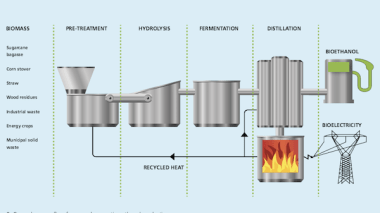
Image (screenshot): via Novozymes.
¶ Nuclear power advocates cling like limpets to the idea of ‘baseload’ power. No surprise there – it’s the only selling point they’ve got. It’s just too bad the idea is obsolete. Variable renewables combined with stronger grids, energy storage and responsive demand can do a better job for a good deal less money. [The Ecologist]
World:
¶ Danish wind energy giant Vestas has announced seven newly awarded wind turbine contracts to provide a total of 332 MW in five different countries. Between August 24th and the 4th of September, Vestas announced seven different contracts to supply wind turbines to projects all over the world, totaling 332 MW. [CleanTechnica]
¶ In southern Europe, the cost of solar PV could be as low as €20 to €25/MWh ($22.40 to $27.90/MWh) by 2030, a report says. Even in London, the cost of large-scale solar PV will be around €50/MWh, way below the cost of nuclear, the Tory government’s clean technology of choice. There are clear implications for fossil fuels. [CleanTechnica]
¶ According to 93% of Germans the further expansion of the country’s renewable energy capacity is important or very important, according to a poll. About 68% of those polled consider having renewable energy systems near their home a good thing. For example, 77% would like having a solar park in the neighbourhood. [SeeNews Renewables]

Wind farm in Germany. Author: Clément Belleudy. License: Creative Commons, Attribution-ShareAlike 2.0 Generic
¶ The renewable energy arm of French utility EDF says its Operations & Maintenance business has reached 13.6 GW in capacity under management during the first half of 2015. This marks a 16% rise from December 31, 2014. Of the total, wind farms account for 12 GW and solar power stations total 1.4 GW. [SeeNews Renewables]
¶ APR Energy announced final signature and government approval of the extension of its 250-MW power generation project through the end of 2015 with Usinas y Trasmisiones Eléctricas, the Uruguayan state power company. The contract terms and conditions are unchanged from the agreement announced on 1 July. [Your Renewable News]
¶ Brazil has the highest share of renewables in its power mix, reaching 73% in 2014, within the BRICS bloc which also includes Russia, India, China and South Africa. The renewables percentage in the other countries from the group ranges from just 2%, as is the case in South Africa, to 22% in China. The figures exclude imports. [SeeNews Renewables]
US:
¶ Five solar projects along the Massachusetts Turnpike and Route 3 are not the largest in the state, but they are among the most visible and striking examples of a solar industry that has grown more rapidly than most policy makers and energy specialists ever imagined. They will produce a combined 2,500 kW, enough for 500 homes. [Boston Globe]
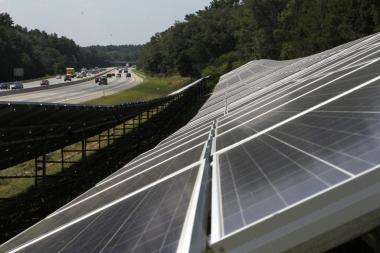
Two solar farms alongside the Mass. Pike contain 2,100 panels each. Photo by Joanne Rathe/Globe Staff
¶ Luminant, one of Texas’ largest coal power generators, is joining the rush to build utility-scale solar farms in West Texas in another sign of the technology’s rapidly declining costs. It is expected to announce a 116-MW complex on 800 acres near Midland, Texas. Luminant started developing wind power over ten years ago. [Dallas Morning News]
¶ In Arizona, the Marana Unified School District will install solar panels at all of its schools as part of its larger goal for energy efficiency to cut costs. Eight schools now have solar power with the help of Tucson Electric Power’s renewable energy credit. The other nine will have solar power installed by the end of the year. [Arizona Daily Star]
¶ Imagine a solar city in a leading coal state. Increasingly, advocates and some public officials are doing just that in Louisville, as the price of using the sun to keep the lights on continues to fall. More people are calculating a solar bottom line in the black, for their household or business finances, as well as for Mother Nature. [Lexington Herald Leader]
Posted in nuclear power, renewable power, solar, wind | Leave a Comment »
Tags: nuclear, nuclear power, photovoltaic, renewable power, solar power, wind power
September 7, 2015
Science and Technology:
¶ New research says even “safe” levels of particulate and nitric dioxide (NO2) air pollution are associated with a notably increased risk of severe heart attacks. The levels in question are well below recommended limits in Europe, so great many people there are probably exposed to such levels at times. [CleanTechnica]

Traffic in Delhi. Auto emissions include NO2. Photo by NOMAD. CC BY 2.0.
World:
¶ Singapore’s public electric vehicle (EV) charging network will be getting a fair boost over coming days, thanks to a new partnership between Greenlots, BMW Group Asia, and CapitaLand that will see the network expanded notably. The companies focus on real estate, automobiles, and EV network technology, respectively. [CleanTechnica]
¶ Despite moves by the UK’s Conservative government to curb onshore wind and other renewables while going “all out for shale”, Tory supporters favored wind over shale, with 58% opting for a turbine and 23% for a well. Among 2,000 people of the general population, the vote was 65% for wind and 14% for shale gas. [Western Daily Press]
¶ Conergy, of Hamburg, Germany, has signed a new contract with B.Grimm Power Limited, one of Thailand’s foremost energy producers, to construct a solar PV power plant with a capacity of 8 MW, supporting the government’s goal to have 20% of the country’s energy needs supplied by renewable sources by 2036. [solarserver.com]
¶ A company has come up with a method to create biofuel pellets from palm oil effluent. Set up in 2012, the Kuala Lumpur-based company Hyper Fusion International is exporting these pellets to its business partner in South Korea. The CEO says the company is not interested in renewable energy so much as sustainability. [Daily Express]
¶ Nordisk Vindkraft inaugurated the 144-MW Sidensjo wind farm in Sweden, which it built for Munich’s municipal utility firm Stadtwerke Muenchen. The wind park has 48 turbines made by Siemens. It is estimated to produce 400 GWh of power annually, avoiding emissions of 380,000 tonnes of carbon dioxide. [SeeNews Renewables]
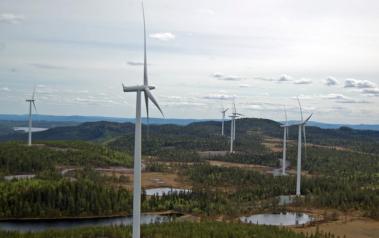
Wind farm in Sweden. Author: Jämtkraft. CC BY 2.0.
¶ SunEdison has installed solar panels at eight stations on a Delhi Metro line, making it the first line in DMRC’s network to be completely solar-powered. SunEdison is also working on solar power stations for the Yamuna Bank station and Yamuna Bank yard. Collectively, these two arrays will have a capacity of 1.9 MW. [pv magazine]
¶ Solarcentury has won a contract to design and build a 6-MW solar farm on Ameland Island in the northern part of the Netherlands. The project is a collaboration between the municipality of Ameland, the Amelander Energy Cooperative and Dutch energy supplier Eneco. It is the largest to date in Holland. [SeeNews Renewables]
¶ In Australia, new TV advertisement that explains the “endless possibilities” of coal in providing “light and jobs” has been labelled “ludicrous” and “desperate” by environmental groups. The groups also criticised a claim that the new coal technology will reduce the emissions by up to 40%. [International Business Times AU]
¶ UK Prime Minister David Cameron is poised to sign a landmark deal next month to allow China to build a prototype nuclear reactor in Bradwell, Essex – which would become the first Chinese-operated facility in the West. The deal, part of a wide-ranging civil nuclear pact between Britain, France and China, may be sealed in October. [Express.co.uk]
US:
¶ A coalition of environmental groups is threatening to sue the EPA, alleging that it has been stalling over the last few years on the issue of oil+gas industry waste regulation despite clear links, shown by much research, between waste disposal via underground injection wells and earthquakes in Oklahoma and Ohio. [CleanTechnica]
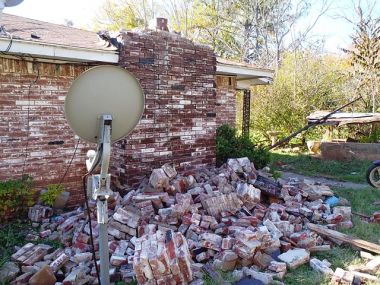
House damage in central Oklahoma from the magnitude 5.6 earthquake in 2011. Photo by Brian Sherrod, USGS. Public domain.
¶ New York Governor Andrew Cuomo announced that construction will start on the area’s first ever large scale anaerobic food waste digester system. Located in the Long Island hamlet of Yaphank, it is expected to handle 160,000 tons of waste annually, including solid food waste, fats, oils, grease, and grass clippings. [CleanTechnica]
¶ Massachusetts ranks among the best in the country for solar energy, but there is increasing concern that Governor Charlie Baker is hampering progress. Environment Massachusetts ranked Massachusetts fourth in the nation last year for new solar capacity per capita. But the net metering program is hitting its limits. [ecoRI news]
Posted in nuclear power, renewable power, solar, wind | Leave a Comment »
Tags: nuclear, nuclear power, photovoltaic, renewable power, solar power, wind power
September 6, 2015
Science and Technology:

Graphene. US Army image. CC BY 2.0
¶ The new ‘wonder material’ graphene has also been suggested as a possible key to the solution for energy storage. Graphene has a number of interesting properties that have led researchers to suggest either modifying components of Li-ion batteries, or using graphene as the energy-storage medium instead as promising solutions. [The Ecologist]
World:
¶ A study from researchers from the Melbourne Energy Institute and RMIT in Australia has highlighted how demand has been reduced in the last five years. But also there are now 1.44 million households with a total of 4.4 GW of rooftop solar. The result is that there have been no more “super peaks” in electricity demand. [CleanTechnica]
¶ Ban Ki-moon is concerned that the climate negotiations are moving too slowly to deliver a new global deal in December. His views were echoed by many delegates at the latest meeting in Germany. But one of the men tasked with drafting a new text said that even going at a snail’s pace , a draft agreement would be ready for Paris. [BBC]

While climate negotiators were meeting in Germany, President Obama was highlighting the issue at a glacier in Alaska.
¶ An environmentalist says Marlow, in Buckinghamshire, can become a ‘beacon of excellence’ for renewable energy after controversial early plans emerged for a solar farm on green belt land. Residents voiced their fears over plans to build a solar farm on land which has long been earmarked to be used for a country park. [Bucks Free Press]
¶ A grant for households in rural areas of the Philippines to install solar energy systems, as well as major airport and elevated commuter railway projects, fill out the list of projects planned for the remaining months of the Aquino administration. Five major projects have been approved for implementation during the remainder of the term. [gulfnews.com]
¶ Gaelectric both builds and buys wind farms. It owns or part-owns wind projects in Kilkenny and Tipperary and is building others at Faughary, Roosky, Leabeg and Ballagh. It wants to almost triple its wind-generating capacity by the end of the year, from 66.4 MW to 177.6 MW and ultimately to 400 MW by 2017. [Irish Independent]
¶ A high-ranking energy source, speaking after a further delay was announced to the building of a new nuclear reactor at Hinkley Point in Somerset, said changes are coming at an extraordinary pace and will result in central power generating capacity becoming redundant. And this will mean fewer big power stations. [This is Money]
US:
¶ Profit margins are notoriously tight on Maine’s small farms, and Little Ridge Farm is among a growing number of ventures using renewable energy to cut costs and improve the bottom line. The latest USDA agriculture census, from 2012, lists 464 renewable energy systems, but new data would show many more. [Press Herald]

New solar panels cover the roof of a barn at Little Ridge Farm. Photo by Gordon Chibroski, Portland Press Herald Staff Photographer.
¶ Once it’s operating next year, Deepwater Wind’s Block Island project should generate 30 MW of electricity, enough for 17,200 homes, roughly 3 miles off Rhode Island’s coast. Two Louisiana firms with roots in the oil and gas industry have leading parts in building what may be the first US offshore wind farm. [The New Orleans Advocate]
¶ Environmental Entrepreneurs, or E2, ranked Utah fourth in a list of the top 10 states seeing job growth in clean energy and clean transportation. Ongoing solar projects in Iron and Beaver counties put Utah on the list, with three more solar farms to be built in the area, according to the E2 executive director. [St. George Daily Spectrum]
¶ North Carolina health officials in 1999 alone issued 111 orange or red warnings for “bad air days,” days on which sensitive groups or everyone was warned against exercising outside. None were made last year, as clean air standards likely helped cut death rates for asthma, pneumonia and emphysema in the state. [Asheville Citizen-Times]
Posted in nuclear power, renewable power, solar, wind | Leave a Comment »
Tags: nuclear, nuclear power, photovoltaic, renewable power, solar power, wind power
September 5, 2015
Economics and Technology:
¶ Compared to “typical” wholesale electricity prices of $25 to $60 per MWh, in the New York ISO’s western region wholesale prices hit $1,100 to $1,200 per MWh during this summer’s heat. There were similar events across the nation. Demand flexibility could help reduce those spikes, ultimately reducing rates for consumers. [CleanTechnica]
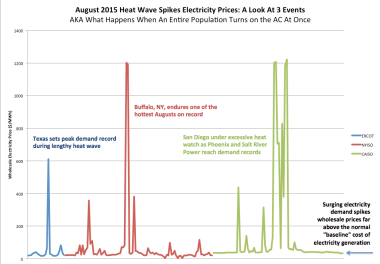
Spikes in wholesale electric rates in three US markets. (Click to enlarge.)
World:
¶ In January this year The Guardian reported that big European energy companies are increasingly taking control of renewable energy lobby groups. As one result, a commentator on the Dutch wind energy association (NWEA) says, “NWEA does not oppose nuclear power, coal power. They’re pro-wind, not anti-coal.” [CleanTechnica]
¶ Visiting Australia, Canadian author Naomi Klein said she believes she owes PM Tony Abbott “a debt of thanks.” In Sydney to promote her new book Capitalism versus the Climate: This Changes Everything, Klein said the conflict between what the planet needs and what capitalism needs is exemplified in Australia. [Green Left Weekly]
¶ The potential loss of thousands of jobs will not be a factor when the UK decides whether to implement its proposed heavy cuts to solar power subsidies. By contrast, government announcements on North Sea gas field development and the fast-tracking of shale gas exploration have highlighted the potential jobs created. [The Guardian]
¶ Plant for the Planet, a global youth initiative that plants trees to reduce the effects of climate change, asked for a worldwide tree count, and scientists at Yale did a study. The good news is that there are 3.04 trillion trees on Earth, 7½ times more than previous estimates. The bad news? The number of trees is down roughly 46%. [CNN]
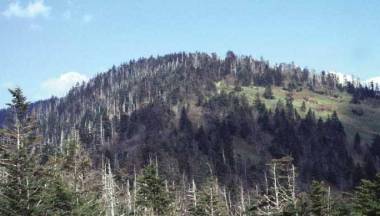
Clingmans Dome (highest point in the Great Smokies). The effects of clearcut logging and fire are clearly visible on the right; the dead trees are Frasier Fir, killed by the Balsam woolly adelgid. United States Geological Survey photo.
¶ The economics behind the UK’s decision to make cuts to a series of green policies are “bonkers”, former energy and climate change secretary Ed Davey says. In his first interview since losing in the election, Davey said he struggled to comprehend the logic behind cuts to efficiency programs and renewable energy incentives. [Solar Power Portal]
¶ Mexican energy firm Grupo Dragon, part of Grupo Salinas, will invest up to $712.9 million in renewable energy in the next four years, according to its CEO. The company has three wind projects in construction, along with a solar project, and will participate in the first geothermal licence auction after the energy reform. [SeeNews Renewables]
¶ Solar generation costs are likely to fall below the average wholesale price of electricity across Europe by 2030, according to a new study. It highlights the potential of a solar revolution across the globe, not just in the household and commercial market, but also for utility-scale installations. [RenewEconomy]
¶ The town of Naraha in Fukushima Prefecture celebrated after the government’s evacuation order was lifted. It is 4½ years since the eruption of the March 2011 nuclear disaster. Naraha is the first of seven radiation-tainted municipalities to be entirely cleared for repopulation since the triple-reactor meltdown. [The Japan Times]
US:
¶ Enel Green Power NA Inc launched its 150-MW Origin wind farm. The farm is in the south-central part of the ‘Sooner State,’ covering 18,000 acres near Hennepin, Oklahoma. It has 75 Vestas wind turbines, enough to provide power to about 55,000 homes. Federal, state, and tribal officials were given a tour of the 18,000 acre site. [reNews]
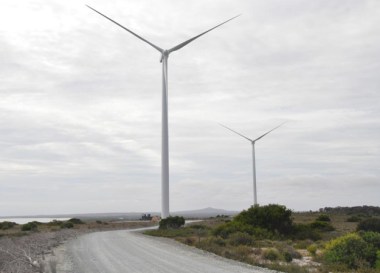
EGP has raised its wind energy capacity in Oklahoma by 56% (Vestas photo)
¶ NV Energy’s incentive and interconnection application volumes grew by 15 times over the past 12 months. To handle the increased workload, they took their interconnection processing online using PowerClerk®. They reduced the time spent processing applications by 63%, and completing the three weeks sooner. [CleanTechnica]
¶ Entergy’s Pilgrim Nuclear Power Station, in Plymouth, Massachusetts, got an unwelcome reminder of the effects of winter storm Juno this week, as the NRC announced that it had finalized a “White” inspection finding issued last spring, placing it among the worst operating facilities in the US. [Wicked Local Plymouth]

Anbaric Transmission image
¶ The Vermont Green Line is the latest proposal to run an electric transmission line under Lake Champlain. The 400-MW underwater and underground line would run 60 miles, from Beekmantown, New York, to New Haven, Vermont. The power, from wind farms in northern New York, would be put on the New England power grid. [WAMC]
¶ One Vermont state park is getting ready to go off the grid. Green Mountain Power is partnering with the Vermont Department of Forests, Parks and Recreation to transform the bulk of Emerald Lake State Park in East Dorset into an ePark, powered entirely by solar and the new Tesla Powerwall battery for storage. [vtdigger.org]
¶ The South Carolina Public Service Commission approved another cost increase for the two new VC Summer Nuclear Generating Station reactors under construction in the state. The deal will increase the cost of the additions to South Carolina Electric & Gas and the South Carolina Public Service Authority to $6.8 billion. [Utility Dive]
Posted in nuclear power, renewable power, solar, wind | Leave a Comment »
Tags: nuclear, nuclear power, photovoltaic, renewable power, solar power, wind power
September 4, 2015
Science and Technology:
¶ SolarWindow Technologies says they have a working, electricity-generating window with a payback of under a year. It is a transparent window coating. Installed on a 50-story building, it would generate up to 50 times the power of conventional rooftop solar. [ENGINEERING.com]
World:
¶ Rich nations at UN climate talks are said to be edging towards a compromise on the thorny issue of loss and damage. Poor countries want compensation for extreme weather events that they link to large scale carbon emissions. But the US and EU have long resisted the idea. [BBC]
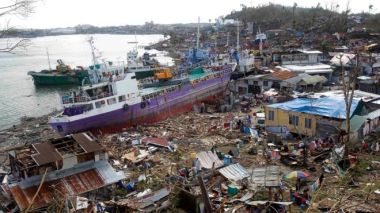
Developing nations point to Typhoon Haiyan as an example of the damage wrought by extreme weather events. Reuters.
¶ Delhi’s Ministry of Power announced plans to install 1 GW of rooftop solar PVs in the capital over the next 4 to 5 years. A medium-term target is to have a total of 2 GW of PVs installed by 2025. Bus stops, metro stations, and railway stations are being considered. [CleanTechnica]
¶ India’s installed solar power capacity has officially crossed the 4-GW mark. As of 31 July 2015, India reached an installed solar power capacity of 4.1 GW, adding 358 MW solar power capacity between April and July, the first four months of India’s financial year 2015-16. [CleanTechnica]
¶ French energy giant EDF admitted that construction of the UK’s first new nuclear power plant in decades has been delayed. Hinkley Point C in Somerset will not start generating power in 2023 as planned. Yesterday it claimed no delays were going to happen. [Western Daily Press]
¶ The city of Marsabit, Kenya has no grid access. It relies on a local microgrid, which requires a reliable power supply of readily available and affordable clean power resources such as wind. It will soon have flywheels to provide backup power for its wind and diesel generation. [ESI Africa]

Remote city in Kenya relies on an isolated microgrid for power.
¶ Danish firm Vestas Wind Systems said it secured a 70-MW turbine order for a wind project in Uruguay. The country was wind energy’s fastest-growing market in 2014, with installed capacity soaring almost eight-fold to 479 MW. This is not Vestas’ first order there this year. [Blouin News Blogs]
¶ The capacity of nuclear power plants starting plant life extension (PLEX) programs will decrease from an estimated 18.1 GW in 2015 to 2.9 GW by 2025, according to GlobalData. Plant operators started 50 PLEX projects in 2010-2011, but the number is expected to fall. [PennEnergy]
US:
Coal. Credit: Fossil Free
¶ The California State Assembly passed a bill which will force the state’s two largest pension funds to divest their holdings in thermal coal. The bill requires the funds to divest their holdings in companies that receive at least half their annual revenue from coal mining. [CleanTechnica]
¶ Santee Cooper’s Green Power program hit a milestone when it generated its 1 millionth MWh of electricity. That’s enough to power 74,000 average-sized homes for a year. Santee Cooper was the first utility in South Carolina to generate renewable power. [Berkeley Independent]
¶ The Power Company of Wyoming expects to get final federal rulings later this year for the 3-GW Chokecherry Sierra Madre wind project. The $5 billion, 1000-turbine proposal is located on a mix of private and public land in Carbon County, including federal land. [reNews]
Posted in nuclear power, renewable power, solar, wind | Leave a Comment »
Tags: nuclear, nuclear power, photovoltaic, renewable power, solar power, wind power
September 3, 2015
World:
¶ The solar industry has launched its fight to stop the changes in the UK’s renewable incentives, by launching an e-petition. It must garner 10,000 signatures before it is taken seriously by government. The petition calls for ‘urgently review’ of changes to the Feed in Tariff. [reNews]
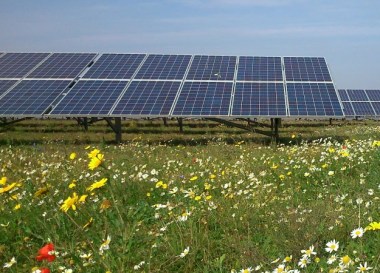
Image: Saxley solar farm in Hampshire (Solarcentury)
¶ Inox Wind Director announced that his company received an order to set up a 100-MW wind project in the Indian state of Madhya Pradesh. With this order, the company now has a pipeline of 1.25 GW, about a 30% share in the country’s wind energy market. [CleanTechnica]
¶ Iceland is luring business with renewable energy. Emerging from financial isolation, Iceland is making a name for itself in the business of data centres, warehouses consuming enormous amounts of energy to store the information of 3.2 billion internet users. [The Rakyat Post]
¶ Canadian Solar has announced that it has won five solar PV projects totaling 185 MW in Pirapora, a municipality in the state in Minas Gerais, Brazil. Canadian Solar will sell the electricity to a Brazilian government entity for about $84.0/MWh. [Your Renewable News]
¶ Renewables are spreading across the developing world, opening markets with a reputation for convenience and plunging costs. That challenges the traditional selling point for coal, which has used the same points as the basis of its appeal. [Sydney Morning Herald]
¶ Solar power generation contributed to about 10% of peak summer power supplies of Japan’s nine major utilities, equivalent to more than 10 nuclear reactors. Solar power supplied only 2% of annual needs, but it came at peak demand time. [Economic Times]
US:
¶ Generation of electricity from utility-scale solar projects in the United States during June 2015 was 31 times what it was in June 2005, and now accounts for roughly half a percent of all US electricity production, according to the US Energy Information Administration. [CleanTechnica]
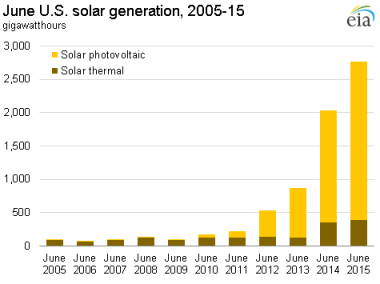
Growth in solar generation in the US. EIA graphic.
¶ The US energy storage market deployed 40.7 MW worth of storage in the second quarter this year, its best quarter in two and a half years, according to GTM Research’s latest report, US Energy Storage Monitor. It is the largest amount since the fourth quarter of 2012. [CleanTechnica]
¶ Colorado’s Attorney General announced that the state will join others in a lawsuit challenging the US EPA’s Clean Power Plan. An EPA spokesperson responded by pointing out the plan’s history of development through years, saying it is legally and technically sound. [The Colorado Statesman]
¶ Many people are looking for ways to save a little extra money where ever they can, especially on the energy bill. Wind energy is prevalent in Iowa, but solar energy is growing in popularity. Solar energy is growing in popularity in agriculture, commercial and residential areas. [KTIV]
¶ FuelCell Energy, Inc revealed that it has been selected for a cost-share carbon capture project by the US DOE’s Office of Fossil Energy. The project, with an outlay of $23.7 million, will be sponsored by the National Energy Technology Laboratory. [Nasdaq]
Posted in nuclear power, renewable power, solar, wind | Leave a Comment »
Tags: nuclear, nuclear power, photovoltaic, renewable power, solar power, wind power
September 2, 2015
World:
¶ After oil prices hit a record high in July 2008, the tiny Pacific nation of the Marshall Islands, which had about 90% of its energy from imported petroleum products, declared a state of emergency. Now, solar power is becoming important everywhere, and 99% of the lighting on its outer islands is powered by the sun. [Voice of America]
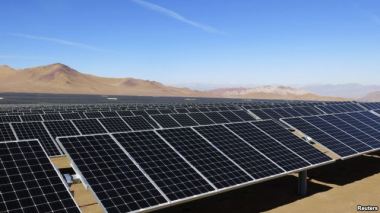
Solar panels are being used extensively on the Marshall Islands, which uses the sun for 99% of the lighting on its outer islands. File Photo.
¶ In what is believed to be the largest Australian trial of its kind, a solar farm in Western Australia’s Pilbara region, will be fitted with “cloud predictive technology.” The technology uses an interconnected network of cameras, pointed towards the sky, to sense approaching cloud cover. This avoids sudden power drop offs. [ABC Local]
¶ New research by AeroThermal Group, pioneers in developing innovative solutions from aerospace through to green energy from waste, has shown that 635 kWh of renewable electricity can be generated from one tonne of waste from fast food outlets. Using the same system, one tonne of pure kitchen waste generated 847 kWh. [Industry Today]
¶ The commitment of the UK’s Big Six energy companies to tackling climate change has been called into question. Yesterday, The Independent revealed that British Gas and SSE use more coal for electricity now than they did ten years ago. Now, it says that not a single one of Britain’s biggest suppliers offers a renewable energy tariff. [The Independent]
¶ The global market for on-site [ie, small] wind power is predicted to grow to $1.89 billion by 2019, according to new analysis. A report from consultancy Research and Markets projects the segment’s steady growth at a compound annual growth rate of 19.5% during the forecast period. [Cogeneration & On-Site Power Production Magazine]
US:
¶ Although wind power provided less than 3% of Alaska’s electric power generation in 2014, Alaska’s wind power capacity has increased 20-fold between 2007 and 2014, growing from 3 MW to 60 MW. This increase is notable in light of the challenges of installing wind generators and connecting them to the grid. [Your Renewable News]
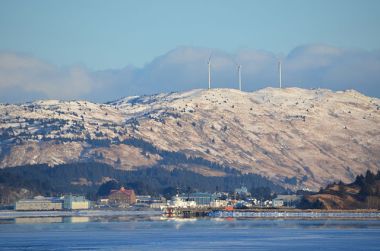
Coast Guard base Kodiak is seen across Women’s Bay. Atop Pillar Mountain, beyond the base, are three wind turbines operated by Kodiak Electric Association. Photo by James Brooks. CC BY 2.0.
¶ A review of 11 studies considering effects of net metering highlighted the importance of reduced or avoided environmental compliance costs, capital investment costs, and energy costs. It showed not only that solar net metering is not been harmful to markets, but that utilities have actually been underpaying for its use. [CleanTechnica]
¶ The Alabama Public Service Commission gave the go-ahead to Alabama Power’s plan to add up to 500 MW of renewable power capacity to its portfolio in six years. At present, the state of Alabama has just 2 MW of installed solar power capacity and is among the bottom 10 US states in the solar ranking. [SeeNews Renewables]
¶ TVA tentatively has approved an agreement with NextEra Energy Resources to buy power for up to 20 years from a bank of solar panels projected to generate 80 MW in Lauderdale, Alabama. The River Bend Solar project will occupy about 645 acres and is scheduled to be built over the next year or so. [RenewablesBiz]
¶ Michigan Governor Rick Snyder’s administration announced it will comply with the EPA’s Clean Power Plan by creating its own state-based carbon implementation plan. Meanwhile, Attorney General Bill Schuette, is suing to stop the plan. Snyder and Schuette, both Republicans, are seen as divided on the issue. [MLive.com]
Smoke stacks from Lansing’s Board of Water and Light in REO Town Lansing Monday, August 3, 2015. (Danielle Duval | MLive.com)
¶ Washington state’s three investor-owned electrical utilities have told the Utilities and Transportation Commission that they’re on track to meet the state’s renewable energy requirements, which require them to have a part of their power from renewable sources. The utilities also reported lower costs to meet those requirements. [seattlepi.com]
¶ At a regional summit in Newfoundland, Massachusetts Governor Charlie Baker said he hopes to bring more Canadian hydropower and natural gas to Massachusetts in the coming years to help solve the state’s energy deficit. He spoke in particular about Canada’s hydropower and natural gas as resources his state needs. [RenewablesBiz]
¶ Exelon announced that all of its Illinois nuclear plants, including Quad-Cities, cleared in the power grid operator’s transition capacity auction, which means they can sell supplemental power to the grid in the 2016-2017 planning year. Some have lost bids to sell power to the grid in the 2018-2019 planning year. [Quad City Times]
Posted in nuclear power, renewable power, solar, wind | Leave a Comment »
Tags: nuclear, nuclear power, photovoltaic, renewable power, solar power, wind power
September 1, 2015
World:
¶ Delhi Metro Rail Corporation has bagged the top spot for highest capacity installation of solar power plants in stations and depots across its vast network. Union Minister of State for Power Piyush Goyal made the award. The solar PV plants DMRC has so far installed generate a total of around 2,794 kW (peak) currently. [YourStory.com]

Image Credit: Shutterstock
¶ The cost of producing electricity from renewable sources like wind and solar has been falling. Now, a report details the contrasting costs for different power generation technologies and shows that renewable sources can produce electricity at close to or even below the cost of new fossil fuel-based power stations. [The Maritime Executive]
¶ The Climate Change (Scotland) Act demands a reduction in greenhouse gas emissions of at least 80% 2050, across sectors ranging from electricity generation to the food sector, building efficiency, and transportation. The goal is shared across political parties, though they will outline competing proposals for how they might be reached. [Scotsman]
¶ Brazil has concluded its second reverse auction for solar power plant projects, with 834 MW of parks being awarded bids, with an average price of 301.79 Real per megawatt-hour (8.42¢/kWh). The average price was 13.5% below the maximum price set for the auction. Thirty large-scale solar projects will be developed in five states. [pv magazine]
¶ Reports from three Chinese agencies all point to the continuing decline in use of coal in the first half of 2015, continuing a trajectory already notable in 2014. These are not declines in the rate of growth, but absolute declines in the amount of coal consumed. Meanwhile, China is working on new laws to speed reduction of pollution further. [Energy Collective]
¶ The bulk of South Africa’s power is currently generated by coal and the nation is looking at all of its alternatives. The ruling African National Congress has come under fire for its plan to build a 9,600-megawatt nuclear facility at a cost of as much as $100 billion to meet future demand. Disturbingly, nuclear procurement decisions are secret. [BizNews]
Nuclear power plant at Cattenom. Photo by Gralo. CC BY-SA 3.0.
¶ Not many Japanese nuclear reactors are likely to restart in the next few years, as safety worries and legal challenges persist. Reuter’s analysis shows that of the other 42 operable reactors remaining in the country, just seven are likely to be turned on in the next few years, down from the 14 predicted in a similar survey last year. [PanARMENIAN.Net]
US:
¶ California investor-owned utilities PG&E, SCE and SDG&E recently submitted proposals to the California Public Utilities Commission designed to destroy the rooftop solar industry and customer choice in California. Meanwhile, these same utilities are running misleading ad campaigns to greenwash their anti-solar position. [CleanTechnica]
¶ Aspen is one of three US cities to run on 100% renewable energy, according to city officials. The shift to energy that is generated from natural resources, including wind power, solar power and geothermal heat, follows a “decade-plus” city goal. Earlier US cities to reach the goal were Greensburg, Kansas and Burlington, Vermont. [Aspen Times]
¶ A private group proposing to build the world’s largest fuel cell park submitted its application to the Connecticut Siting Council. The Beacon Falls Energy Park, with 63.3 MW of output, would use fuel cells purchased by FuelCell energy of Danbury, Connecticut. It would be located in a former sand and gravel mine. [Hartford Courant]
¶ The clean energy industry supports nearly 10,000 jobs in Rhode Island, according to a new state report from the Office of Energy Resources and the Executive Office of Commerce. The report found that the sector has a total of 9,832, and projected that another 1,600 positions would be created over the next year. [The Providence Journal]
Welders for Specialty Diving Services working on the Deepwater Wind project. Photo by Sandor Bodo, The Providence Journal
¶ Vermont’s forests could substantially contribute to renewable energy goals if sustainably harvested methods, according to a study from Vermont Law School’s Institute for Energy and the Environment. Managing the health of local forests will likely be challenged by an expanding renewable energy market. [BurlingtonFreePress.com]
¶ Public health experts at Harvard University evaluated the impacts of different renewable energy or energy efficiency installations in six locations in the mid-Atlantic and Great Lakes regions and produced with a model to compare climate and health benefits. They found that benefits ranged from US $5.7 million to $210 million per year. [IEEE Spectrum]
¶ The economic potential for deploying renewable energy resources today is enormous nationally. Across the three primary cases that NREL examined, the range of results show that renewable energy resources have the potential to affordably supply as much as 10 times total current US generation [The Equation: Blog of the Union of Concerned Scientists]
¶ The former CEO of Duke Energy, the country’s biggest power company, now says that the way big US power companies operate is out of date. “It’s very clear to me that the system of electric power we have in North America … is not sustainable for the future of the planet. So we’re going to have to figure out something else, and soon.” [Tampabay.com]
Posted in nuclear power, renewable power, solar, wind | 1 Comment »
Tags: nuclear, nuclear power, photovoltaic, renewable power, solar power, wind power
August 31, 2015
Science and Technology:
¶ Flow batteries may offer a solution for utility-scale wind and solar energy storage. UniEnergy Technologies is part of a new demonstration program in the Pacific Northwest that pits the technology against lithium-ion batteries. UniEnergy claims their flow battery will have a levelized cost that is far lower than a lithium-ion system’s. [CleanTechnica]
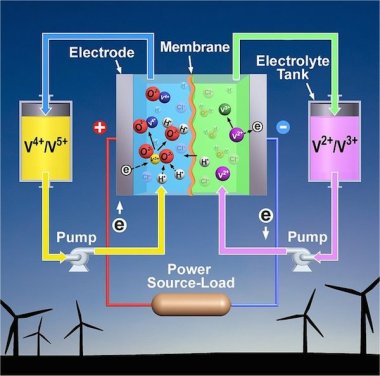
Vanadium flow battery. Image Credit: Pacific Northwest National Laboratory.
¶ ViZn Energy Systems Inc will supply a 2 MW zinc-iron redox flow battery system to Hecate Energy to provide support to the Ontario grid. (ViZn and Hecate are both located in the United States, ViZn in Austin and Hecate in Nashville.) Here is an interview the CEO of ViZn Energy Systems about the company’s technology. [CleanTechnica]
World:
¶ Enel Green Power has been awarded the right to sign 20-year energy supply contracts for a total of 553 MW with three new solar photovoltaic projects in Brazil. The awards for the projects – the 103-MW Horizonte MP, the 158-MW Lapa and 292-MW Nova Olinda – came through the ‘Leilão de Reserva’ public tender. [reNews]
¶ The government wants to slash by 87% subsidies for householders who install solar panels on their rooftops, in a move that renewable energy experts warn could kill off a promising industry. The assault on solar power comes after ministerial decisions to remove financial aid from new onshore wind farms and slash home energy efficiency measures. [The Guardian]
¶ Greek wind farm operator Eltech Anemos SA reported a first-half 2015 net profit of €4.6 million ($5.2 million), compared to €3.3 million last year. The performance improved thanks to improved wind conditions. It operates 184.5 MW of wind farms, one small hydro plant of 4.95 MW, and a 2-MW solar PV system. [SeeNews Renewables]
Wind turbines at work. Author: Nick Cross. License: Creative Commons, Attribution-NoDerivs 2.0 Generic.
¶ Major oil-producing countries are looking to sustainability. Recently, Bloomberg forecast that two-thirds of the $12.2 trillion global investment in capacity-generation to 2040 will be in the renewables sector. A signal simply of economic progression or of an increasing need for diversification in the energy mix. [Oil and Gas Industry Latest News]
¶ Eni’s discovery of potentially the world’s largest natural-gas field off the Egyptian coast will be a game changer for Egypt and the Mediterranean in terms of energy stability, the CEO of the Italian energy giant told CNBC on Monday. Eni said in a press release that the gas field that could satisfy Egypt’s natural gas demand for decades. [CNBC]
¶ Days after Western Australia’s energy minster predicted solar PV would soon displace coal as the state’s major generator of daytime, the Queensland government confirmed a similar departure from reliance on coal, with the promise to do everything it can to support the development of solar and wind projects in the state. [RenewEconomy]
US:
¶ The White House might say Alaska is the canary in the climate change coal mine, with raging wildfires, ice melts in the arctic, vanishing glaciers, and whole villages forced to relocate away from rising seas. President Obama will carry that urgent message to Alaska as part of a drive to change the conversation on global warming. [CNN]
Mount McKinley is to be renamed Denali. Photo by Frank K. from Anchorage, Alaska, USA. Creative Commons Attribution 2.0 Generic.
¶ SolarCity’s goals for the Silevo solar module manufacturing facility under development in Buffalo, New York, are certainly ambitious. Amongst them is to meet production costs of just 50¢/watt for solar modules with a +20% conversion efficiency. Another goal is an annual production output of 1 GW of solar modules [CleanTechnica]
¶ A 100-MW solar power project will be located in Cumberland County, in North Carolina, and is set to generate enough electricity to provide for the equivalent needs of 20,000 average US homes. Construction began earlier in August, and Principal Solar expects the project to begin generating power before the year is out. [CleanTechnica]
¶ The owner of Illinois’ 11 nuclear reactors must decide next month whether to close its Quad Cities plant, one of three generating stations Exelon Corp has said are in danger of closing if lawmakers don’t approve a surcharge on electric bills to boost profits. The future of the Clinton nuclear plant is also still in doubt. [Northwest Herald]
¶ With just a few days left in the state legislative session, more than 24 California companies have announced their support for two major climate bills that would set new ambitious state goals for reducing climate-changing pollution, boosting renewable energy and decreasing petroleum use over the next 15 years. [Environment News Service]
Posted in nuclear power, renewable power, solar, wind | Leave a Comment »
Tags: nuclear, nuclear power, photovoltaic, renewable power, solar power, wind power
August 30, 2015
Opinion:
¶ “Climate Change and Nuclear Power: You Don’t Cure the Plague by Spreading Cholera. Nuclear Radiation is not the Solution to Global Warming” In the lead-up to COP21, there is more than one petition to leave the fossil fuels in the ground. But some appeals back nuclear power, in some cases by failing to mention it. [Center for Research on Globalization]
World:
¶ Technological advances mean businesses no longer need to choose between economic growth and climate stability, said former UN secretary-general Kofi Annan. Mr Annan told people at an event: “There is no such trade-off, we can have both… What is required is a will.” He noted the progress already made in renewable energy. [AsiaOne]
Former UN secretary-general Kofi Annan said technological advances mean businesses no longer need to choose between economic growth and climate stability. Reuters
¶ A community-owned organisation in north-eastern NSW is set to take on the big guns in electricity supply through a $4 million initial public offering to fund a renewable energy retailing and solar company it hopes will stimulate local renewable energy projects across the country. Enova Energy hopes to capture customers from the local utility. [Sydney Morning Herald]
¶ Construction of the first solar power plant in Vietnam began recently in Mo Duc district, central Quang Ngai province, with capital of $37.17 million and a capacity of 19.2 MW. The solar power plant will be built on an area of 24 hectares and use solar photovoltaic technology from Thailand. It is expected to come into operation in mid-2016. [VietNamNet Bridge]
¶ In Australia, a new report says that batteries may transform the energy sector, reducing dependence on fossil fuels. It said it would cost only about $4.2 billion (Aus) to have batteries with capacity to deliver 10% demand across the energy grid at peak times. The question is, who should own the batteries, consumers or utilities? [The Australian Financial Review]
¶ New South Wales has the highest level of greenhouse gas emissions in Australia and does not have a renewable energy target. Only 6% of its electricity is from wind, solar and water. By comparison, Tasmania uses 95% renewables. New South Wales used to be ahead of the pack when it came to renewable energy. [ABC Online]

The Nyngan solar plant. Photo supplied: AGL
¶ The Department of Energy and Petrochemicals has released a new solar policy for the Indian state of Gujarat which aims to scale up solar power generation to 10 GW by 2020. The policy aims to achieve targets sustainably while encouraging investors for large-scale solar projects, but emphasizing solar rooftop systems as small as 1 kW. [CleanTechnica]
¶ Vattenfall has produced first power at the 49.5-MW Kentish 2 offshore wind farm in the southeast of England. The company said the milestone export to the National Grid was reached at 14:05 local time on Saturday. Two of the 15 MHI Vestas V112 3.3-MW turbines are now producing power with the remaining 13 “to follow shortly”. [reNews]
US:
¶ According to the US EPA, 77% of Massachusetts’ greenhouse gases came from power plants in 2013, a decrease from the 85.2% in 2010. That is attributed, in part, to the rise of less-expensive natural gas as a primary fuel source and less reliance on nuclear power and coal as fuel. The shift has been going on since 2000. [Wicked Local]
Kevin Thornton, a spokesman for Exelon, leads a tour of the power company’s existing Summer Street plant in Medway earlier this summer. Daily News Staff Photo/Allan Jung
¶ Among the things the White House announced last week is a $1 billion increase in loan guarantees for renewable energy projects, $24 million in new grants for solar research and measures to reduce costs for homeowners to install solar panels. Fossil fuel and utility interests argue that the matter should be left to the free market. [Rapid News Network]
¶ A few years ago, New Jersey Governor Christie and others laid out a vision: acres of giant wind turbines, rising like a modern flotilla in the Atlantic, their white blades spun by ocean gusts, generating clean renewable energy just beyond the horizon at the Jersey Shore. But New Jersey’s offshore wind energy appears to have stalled. [NorthJersey.com]
Posted in nuclear power, renewable power, solar, wind | Leave a Comment »
Tags: nuclear, nuclear power, photovoltaic, renewable power, solar power, wind power
August 29, 2015
Opinion:
¶ “Far-reaching climate bills warrant approval” Forgive us if we are jaded about oil industry claims that California as we know it will collapse if the Legislature passes bills aimed at further curbing emissions of greenhouse gas. Time and again, the state and the industry have survived efforts to address the all-too-real prospect of global warming. [Sacramento Bee]

Traffic jams are a major source of greenhouse gas pollution, and a key target for new environmental goals. Shawn Hubler The Sacramento Bee.
¶ “It’s Time For Corporate America To Stand Up To Republican Climate Deniers” Like a cornered wild animal, the fossil fuel industry and its supporters are recognizing the tide of history is beginning to turn against them, and they are going to act with increasing viciousness, supported by lobbying dollars, to protect their wealth and status. [Huffington Post]
Science and Technology:
¶ Researchers at the University of South Australia developed a low-cost energy storage solution that uses salt to store excess electricity. Their system uses salt as a phase-change material for smaller-scale, rapid-discharge batteries for residential and commercial use. It has a cost of up to 10 times cheaper than batteries. [CleanTechnica]
¶ What does it take to build a 2-MW wind turbine? This time-lapse video of the construction of a wind turbine at the Bald Hills Wind Farm in Victoria, Australia gives a glimpse into the process, and makes it look almost simple (though it is clearly no small undertaking). It shows a 2.05-MW turbine being erected. [CleanTechnica]
World:
¶ Thousands of UK householders are installing solar-powered smart meters. The devices track when rooftop solar panels produce excess energy and divert it to water heaters. Calculations produced for Telegraph Money suggest that an average family of four would save £243 per year, earning back the original outlay in less than two years. [Telegraph.co.uk]
The ‘Immersun’ device works by automatically redirecting solar energy to your water heater, effectively storing power to use later
¶ Despite mounting evidence that new coal generation regularly fails to deliver energy access, especially in rural areas, Amu Power is proposing a 1,000 MW coal plant in Kenya. A report from Oxfam and the Overseas Development Institute recently shows that off-grid and mini-grid technologies are better at delivering power. [Huffington Post]
¶ Studies link production from Alberta’s tar sands to devastating impacts on both the environment and aboriginal communities. Oil companies have reportedly taken $14 billion in resources from the Lubicon Cree’s traditional territory, with royalties going to the Alberta government. The community is fighting back with a solar project. [Inhabitat]
¶ At first glance, it seemed the UK’s fledgling anaerobic digestion industry has been protected from the government’s sweeping reforms to the popular feed-in tariff incentive scheme. But the AD industry body yesterday warned the proposed changes could have “disastrous” effects on deployment of the biogas technology. [Business Green]
¶ Kyushu Electric Power Co said on August 28 that it intends to resume full-scale commercial operations at the Sendai nuclear power plant’s No 1 reactor on September 10. The utility said the reactor, which has an output of 890 megawatts, will run at full capacity on August 31 on a trial basis ahead of a final inspection. [Asahi Shimbun]
US:
¶ Just as Sacramento policy makers focus on a number of bills to help California make real and measurable progress towards relying on renewable resources, UCS released analysis examining how to transform California’s electricity grid to one that relies more heavily on renewable energy. [The Equation: Blog of the Union of Concerned Scientists]

Please click on the image to enlarge it. Source: UCS.
¶ FFP New Hydro announced that it had closed a senior loan facility, allowing continuing development of its portfolio of 21 advanced stage hydropower projects on existing US dams in Pennsylvania, West Virginia, Indiana, Mississippi, and Ohio. The projects will cumulatively reach 200 MW of new generation capacity. [CleanTechnica]
¶ At Young Brothers Ltd’s Port of Honolulu facility, Sandia National Laboratories is leading the Maritime Hydrogen Fuel Cell project to test a hydrogen-fuel-cell-powered generator as an alternative to conventional diesel generators. The hydrogen fuel cell is expected to be more energy efficient than diesel for the facility. [The Maritime Executive]
¶ A 27-year low in carbon dioxide emissions earlier this year shows the US may be heading toward meeting its emissions goals. US power plants emitted less carbon dioxide – 128 million metric tons – in April than at any point in since April 1988, according to new US Energy Information Administration data. [Kitsap Sun]
¶ Ohio state officials have dismissed a challenge to Windlab’s proposed 60-MW Greenwich wind farm project in Huron County. The Ohio Power Siting Board ruled this week against a motion filed by neighboring interests. Landlord group Omega Corp last year filed a motion to intervene in the board’s approval of the project. [reNews]
Posted in nuclear power, renewable power, solar, wind | Leave a Comment »
Tags: nuclear, nuclear power, photovoltaic, renewable power, solar power, wind power
August 28, 2015
World:
¶ What would a car-free Paris look like? We will soon find out, as this French city hosts its “Day Without Car,” or “Une Journée Sans Voiture” event. On September 27th, five major areas of Paris will be closed to nearly all motorized traffic from 11 am to 6 pm, allowing pedestrians and cyclists to go about freely without air pollution. [CleanTechnica]

Une Journée Sans Voiture
¶ The UK’s Department of Energy and Climate Change has proposed to make calamitous cuts to the country’s renewable energy Feed-in Tariff scheme. The plan’s details have emerged, with proposals that domestic solar support could be cut by 87%, commercial rooftops by 82%, in addition to devastating cuts to onshore wind. [CleanTechnica]
¶ One of Britain’s most controversial energy projects for decades, the £24.5 billion nuclear power development at Hinkley Point in Somerset, is poised to get the green light. The Government and EDF have agreed a deal that would guarantee EDF a price of £92.50 per MWh, up to 2061. That’s nearly three times the current price. [The Independent]
¶ Danish company Vestas Wind Systems A/S says it received a firm order to supply 22 turbines for Wpd AG’s 72.6-MW Tohkoja wind farm in Finland. The contract for Vestas includes the supply, installation and commissioning of 22 units of the V117-3.3 MW turbine model, a 15-year service agreement, and the Vestas De-icing System. [SeeNews Renewables]
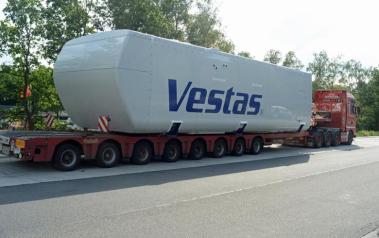
Vestas nacelle. Author: free photos. License: CC BY 2.0
¶ According to Railway Technology, all Netherlands Railways trains will be powered 100 percent by wind by 2018. A deal struck between the railway and power suppliers will result in carbon-free transportation. Electricity will come from wind farms not only in The Netherlands and Belgium, but also from the Scandinavian countries. [Discovery News]
¶ Windpark Kirchberg GmbH & Co KG has placed an order of eight V126-3.3 MW for a 26.4-MW wind park in Baden Wurttemberg. With over 90% share, local citizens will own a larger share of this wind park than any other in southern Germany. The turbines will be installed in the Hohenlohe region in northeast Baden Wurttemberg. [7thSpace Interactive]
¶ Already Canberra and the Australian Capital Territory Government are poised to be running on 90% renewable electricity by 2020. Now, they want to go the extra mile and achieve 100% renewable energy by 2025. And one French company has stepped up to help. Neoen has joined with the ACT Government in a $250 million wind farm venture. [Energy and Capital]
¶ Beginning their work in April 2014, a team at South Africa’s Stellenbosch University came up with a small heliostat system made of six triangular mirrors. They also devised wireless, smart positioning technology. The compact construction makes a “plonkable” concentrating solar system. It can be plonked down by two people. [Newser]
US:
¶ Americans support the Environmental Protection Agency’s Clean Power Plan by a margin of nearly two to one, a new poll from the League of Conservation Voters found. Despite the rhetoric from some Republican governors, 70% of Americans want their states to develop plans to meet the EPA’s guidelines under the Clean Power Plan. [ThinkProgress]
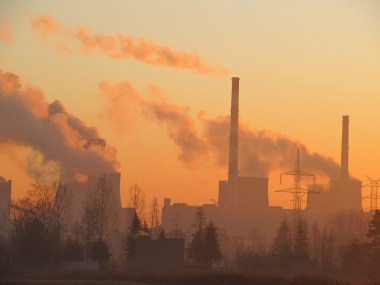
Credit: Shutterstock
¶ Chicago is now home to the Renewable Energy Training Field, a facility to train electricians and support electrical contractors in smart grid renewable energy applications. The facility was created by the National Electrical Contractors Association of Chicago and the International Brotherhood of Electrical Workers Local 134. [Plant Services]
¶ Critics of President Barack Obama’s landmark regulation to reduce carbon dioxide emissions almost always highlight a series of flawed studies (which are often paid for by utility or fossil fuel interests) to attack the Clean Power Plan. Many of these reports did not even look at the EPA’s final (and official) regulations, instead working on drafts. [Huffington Post]
¶ Since wind turbines have been found to kill golden eagles in some locations, a solution for the two coexisting needed to be found, setting researchers at University of Waterloo in Canada to work. Their study of potential wind-power sites and eagles’ nesting patterns suggests that there are numerous safe places with abundant wind power. [Nature World News]
¶ Blue Lake Rancheria, a Native American reservation in northern Californian, will have a microgrid powered by a 0.5-MW PVs array, a 950-kWh battery system, a biomass fuel cell system, and diesel generators. It is projected to be the largest solar array in Humboldt County, California and estimated to reduce 150 tons of carbon per year. [Fierce Energy]
Posted in nuclear power, renewable power, solar, wind | 1 Comment »
Tags: nuclear, nuclear power, photovoltaic, renewable power, solar power, wind power
August 27, 2015
World:
¶ The future of the UK’s popular feed-in tariff has been thrown into doubt, after the government this morning published a wide-ranging consultation on the program. The document proposes deep cuts to support for solar PV, wind and hydropower from January in a bid to cap government spending on feed-in tariffs at £75 million to £100 million. [Business Green]

Solar rooftops on residential buildings in the UK.
¶ A new Citigroup report values the fossil fuel reserves that need to be left in the ground if the world is to meet its targets of trying to limit global warming to 2° C at $100 trillion. But 2° C is a target that, according to a new Climate Council report, is actually a lot less “safe” for humankind than the science thought it was just 10 years ago. [CleanTechnica]
¶ Uzbekistan has taken its first major steps towards setting up large-scale solar power projects. The central Asian country has announced that work on three large-scale solar power projects has been initiated. The total installed capacity of these projects would be 300 MW, and will require an estimated investment of nearly $700 million. [CleanTechnica]
¶ The Canadian Medical Association will divest its holdings in fossil-fuel companies, a move doctors hope will send a powerful symbolic message that climate change is an urgent health concern. “Given the health impacts of fossil fuels, we have to take a stand,” one physician said in addressing the CMA’s general council meeting on Tuesday. [The Globe and Mail]
¶ Australia’s city of Newcastle may be the world’s biggest coal export port, but it will pull money out of fossil fuel industries, favoring sustainability. The city council, which manages a Aus$268 million (US$191 million) investment fund for the city, voted to move towards “environmentally and socially responsible investments”. [Peninsula On-line]
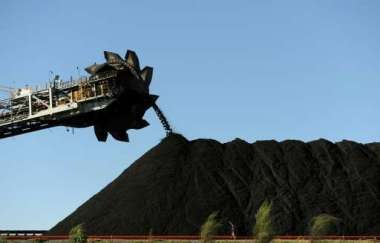
Coal storage.
¶ In the Philippines, the Energy Regulatory Commission approved a certificate of compliance for the 36-MW Nabas Phase-1 wind power project in Aklan province paving the way for feed-in-tariff eligibility. It will become the single biggest investment in Aklan province and the largest renewable energy project to date in Panay island. [Manila Standard Today]
¶ Vermont Law School senior fellow Mark Cooper called on South Australia’s Nuclear Fuel Cycle Royal Commission to reject nuclear power. His submission to the commission argues that the rapid development of renewable energy technology renders nuclear power a 20th-century “relic” that will be outdated before a new reactor could be built. [The Australian]
US:
¶ Hoosier Energy and Randolph Farms Landfill are forming a partnership that will turn landfill gas into a renewable energy resource for Randolph County, Indiana. Hoosier Energy will build the Cabin Creek renewable energy project, a 4-MW landfill gas facility, at the Randolph Farms Landfill in rural east-central Indiana. [REjournals.com]
¶ In Vermont, two long-delayed Windham County hydroelectric stations are well underway and may begin producing power by fall, producing about 3.1 MW, in combination. New Jersey-based Eagle Creek Renewable Energy LLC is building hydro projects at U.S. Army Corps of Engineers dams in Townshend and Jamaica. [vtdigger.org]
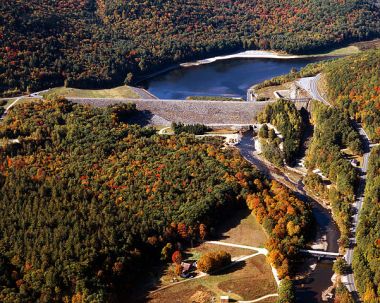
Townshend Lake and Dam. US Army Corps of Engineers photo.
¶ Nevada regulators decided to keep existing rates in place for rooftop solar customers for a few more months even though the state hit a cap on how much energy can be sold back to a utility. Rooftop solar advocates, who have decried the cap and argued that utility company NV Energy is trying to kill the industry, said they were grateful. [Mohave Valley News]
¶ The Imperial Irrigation District is preparing to build one of the largest battery storage systems in the western United States. The electricity storage unit will help the utility deal with fluctuating power. The battery could even help keep the grid operating during a big blackout. The 30-MW battery complex will use lithium-ion battery technology. [KPBS]
¶ The Rocky Mountain Institute released a report, The Economics of Demand Flexibility. It shows how simple, Internet-connected technologies can give consumers more choice and save money. It also shows how billions of dollars on grid investments can be saved, and how we can achieve a carbon-free grid faster. [Natural Resources Defense Council]
Posted in nuclear power, renewable power, solar, wind | Leave a Comment »
August 26, 2015
World:
¶ SolarReserve’s baseload solar 260 MW Copiapó project bids into the grid in April, having cleared Chile’s permitting with a Resolución de Calificación Ambiental. SolarReserve has combined two solar technologies, PVs and concentrated solar power with energy storage, so it can supply electricity both day and night. [CleanTechnica]
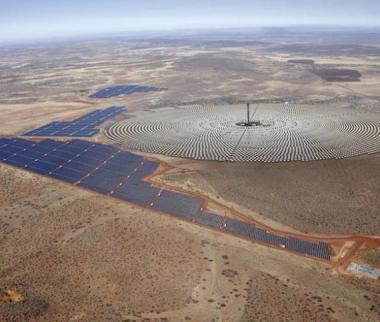
Credit: SolarReserve — Redstone
¶ Citigroup published a detailed analysis of the costs of various energy sources, concluding that the levelized cost of energy of renewables is below that of fossil fuels and that renewables are a “benefit rather than a cost to society.” And as cost of renewables is still declining, renewables advantages will only become clearer. [CleanTechnica]
¶ Ontario’s Electricity System Operator released the list of 119 projects that will compete for power contracts under the 565-MW Large Renewable Procurement program. About 1,400 MW of projects proposed by units of NextEra Energy, Renewable Energy Systems, and SunEdison have qualified for the program. [SeeNews Renewables]
¶ The world’s largest manufacturer of wind turbines, Vestas Wind Systems, announced record first-half orders, and profits exceeded analyst estimates. Other European wind turbine manufacturers are also riding a surge in orders on the back of government efforts to rein in carbon emissions and favourable policies for clean energy. [Business Spectator]
¶ The UK’s anaerobic digestion generation capacity now exceeds 500 MW, according to the Anaerobic Digestion and Bioresources Association. The trade body yesterday revealed 514 MW of electrical equivalent capacity is generated as electricity or biogas from more than 400 AD plants across the farming, waste, and water sectors. [Business Green]

Anaerobic digestion plant.
US:
¶ President Barack Obama has accused businesses profiting from fossil fuels of “standing in the way of the future” by actively trying to restrict customers’ access to solar, wind and renewable sources of energy. Speaking in Las Vegas, the president singled out billionaire brothers Charles and David Koch. [Telegraph.co.uk]
¶ A study conducted by researchers at Lawrence Berkeley National Laboratory and Stanford University, found that while the average frequency of power outages in the US has not changed in recent years, the amount of time customers are without power, i.e. the length of these power outages, has been increasing over time. [CleanTechnica]
¶ Over the last 40 years, California invested about $1 billion per year in energy efficiency initiatives, which saved its residents some $90 billion in utility costs, created “hundreds of thousands” of energy efficiency jobs, and avoided pollution of numerous power plants, according to the Natural Resources Defense Council. [CleanTechnica]
¶ North Dakota regulators are on board with Xcel Energy’s plan to take over, build and operate the 200-MW Courtenay wind project. The state Public Service Commission this week approved the transfer of a certificate of site compatibility after the initial developer, Geronimo Wind Energy, decided to exit the project. [reNews]
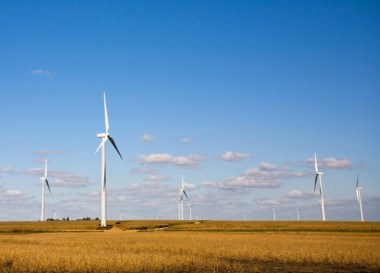
Xcel’s Grand Prairie wind farm (Xcel)
¶ San Diego Gas & Electric reached a record renewable power generation of 1,042 MW on August 19, thanks to a combination of bright sunshine and strong wind conditions. The output of 61,000 rooftop solar customers is not included in the figure. SDG&E is the first utility in California to deliver 33% renewable power over 12 months. [SeeNews Renewables]
¶ In Colorado, Boulder County is joining Adams and Denver counties to offer residents the opportunity to purchase discounted home solar systems and electric vehicles. The program offers homeowners discounts of about 15% on solar rooftop systems and roughly $8,300 off the cost of a Nissan Leaf. [Boulder Daily Camera]
¶ Regulators for Washington DC rejected the proposed purchase of Pepco Holdings by Exelon, potentially killing off the $6.84 billion deal. Exelon’s core business is from big centralized power plants, about 80% of which are nuclear, but those plants are losing business, and a merger is seen as a means to protect their profits. [OilPrice.com]
¶ A coal-burning power plant in New York’s Finger Lakes region sparked protests in Albany this week when opponents gathered in hopes of derailing a plan that would enable the plant to burn natural gas as well. The owners of the 60-year-old Cayuga Power Plant want customers to subsidize alterations over a 10-year period. [WAMC]
Posted in nuclear power, renewable power, solar, wind | Leave a Comment »
Tags: nuclear, nuclear power, photovoltaic, renewable power, solar power, wind power
August 25, 2015
World:
¶ A recent earthquake of magnitude 4.6 is the largest of over 500 seismic events in British Columbia believed to be caused by fracking. The quake’s epicentre was just 3 kilometres from Progress Energy’s fracking site. The company immediately shut down operations and notified the province’s oil and gas commission. [CleanTechnica]

Image of Wonowon, BC, earthquake site, from Google Maps Streetview
¶ Most carbon credits generated by Russia and Ukraine did not represent cuts in emissions, according to a new study. The authors say that offsets created under a UN scheme “significantly undermined” efforts to tackle climate change. In some projects, chemicals known to warm the climate were created and then destroyed to claim cash. [BBC]
¶ Australian utility Ergon Energy is launching a tender for 150 MW of renewable energy projects for its regional grid in Queensland, which up till now has been largely devoid of large-scale renewable projects despite strong solar resources. The firm will take on new solar, wind and hydro power opportunities. [PV-Tech]
¶ Germany’s shift to renewable energy sources will have a greater impact on operators of traditional power plants than originally thought, according to new data from the country’s grid supervisor. Fifty-seven traditional gas and coal power plants are set to close in Germany as a consequence of Energiewende, or energy transition. [Daily News Egypt]
US:
¶ President Barack Obama accused fossil fuel interests of trying to restrict consumer access to solar, wind and other renewable sources in order to protect the status quo. The president also questioned the ideology of those who champion free-market solutions, except when the free market is pointing to the wisdom of renewable energy. [Stockhouse]
¶ The Federal Housing Authority (FHA) is developing the guidelines under which it will accept Property Assessed Clean Energy (PACE) funding. The development means that PACE will soon be available to all US homeowners. Ed Golding, Head of the FHA, acknowledged the value of the program in a press release. [CleanTechnica]
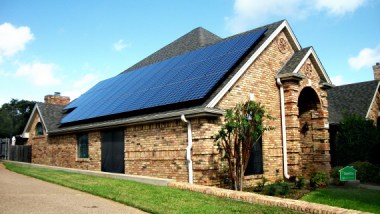
SolarCity in Arlington, TX – courtesy SEIA)
¶ The Asia Pacific Resilience Summit kicked off this morning, showcasing clean tech solutions for island grids, communities, and military applications across the Pacific. Hawaiian Governor David Ige’s opening keynote speech made headlines, as he stated for the first time publicly a strong opposition to proposed LNG projects. [CleanTechnica]
¶ Hawaiian Electric Co. is not backing down from its commitment to ship liquefied natural gas to Hawaii, following Gov. David Ige’s new stance made known on Monday that he is in opposition to LNG being imported to the state as a replacement for oil. They are looking at LNG for a transition from oil. [Pacific Business News (Honolulu)]
¶ Determining the potential energy your roof could generate with solar is an ever-increasing business. Following in the footsteps of Google’s new Project Sunroof, Mapdwell, an MIT cleantech spinoff, has revealed that New York City has the potential to install 4.7 GW worth of solar PV across over 1 million buildings. [CleanTechnica]
¶ The Idaho Public Utilities Commission gave the state’s three major electric utilities what they asked for in limiting the length of contracts for renewable energy from independent developers. Contracts were limited to 2 years, down from 20 years, nearly ensuring that no new contracts will be signed any time soon. [The Idaho Statesman]

Workers install a SunEdison/First Wind solar project in Massachusetts. The company is one of the developers that has a contract to sell power to Idaho Power. Provided by First Wind.
¶ The Indiana Utility Regulatory Commission has approved Duke Energy’s 20-year agreements with two solar developers to buy up to 20 MW of solar power for its customers in the US state. The developers, Cypress Creek Renewables and Inovateus Solar, will build and operate four projects, each producing up to 5 MW. [reNews]
¶ The town of Strafford, Vermont, has changed its tune on approving a 4.9-MW solar array at the Elizabeth Mine. In a letter sent to the Public Service Board, the Selectboard wrote they will not let Wolfe Energy and Brightfields Development install solar at the site if the array’s renewable energy credits are sold out of state. [Watchdog.org]
¶ US Secretary of the Interior Sally Jewell announced the Bureau of Land Management’s approval of the Blythe Mesa Solar project in California. The 485-MW photovoltaic facility will be constructed on 3,587 acres of previously disturbed private land and will generate enough electricity to power more than 145,000 households. [Energy Matters]
¶ Exelon Corp. announced Monday that three of its aging nuclear stations did not clear the regional power grid’s capacity auction on Friday, calling the plants’ long-term financial viability into question. The plants include Unit 1 at Three Mile Island, one of the units at Quad Cities, and Oyster Creek. [Philly.com]
Posted in nuclear power, renewable power, solar, wind | Leave a Comment »
Tags: nuclear, nuclear power, photovoltaic, renewable power, solar power, wind power
August 24, 2015
World:
¶ In Australia, rather inconveniently for the Coalition’s intentions to reduce its support for renewable energy, the Government’s commissioned modeller found the same answer as several other energy market analysts had before them: slashing the Renewable Energy Target would actually INCREASE consumers’ and businesses’ power bills. [Business Spectator]
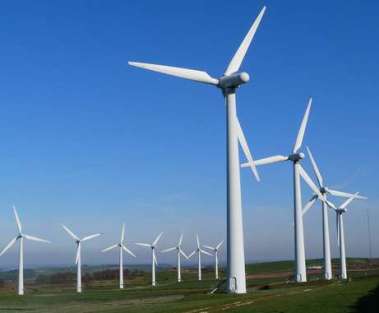
Wind turbines in Azerbaijan.
¶ Azerbaijan’s State Agency on Alternative and Renewable Energy Sources is conducting test trials on a new wind plant Yeni Yashma. Simultaneous testing of 18 of a total of 20 turbines of the power plant is underway. The wind plant Yeni Yashma, with a capacity to generate 50 MW, is located in Khizi region of Azerbaijan. [AzerNews]
¶ China’s use of coal is falling. After decades of explosive growth, Chinese coal use fell by as much as 3.5% last year. Some of that is due to a slowing economy, but a representative with the Sierra Club’s international climate and energy program says the government there has declared it is shifting away from coal. [Public News Service]
¶ PV systems installed on residential buildings in Oman could offer an estimated 1.4 GW of solar energy capacity, according to a report. Rooftop PV capacity in Muscat alone is estimated at 450 MW, equivalent to a mid-size conventional power plant, the Oman Observer report added, quoting a senior renewable energy engineer. [Trade Arabia]
¶ The Australian state of Victoria has released a Renewable Energy Roadmap for the state that sets a target of at least 20% of electricity generated from renewable sources by 2020. The roadmap commits the state government to using its purchasing power to support clean energy projects and distributed renewable energy generation. [The Fifth Estate]
¶ Vestas is to supply Glymont, a joint venture between Akuo Energy and Eurus Energy America, with 15 V117 3.3-MW turbines for a project in Uruguay. Delivery is expected to start in the first quarter of 2016, with commissioning expected for the third quarter of 2016. UTE, Uruguay’s state-owned grid operator, will buy the power. [reNews]
¶ Nordex is to supply Gul Ahmed Wind Power with 50 MW for the Gul Ahmed wind farm in Pakistan. The German manufacturer will provide 20 N100/2500 turbines to the company. The wind farm is situated in a semi-desert area in the south of Pakistan, near the city of Jhimpir, where temperatures climb as high as 44° C (111° F). [reNews]
¶ Hirohiko Izumida, governor of the prefecture that’s home to Tokyo Electric’s Kashiwazaki-Kariwa nuclear plant, said after meeting regulators that the time isn’t right to consider restarting the facility. While not enshrined in law, local government approval is traditionally sought by Japanese utilities before they turn on atomic plants. [Bloomberg]
¶ China Sunergy subsidiary CEEG (Nanjing) Renewable Energy is to supply China Power Investment Corp with 260 MW of photovoltaic modules for several ground-mounted solar projects in China. The units will be delivered to the state-owned energy group over a period of 12 months, starting from July of this year. [reNews]
US:
Wind turbine and crane.
¶ It’s not enough to say that fossil fuels have to go or nuclear is hopeless (which are both probably true statements). The question is: What will replace them? Furthermore, how long will it take? Though solar energy has become the poster child for renewable energy generally, the strongest player in the game, for now, is wind. [OilPrice.com]
¶ Nebraska is facing pressure to meet federal emission requirements, and renewable energy advocates will push again next year for a state tax credit for wind farms and solar projects. Supporters have spent the summer meeting with senators in hopes of passing the production tax credit, which was narrowly defeated this year. [The Republic]
¶ The Pilgrim Nuclear Power Station on Cape Cod Bay in Plymouth remained closed Sunday after going into an automatic shutdown Saturday afternoon, according to station and government officials. NRC officials reiterated Sunday afternoon that there were no safety concerns regarding the nuclear power station. [Boston Globe]
Posted in nuclear power, renewable power, solar, wind | 1 Comment »
Tags: nuclear, nuclear power, photovoltaic, renewable power, solar power, wind power

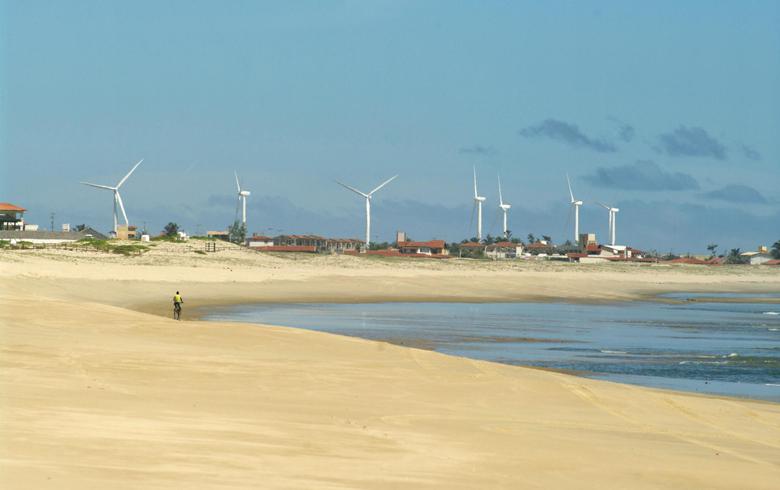
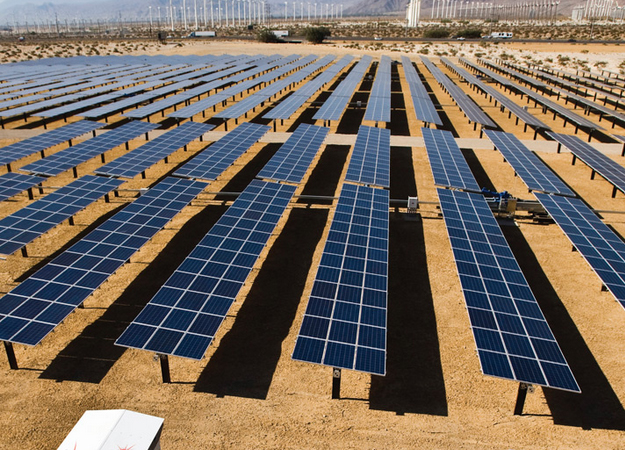
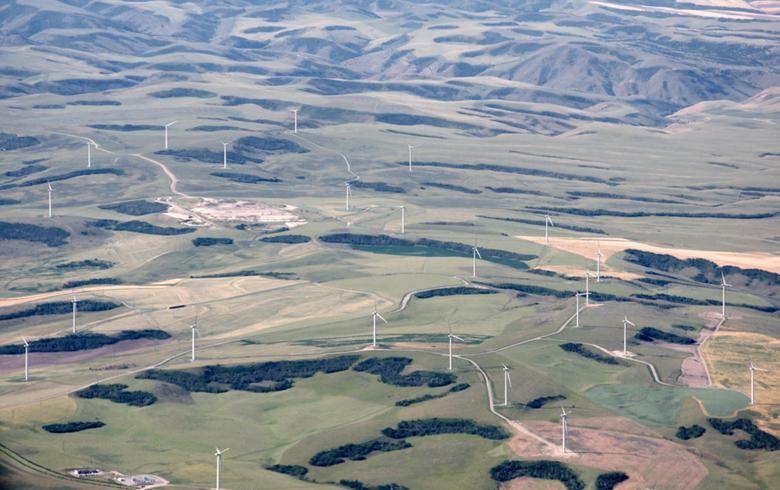
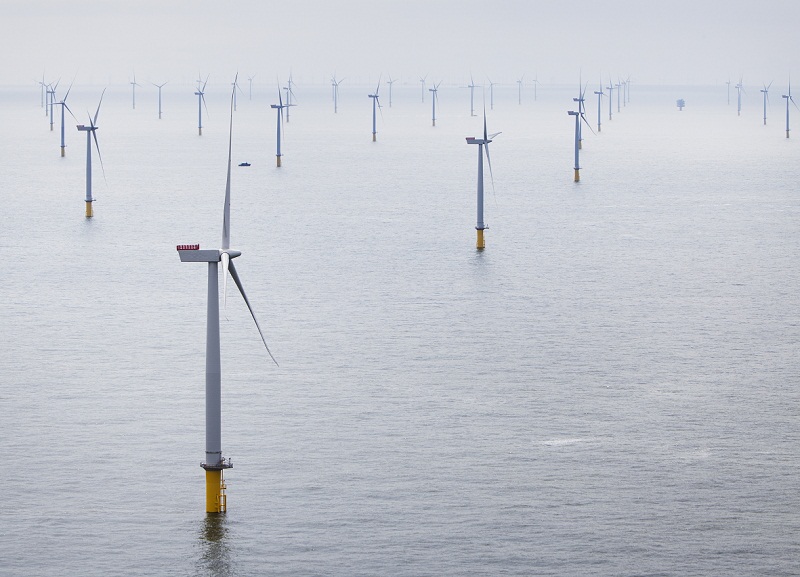

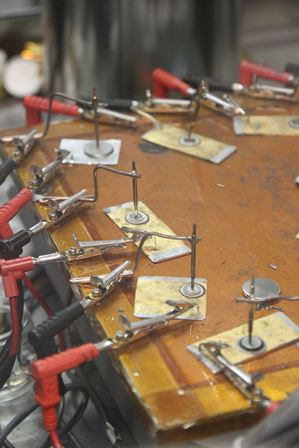
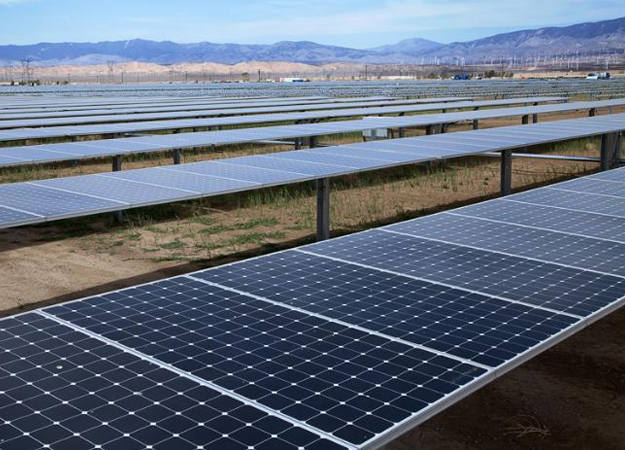

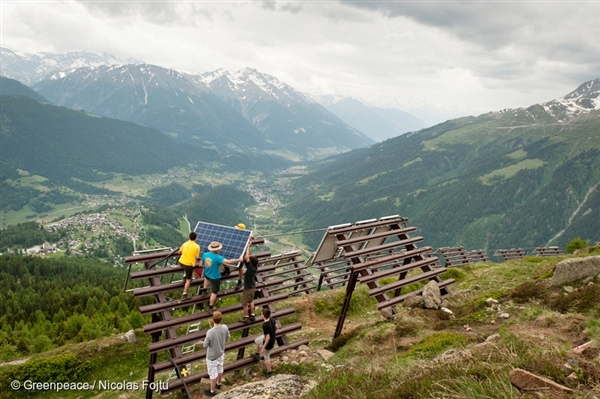

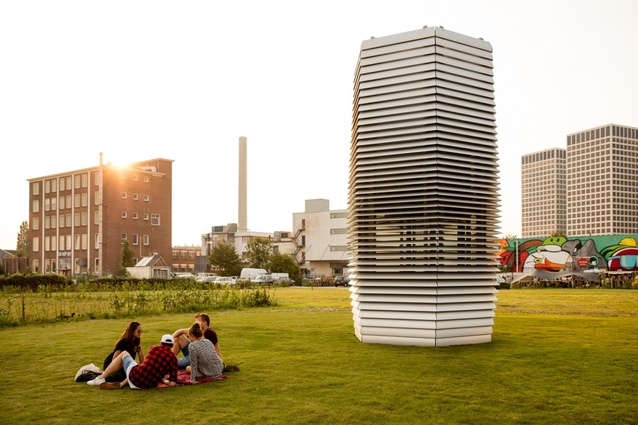
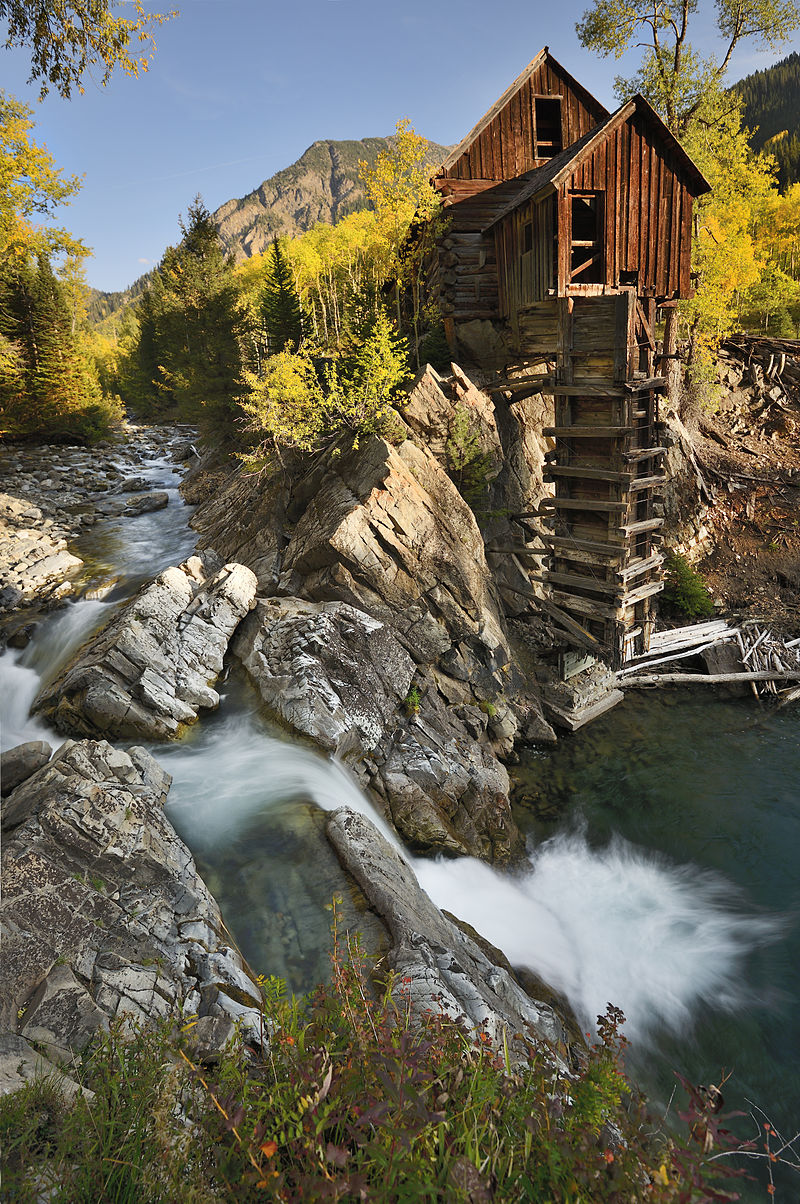



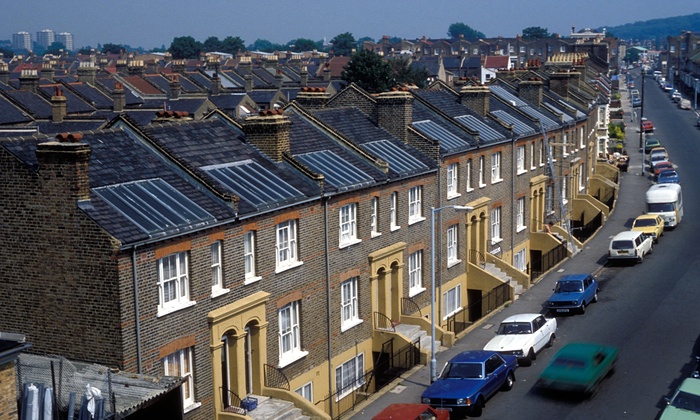

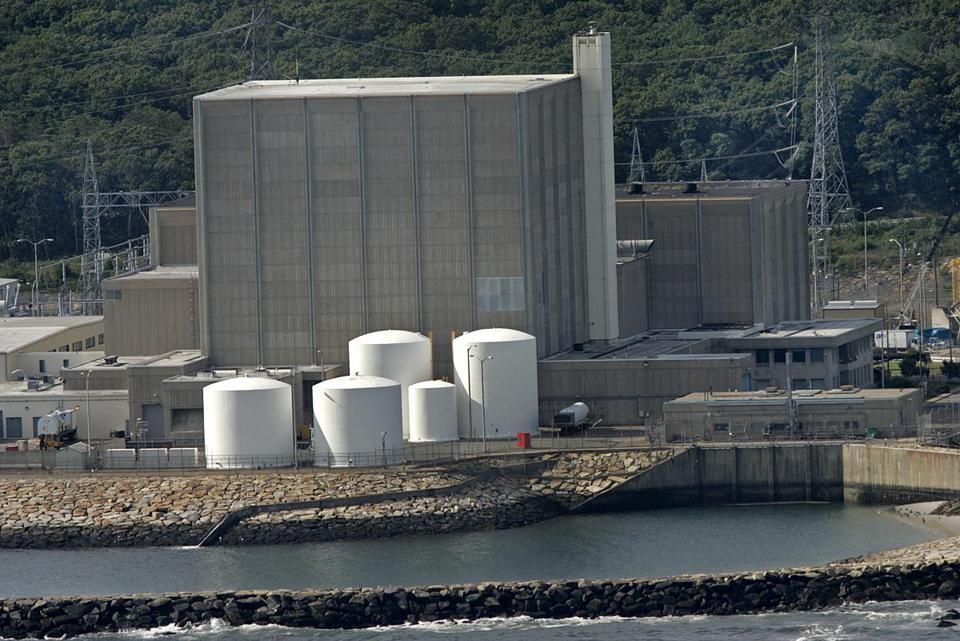
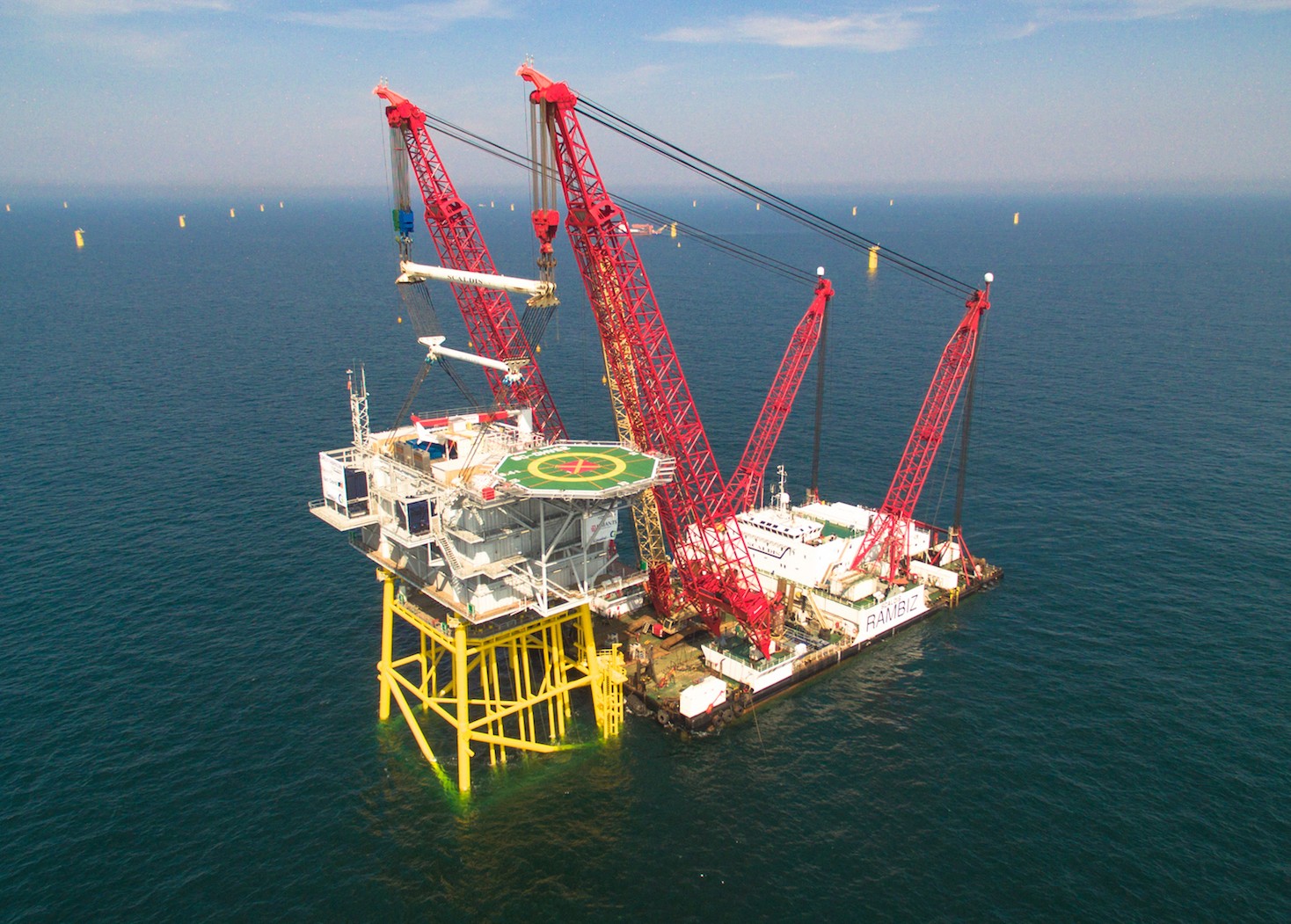
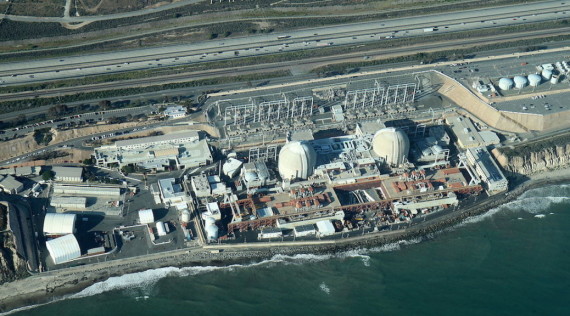
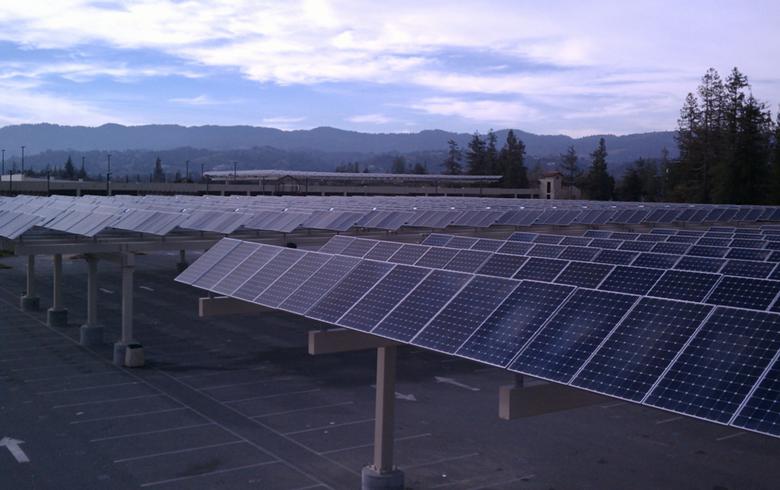

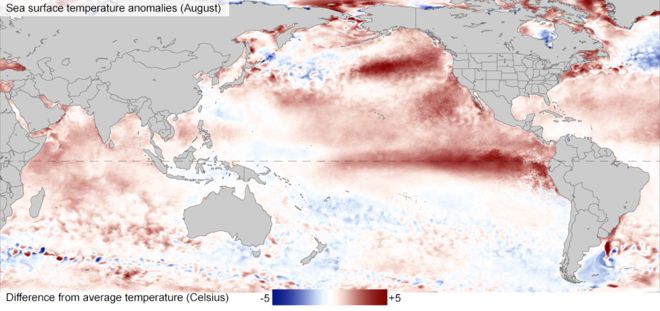
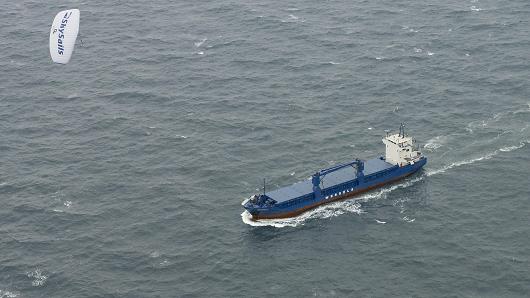
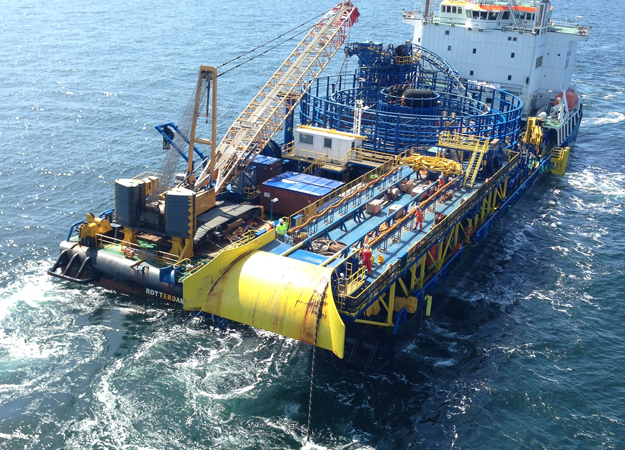
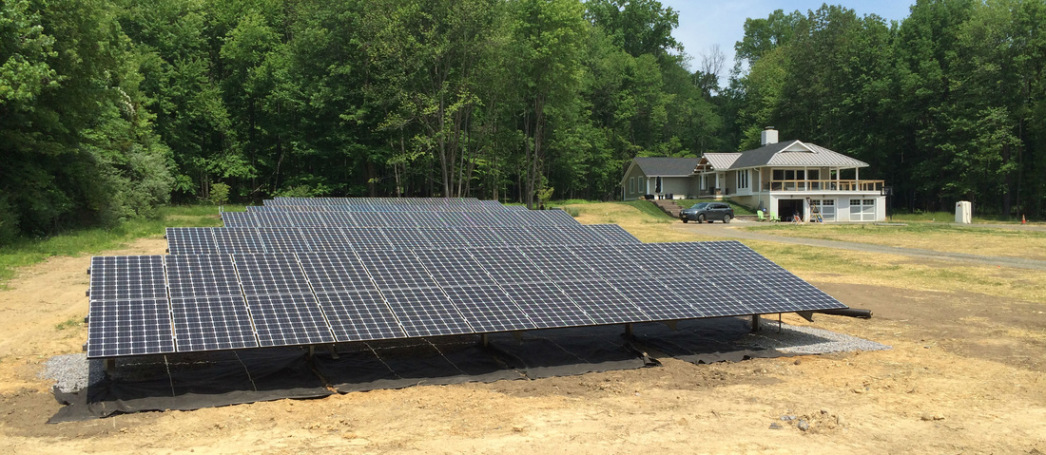




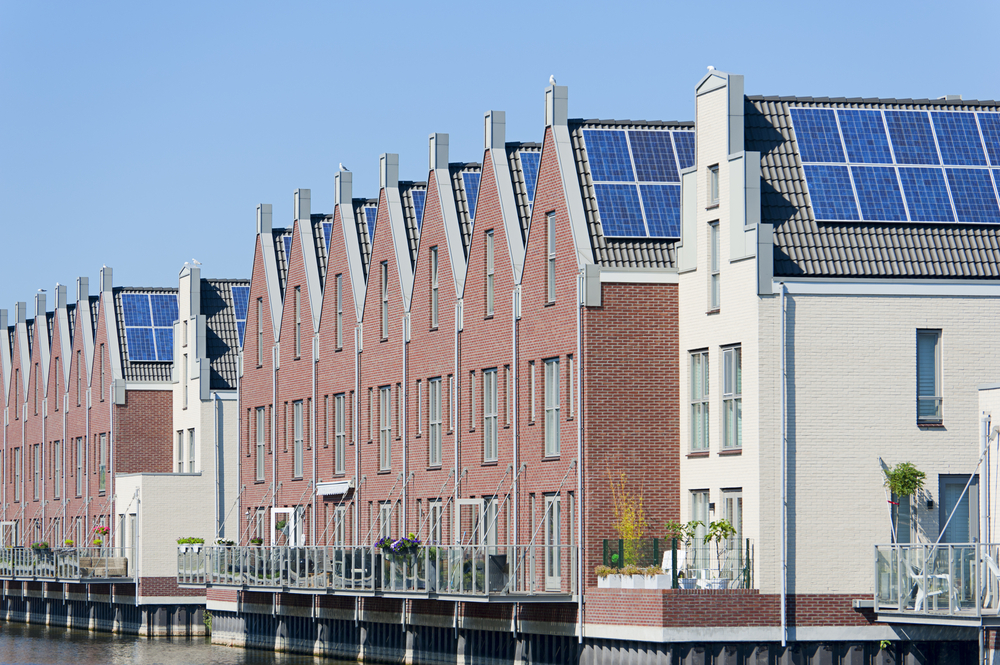

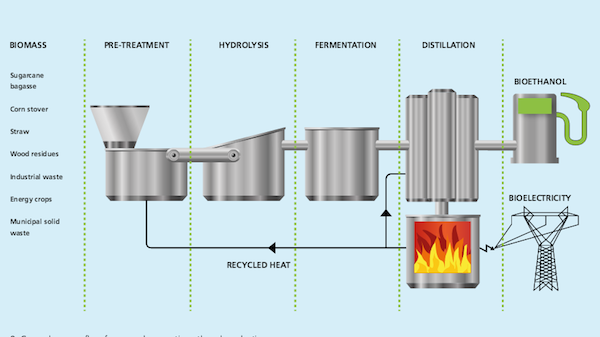


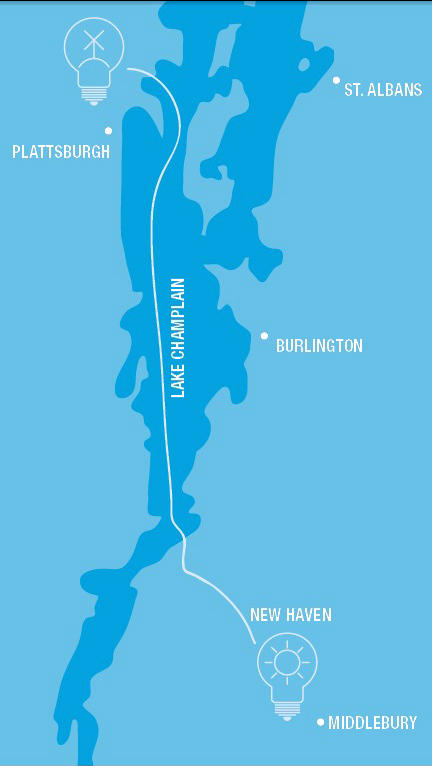
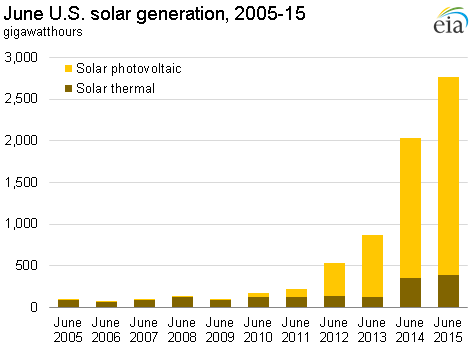
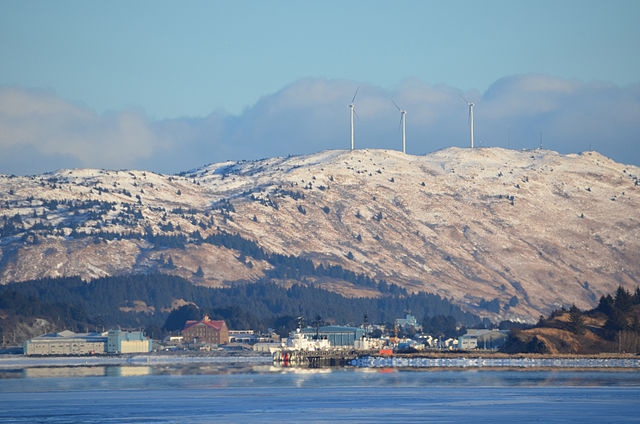
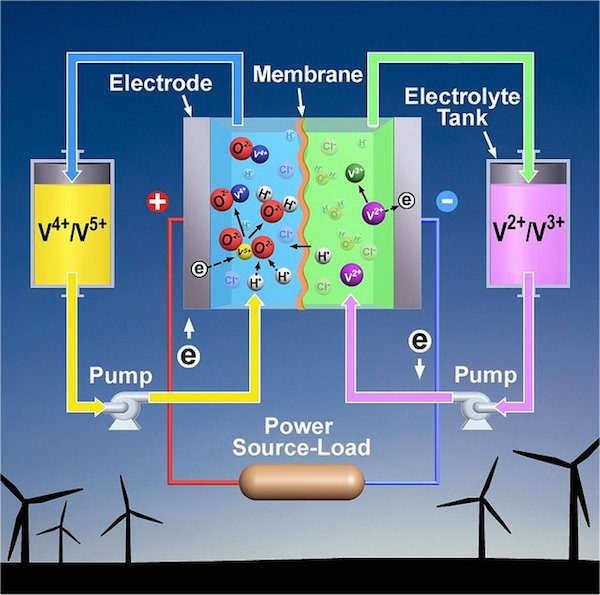
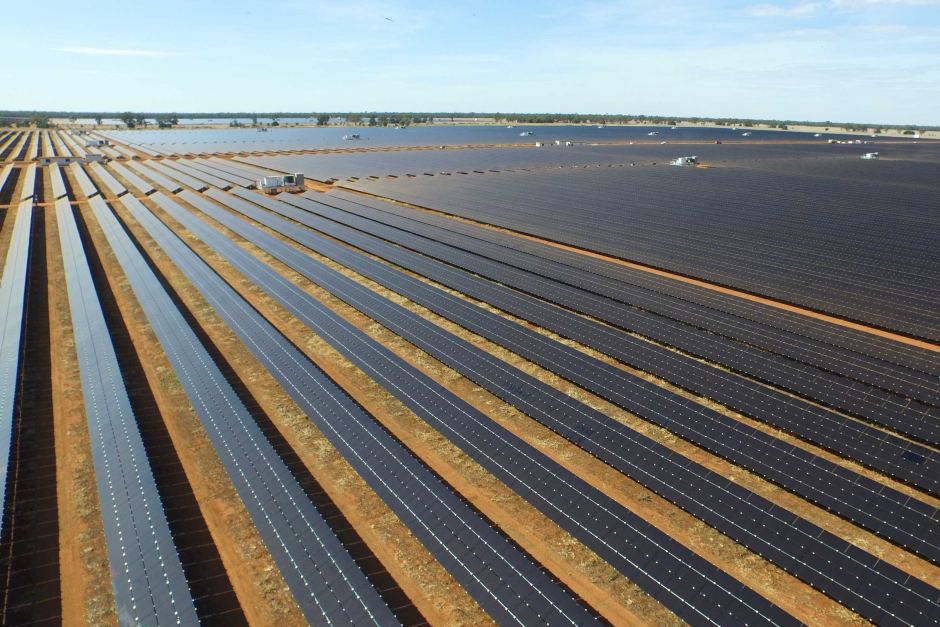
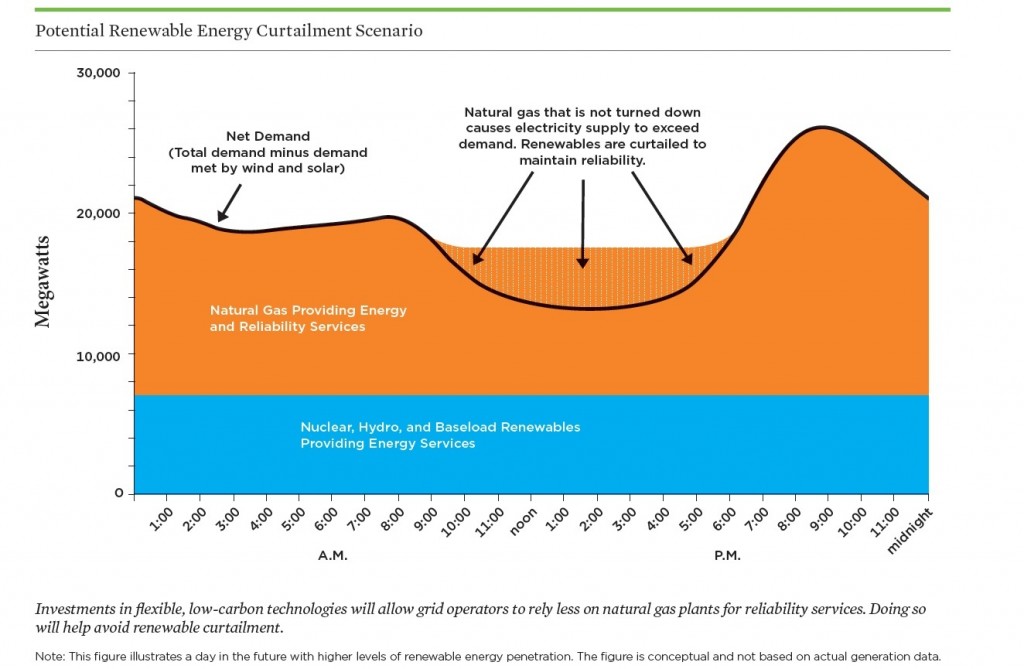
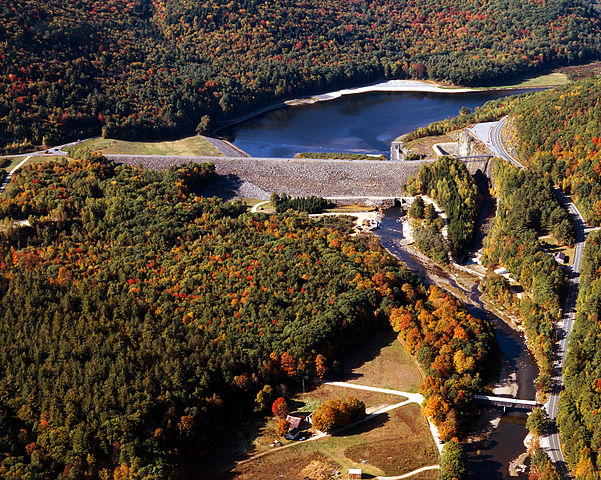
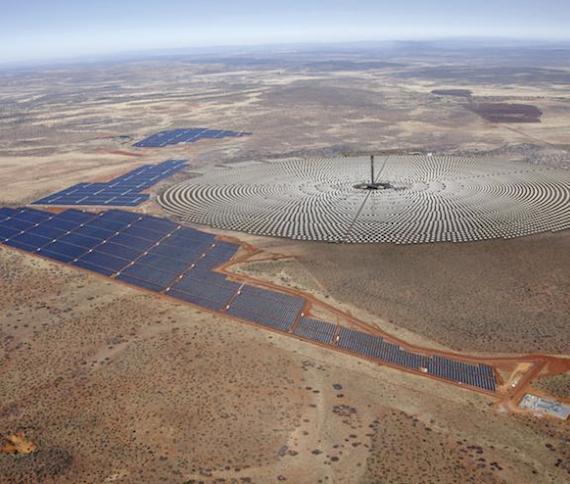
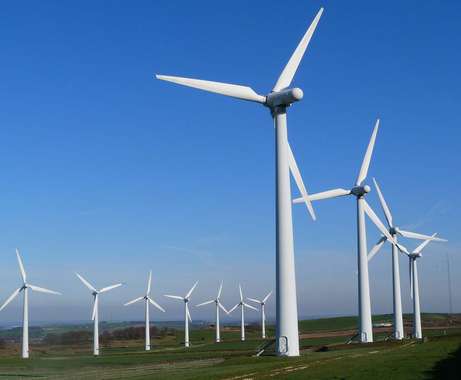
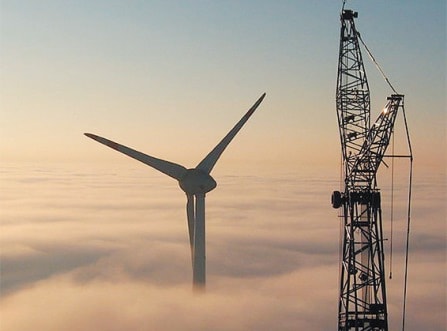

 geoharvey