Archive for the 'solar' Category
May 16, 2017
Opinion:
¶ “Resilience bonds: a secret weapon against catastrophe” • While the inflation-adjusted cost of natural disasters was about $30 billion annually in the 1980s, it’s now more than six times that: an average of $182 billion. Resilience bonds can improve on insurance by evaluating a community’s risks and giving guidance on reducing them. [BBC]

To prepare for catastrophe, not just help
clean up after it. (Credit: Alamy Stock Photo)
¶ “6 Reasons Trump Can’t (Totally) Derail Progress on Climate” If ever there was a symbolic moment when the past met the future, it arrived as the Kentucky Coal Mining Museum announced in April it is converting to solar. To save money. Here are six reasons to take why we will continue to move forward on climate change. [National Geographic]
¶ “US Lags Developing a Key Military Materiel” • James J Greenberger addressed a National Defense Industrial Association conference about the “exciting field of electro-chemical energy storage technologies.” Batteries are critical technology that all four services rely on to maintain their edge against adversaries. [National Defense Magazine]
World:
¶ UK supermarket chain Tesco has announced a commitment to using 100% renewable electricity by the year 2030. Tesco has been stepping up its sustainability efforts in recent years. Since 2007, more than £700 million ($905 billion) has been invested in energy and refrigeration efficiency, and Tesco’s electricity bill has fallen by £200 million annually. [CNBC]
¶ With oil markets flagging, the world’s two biggest oil exporters, Saudi Arabia and Russia, agreed to extend production cuts for several months, sending the price of crude soaring. Inventories had piled up and crimped the potential for demand. Prices had dipped below $44 a barrel this month, their lowest level in more than a year. [New York Times]

Saudi oil facility (Credit: Saudi Aramco, via Reuters)
¶ Global solar investment is to be higher than coal, gas and nuclear combined in 2017, according to a report from Frost & Sullivan. Global Power Industry Outlook, 2017 examines power market trends, installed capacity, investment, and regional growth across coal-fired, gas-fired, nuclear, hydro, solar PV, wind, and biomass. [Your Renewable News]
¶ Thanks to strong government support, India has moved up to the second spot in the “Renewable energy country attractiveness index” 2017, according to a report released by Ernst & Young. The report released globally stated that China and India have surpassed the US, which has fallen to third place on Trump administration policy. [Livemint]

Indian renewable energy (Photo: Abhijit Bhatlekar | Mint)
¶ Slowing coal use in China and India has put the world’s two most populous countries on track to beat their carbon emission goals under the Paris climate agreement, while the US falls short, according to a new analysis by issued by Climate Action Tracker, a consortium of three international research organizations. [InsideClimate News]
¶ Australia’s large-scale solar industry now appears to be on solid ground, with all of 12 large plants recently awarded grant funding by the Australian Renewable Energy Agency reaching “financial close” this month. Construction has already begun at nine of the 12 Arena-funded plants, and the others three are a done deal. [The Guardian]

Broken Hill solar farm (Photo: Josh Wall | Guardian Australia)
¶ Toshiba, which has made financial guarantees to help complete a troubled South Carolina nuclear power project, is reporting the equivalent of a $8.4 billion net loss for its fiscal year. Toshiba called the figures released Monday as projections rather than results, since they lack the company’s auditors’ approval. [Charleston Post Courier]
¶ Over 1400 oil and gas platforms in the North Sea might eventually be used to fight the problem they helped to create: unsustainable energy generation. Both fossil fuels and renewable companies are working on a system design that could make the platforms part of the energy revolution as hydrogen production and storage facilities. [CleanTechnica]

North sea oil platform (Image: Berardo62, some rights reserved)
US:
¶ A study finds there is still plenty of dirty air around western New York. The study carries a confrontational name: “Our Health at Risk: Why Are Millions of Americans Still Breathing Unhealthy Air?” It comes from the Environment New York Research & Policy Center and is based on the most recent data, from 2015. [WBFO]
¶ Consumers Energy is planning to set up a program to help Michigan businesses become 100% supplied by renewable electricity by investing in clean power projects. The utility has applied to the Michigan Public Service Commission to approve the plan. Businesses would help fund new renewable energy sources as part of the plan. [reNews]
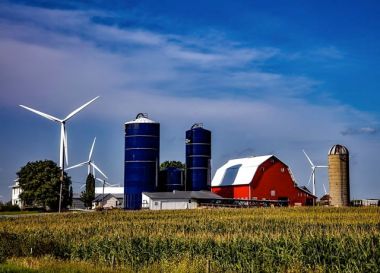
Wind power (Image: Pixabay)
¶ A tentative lease extension will keep the 43-year-old Navajo Generating Station open through the end of 2019, instead of beginning a shutdown as early as this summer, Navajo Nation President Russell Begaye said at a public hearing Monday in Phoenix. The plant is one of the American West’s biggest electric generators – and polluters. [NBCNews.com]
¶ Southern Company subsidiary Southern Power announced that the 102-MW Lamesa Solar Facility has reached commercial operation. The facility is located in Dawson County, Texas. With three large-scale PV projects operating in the state, Southern Power owns one of the largest utility-scale solar portfolios in Texas. [PV-Tech]
geoharvey is free and without ads.
 geoharvey is not tax-deductible.
Posted in nuclear power, renewable power, solar, wind | 1 Comment »
Tags: nuclear, nuclear power, renewable power, solar power, wind power
May 15, 2017
Opinion:
¶ “Florida Sea Level Rise & Unchecked Coastal Developments” • With climate change and sea level rise, coastal developments make no sense – and yet, day by day, month by month, large coastal luxury buildings shoot sky-high, with almost no sidewalk to spare on one side and sand that will soon be underwater on the other. [CleanTechnica]

St Petersburg (Image: Cynthia Shahan | Cleantechnica.com)
¶ “Are Solar and Wind Really Killing Coal, Nuclear, and Grid Reliability?” • Are wind and solar killing coal and nuclear? Yes, but not by themselves and not for the reasons most people think. Are wind and solar killing grid reliability? No, where the grid’s technology and regulations have been modernized, the grid’s operation has improved. [DeSmog]
Science and Technology:
¶ Final trials of printed PVs on sheets of plastic are underway at the University of Newcastle in New South Wales. Conventional printing technology is used to print electronic ink on clear plastic sheets. The finished product is very lightweight. Printed PVs are expected to be available commercially in about three years. [ABC Online]

Prof Paul Dastoor and printed PVs (ABC News | Kerrin Thomas)
¶ Nearly one-third of all trees in urban forests around the southwest shore of Lake Michigan are of species that are highly vulnerable to climate change, says a new study by the US Forest Service. The health and numbers of at least 85 species evaluated in the study are expected to decline over the next several decades. [Milwaukee Journal Sentinel]
¶ New research finds that global average temperatures may rise 1.5° C over pre-industrial temperatures by as early as 2026, if the Interdecadal Pacific Oscillation has in fact now moved into a positive phase, as is now suspected. The new research comes from the ARC Centre of Excellence for Climate System Science. [CleanTechnica]

Global warming – please click on the image to enlarge it
World:
¶ Toshiba has missed a Tokyo Stock Exchange deadline to file its annual results, but warned it was likely to report a loss of ¥950 billion ($8.4 billion; £6.5 billion). Problems, starting with an accounting scandal, came to a head again in January this year, when it became clear its US nuclear unit, Westinghouse, was in financial trouble. [BBC]
¶ Korean President Moon Jae-in ordered a temporary shutdown of outdated coal-fired plants, aged 30 years or over, as part of an emergency measure to combat fine dust. Under the plans, 10 out of 59 coal-fired plants will stop operating for a month in June. He has also pledged to close nuclear plants and increase renewable generation. [The Korea Herald]

Seoul’s polluted air (Yonhap)
¶ Vietnam’s north-central province of Thanh Hoa will build a new 30-MW solar energy plant, financed by domestic sources with total investment of ₫800 billion ($35 million). The solar plant is a joint venture of two companies, which will provide 30% of the financing. The remainder will come from commercial banks. [VnExpress International]
¶ The new energy strategy of the Grand Duchy of Luxembourg aims to increase the share of renewables in its energy mix from around 6% currently to 70% by 2050. About 4.8 GW of new renewable energy power generation capacity is expected to be installed in order to reach this target, and to reduce dependence from power imports. [pv magazine]

Luxembourg has 117 MW of solar power now. (Wolfgang Staudt)
¶ The South African government is still trying to come to terms with a court judgement that has stopped nuclear procurement in its tracks, and other technologies are being affected. No new date has been set for the signing of 37 outstanding power purchase agreements, as the procurement process suffers from the same defects. [Moneyweb.co.za]
¶ Western Australia network operator Horizon Power announced plans to take more remote regional customers off grid, offering stand-alone solar plus battery storage systems and back-up diesel generators as a cheaper and more reliable alternative to poles and wires. Five test systems installed last year were successful. [One Step Off The Grid]
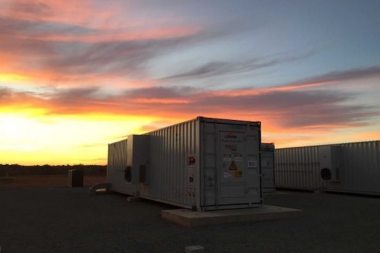
Battery storage (Horizon Power image)
US:
¶ President Trump has reportedly picked a conservative talk show radio host and climate change denier to be the “chief scientist” of the USDA’s research division. The 2008 Farm Bill says the position is to be filled by “distinguished scientists with specialized or significant experience in agricultural research, education, and economics.” [Mashable]
¶ PepsiCo confirmed that its new target for greenhouse gas emission reduction has been verified and approved by the Science Based Targets Initiative as in line with what is necessary to keep global warming below two degrees Celsius. The company will work to reduce GHG emissions across its value chain by at least 20% by 2030. [PotatoPro]

Farming emissions are included in the value chain. (PepsiCo)
¶ A key argument against a proposed Burrillville, Rhode Island, fossil-fuel power plant has derailed a similar natural-gas project in nearby Killingly, Connecticut. Opponents argue that the electricity generated would be redundant. Energy efficiency and renewable energy reduce electric demand, and they say the proposed facility is not needed. [ecoRI news]
¶ A state-of-the-art biodigester facility in Newaygo County, Michigan, is getting a second life from one of the nation’s leading clean energy investors, after closing abruptly two years ago. San Francisco-based Generate Capital has purchased the facility after the former owner, NOVI Energy failed to cover its upfront costs. [MiBiz]
geoharvey is free and without ads.
geoharvey is not tax-deductible.
Posted in nuclear power, renewable power, solar, wind | 1 Comment »
Tags: nuclear, nuclear power, renewable power, solar power, wind power
May 14, 2017
Opinion:
¶ “The UAE is well placed to take the lead in renewable energy storage” • For the UAE and other governments of the region, the emergence of an energy storage market opens up a new set of decisions about how best to generate and distribute low-cost, emissions free electricity while reserving oil and natural gas for export. [The National]
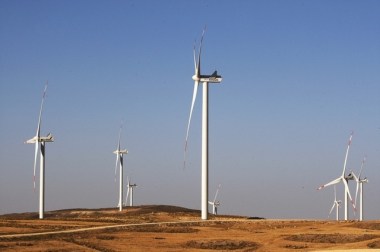
Tafila Wind farm in Jordan (Salah Malkawi | The National)
¶ “Whose Power Plans Are Greener: China or India?” • While China got off to an early lead in renewable energy sources, India is looking to catch up over the next ten years. So which country will be crowned the greenest? In the years ahead China looks set to lead on renewables, but India’s power sector will be greener overall. [The Wire]
¶ “Policy guidance needed for renewables” • The future energy system in Australia is built on an assumption of renewables in the electricity grids, but the pipeline of projects may not last beyond 2020. Uncertainty arises because the federal government does not have a Renewable Energy Target beyond that date. [The Australian Financial Review]
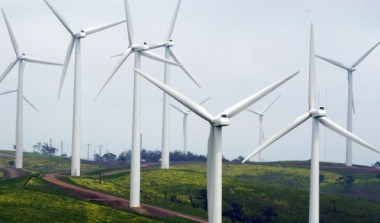
Costs for renewables have fallen in recent years. (Jo Buchanan)
World:
¶ Environment advocates said Philippine coal-fired projects under construction could cause 70,000 deaths per year by 2030. Residents of Ozamiz City protested the impending construction of a 300-MW coal-fired power plant, saying the it will also prevent people from enjoying clean and cheap energy from renewable resources. [Manila Bulletin]
¶ In 2016, Victoria’s United Energy had two distribution transformers blow. That was fewer than had been the case about a decade ago, when there had been difficulties predicting where load issues would occur. One expert puts the change down to 98% of residential and small business customers having smart meters. [The Australian Financial Review]

New technology can increase productivity. (Supplied)
¶ Nearly a century after importing equipment from Britain for setting up its first thermal power station at Husain Sagar in Andhra Pradesh, India launched the process to export “Ujala” – Hindi for light – to the United Kingdom with affordable “Made in India” LED bulbs. Ujala is one of the world’s largest efficiency programs. [ETEnergyworld.com]
¶ General Electric is planning to install hydroelectric plants that will generate additional 2 GW of electricity in Nigeria by 2030, in view of the nation’s growing power demands. This is part of 29-GW hydropower expansion projects to be executed by the American multinational corporation in four African countries in the next 13 years. [Naija247news]

African hydropower plant
¶ Chhattisgarh is working hard to make itself one of India’s leading states for distributing solar-powered irrigation pumps, officials said. Its government is aiming to install around 11,300 solar powered irrigation pumps in the first of three distribution phases, with the second and third each adding roughly 20,000 more. [Daily Pioneer]
¶ The Lucot Investment Committee, after a number of meetings with the Cameroon Government, will invest $500 million in a solar power project, partnering with Phoenix Green Capital Corp Ltd. Lucot has been investing in the ASEAN region for a number of years and sees opportunities for more investment in Africa. [Proshare Nigeria Limited]
¶ South Africa’s Energy Minister will try again to build nuclear reactors in the country, after a court ruled the government had failed to allow adequate public consultation for preliminary agreements. This will happen by signing new plans and submitting them to the parliament, rather than by appealing the court’s decision. [ETEnergyworld.com]
US:
¶ Last December, after years of legal wrangling, the Arizona Corporation Commission set a new solar policy phasing out net metering. Now, Tucson Electric Power Co proposed a rate structure for future customers with PVs that would cut credits for excess solar production and mandate time-of-use rates with new monthly charges. [Arizona Daily Star]

Tucson rooftop solar (Ron Medvescek | Arizona Daily Star)
¶ The North Bay pioneered a new type of public energy program in California seven years ago, and now it appears poised to change who buys electricity for homes and businesses across large swaths of the state. The growth is also prompting a face-off between the public programs and California’s three biggest private utilities. [Santa Rosa Press Democrat]
¶ Some New York residents and business owners said they would need to change how they live or operate to compensate for electric and gas delivery rate increases proposed by National Grid. The company would increase gas and electric bills from 7% to 14.9% for upstate customers, partly to pay for nuclear power subsidies. [WatertownDailyTimes.com]
geoharvey is free and without ads.
geoharvey is not tax-deductible.
Posted in nuclear power, renewable power, solar, wind | 1 Comment »
Tags: nuclear, nuclear power, renewable power, solar power, wind power
May 13, 2017
Opinion:
¶ “The Casual Gardener: Adapt your garden for a changing climate” • According to the RHS’s “Gardening in a Changing Climate” report, the lush, green, “quintessentially British” lawn could become a thing of the past. It also warns that pests and diseases not yet established in some areas could become commonplace. [the Irish News]

Needing to adapt to climate change
Science and Technology:
¶ When it comes to making predictions, Stanford economist Tony Seba has a pretty good track record. His latest report predicts two things. First, he says that by 2030, 95% of people won’t own a private car, killing off the auto industry. Second, he predicts electric vehicles will devastate the global oil industry by the same date. [CleanTechnica]
¶ An Australian company, Wave Swell Energy, is developing a new renewable energy system that harvests wave energy. The system, called an “artificial blow-hole,” consists of a giant hollow chamber that sits partially submerged on the seabed, funneling waves in and out of an underwater opening and generating electricity via a turbine. [Daily Mail]

Prototype artificial blow-hole in use
World:
¶ Indian solar power tariffs dropped to a new low of ₹2.44 per unit (3.8¢/kWh) in an auction for the 500-MW Bhadla solar power park in Rajasthan. ACME Solar Holdings won the bid at ₹2.44 per unit for 200 MW, and SoftBank Energy, quoting ₹2.45 per unit, won the remaining 300 MW. Two days ago, the lowest bid was at ₹2.62 per unit. [Scroll.in]
¶ Australia installed another 71 MW of small scale (under 100 kW) rooftop solar in April, extending its record start to the year as households and business respond to high electricity prices and falling costs for solar modules and batteries. According to Sunwiz, installations from the first four months have totaled 301 MW. [CleanTechnica]

Australian solar installations by month
¶ China will suspend approvals for new coal-fired power plants in 29 provinces to reduce overcapacity, the official China Securities Journal reported. The National Energy Administration put as many as 25 provinces on “red alert”, meaning that new projects would create severe overcapacity or environmental risks. [Hellenic Shipping News Worldwide]
¶ Scotland’s Atlantis Resources Ltd signed a strategic partnership agreement with Hyundai Engineering & Construction Co, Ltd, to collaborate on global development of marine energy projects. The move continues Atlantis’ push into Asia. It had announced signing a deal to supply equipment for a 150-MW project in Indonesia in March. [HydroWorld]

Atlantis tidal turbine
US:
¶ Portland General Electric has suspended efforts to permit two new natural gas plants at a site in Boardman, Oregon, about 150 miles east of Portland, saying it is in negotiations to potentially acquire existing resources instead. Environmental groups objected to a plan to replace a coal-fired plant set to close in 2020 with the two plants. [OregonLive.com]
¶ The Palm Beach Post reported that a bill to implement the constitutional amendment designed to expand the use of solar and other renewable energy is ready to go to Governor Rick Scott. The bill, now off to a governor who is ecologically deaf, blind, and unaware, was passed unanimously by both of the Florida legislative chambers. [CleanTechnica]
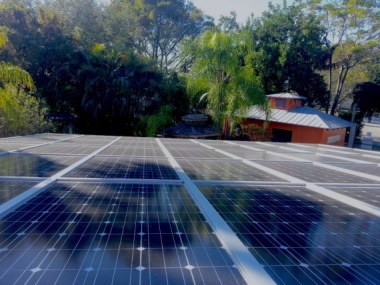
Rooftop solar in Florida
¶ Missouri General Assembly adjourned without passing House Bill 340, a tax on solar energy users that would have devastated one of the state’s fastest growing industries. HB 340 passed the Missouri House on April 3 but was not taken up in the Senate after thousands of Missourians signed petitions opposing the measure. [The Missouri Times]
¶ Tesla has begun accepting deposits for its new solar roof system, offering an “infinity” warranty for tiles that integrate solar power into roof coverings. The sales have begun and are open to consumers worldwide through the Tesla solar roof website. Installations will begin next month in the US, starting with California. [Renewable Energy Magazine]

Tesla solar roof
¶ Southern Co has agreed to take the lead on building two nuclear reactors at its Vogtle power plant in Georgia from the bankrupt Westinghouse Electric Co as soon as next month. Westinghouse’s bankruptcy threw into question the fate of four US nuclear reactors, two at Southern’s Vogtle plant and two more in South Carolina. [Bloomberg]
¶ In 2016, nuclear power accounted for about 20% of US power generation, but that share is expected to fall to just 11% in 2050, according to the US Energy Information Administration’s 2017 Annual Energy Outlook. It says 25% of the nation’s nuclear capacity that is not yet announced to be retired is likely to be taken offline by 2050. [POWER magazine]
geoharvey is free and without ads.
geoharvey is not tax-deductible.
Posted in nuclear power, renewable power, solar, wind | 1 Comment »
Tags: nuclear, nuclear power, renewable power, solar power, wind power
May 12, 2017
Opinion:
¶ “Think windfarms are ugly? It’s not only a matter of perception, but policy too” • The Australian landscape is changed by words on paper. The renewable energy target as a mechanism for building zero-carbon technologies has worked brilliantly. It incentivizes mainly windfarms, as they’re the cheapest, most readily deployable technology. [The Guardian]

Capital windfarm (Photo: Bloomberg via Getty Images)
¶ “Coal And Nuke Investors Think Trump Just Saved Their Bacon. They’re Naïve.” • Once again, the Trump administration is being hailed by investors in coal and nuclear power. But a skeptical message may be more appropriate. If you’re an energy investor, be afraid. You may be picking up pennies in front of Trump’s regulatory steamroller. [Forbes]
¶ “Important Year For Microgrids In Remote Countries” • This year could be big for microgrid developments in remote and non-electrified regions and countries. Storage companies and technology behemoths are leading the way on installing and investing in storage microgrids and solar for regional and island countries and communities. [CleanTechnica]

New island microgrid projects, Q4 2016 and Q1 2017
World:
¶ The renewable energy sector in the UK has experienced its best ever quarter with wind, solar, biomass and hydro all registering record levels of energy generation. According to the latest Electric Insights report, which covered January to March, output from coal generation fell by 30% compared to the same quarter in 2016. [Climate Action Programme]
¶ BayWa’s earnings before interest and tax from renewable energy jumped 77.5% in the first three months of 2017 to €21.3 million ($23.16 million), compared with €12.0 million in the period last year. Revenue from clean power also soared to €251.8 million, up 57% on the €160.4 million posted in the first quarter of 2016. [reNews]
¶ The Indonesian government appears to be backtracking on its aggressive 35,000-MW, coal-centric energy development plan. The ambitious 35,000 MW of new electricity generation projects were to be completed by 2019, according to a plan announced by President Joko Widodo in 2014. However, only 15,000 MW will be required by then. [Mongabay.com]
¶ Wärtsilä has launched hybrid and standalone energy storage systems, targeting areas where it sees “high market potential”, including remote microgrids and solar PV integration. The Finnish company, known as a supplier of engines to the maritime industry, will also make standalone energy storage solutions available. [Energy Storage News]

Please click on the image to enlarge it.
US:
¶ President Donald Trump’s efforts to dilute US climate policies put Tillerson in an awkward position at a meeting of Arctic nations in Fairbanks. Tillerson signed an agreement recognizing the Paris climate accord, but he said Trump was not rushing to decide whether to leave or weaken US commitments to the pact. [Financial Express]
¶ Each year the US intelligence community puts together a “Worldwide Threat Assessment” report. This year’s report makes for particularly disquieting reading. While it focuses on the increasing danger that North Korea’s nuclear weapons program poses as well as cyberterrorism threats, one environmental concern stands out: climate change. [Yahoo News]
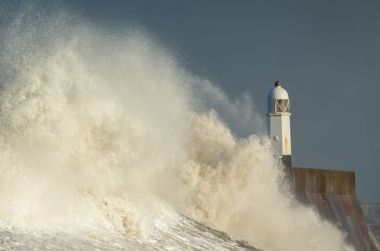
Wave
¶ The Dakota Access pipeline has already spilled crude oil into the environment and it is not even in operation yet. On April 6, 84 gallons of the liquid crud was dumped into a containment pit in South Dakota. That may be small, but it drives home an essential truth. Of the systems mankind has devised to transport oil, all leak. [CleanTechnica]
¶ Maryland regulators approved plans for the nation’s first large-scale offshore wind projects. The Maryland Public Service Commission awarded renewable energy credits for two projects off Maryland’s Eastern Shore near Ocean City. The PSC says the decision allows US Wind and Skipjack Offshore Energy to build 368 MW of capacity. [PennEnergy]

Offshore Wind in Denmark
¶ Two years after NextEra Energy Resources and Entergy Arkansas received approval for an 81-MW solar project in Stuttgart, Arkansas, the companies have finally broken ground on the project. The Stuttgart Solar Energy Center is not expected to be finished until January 2018. They say time moves slower in the South. [pv magazine USA]
¶ A committee of Maine legislators today voted unanimously against a bill that would have blocked the 12-MW Aqua Ventus floating offshore wind demo. The decision by the Energy, Utilities and Technology Committee effectively kills the bill. Republican senator Dana Dow proposed the law to protect local scenic beauty and tourism. [reNews]

Aqua Ventus prototype (UMaine)
¶ Akamai Technologies, one of the largest Cloud-delivery platforms, invested in a wind farm as part of its commitment to source renewable energy for 50% of its global network operations by 2020. Akamai intends to source enough energy from the 80-MW Seymour Hills Wind Farm to offset its Texas data center operations. [Windpower Engineering]
¶ In a sometimes testy hearing that opened the latest biannual review of project costs by the Georgia Public Service Commission, Georgia Power executives said they’re considering all options for the fate of a planned nuclear plant. The project’s completion date and cost are in flux as its main contractor has filed for bankruptcy. [Thegardenisland.com]
geoharvey is free and without ads.
geoharvey is not tax-deductible.
Posted in nuclear power, renewable power, solar, wind | 1 Comment »
Tags: nuclear, nuclear power, renewable power, solar power, wind power
May 11, 2017
Opinion:
¶ “Indian solar power prices hit record low, undercutting fossil fuels” • Wholesale solar power prices have reached a record low in India. They now undercut prices of fossil fuel-generated power, increasing the likelihood that India will exceed the renewable energy targets it set at the Paris climate accords in December 2015. [The Guardian]

Market in New Delhi selling PVs (Photo: Saurabh Das | AP)
¶ “While Trump Tries to Bring Back Zombie Coal, the UK Goes Coal-Free” • When President Trump told supporters at his 100th day rally in Pennsylvania, “We are putting our coal miners back to work,” he just burrowed deeper into the bed of administration lies on energy. But the truth is, the demand for US coal has collapsed. [Foreign Policy In Focus]
Science and Technology:
¶ SolarGaps motorized blinds, from a Ukrainian startup, is one of those ideas that seems so obvious after you hear about it, because while even ‘dumb’ window blinds can save a significant amount of energy by reducing the cooling load of a room, adding solar cells and a tracking mechanism to them makes a good thing better. [Treehugger]

SolarGaps smart solar blind (© SolarGaps)
World:
¶ The Oman Investment Fund and the Ningxia Zhongke Jiaye New Energy and Technology Management Co have signed an agreement to develop a 1,000-MW solar power plant in Oman. The first development phase will see the installation of 400 MW of capacity, with the full 1,000 MW to be installed during the second phase. [Climate Action Programme]
¶ South Africa’s energy regulator has agreed to investigate power utility Eskom’s refusal to sign power purchase agreements worth billions of rands with independent power producers. The chief executive of the South African Wind Energy Association said in a statement that it had received confirmation of the investigation from NERSA. [Nasdaq]
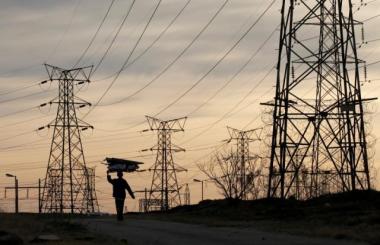
Eskom transmission lines
¶ Plans for a floating power plant that will harness solar energy in Cayman’s coastal waters are moving forward following the completion of an environmental impact study. Public meetings are expected for the summer, as the company seeks approval for the pioneering project ahead of a 36-month construction process. [Cayman Compass]
¶ A solar and battery storage mini-grid trial by Victorian network operator AusNet Services has succeeded in taking part of a Melbourne suburb completely off grid, demonstrating how utilities can use solar, battery storage and the internet of things to boost energy security and reliability in the future. Eight homes were in the trial. [RenewEconomy]

Eight homes went off the grid.
¶ TEPCO announced it will seek partners for its nuclear business as part of a recovery plan after the Fukushima disaster brought the utility to its knees. The company is trying to place itself on a sounder financial footing after the government estimated that costs related to the Fukushima disaster would be ¥21.5 trillion ($188 billion). [Reuters]
¶ India’s largest power generation company, NTPC Ltd, invited bids for battery energy storage system for an 8-MW solar project at Chidiyatapu in Andaman and Nicobar islands. NTPC has planned capacity addition of about 1,000 MW of renewable resources by 2017 and has already commissioned 310 MW solar PV projects. [ETEnergyworld.com]
US:
¶ President Donald Trump can’t seem to make up his mind about to keep the US in the Paris Climate Agreement or pull out, but there are signs he is getting advice from across the ideological spectrum. A source close to Gore said the president and the Nobel Prize-winning climate activist spoke by phone about the Paris accord. [Yahoo News]
¶ The town of Hanover, New Hampshire voted to establish a goal of transitioning to 100% clean and renewable energy by 2050. The article approved at town meeting sets a community-wide goal of 100% renewable electricity by 2030 and a 2050 goal of transitioning heating and transportation to clean sources of energy. [EcoWatch]

Dartmouth College, in Hanover, New Hampshire
¶ The 37 glaciers remaining at Glacier National Park are vanishing. In the past half century, some of the ice formations in Montana have lost 85% of their size, and the average shrinkage is 39%, a study released by the US Geological Survey and Portland State University says. One scientist said, “The glaciers will be gone in decades.” [CNN]
¶ Republicans’ bid to roll back an Obama-era rule limiting methane emissions from drilling rigs on public lands narrowly lost in the Senate after three GOP senators voted against the repeal in a 49-51 vote. The rule limited the amount of methane that can be vented and burned from oil and gas extraction sites on federal lands. [Huffington Post]

Gas being flared (Andrew Burton | Getty Images)
¶ Furman University’s $1.7 million solar facility is online and supplying the campus with electrical power. According to Furman, the facility is the largest of its kind on a college campus in South Carolina. It has 2,994 solar panels across six acres of land along Poinsett Highway near the campus. Excess power can be sold to Duke Energy. [GSA Business]
¶ The Tennessee Valley Authority, in partnership with the Tennessee Valley Public Power Association, has awarded 10 MW of solar capacity to seven local power companies that applied through TVA’s Distributed Solar Solutions pilot program. The projects will generate enough solar energy to power more than 900 average homes. [Solar Industry]
geoharvey is free and without ads.
geoharvey is not tax-deductible.
Posted in nuclear power, renewable power, solar, wind | 1 Comment »
Tags: nuclear, nuclear power, renewable power, solar power, wind power
May 10, 2017
Opinion:
¶ “Buffett Thinks That If You Are Tied to Coal, You Are Screwed” In a nutshell, that’s how the oracle of Omaha perceives the direction that coal is taking. Buffett’s approach is the opposite of that of the Trump administration, which favors reviving US coal industry. He sees a possibility of no coal being burned at all in 20 years. [Wall Street Pit]

Coal smoke
¶ “Australia’s Renewable Energy Target Is Within Grasping Distance” • According to the Clean Energy Regulator, Australia’s 2020 Renewable Energy Target, sourcing 33,000 GWh of large-scale renewable energy by 2020, is potentially within grasping distance if the current pace of investment continues through the rest of 2017. [CleanTechnica]
Science and Technology:
¶ The pace of global warming is likely to quicken as natural processes in the Pacific switch from serving as a brake to an accelerator, placing the planet on course to exceed a landmark level within a decade, a paper says. The Interdecadal Pacific Oscillation, a cycle that lasts 10-30 years, is switching to its “warm” phase. [The Sydney Morning Herald]

Global warming may speed up. (Photo: Leigh Henningham)
¶ A research project, led by the VTT Technical Research Center of Finland, has developed a concept for increasing solar energy production and reducing fuel consumption at traditional power plants by over 33%. It creates a hybrid plant that combines concentrated solar power technology with that of a traditional power plant. [Renewable Energy Magazine]
World:
¶ Navigant Research published its latest Distributed Solar PV Plus Energy Storage Systems report this week. It says the global annual market for the deployment of distributed solar PV plus energy storage is expected to exceed $49 billion and reach 27.4 GW by 2026. The largest growth is expected to be in the Asia Pacific region. [CleanTechnica]

Distributed and remote off-grid solar plus storage growth
¶ Customers visiting thousands of hotels and coffee shops across the UK can now be assured that they are using 100% renewable power. Hospitality giant Whitbread confirmed that all of its UK operations are now sourcing electricity from renewable energy projects. The company owns Costa Coffee, Premier Inn, and Beefeater Grill. [businessgreen.com]
¶ A record €18.2 billion was invested in new offshore wind farms in Europe last year, out of total wind farm investments of €43 billion, according to data released by WindEurope. The report from Wind Europe, Financing and Investment Trends 2016, showed wind farm investments were up 22% in 2016 from €35 billion in 2015. [reNews]
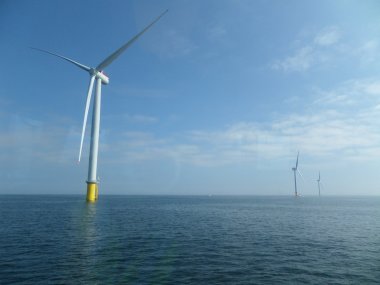
Offshore wind farm (DONG image)
¶ Solar power tariff dropped to a record low of ₹2.62 per unit (4.05¢/kWh) in an auction for Bhadla solar park in Rajasthan. This price is lower than the average rate of power generated by the coal-fuelled power generation utility, NTPC Ltd, at ₹3.20 per unit. The price is considered a major milestone toward powering India. [Deccan Herald]
¶ In Alberta, the County of Grande Prairie and other local municipalities are looking into developing geothermal power. Proponents say makes it economic sense, as a carbon tax makes traditional power more costly. A study identified enough sources to power all of the county’s domestic and commercial needs. [Alberta Daily Herald Tribune]

Steam rising from a geothermal station in Iceland (Wikipedia)
¶ The South African government may appeal a recent High Court judgement that declared a nuclear deal with a Russian company as invalid. South Africa and Russia signed an Intergovernmental Agreement in 2014 for cooperation between Rosatom and Eskom, aiming to build 9,600 MW of nuclear energy capacity. [IMIESA]
US:
¶ Enel Green Power North America has started construction of the 298-MW Thunder Ranch wind farm in Oklahoma. The $435 million project, which is in Garfield, Kay, and Noble counties, will be financed through the Enel Group’s own resources. It is supported by long-term agreements and is expected to be online by the end of the year. [reNews]

Enel wind Farm (Enel image)
¶ With the internal White House debate over whether to remain in the Paris Agreement, a bipartisan group of 20 retired senior military officers and national security experts have signed companion joint letters urging Secretary of State Rex Tillerson and Secretary of Defense James Mattis to lead the security implications of climate change. [CleanTechnica]
¶ New restrictions are coming to Southern New England’s lobster fishery in an attempt to save their populations in the area. Numbers of lobsters have dwindled as climate changed has warmed waters. An arm of the Atlantic States Marine Fisheries Commission voted to pursue new management measures to try to slow their decline. [The Providence Journal]
¶ Last year, New Mexico’s Kit Carson Electric Cooperative ended its long-term wholesale electricity contract with Tri-State Generation and Transmission Association. Now, Kit Carson and its new electricity supplier, Guzman Renewable Energy Partners, have announced a plan to build 30 MW of solar arrays, starting this month. [High Country News]
¶ A 20-foot hole in the ground at Washington state’s Hanford nuclear waste site appeared when a section of a tunnel caved in. The tunnel, which was covered in 8 feet of soil, was built during the Cold War to hold rail cars loaded with equipment that had been contaminated in the process of plutonium production. There was no evidence of contamination. [CNN]
geoharvey is free and without ads.
geoharvey is not tax-deductible.
Posted in nuclear power, renewable power, solar, wind | 1 Comment »
Tags: nuclear, nuclear power, renewable power, solar power, wind power
May 9, 2017
Opinion:
¶ “US Energy Dept To Trump: Lalalalala We Can’t Hear You, Wind Power Rocks!” • Energy Secretary Rick Perry has been steadily undercutting the Trump Administration’s pro-coal messaging with a flood of press releases, tweets and articles touting clean tech and renewables. It’s almost like he’s laughing and pointing at the White House. [CleanTechnica]
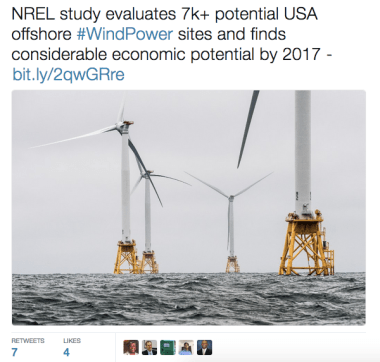
Offshore wind study tweet
World:
¶ Emmanuel Macron, a centrist, pro-EU French presidential candidate, won two thirds of the vote in a run-off against the far right’s Marine Le Pen. He promised to promote international cooperation on climate change in his victory speech. He supports ending the use of coal, a carbon price, and trade sanctions on polluting countries. [Climate Home]
¶ The Netherlands has put the world’s second largest offshore wind farm online, with 150 turbines spinning in action in the North Sea, substantially reducing the country’s carbon footprint and enhancing its energy security. The Gemini wind farm has a capacity of 600 MW and was built at a cost of €2.8 billion ($3 billion). [Deutsche Welle]
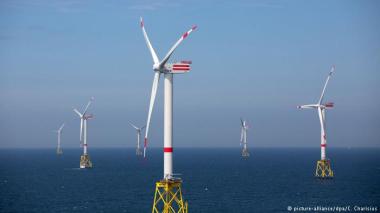
Windpark Nordsee Ost
¶ Participants in UN climate talks have expressed reservations about making changes to the Paris climate agreement just to keep the US in the treaty. There have been suggestions that the US might stay in, if it was allowed to lower its carbon targets. But delegates at the talks say countries should raise not cut their commitments. [BBC]
¶ After trying to avoid releasing an air pollution plan prior to elections, the UK’s government has obeyed a court order to issue it. The new plan to cut levels of diesel fumes, nitrogen oxides, and particulates has been greeted with derision by climate advocates, who say it flouts the government’s obligation to protect public health. [CleanTechnica]
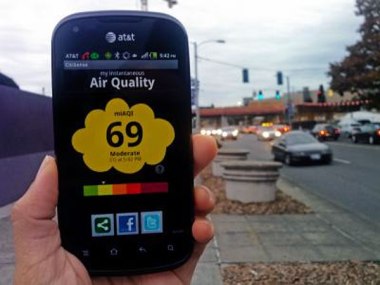
Measuring air quality
¶ Australia’s Clean Energy Regulator released a report detailing progress on the 2020 renewable energy target. It says a record high investment in renewables in 2016 was five times that of 2015, and it says, “Of the 98 new power plants accredited in 2016, 86 were solar, reflecting the rapidly declining cost and increased capacity of photovoltaics.” [PS News]
¶ Last August, it turned out to be challenging to install 27 solar panels on the community hall in Clyde River, Nunavut. And then the electrical inspection and approval came belatedly this spring. But the panels and their inverters are now converting sunlight into power. (Clyde River is on Baffin Island, well north if the Arctic Circle. – ghh) [Nunatsiaq News]

Niungvaliruluit, “pointer like a window,” Baffin Island
(Ansgar Walk, Wikimedia Commons)
¶ India’s solar power tariffs are set to fall below ₹3 per unit (4.66¢/kWh) in Rajasthan. State-run Solar Energy Corp of India, which is running the bid process for 750 MW of solar power capacity at two parks, has received price bids for the 250-MW Adani Renewable Energy Park Rajasthan Ltd, with the reserve price set at ₹3.01 a unit. [Livemint]
¶ Modernising small island power systems with renewable energy will supply cheaper, efficient, secure, cleaner power, a newly-released report says. The Philippines can save up to $200 million per year, and build a more reliable energy supply for millions of its residents, by replacing diesel generators with renewable sources. [en.vietnamplus.vn]
Wind turbines
US:
¶ The ongoing argument over the fate of the 2015 Paris climate accord has spilled into unusually public view as top advisers to the President near a decision on withdrawing from the landmark pact, which every nation except Syria and Nicaragua has signed onto. But a Tuesday strategy session was postponed due to a scheduling conflict. [CNN]
¶ The US added more than 11 GW of solar power last year, according to a report released by the Energy Information Administration. This means the US has nearly 50% more solar power than it did a year earlier. And the American Wind Energy Association says the wind industry had its best first quarter since 2009. [The Desert Sun]

Antelopes in Wyoming (Photo: Jay Calderon | The Desert Sun)
¶ More than two hundred institutional investors worth the tidy sum of $15 trillion have just put the Trump Administration on notice that climate change has put their assets at risk. The notice comes in the form of a newly published letter to the G7 group of seven industrialized nations and the G20 group of 20 major economies. [CleanTechnica]
¶ Virginia Governor Terry McAuliffe signed 11 bipartisan bills that promote the use of solar and other renewable energy options and aim to reduce energy consumption across the commonwealth. One bill allows localities to establish green development zones where businesses can receive special taxing and zoning treatment. [Fauquier Times]

Solar installation near Remington, Virginia
¶ The School for International Training, in Brattleboro, Vermont, received a $100,000 grant from Windham Regional Commission to install a solar energy system. Its benefits will include enhancing the curriculum at the SIT Graduate Institute. The project will be installed in partnership with Dynamic Organics, based in Putney, Vermont. [vtdigger.org]
¶ Construction of two nuclear reactors at Plant Vogtle is years behind schedule and billions over budget. The contractor, Westinghouse Electric, has filed for Chapter 11 bankruptcy protection last month, and a temporary labor contract is about to expire. But come what may, Georgia Power will make a profit, and the customers will pay. [WJBF-TV]
geoharvey is free and without ads.
geoharvey is not tax-deductible.
Posted in nuclear power, renewable power, solar, wind | Leave a Comment »
Tags: nuclear, nuclear power, renewable power, solar power, wind power
May 8, 2017
Opinion:
¶ “Trump failure to lead on climate doesn’t faze UN policymakers in Bonn” • Policymakers from nearly 200 countries are gathering in Bonn for talks aimed at fulfilling the Paris Agreement. They are unfazed by Trump’s threat to withdraw from the accord. It seems likely China would step into the leadership gap left by the US. [Mongabay.com]

Arctic melt ponds (Photo courtesy of NOAA)
¶ “Stop insuring climate disaster” • The ‘massive and mighty’ insurance industry needs to play its part in speeding up the global transition to renewable energy, 350.org founder Bill McKibben says. He calls on the sector to stop underwriting fossil fuel projects. By distributing risk, insurers been enabling high-risk activities. [eco-business.com]
¶ “At the Bonn Climate Talks, Developing Countries Will Need to Hold Their Own” • While it is not clear whether a final decision on the US remaining in the Paris Agreement will be announced during the climate talks, what is clear, however, is that US’s decision to slash funding to UN systems will have an adverse impact. [The Wire]

An earlier UN Climate Change Conference
in Bonn (Credit: UN Climate Change | Flickr)
World:
¶ The European Commission approved three schemes to support electricity generation from small-scale onshore wind, solar, and sewage gas installations in France. The schemes will enable France to develop over 17 GW of additional renewable energy over the next decade, including 15 GW of onshore wind power and 2.1 GW of solar. [Power Technology]
¶ Construction of a small, two-turbine wind farm in western Victoria is due to begin soon after Future Energy secured equity and debt financing for the 6.9-MW project. The Maroona wind farm will feature just two Vestas V126 wind turbines, located on two separate properties, generating the equivalent power needs of 4,000 households. [RenewEconomy]
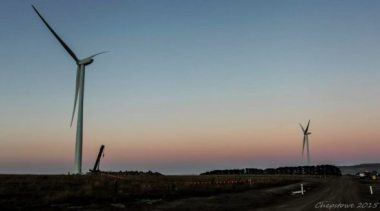
Chepstowe wind farm
¶ South Australia’s Treasurer said that with 53% of the state’s electricity last year coming from solar and wind – reaching a 50% target 8 years ahead of schedule – the focus in the state has to be on making all this clean energy more capable of being controlled with respect to when it is released to the grid. This means more emphasis on storage. [RenewEconomy]
¶ Chinese wind turbine manufacturer Goldwind acquired the 530-MW Stockyard Hill wind farm in Victoria from Origin Energy. Origin has committed to a long-term power purchase agreement for the project’s electricity below AUS$60/MWh (US $44.4/MWh). It will be Australia’s largest wind farm and will feature 149 turbines. [reNews]
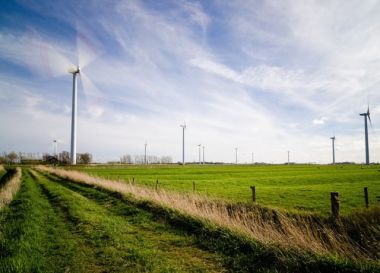
Australian wind farm (Image: pexels)
¶ Wales’ largest wind farm, the 76-turbine Pen y Cymoedd Wind Energy Project, is operating, 38 months after construction began. It can meet the annual electricity needs of more than 13% of households in Wales. It can also displace in an average year more than 300,000 tonnes of CO2 from fossil-fueled generation. [Your Renewable News]
¶ A $100 million (US$74 million) solar power station will begin construction at the Queensland coal town of Collinsville within weeks, providing 120 construction jobs and 20 in operation. Developer Ratch Australia Corporation said it had reached a financial decision on the 180,000-panel, 42.5-MW project and would break ground this month. [Courier Mail]
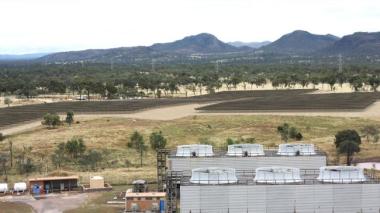
Computer image showing how the Collinsville station will look
¶ About 200 people protested outside the gates of the Kansai Electric Power Co’s Takahama Nuclear Power Plant to voice their opposition to the planned restarting of the plant’s No 4 reactor in mid-May. Anti-nuclear protesters from groups based in Fukui Prefecture and the Kansai region turned up from cities such as Kyoto and Kobe. [The Mainichi]
¶ Some EU countries are using the low carbon transition to justify new subsidies to the coal industry, instead of investing in clean alternatives, say analysts. Six EU member states have introduced support totaling €875 million a year ($960 million) since 2015, according to a report by the Overseas Development Institute. [Climate Home]
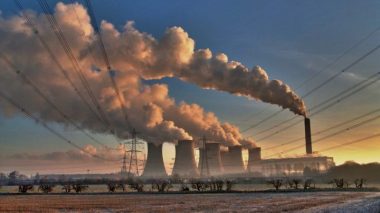
Eggborough coal station, UK (Pic: Flickr | John Mabbitt)
US:
¶ The Climate Solutions Caucus, is a place representatives concerned about climate change can meet to exchange ideas about how the federal government should respond to environmental challenges. We might assume that most of those people would be Democrats, but in fact half of the caucus members are Republicans. [CleanTechnica]
¶ Owing to the widespread use of air conditioners, emissions of SO2, NOx, CO2 increase substantially during the summer. As global temperatures increase, many more people are turning on air conditioners, which use a lot of electricity. This requires increasing the electricity production, and that is a leading cause of global warming. [CleanTechnica]
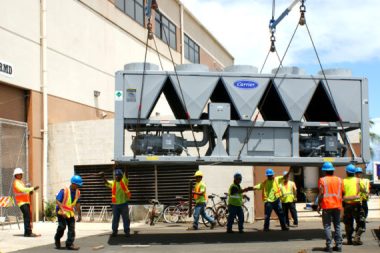
Air conditioner (US Navy photo, Thomas Obungen)
¶ The solar power industry has boomed in Minnesota in the last few years, mainly on dropping costs. According to the Solar Energy Industries Association, a industry trade association based in Washington, DC, Minnesota boasts 372.5 MW of solar capacity installed with most of that – 339.8 MW – utility-scale projects coming in 2016. [Winona Daily News]
¶ The California Public Employees’ Retirement System joined more than 150 other international investors in a letter Sunday urging the world’s largest economies to remain committed to the 2015 Paris Agreement. The letter is both a sign that investors consider the pact to be in jeopardy and an example of the shareholder activism. [Sacramento Bee]
geoharvey is free and without ads.
geoharvey is not tax-deductible.
Posted in nuclear power, renewable power, solar, wind | Leave a Comment »
Tags: nuclear, nuclear power, renewable power, solar power, wind power
May 7, 2017
Opinion:
¶ “Long Island’s energy future may be blowin’ in the wind” • Earlier this year, final agreement was reached between the Long Island Power Authority and Deepwater Wind, which had developed the Block Island offshore wind farm, to provide power to Long Island’s South Fork. It is one more in a series of developments. [Newsday]
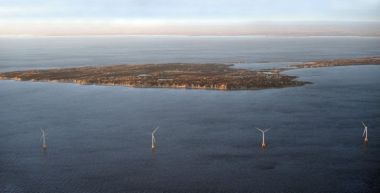
Block Island (Photo: AllIslandAerial | Kevin P Coughlin)
¶ “Noah Smith: Climate skeptics always assume risks are overhyped” • Bret Stephens of the New York Times made a splash with a column questioning the scientific consensus on climate change. He didn’t cite any skeptical research papers or alternative theories. His doubt was based purely on distrust of scientific consensus. [WatertownDailyTimes.com]
Science and Technology:
¶ The amount of dissolved oxygen in the water of the world’s oceans, an important marker of overall oceanic biological health/livability, has been declining at a notable rate for more than 2 decades now, according to analysis from the Georgia Institute of Technology, which looked at historic data going back more than 5 decades. [CleanTechnica]

Linear trend of dissolved oxygen at 100 meters (Georgia Tech)
¶ To avert extinction within the next century, astrophysicist Stephen Hawking has called on mankind to search aggressively for a new planet where we can live and thrive. Hawking warned that time is no longer on the side of humans as life on Earth could be decimated by asteroids, climate change, population growth, and epidemics. [Telegiz News]
World:
¶ The UK government is currently considering implementing a “scrappage scheme” to get the oldest, most heavily polluting cars and vans off the country’s roads. It is also giving thought to implementing low-emissions zones in certain parts of the country, where drivers of some vehicles would be required to pay fees to use the roads. [CleanTechnica]
¶ The standard way of estimating air and climate pollution from Canada’s oil sands operations greatly understate the reality of the situation, according to a study from the Canadian government. The study found that actual air and climate pollution from Alberta’s oil sands operations may be up to 4.5 times higher than officially acknowledged. [CleanTechnica]
¶ SolarReserve is planning a series of solar power plants across Queensland, creating more than 20,000 construction jobs. The company is scouting sites for up to half a dozen solar thermal stations, each of which generate enough electricity for 90,000 homes. Their solar thermal system uses molten salt to store energy to use at night. [Courier Mail]
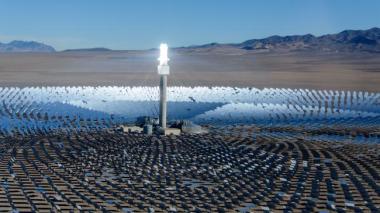
A SolarReserve project at Crescent Dunes in the US
¶ Sonnen GmbH, a German company developing home energy systems for private households and small businesses, is planning to use Blockchain technology to distribute renewable energy such as solar power in Germany. Earlier, Sonnen revealed a partnership with TenneT to use decentralized residential storage batteries in Germany. [CoinTelegraph]
¶ Battery makers are watching to see if Australia’s most wind power-dependent state can keep the lights on by installing grid-scale batteries this year. If batteries help solve South Australia’s electricity problems by storing surplus renewable electric power, countries like Indonesia, the Philippines, and Chile, may follow suit. [Ten Eyewitness News]
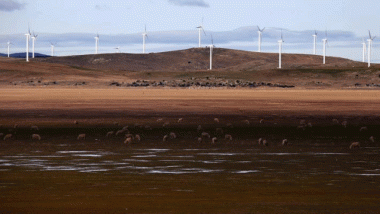
Australian wind farm
¶ Union minister Suresh Prabhu today said India Railways will save ₹41,000 crore ($6.16 billion) in the next 10 years on energy cost because of its thrust on solar power generation and electrification. The railway minister informed that only 42% of railway tracks across India have been electrified so far, but it has a target of 1,000 MW. [ETEnergyworld.com]
US:
¶ The reality coal miners face is that coal jobs have shrunk by 40% since 2011. What is growing is the number of jobs in renewables. Solar power accounts for just under 1.5% [actually, well over 2% – ghh] of electricity in the US, and yet, according to the DOE, there are more than twice as many jobs in solar as in coal. [Tri States Public Radio]

Millvale, Pennsylvania (Reid Frazier | The Allegheny Front)
¶ US representatives are in Bonn, Germany, this week for United Nations climate change meetings. Meanwhile, President Donald Trump’s advisers expect to meet Tuesday to discuss what to do about a global emissions-cutting deal, officials said. Trump is trying to determine whether to withdraw from the Paris agreement. [NWAOnline]
¶ Some communities in Massachusetts are boosting their use of renewable energy, bypassing basic electric service to negotiate contracts with third-party generators. Two of the programs are running, and eight more are under development. Those 10 communities’ plans could result in 17 MW of new wind turbines. [Wicked Local Brewster]
¶ The EPA has fired members of a scientific advisory board. The agency quietly forced out some members of the Board of Scientific Counselors just weeks after leaders told them their tenure would be renewed. The board is tasked with reviewing the work of EPA scientists, providing feedback that shapes future research. [Science Magazine]
¶ Seventeen Republican representatives sent a letter to the president asking that he include money for the DOE’s small modular reactors in his fiscal 2018 budget request to Congress. NuScale Power, an Oregon company, has a design under consideration for certification by the NRC. Review will take over three years. [Tri-City Herald]
geoharvey is free and without ads.
geoharvey is not tax-deductible.
Posted in nuclear power, renewable power, solar, wind | 1 Comment »
Tags: nuclear, nuclear power, renewable power, solar power, wind power
May 6, 2017
Opinion:
¶ “Rising Tides Will Create The World’s Next Refugee Crisis” • Experts say climate change poses the greatest security threat and mass displacements will soon be normal. With human-caused climate change, sea levels will rise, storms will grow stronger, floods more violent, and draughts harsher, increasing risk to human beings. [Huffington Post Canada]
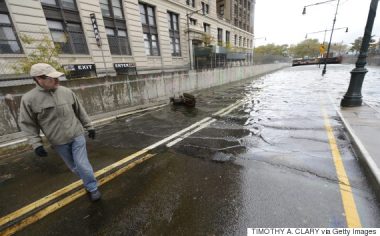
Brooklyn, the morning after Hurricane Sandy’s landfall.
¶ “Missing EPA Webpage Could Be Violation of Federal Law” • When EPA’s climate change pages were shuttered for revisions reflecting the administration’s views, users are told they can check out a snapshot of the entire EPA site from the day before Trump took office. But in the archived snapshot, pages relating to climate change are missing. [Seeker]
Science and Technology:
¶ Decades of increasing temperatures in Alaska have lengthened the fire season and dried out vegetation, especially in the forest floor, and created conditions for busier fire season with bigger and more frequent wildfires, according to one study. Other studies say increased lightning strikes will bring more fires and that they will be bigger. [KUAC]

The Fort McMurray fire caused C$3.7 billion in damages.
(Credit: Jonathen Hayward | The Canadian Press)
¶ Every person on Earth got the equivalent of an extra x-ray from the Fukushima nuclear disaster, a new study claims. Researchers have carried out the first global survey of radiation exposure caused by the meltdown of three nuclear reactors at the Fukushima Daiichi nuclear plant in Japan after a tsunami struck in 2011. [Daily Mail]
World:
¶ Tapping into geothermal energy is nothing new, but Iceland is taking things majorly next level by drilling nearly 3 miles into a live volcano to tap liquid hot magma. The well is likely the hottest hole on the planet, reaching oozing magma that averages 800 °F. The hole was completed in January and energy production is starting. [Inhabitat]

Icelandic volcano
¶ China installed 7.21 GW of new solar capacity in the first quarter of 2017 and generated 21.4 billion kWh of electricity, up 80% over the same period last year. The National Energy Administration says 4.78 GW of utility-scale solar and 2.43 GW of distributed solar PV were added in the quarter. China’s PV capacity is now almost 85 GW. [CleanTechnica]
¶ Last week, the US Commerce Department announced it will charge five Canadian softwood exporters duties ranging from 3.2% to 24.12% to make it a “level playing field.” Canada is considering multiple trade actions US in response. Prime Minister Justin Trudeau said he was considering banning US coal exports in response to the “unfair” tax. [BBC]
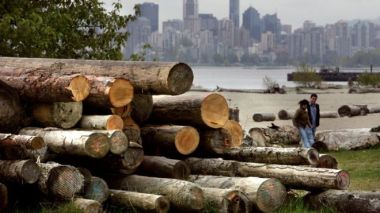
Logs in British Columbia (Reuters)
¶ Royal Dutch Shell’s chief financial officer, has reiterated the company’s backing of the Paris climate agreement. The support from Europe’s largest oil and gas group comes on the heels of America’s largest equivalent, ExxonMobil, sending the Trump administration a letter urging the US to support the accord. [Power Engineering International]
¶ ET Energy, the global solar development arm of Chinese PV company ET Solar, announced that is has commissioned 26 MW of PV capacity across the UK, on six sites in England, Wales and Scotland. The solar farms were completed before a March 31 deadline to be eligible for Renewable Obligation Certificate at a rate of 1.2. [pv magazine]
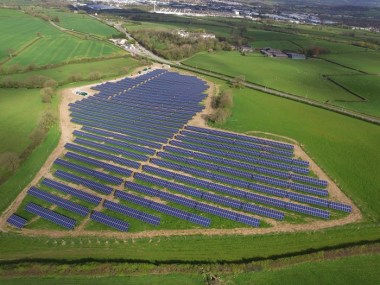
ET solar farm in England (ET image)
US:
¶ US EPA administrator Scott Pruitt said grid reliability is threatened by potential over-reliance on gas-fired electric generation. He said he believes we have a need for power plants to have fuel stockpiles (ie, coal) nearby in the event of supply disruptions. The US has lost 54 GW of coal capacity and added 34 GW of gas capacity since 2012. [Argus Media]
¶ Facebook announced the opening of its Fort Worth, Texas data center. The new billion-dollar data center campus is powered by 100% clean and renewable energy with the inclusion of over 200 MW of wind power that was developed with Citigroup Energy, Alterra Power Corporation and Starwood Energy Group. [Computer Business Review]

Data farm
¶ UPS will begin deploying its first electric hydrogen fuel-cell range-extended delivery trucks this September in Sacramento. The delivery trucks, which are being designed in partnership with the US DOE and others, are intended to meet the same route and range standards as the company’s internal combustion engine vehicles. [CleanTechnica]
¶ With help from elementary school students, who have been studying ecology, state and local officials opened a solar park southwest of Anderson, Indiana. They called the Anderson 1 Solar Park a gateway to the future. The 5-MW system has over 19,500 PV panels on 35 acres and will provide power for about 500 homes. [The Rushville Republican]

Ribbon cutting (John P Cleary | the Herald Bulletin)
¶ A plan to carry out a constitutional amendment designed to expand the use of solar and other renewable-energy devices is ready to go to Florida Governor Rick Scott. The Senate voted 33-0 to accept House changes to the plan. It establishes rules for implementing the amendment, which was approved by 72.6% of voters. [Sun Sentinel]
¶ The Bay Area Rapid Transit board of directors just passed an electrical portfolio policy that requires half of the organization’s power to come from renewables by 2025, and 100% by 2045. That has broad implications for the region around San Francisco, because the electric train system consumes roughly 400,000 MWh annually. [Greentech Media]
geoharvey is free and without ads.
geoharvey is not tax-deductible.
Posted in nuclear power, renewable power, solar, wind | 1 Comment »
Tags: nuclear, nuclear power, renewable power, solar power, wind power
May 5, 2017
Science and Technology:
¶ Climate change is melting permafrost soils that have been frozen for thousands of years, and as the soils melt they are releasing ancient viruses and bacteria that, having lain dormant, are springing back to life. The worry is that diseases that have been absent for millennia could reappear, infecting people who have lost resistance to them. [BBC]

Melting Permafrost (Gertrud & Helmut Denzau | naturepl.com)
¶ In the UK, Tokamak Energy says it activated its newest fusion reactor, the ST40, and it has already managed to achieve “first plasma” within its core. The reactor’s developers believe it will be safe and inexpensive to run, once they demonstrate that they can handle plasma successfully, at a temperature of 100,000,000° C. [CleanTechnica]
World:
¶ Oil prices are down by about 15% since the start of the year, despite OPEC’s agreement in November which cut output by 1.8 million barrels a day. Oil is at its lowest level since November, when producers’ cartel OPEC struck a deal to cut output. Most recently, Brent crude has fallen to $47.49 a barrel, while US crude dropped $44.58 a barrel. [BBC]

Oil rig and sail boat (Reuters image)
¶ India’s Ministry of New and Renewable Energy has announced the launch of second round of wind energy auction for 1,000 MW. Electricity distribution companies of Uttar Pradesh, Bihar, Jharkhand, Delhi, Assam and Odisha will buy wind power from PTC to meet their renewable purchase obligation, which is mandated by law. [Hindu Business Line]
¶ Official data revealed that India fell 5 GW short of hitting its new renewable energy installation target in financial year 2016-17. The MNRE data, compiled by Mercom Capital Group, shows that combined new renewable energy capacity grew 11,320 MW in FY 2016-17, while the national target for that period was set at 16,660 MW. [pv magazine]
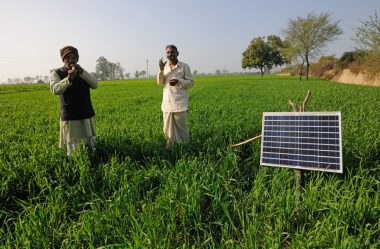
Small solar system in India (Photo: Asian Development Bank)
¶ Taxpayers will wear tens of millions of dollars in losses on the botched refurbishment of the Muja AB power station after the Government of Western Australia decided to close the ageing coal-fired plant. The Energy Minister confirmed that the 52-year-old plant would be shut in September of next year. [The West Australian]
¶ Combined, Queensland and New South Wales have 1980 MW of large-scale renewable energy projects under construction or slated to begin construction in 2017, a Clean Energy Council report says. Politics kept Western Australia to only 20 MW, but now it must close 240 MW of aged coal-fired units. Now, it must turn to solar and wind. [RenewEconomy]

Collapsed wall at the Muja CD plant
¶ The United Arab Emirates was forced to delay by a year the start-up of its first nuclear reactor as the company set up to run it has not yet received an operating license. The world’s largest single nuclear project, the Barakah nuclear plant will deliver up to a quarter of the UAE’s electricity when completed around 2020. [Reuters]
US:
¶ The Vermont Public Service Board held a series of meetings on proposed sound standards for wind turbines. The board released its draft version of the new rules in March, and its members held four meetings this week to hear from the public and from wind and sound experts as they get ready to finalize the sound standards. [Vermont Public Radio]
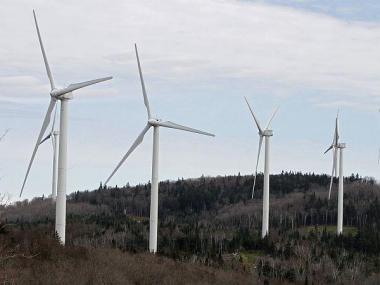
Wind turbines in Sheffield (Toby Talbot | AP File)
¶ The US has no plan yet for how to meet its 2020 climate target and has made no analysis of the impact of recent policy changes, according to an official submission to the UN. The US submission for the Multilateral Assessment, which was published this week, says “jobs, economic growth and energy independence” are its priority. [Carbon Brief]
¶ Competition from cheap natural gas accounts for nearly half the decline in domestic US coal consumption in recent years, Columbia University researchers said. Lower electricity demand electricity and growing use of renewable energy also took a bite out of coal’s market share. Environmental regulations took a smaller share yet. [Lexington Herald Leader]

Loading coal into a truck to be taken to a rail
facility (Bill Estep bestep@herald-leader.com)
¶ Utility-scale solar installations grew at an annualized rate of 72% from 2010 to 2016, according to the Energy Information Administration. Though the first utility-scale solar plants were installed in the mid-1980s, but more than half of all currently operating solar capacity came online over the last two years. [Power Engineering Magazine]
¶ According to the Arizona Republic, Arizona Public Service Commissioner Andy Tobin sent a letter to US Interior Secretary Ryan Zinke asking the federal government to pick up half of maintenance costs of the coal-fired Navajo Generating Station. Tobin hopes the plant would keep running at least five more years. [Utility Dive]

Navajo Generating Station
¶ BYD announced a new electric long-range class 8 refuse truck at the ACT Expo in Long Beach. It is estimated to save operators more than $13,000 per year in fuel and maintenance when compared to a diesel-based refuse truck. The new 10-ton payload trash truck can achieve 76 miles per charge with minimal battery degradation. [CleanTechnica]
¶ Feeling heat from environmentalists, residents, and politicians, supervisors of Contra Costa County, California, took the big step of picking a solar power plant developer that may be able to help consumers on average cut monthly bills up to 55%. On a 4-1 vote, they selected San Rafael-based MCE Clean Energy to develop solar power plants. [Antioch Herald]
geoharvey is free and without ads.
geoharvey is not tax-deductible.
Posted in nuclear power, renewable power, solar, wind | 2 Comments »
Tags: nuclear, nuclear power, renewable power, solar power, wind power
May 4, 2017
Opinion:
¶ “With Renewables Surging, Nuclear And Petroleum Battle Over Subsidies” • If the petroleum industry keeps fighting subsidies for nuclear power, the nuclear industry will go after petroleum-industry tax breaks, the president of the Nuclear Energy Institute said. He said if people compare nuclear subsidies with petroleum tax breaks, nuclear will fare well. [Forbes]
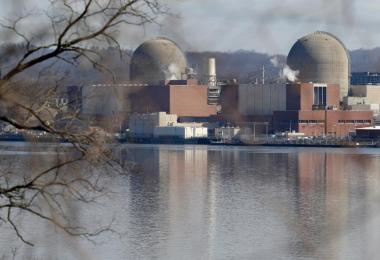
Indian Point nuclear plant
¶ “Carbon Capture And Storage: An Expensive Option For Reducing U.S. CO2 Emissions” • While many technologies can reduce power sector emissions, carbon capture and storage has gained support in Congress. Analysis shows coal with CCS will always need significant subsidies to complete economically with wind and solar. [Forbes]
Science and Technology:
¶ A model presented to the General Assembly of the European Geosciences Union in Vienna, Austria details how changing US Midwestern land use could have led to more rainfall. The model addresses climate change not from greenhouse gases, but from crop cover changes associated with the move from horses to mechanized plows. [Gizmodo]

Midwest agriculture (AP Photo | Seth Perlman)
World:
¶ The global installed capacity of distributed solar PV between 2017 and 2026 is expected to reach 429 GW, while an additional 591 GW of utility-scale solar are also expected to come online during the same period, according to new figures from Navigant Research in its latest Market Data: Global Distributed Solar PV report. [CleanTechnica]
¶ Cornwall now has the second highest number of independent renewable projects of any county in the UK, new figures have revealed. According to SmartestEnergy’s fifth annual Energy Entrepreneurs Report, Cornwall now has 320 renewable energy projects generating enough energy to provide power for 170,000 homes. [Cornwall Live]

Wind turbine
¶ Singaporean solar firm Sunseap is building a 10-MW solar power plant in Cambodia to provide a quarter of the energy needs of the city of Bavet. The Asian Development Bank is funding Sunseap via a $9.2 million debt package. It will be Cambodia’s first sun-powered electricity source to be connected to the national grid. [Renewable Energy Magazine]
¶ Air pollution from internal combustion engine vehicle use is altering the environment notably, even along the remote Manali-Leh Highway in the Himalaya Mountains in India, research from the University of Cincinnati has found. The amount of sulfur, a diesel exhaust pollutant, was at a level among the highest ever reported. [CleanTechnica]

Manali-Leh Highway (Image: Narender9, some rights reserved)
¶ Enel, through its subsidiary Enel Green Power RSA, started commercial operation at its 111-MW Gibson Bay wind farm, in the Eastern Cape province of South Africa. The Gibson Bay wind farm can generate around 420 GWh per year, equivalent to the consumption needs of around 131,000 South African households. [Your Renewable News]
¶ Meeting in Tonga, a coalition of countries from the Pacific Islands and Europe announced their intention to ensure that the UN’s International Maritime Organisation delivers on shipping climate goals. Shipping emissions were not covered under the 2015 Paris Agreement, but the IMO was mandated to deliver a package for the sector. [CleanTechnica]

Beach on Vava’u, Tonga (Jansan, Wikimedia Commons)
¶ Just 1% of the UK’s public are “strongly opposed” to renewable energy, according to a new Government survey. The poll found a further 4% were simply “opposed” to solar, wind and other such forms of electricity generation, but both groups were massively outnumbered by the 79% who support use of renewable energy. [The Independent]
US:
¶ In response to California’s ongoing tree mortality crisis and increased wildfire threat, Pacific Gas and Electric Co is working with local communities and power generators to dispose of dead tree debris and turn it into renewable energy. PG&E is operating sorting and chipping yards in eight counties hard hit by tree mortality. [Electric Light & Power]

Dead trees for biomass power
¶ Legal issues are now the sticking point in discussions in the Trump administration over whether to withdraw from the Paris climate accord, according to a person close to the talks. The lawyers aren’t sure whether the US would expose itself legally if it remains in the Paris agreement, but decreases its carbon reduction goals. [CNN]
¶ E&E News reports President Trump will select Daniel Simmons, former director of the natural resources task force at the American Legislative Exchange Council, to head the DOE’s Office of Energy Efficiency & Renewable Energy. Simmons also worked at one time for the Koch-funded Institute for Energy Research. [Utility Dive]
geoharvey is free and without ads.
geoharvey is not tax-deductible.
Posted in nuclear power, renewable power, solar, wind | 1 Comment »
Tags: nuclear, nuclear power, renewable power, solar power, wind power
May 3, 2017
Opinion:
¶ “How The Small Community Of Moab, Utah, Is Making A Big Difference” • The city of Moab, Utah, with a population of 5,325 and a per capita income of $23,586, has committed to 100% renewable electricity by 2032. You can find out how Moab made the dream of going renewable into reality and how your community can do the same. [CleanTechnica]
¶ “Microgrids could whet the big appetite for clean energy in Texas” • With clean microgrids, the power supply is controlled closer to the source of generation. This gives locals an opportunity to trade energy with local neighbors, monetize excess supply, help stabilize the power grid locally and keep it from overheating from oversupply. [GreenBiz]
¶ “Tesla Will Disrupt Not Just The Automotive Industry, But Transportation In General” • Tesla envisions an entire new transportation ecosystem, one that ranges from vehicle autonomy to distributed renewable energy. One Morgan Stanley analyst said, “We see Tesla as disrupting transportation, not just the automotive industry.” [CleanTechnica]

Tesla CEO Elon Musk (Photo: Bret Hartman | TED
World:
¶ An industry report said energy from renewable sources provided the majority of the power over the weekend in Germany. For the first time, most of the country’s coal-fired power plants were offline. Renewable energy sources provided the majority of the power over the weekend, producing over 85% of the electricity on Sunday. [malaysiandigest.com]
¶ Grid operator Tennet and solar battery maker Sonnen GmbH have launched a pilot project that will tap home PV systems to help iron out imbalances on Germany’s power network. TenneT and Sonnen’s e-Services subsidiary aim to sign up 6,000 household PV producers equipped with storage batteries by the end of May. [Tech2]

Sonnen Battery (Image: Sonnen)
¶ Amid on-going industry concerns about the uncertainty of the government’s climate change policies after 2020, a report from the Clean Energy Regulator found Australia recorded its biggest ever year for renewable energy investment in 2016. This puts Australia on track to meet its 2020 Renewable Energy Target. [The Australian Financial Review]
¶ A joint venture created by Burmeister & Wain Scandinavian Contractor, PensionDanmark, and Copenhagen Infrastructure Partners completed the 44-MW Snetterton biomass plant in the UK county of Norfolk. The £175 million project was finished a month ahead of schedule. BWSC will undertake operation and maintenance under a 15-year agreement. [reNews]
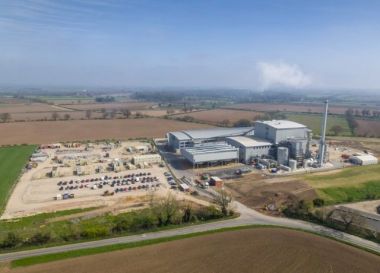
Snetterton bio plant (Copenhagen Infrastructure Partners)
¶ Environmental organisations and South Africa’s renewable energy industry say it does not make sense for the country to invest in nuclear energy. These comments follow last week’s ruling by the Western Cape High Court in favor of anti-nuclear activists, stating government’s nuclear procurement process was not valid. [ITWeb]
¶ The Indonesian Energy and Mineral Resources Ministry is planning to develop wind power plants in 16 locations across the country. The locations of the projects, which are to be developed in cooperation with Denmark, include Surakarta in Central Java and the South Sulawesi towns of Jeneponto and Sidrap, Antara news agency reported. [Jakarta Post]
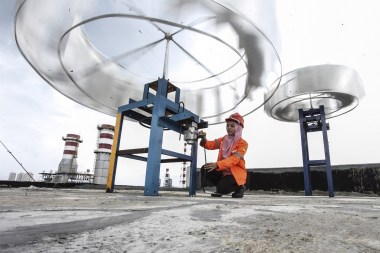
Vertical axis wind turbines at the Jawa Bali Power Plant
Office in Jakarta. (Antara | Muhammad Adimaja)
¶ Solar PVs could provide 30% of Australia’s electricity needs by 2030, according to the Australian Renewable Energy Agency. On May 1, the agency laid out its new Investment Plan outlining its investment priorities for the coming years. It has promised to accelerate solar PV innovation and development. [Climate Action Programme]
¶ NS, a rail company based in the Netherlands, has been working with renewable energies partners involved in sustainable energy, such as wind turbines, to move their rail fleet to use wind power to transport 600,000 passengers daily (1.2 million trips per day). This has reduced the carbon footprint to zero since the project began, two years ago. [Techly]

Wind turbines
US:
¶ Atlanta is joining the growing ranks of US cities that want to get 100% clean energy. Lawmakers in Georgia’s capital city approved a measure to get all of Atlanta’s electricity supplies from renewable sources, including wind and solar power, by 2035. The resolution commits city officials to developing a plan to make that happen. [Mashable]
¶ Wind power accounted for eight per cent of total US electricity generating capacity in 2016, according to the latest figures from the federal government’s Energy Information Administration. Wind turbines have contributed more than a third of the utility-scale power capacity added across the country over the past decade. [www.businessgreen.com]
Federal figures show growth in US wind capacity.
¶ Californians could be getting all of their electricity from renewable energy sources within 30 years under new legislation from Senate President Pro Tem Kevin de León (D-Los Angeles). An amended version of SB 100 calls for 60% of the state’s power from renewables like solar and wind by 2030 on its way to 100% clean energy by 2045. [KQED]
¶ Installed US capacity of offshore wind will be about 2.2 GW by 2026, according to a report by Make Consulting. It says robust state-level policies in the Northeast will help support the development of at least one new project a year out to 2026. It also says the US will install about 59 GW of new renewable projects to 2026. [reNews]
geoharvey is free and without ads.
geoharvey is not tax-deductible.
Posted in nuclear power, renewable power, solar, wind | 1 Comment »
Tags: nuclear, nuclear power, renewable power, solar power, wind power
May 2, 2017
Opinion:
¶ “New Mexico’s Largest Electricity Provider Proposes Going 100% Coal-Free” • The Public Service Company of New Mexico has issued a landmark finding. After a routine assessment of future power supply scenarios, the utility made a conclusion that was anything but routine: the best version of its future self was coal-free. [Union of Concerned Scientists]
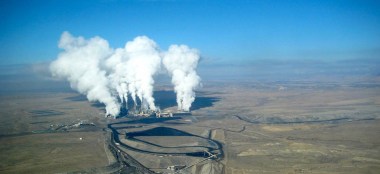
San Juan generating station
World:
¶ The recent increase in oil prices has helped BP to record a healthy profit for the three months to March. The $1.4 billion (£1.1 billion) profit, on the replacement cost measure, compared with a $485 million loss a year earlier. Oil prices have been about 35% higher in the first three months of 2017 compared with a year earlier. [BBC]
¶ Researchers from West Coast Wave Initiative in partnership with the Pacific Institute for Climate Solutions and the University of Victoria, have mapped the waves off British Columbia’s coast at 50-meter resolution using data from the past 12 years. The data could help wave-tech companies who want to test their instruments. [MetroNews Canada]

Sea lions lounging on a wave-measuring buoy
(University of Victoria, contributed)
¶ India added more renewable energy capacity than thermal power capacity in the financial year 2016-17, the Central Electricity Authority of India has reported. The renewable energy capacity added during the period of April 2016 to March 2017 was nearly twice as much as the thermal power capacity added during the same period. [CleanTechnica]
¶ In its new investment plan, Innovating Energy, the Australian Renewable Energy Agency has laid out its new investment priorities for the coming years and has promised to accelerate solar PV innovation and development to the point where it believes solar could provide 30% of Australia’s electricity within the next 20 years. [CleanTechnica]

Rooftop solar in Australia
¶ The Philippine Department of Energy approved four large-scale solar power projects to assess impacts of their integration into the transmission network. These projects include two of 70 MW capacity each, one of 22 MW, and another of 30 MW with battery storage. They will be used to develop a roadmap for large-scale integration. [CleanTechnica]
¶ The UK’s Ministers must act “as urgently as possible” to clarify how the nuclear industry will be regulated after Brexit, the Commons energy committee warned. Investigating the impact of Brexit on energy policy, it urged the UK to delay leaving Europe’s nuclear regulator. Power supplies could be threatened if a new regulator was not ready. [BBC]

First concrete at the Hinkley Point C nuclear plant (AP image)
¶ Australia’s largest integrated energy company, AGL Energy, says Australia’s transition away from a grid dominated by coal to low-carbon generation will largely bypass “baseload” gas. The prediction is based on the now fairly well accepted economic view that gas power is becoming less competitive with large-scale solar and wind. [RenewEconomy]
US:
¶ Advanced Energy Economy, the American Wind Energy Association, and the Solar Energy Industries Association sent a letter to Secretary of Energy Perry welcoming his study of the electric power system. But they stressed that wind and solar did not cause the challenges facing coal and nuclear plants and do threaten reliability. [Windpower Engineering]

Electric grid transmission lines
¶ New York Assembly Democrats grilled Governor Andrew Cuomo’s energy officials for more than four hours about a plan by the Public Service Commission and Exelon to keep three upstate nuclear power plants alive for 12 years. Utility ratepayers, mostly from downstate, will pay for the deal through surcharges on their bills. [WBFO]
¶ Last year, 760 MW of new solar helped power up the energy grid in Utah, putting Rocky Mountain Power in the No 3 spot in the country for the amount of added solar connections in an annual survey of 412 utilities across the country. Rocky Mountain Power was also ranked sixth in the nation in watts per customer with 846 watts. [KSL.com]
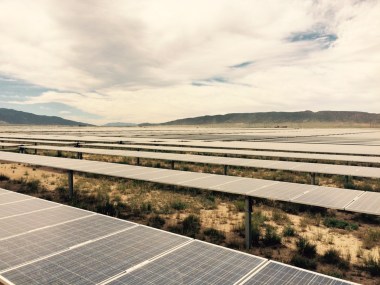
The Scatec solar project in Utah
(Photo: Governor’s Office of Energy Development)
¶ Dominion Virginia Power is planning to reduce its carbon emissions by up to 25% by building new renewable projects and closing some coal facilities. It also plans for 3,200 MW of new solar capacity by 2032 and 5,200 MW of new solar by 2042. An oil-fired plant and several coal-fired plants would be closed. [Power Engineering Magazine]
¶ Massachusetts has taken the wraps off plans to solicit up to 800 MW in its first call for offshore wind. A draft request for proposals seeks 400 MW, but up to 800 MW will be considered if the evaluation team determines that a larger-scale proposal is “superior” to other bids or is likely to produce “significantly more” economic net benefits. [reNews]
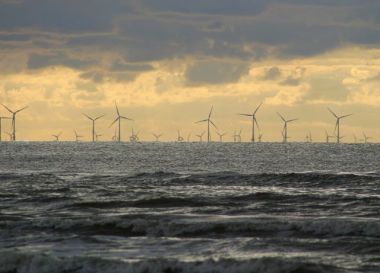
Offshore wind power (Image: Pixabay)
¶ The US Army’s largest single renewable energy project has begun officially generating clean electricity. Apex Clean Energy developed, managed construction of, and currently operates the hybrid wind and solar complex, which will provide more than 50% of the annual load at US Army Garrison Fort Hood in Killeen, Texas. [Windpower Engineering]
¶ Closing nuclear power plants serving New Jersey could lead to higher electricity prices for consumers, according to Ralph Izzo, chairman, CEO, and president of Public Service Enterprise Group, the company that owns the units. Izzo continued the drumbeat of lobbying for incentives to subsidize the operation of the three reactors. [Newsworks.org]
geoharvey is free and without ads.
geoharvey is not tax-deductible.
Posted in nuclear power, renewable power, solar, wind | 1 Comment »
Tags: nuclear, nuclear power, renewable power, solar power, wind power
May 1, 2017
Science and Technology:
¶ Climate change is a notoriously difficult concept to visualize, but a paper from the Geological Society of America makes climate science more accessible by showing the impact that warming has had on glaciers around the world. The paper aims to improve public awareness of our planet’s disappearing glaciers. [ScienceAlert]
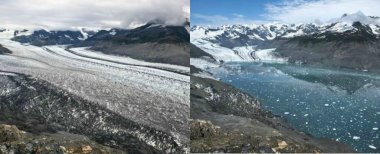
Six years’ change – Columbia Glacier in 2009 and 2015
(Image: James Balog | Extreme Ice Survey)
World:
¶ In what is part of a growing trend, Europe is accelerating its shift away from coal and to more renewable alternatives. According to Bloomberg, companies all over Europe are closing or converting existing coal-burning generators. The fast-paced phase out is a practical and economical choice, as the cost of renewable energy continues to drop. [Futurism]
¶ Australia’s government announced that it will restrict energy exports to avert a looming natural gas shortage. Australian Prime Minister Malcolm Turnbull said steps were needed to secure natural gas for domestic manufacturers and households. Previously, the gas had been sent to export facilities for sale around the world. [The National Interest Online]
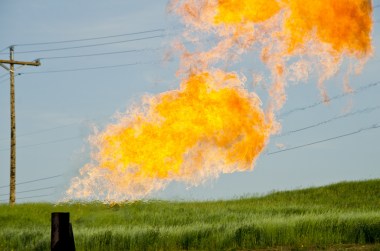
Flaring natural gas (Credit: Creative Commons)
¶ At a conference titled “Powering Viet Nam” held in Ha Noi, leaders of US multinational conglomerate General Electric as well as global and local energy sector experts shared ideas, case studies and best practices with more than 200 attendees and industry experts, the Dau tu (Investment) newspaper reported. [VietNamNet Bridge]
¶ With electricity prices spiralling and a rush towards green energy, fresh figures show the rate of solar panel installations across Australia led by West Australia is gathering pace. The southern Perth postcode of Baldivis is Australia’s solar capital, with more than two-thirds of houses generating their own power from the sun. [The West Australian]

Solar panels on homes in Baldivis, West Australia
(Picture: Mogens Johansen | The West Australian)
¶ The Community Power Agency has produced a snapshot of community-owned energy projects and found Australians had financed more than 30 wind and solar projects to the tune of almost $24 million in the last six years. Community-owned projects are so popular, they are being funded within hours of being offered in many cases. [NEWS.com.au]
¶ A state-owned Swedish company has become the latest European firm to enter the UK’s lucrative energy market, as Britain’s appeal to continental power suppliers shows no sign of abating after the Brexit vote. Vattenfall is launching its first foray into UK energy supply as it joins a competitive field of European players. [The Guardian]
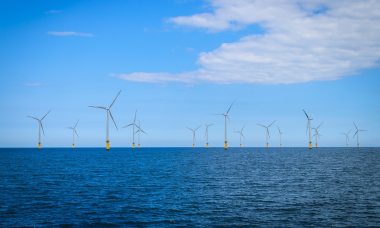
Vattenfall wind farm (Kapook2981 | Getty Images | iStockphoto)
¶ Construction is set to begin on one of the largest solar projects in Australia’s development pipeline, after the 148-MW Ross River Solar Farm this week achieved financial close. Large wind and solar farms can be planned and built in 2 to 3 years (compared with 10 to 15 years for nuclear) and are ready now to replace fossil and nuclear electricity. [RenewEconomy]
¶ Brazil’s government-run energy agency Empresa de Pesquisa Energética has conducted a study to assess the country’s potential for hybrid solar-wind power installations. EPE’s study was conducted after several developers expressed the desire to see a hybrid wind-solar category included in the national power auctions. [pv magazine]
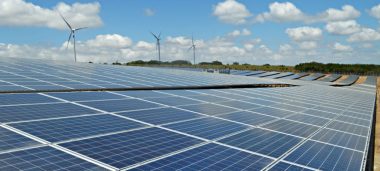
Hybrid wind-solar power plant (Governo de Pernambuco)
¶ A new Global Wine Index outlines the most at-risk wine regions according to rising temperatures and other climate change factors. Unfortunately, some of the world’s finest grapes are unlikely to survive. A multidisciplinary research team of engineers, seismologists, meteorologists, scientists, and wine lovers created the index. [AlterNet]
US:
¶ A proposal to build an electric transmission line to carry Canadian power through Vermont on its way to southern New England would reopen public debate about the use of the land that began nearly two decades ago. The proposal by National Grid would install the power line alongside an existing transmission line. [The Recorder]
Power lines in Vermont (AP Photo | Wilson Ring)
¶ Negotiators have reached a bipartisan agreement on a spending package to keep the US federal government funded until the end of September, according to congressional aides. It is very different from what the president proposed. The EPA’s budget is at 99% of current levels and also includes increased infrastructure spending. [The Guardian]
¶ For decades, the Block Island Power Company ferried up to a million gallons of diesel fuel a year from the Rhode Island mainland to power Block Island. The fuel is a costly and dirty energy source whose CO2 emissions are second only to burning coal. Now, America’s first offshore wind farm is delivering it electricity. [InsideClimate News]

Tourists on Block Island taking in the view of the wind farm
(Credit: Phil McKenna | InsideClimate News)
¶ Californians who get electricity from one of the state’s community choice aggregators could face higher costs under a plan being proposed by the state’s three investor-owned utilities. The proposal calls for a new approach to apportioning the utilities’ costs for energy contracts among the departing and remaining customers. [RTO Insider]
¶ Over the past decade, battery storage has taken great leaps toward mainstream use, expanding exponentially alongside renewable technologies. In the US, battery storage is now clearly an established market. Battery storage deployments grew to 336 MWh in 2016, doubling the amount deployed in 2015. [POWER magazine]
geoharvey is free and without ads.
geoharvey is not tax-deductible.
Posted in nuclear power, renewable power, solar, wind | 1 Comment »
Tags: nuclear, nuclear power, renewable power, solar power, wind power
April 30, 2017
Opinion:
¶ “Yes, I am a climate alarmist. Global warming is a crime against humanity” • Most of us have wondered about the human context of past crimes against humanity: why didn’t more people intervene? How could so many pretend not to know? The principled condemnation of large scale atrocity is, too often, a luxury of hindsight. [The Guardian]

A pair of walruses (Dan Beecham | BBC)
¶ “Take cheap solar power seriously” • Two new nuclear reactors under construction in central South Carolina will cost state residents billions of dollars for years to come, even if they never get finished. But solar power has gotten so cheap that the state’s utilities could massively expand their renewable energy capacity and save money. [Charleston Post Courier]
¶ “Trump eyes a monumental land grab” • Beginning with Theodore Roosevelt, presidents have exercised their authority under the Antiquities Act to establish national monuments on some of America’s most scenic, historic and sensitive public lands. Before Trump, no president ever tried to overturn a predecessor’s decision. [Santa Rosa Press Democrat]

Berryessa Snow Mountain National Monument
(Photo: Ken Porter | The Press Democrat)
World:
¶ The Indian Government’s aim is to ensure power at ₹3 per unit (4.67¢/kWh) irrespective of source in the medium term, according to Piyush Goyal, Minister of State with Independent Charge for Power, Coal, New and Renewable Energy, and Mines, speaking at the 2017 Annual Session of the Confederation of Indian Industry. [EnergyInfraPost]
¶ If geothermal power stations on the seabed become a reality in Iceland, the plan is to sell the power straight to Europe through an undersea cable. It is hoped that this direct sale, bypassing Iceland’s terrestrial electricity grid, would generate the best price possible for the electricity without forcing electric prices up in Iceland. [IcelandReview]

Geothermal platforms could look like oil rigs. (Photo: Wikipedia)
¶ Iranian Energy Minister Hamid Chitchian said the country’s capacity to produce electricity from renewable energy resources would hit 7,500 MW in the next few years. The minister said that three years ago, diesel accounted for about 43% of fuels consumed in the country’s thermal power plants but the figure is down to 14% now. [Tasnim News Agency]
¶ India is one of the last bastions of coal, but construction of new coal-fired power plants is faltering. Around the world, construction of coal-burning plants is falling quickly. From January 2016 to January 2017, pre-construction activity dropped 48%, start of construction fell 62%, ongoing construction fell 19%, a report says. [Hindustan Times]

Workers clean PV panels in Gujarat. (File Photo)
¶ Norway and Australia are racing each other to show they can supply Japan with hydrogen, hoping to fulfill its ambition to become the first nation significantly fueled by the super clean energy source. Australia has planned to derive liquid hydrogen from brown coal, Norway could steal a march by producing the fuel using renewable energy. [The Japan Times]
¶ Nova Scotia Powers is making progress in reducing carbon and increasing renewable energy, with 28% of the electricity used in 2016 coming from renewable resources. Renewable energy generation in Cape Breton County has made a significant contribution to the success, with power coming from both hydro plants and wind turbines. [Cape Breton Post]
¶ India is looking at having an all-electric car fleet by 2030 with an express objective of lowering the fuel import bill and running cost of vehicles. “We are going to introduce electric vehicles in a very big way. … The idea is that by 2030, not a single petrol or diesel car should be sold in the country,” said Piyush Goyal. [ETEnergyworld.com]
US:
¶ Iowa’s largest utility is in the midst of a $3.6 billion investment in wind power with a goal of producing 100% of its energy from renewable sources. MidAmerican Energy plans to build 1,000 more turbines over the next couple of years on top of the more than 2,000 it already has around the state, the Des Moines Register reported. [Omaha World-Herald]

Old MidAmerican plant in Council Bluffs (Mark Davis)
¶ Thousands of people have assembled in Texas on President Donald Trump’s hundredth day in office to demand federal action on climate change. The Texas Department of Public Safety told the Austin American-Statesman that about 3,500 people participated in a rally in Austin alone, part of nationwide marches calling for climate action. [KTXS]
¶ Thousands of people, including members of the union representing EPA employees, marched in downtown Chicago and outside Trump Tower to demand action to prevent climate change and protect the environment. The rain-soaked march coincided with hundreds of similar events, marking Trump’s 100th day in office. [news9.com KWTV]

Climate demonstration (AP photo, | Nam Y Huh)
¶ Vermont Senator Bernie Sanders says climate marches taking place around the country are part of a fight for the future of the planet. The former candidate for the Democratic presidential nomination addressed an adoring crowd of about 3,000 people who turned out for a rally at the Vermont Statehouse in Montpelier. [WCBI]
¶ The University of Iowa has been burning a grass, Miscanthus, in its power plant to reduce its reliance on coal. Burning an acre of Miscanthus, which looks a bit like sugar cane, can offset 4 tons of coal in the power plant. And a field of Miscanthus can grow for a decade or more without replanting, weeding, or spraying. [Omaha World-Herald]
geoharvey is free and without ads.
geoharvey is not tax-deductible.
Posted in nuclear power, renewable power, solar, wind | Leave a Comment »
Tags: nuclear, nuclear power, renewable power, solar power, wind power
April 29, 2017
Opinion:
¶ “Hydropower boom in China and along Asia’s rivers outpaces regional electricity demand” • For the past two decades, China has been in an unprecedented dam-building boom, developing over 300 GW of hydropower. But is it too much? Probably, at least in the short to medium term. Installed hydropower far outstrips demand. [thethirdpole.net]
Xiaowan (Photo by International Rivers)
¶ “How A Professional Climate Change Denier Discovered The Lies And Decided To Fight For Science” • It might seem like an impossible transition, but Jerry Taylor, who used to be staff director for the energy and environment task force at the American Legislative Exchange Council and vice president of the Cato Institute, made it. [UPROXX]
¶ “Why nuclear power has no future in California or U.S.” • To those who have watched the nuclear industry collapse, the Westinghouse bankruptcy represents the final chapter in the 20th century’s deluded affair with nuclear power. It can only be read as decisive proof: There is no economic future in nuclear power. [The San Diego Union-Tribune]

Vogtle Nuclear Power Plant (AP Photo/File)
Science and Technology:
¶ New climate-change findings mean the Pacific Ocean off California may rise higher, and storms and high tides hit harder, than previously thought. The state’s Ocean Protection Council revised upward its predictions for how much water off California will rise as the climate warms. The forecast helps agencies plan for climate change. [KSWO]
World:
¶ Nova Scotian energy company Emera began laying a cable that will connect Newfoundland with Nova Scotia. The ship Nexans Skagerrak is installing 170 km of cable on the ocean floor across the Cabot Strait. Emera says deployment of the first cable started off Cape Ray on April 26 and the vessel should have it completed by May 8. [VOCM]
Nexans Skagerrak (Photo: Emera NL)
¶ The UK installed 111 MW of PV capacity in the first quarter of 2017, according to provisional statistics from the Department for Business, Energy & Industrial Strategy. This is a 92.9% drop from the 1543 MW installed in the first quarter of 2016, when the Renewable Obligation scheme for large-scale renewable energy projects was closed. [pv magazine]
¶ Canadian renewable energy developer Northland Power Inc has officially wrapped up construction on a 600-MW offshore wind farm about 85 km off the coast of the Netherlands. With the official end of construction, Northland reports crews finished the sprawling wind energy park ahead-of-schedule and under-budget. [CanadianManufacturing.com]

Gemini Windpark (Gemini Windpark image)
¶ The Indian Central Electricity Authority’s ban on construction of new thermal power plants has prompted the state of Andhra Pradesh to drop the AP-Genco’s 4,000-MW facility in Polaki village of Srikakulam district. There has also been a rethink on the proposed coal-based plant of the East Coast Energy Private Limited at Bhavanapadu. [The Hindu]
¶ Within just about two years of its conception, much of the 1,000-MW Kurnool Ultra Mega-Solar Park at Orvakal in Kurnool district is already generating 900 MW of the clean energy. It is the world’s largest solar power plant at any single location. The plant has a staggering 40,00,000 solar panels spread over 5,812 acres of parched landscape. [The Hindu]

Indian solar park (©AP Photo | Ajit Solanki)
¶ The Finnish utility Fortum is partnering with Russian state-owned company Rusnano to develop about 500 MW of wind power in the country, supported by capacity payments. The utility will provide up to 15 billion rubles (€240 million, $263 million) in equity to the joint venture, in which both partners will hold equal stakes. [reNews]
US:
¶ For the second time in a week, activists will take to the streets of Washington, DC, and hundreds of other locations worldwide. This time, the issue at hand will be global warming, and the backdrop in the nation’s capital on Saturday could not be more appropriate. The weather forecast for Washington calls for potentially record-shattering heat. [Mashable]

White House protest (Image: Paul J Richards | AFP | Getty Images)
¶ The website of the US EPA, EPA.gov, is getting a makeover to reflect the views of President Donald Trump and EPA Administrator Scott Pruitt. The agency said in a statement, “As EPA renews its commitment to human health and clean air, land and water, our website needs to reflect the views of the leadership of the agency.” [The Indian Express]
¶ A 500-MW energy storage facility with “5-8 hours” storage duration could be built in San Diego, with a local water authority seeking detailed proposals for such a project to support the grid and help integrate renewable energy. The facility would support the electric grid’s stability in a region struck consistently with drought. [Energy Storage News]

Canary Islands pumped hydro project (Image: Gorona del Viento)
¶ Green Mountain Power, Vermont’s largest electric utility, is asking the state to approve a 5% rate increase that would go into effect on January 1. The requested rate increase is slightly less than the increase in costs the utility has experienced, according to a company representative, as GMP’s costs have actually increased by 6%. [Valley News]
¶ A new report published by Columbia University’s Center on Global Energy Policy has concluded that no amount of regulatory rollbacks and policy decisions made by Donald Trump’s administration will be able to succeed in bringing back coal jobs. Even if natural gas and renewable energy prices start to rise, coal has no real hope. [CleanTechnica]
geoharvey is free and without ads.
geoharvey is not tax-deductible.
Posted in nuclear power, renewable power, solar, wind | 2 Comments »
Tags: nuclear, nuclear power, renewable power, solar power, wind power
April 28, 2017
Opinion:
¶ “Big, young power plants are closing. Is it a new trend?” • Many of the US coal plants retired in recent years were geezers by industry standards. They trended old and small, and ran a fraction of the time. But in a vexing sign for the industry, those in the next round of retirements are decidedly younger. In fact, they are just middle-aged. [E&E News]
San Juan Generating Station could close in 2022, three
decades earlier than anticipated. (Doc Searls, Wikipedia)
¶ “How much storage and back-up do high renewable grids need?” • It’s a question at the heart of electricity planning and the subject of many of the myths peddled by vested interests in the fossil fuel lobby and reported by the gullible media. The answer is: not nearly as much as the naysayers would have you think. [RenewEconomy]
World:
¶ The Australian Photovoltaic Institute, with data from the Clean Energy Regulator, says the country has a new solar energy record. There are now 6 GW of solar power across the country, enough to meet the electricity needs of 1.3 million households. Solar power now makes up 11% of Australia’s installed capacity. [Energy Matters]
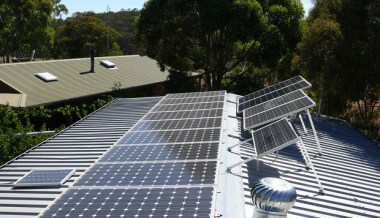
Australian rooftop solar (public domain image)
¶ South Australia set a new record for wind output on Tuesday, April 25, reaching 1,540 MW. The previous record of 1,400 MW was set just two weeks earlier. At its peak, the wind output equated to 96.6% of its registered capacity. Under new rules imposed since last September’s blackout, two gas-fired generators were kept on line. [CleanTechnica]
¶ The Australian government is being told that “green fuel” exports, powered by wind and solar, could reach $40 billion a year in the next few decades, a market equivalent in size to the export coal industry, and essential if Australia is to maintain its pivotal position as a major fuel supplier in a decarbonized world. [RenewEconomy]

Please click on the image to enlarge it.
¶ The 1,805 MW of solar PV capacity on the rooftops of Queensland homes and business now amount to be the biggest power station by capacity in the state, overtaking the 1,780 MW of the Gladstone coal-fired power station. Homeowners and business owners in Queensland added 25 MW of rooftop solar capacity in March. [CleanTechnica]
¶ Electricity generated by offshore wind in Germany increased almost 37% in the first quarter of 2017 compared with the same period last year, according to new figures. Some 4,800 GWh of electricity was generated from offshore wind in the first three months of the year, up from 3,500 GWh in the first quarter of 2016. [reNews]
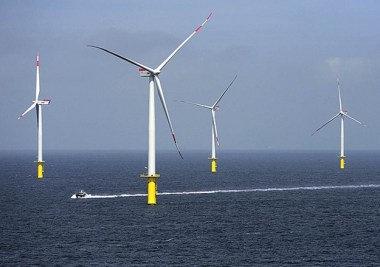
Riffgat offshore wind farm in Germany (EWE image)
¶ According to the International Energy Agency, oil discoveries declined to 2.4 billion barrels in 2016, compared to the previous average over the last 15 years of 9 billion barrels a year. The IEA reported that because of low oil prices, the number of projects receiving final investment decision has fallen to the lowest levels seen since the 1940s. [CleanTechnica]
¶ Geothermal’s contribution to New Zealand’s total renewable energy generation increased from 11.5% in 2007 to 21% in 2015. Over the same period, its value rose from $1.3 billion to $2.9 billion (US$ 2.0 billion). The value of wind jumped from $238 million (2% of total renewable energy generation) in 2007 to $884 million (6%) in 2015. [ThinkGeoEnergy]
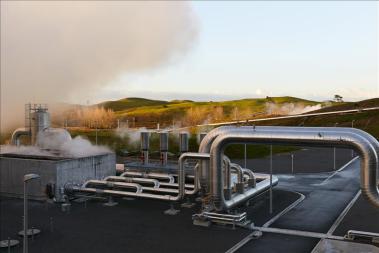
Te Mihi geothermal plant, New Zealand (source: Contact Energy)
US:
¶ Senators Bernie Sanders (I-Vt.), Jeff Merkley (D-Ore.), and Edward J. Markey (D-Mass.) introduced legislation to build a 100% renewable energy economy by 2050. It was called “the most ambitious piece of climate legislation Congress has ever seen” by 350.org. Others caution that it is not enough to deal with climate change. [Common Dreams]
¶ New England Hydropower Company has commissioned the first Archimedes screw generation facility in the country. The turbine, installed in Meriden, Connecticut, late last year, is expected to generate 920,000 kWh of electricity annually for the city, saving it $20,000 a year in power costs and property taxes over 20 years. [Meriden Record-Journal]
Archimedes screw turbine (Dave Zajac, Record-Journal)
¶ More than 1,000 US companies are calling on the Congress and administration to strengthen the EPA’s ENERGY STAR program, instead of following through on its proposed elimination, as per Trump’s recent budget proposals. The companies signed a joint letter, organized by the Alliance to Save Energy, to congressional leaders. [CleanTechnica]
¶ Lindahl wind farm, Enel Green Power’s first project in the state of North Dakota, has started generating energy. Lindahl has an installed capacity of 150 MW and can generate approximately 625 GWh annually, enough for over 50,000 US households, while avoiding the emission of about 450,000 tonnes of CO2 each year. [Renewable Energy Magazine]

Lindahl wind farm
¶ Pacific Gas and Electric Company announced a call for proposals for renewable developers to build new projects for a clean-energy program available to PG&E customers. Those who participe will pay the developers for the new energy directly, and receive a bill credit from PG&E on their monthly energy statement. [Windpower Engineering]
¶ The owners of the new nuclear reactors being built in Georgia and South Carolina said the half-finished reactors might not be completed without changes to a proposed $800 million loan to Westinghouse, which is bankrupt. The utilities are evaluating how to complete them, or alternatively, whether they should be abandoned. [Reuters]
geoharvey is free and without ads.
geoharvey is not tax-deductible.
Posted in nuclear power, renewable power, solar, wind | 1 Comment »
Tags: nuclear, nuclear power, renewable power, solar power, wind power
April 27, 2017
Opinion:
¶ “Future of Westinghouse may hinge on fate of its new Shanghai reactor” • The start-up of a nuclear power plant south of Shanghai later this year has a lot riding on it. It will be the first to use an AP1000 reactor, the model that has been disastrous for Westinghouse, leading to bankruptcy and doubts over the future of its owner Toshiba Corp. [The Japan Times]

Rendering of the Westinghouse AP1000 (Westinghouse)
World:
¶ China’s installed wind energy capacity grew 13% in the first quarter over the same time last year, bringing the country’s capacity to 151 GW. Wind energy generated 68,700 GWh of electricity in the first quarter, an increase of 26% over the same quarter a year earlier. Curtailments fell from 13,500 GWh last year to 5,700 GWh. [CleanTechnica]
¶ Previously known as Turanor Planetsolar, the 31-meter electric trimaran Race For Water has been relaunched in Lorient, where its latest round-the-world mission will begin. The four-year trip will be powered by a 160-hp hybrid solar-hydrogen propulsion system, with a 40 square meter skysail kite providing additional wind power. [Boat International]
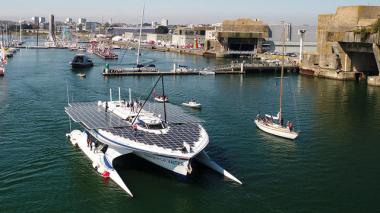
The boat, Race For Water
¶ India is making a big push for solar energy, with power capacity expected to double this year. But some of the gains could be lost to air pollution. A study, the first of its kind in India and one of a handful globally, has found that dust and particulate matter may be reducing the energy yield of solar power systems in north India by 17-25% annually. [Times of India]
¶ London’s largest electric vehicle charging network, Source London, will only use renewably-sourced electricity in the future. Source London is working with energy supplier SSE Energy to see its electricity come entirely from wind and hydro. Source London plans to reach 1,000 charger points by the end of this year. [Clean Energy News]

Source London charger station
¶ Apple is building a new data center in Denmark, and it has some interesting ideas on how to power the data center with renewable energy, while also giving back to the community. Excess heat generated by the data center will be captured and returned to the local district’s heating system, which will warm up homes in the community. [Networks Asia]
¶ Solar power now makes up 11% of Australian generating capacity. South Australia has the highest penetration among dwellings at 32%, with Aberfoyle Park the state’s “solar rooftop hotspot.” The market is driven by increased knowledge, high electricity prices, and fear the Federal Government will cut incentives in the future. [The Advertiser]

Installing solar panels
¶ Bord na Mona and the ESB are joining forces to develop four solar farms in Ireland that are likely to cost about €500 million and generate enough power for 150,000 homes. The four solar farms will have a total capacity of 570 MW of electricity. All Ireland’s commercial renewable power generation is currently sourced from wind. [Irish Independent]
¶ Green energy company Energia has started supplying energy from five new windfarms to power homes and businesses across Ireland. Two windfarms are in County Antrim and three in county Tyrone. The new facilities will have a total of 73 MW of capacity. They should produce enough electricity for about 36,000 homes. [Renewable Energy Magazine]
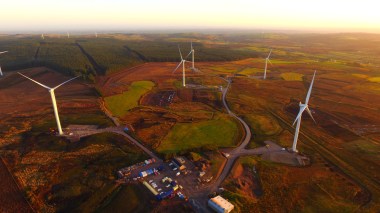
Energia wind power (Energia image)
¶ At the Bloomberg New Energy Finance conference in New York on April 25, chief economist for oil giant Total, predicted that sales of electric cars will surge from about 1% globally in today’s new car market to up to 30% of the market by 2030. If that happens, he says, demand for petroleum-based fuels “will flatten out, maybe even decline.” [CleanTechnica]
US:
¶ An energy startup, LO3 Energy, is developing and running the Brooklyn Microgrid, an effort to create a localized, sustainable energy market in the neighborhoods of Park Slope and Gowanus. It is a test run in small-scale energy trading, which has already recruited and linked up dozens of consumers and residents with solar panels. [Curbed]
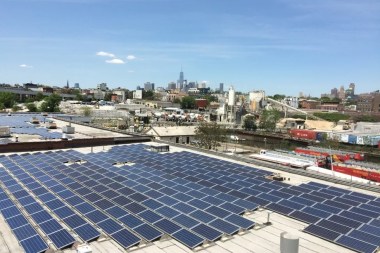
Solar panel installation in Brooklyn (LO3 image)
¶ The US electricity sector faces many uncertainties in the spring of 2017, but the resurgence of coal-fired generation is not among them – it will not happen. Those were points made by speakers at S&P Global Platts’ 32nd annual Global Power Markets Conference in Las Vegas. Coal-burning plants are just not economical. [Platts]
¶ There is a strong renewable energy target set by almost 50% of the major companies of the US. A report from the World Wildlife Fund, Ceres, Calvert Research and Management shows that increasing numbers of investors are promising to rely on clean energy. In the process, they are already saving $3.7 billion per year. [Insider Tradings]

Solar farm
¶ The Great America amusement park in Santa Clara will cover 100% of its electricity use with renewable energy through Silicon Valley Power’s Green Power program. The 100-acre amusement park, which features roller coasters, family rides, Boomerang Bay Water Park, and shows, uses 12,810 MWh of electricity annually. [InterPark]
¶ As industries go, agriculture is one of the worst environmental offenders, research by the United Nations Environment Programme says. Now a major US agricultural player, Taylor Farms, is making an effort to shrink its environmental footprint. A facility in Gonzales, California, now employs: solar, wind and co-generation systems. [TechCrunch]
geoharvey is free and without ads.
geoharvey is not tax-deductible.
Posted in nuclear power, renewable power, solar, wind | Leave a Comment »
Tags: nuclear, nuclear power, renewable power, solar power, wind power
April 26, 2017
Opinion:
¶ “Is Trump warming to wind power?” • Trump’s position on wind may be shifting. During the election, the narrative on wind wasn’t looking good. Trump promised a national energy policy that prioritized domestic fossil fuels over renewables. But the narrative seem to be shifting, and the biggest game-changer for Trump seems to be jobs. [WorkBoat]

Brave Tern at work (Photo: Deepwater Wind)
¶ “100 days of Trump: Round 1 to renewables” • Despite battle cries to end the ‘war on coal’, Trump’s first 100 days as president have done very little to dismantle progress in renewable energy and climate action materially, according to energy and national security expert Kevin Book. He and other experts spoke at a webinar. [PV-Tech]
World:
¶ ABB has won the contract to provide fast chargers that will support the 8 fully electric Volvo buses being brought to the city of Harrogate in northern England. In just a short 3 to 6 minute stop, the chargers will supply enough power for the fully electric buses to complete the route. “Opportunity charging” has a number of advantages. [CleanTechnica]

Electric Bus at Harrogate
¶ In November, the UK’s highest court found the government’s proposed clean air rules were deficient, and it ordered the government to present a new plan to the court by April 24. After calling for new elections, the government claimed that revealing its plans would be improper during an election campaign. The court was not impressed. [CleanTechnica]
¶ Global wind power capacity stood at almost 487 GW at the end of 2016 and is on track to reach 800 GW by the end of 2021, according to a report from the Global Wind Energy Council. The report, “Global Wind Report: Annual Market Update,” predicts 60 GW of new annual capacity in 2017, rising to 75 GW annually in 2021. [reNews]

Wind farm (Image: FreeImages | Hyoung Il So)
¶ A proposal from struggling Indian multinational Adani Group to develop a new coal mine in Australia’s north-east is becoming increasingly difficult to justify, not least because Adani is unlikely to be able to contribute much in the way of equity for the $5 billion project. The entire coal mining industry is in decline worldwide. [CleanTechnica]
¶ India has pledged to the international community to reduce its emissions intensity by as much as 35% from 2005 levels by 2030, and to increase the percentage of renewable energy in its power grids. US researchers warn that it will be nearly impossible to achieve the goal if the country builds 65 GW of coal-burning plants it plans. [Livemint]
Indian coal-burning plant (Photo: Bloomberg)
¶ The Western Cape High Court set aside all nuclear deals with South Africa, ruling they were unlawful and unconstitutional, including deals with the United States, Russia, and South Korea. Two NGOs had sued when the energy department moved the procurement of the nuclear energy to the South African utility Eskom. [Huffington Post South Africa]
¶ South Africa’s Ministry of Environmental Affairs announced that it has simplified the procedure to conduct environmental impact assessment for large-scale PV and wind power projects that would be in any of the country’s eight Renewable Energy Development Zones or its associated Strategic Transmissions Corridor. [pv magazine]

Solar farm built by Acciona in South Africa (Acciona)
US:
¶ US Energy Secretary Rick Perry said the US should renegotiate the Paris accord on climate change instead of abandoning it, while criticizing Germany for allowing its fossil-fuel emissions to rise. The remarks put Perry among a group of advisers urging President Donald Trump to stick with the United Nations accord that he vowed to scrap. [BOE Report]
¶ The City of Hartford, Constellation, a subsidiary of Exelon Corporation, and Bloom Energy announced the completion of a fuel cell microgrid that will generate clean energy, manage electricity costs, and supply emergency power for public buildings and businesses in the city’s Parkville neighborhood. [Asia Cruise News]

Please click on the image to enlarge it.
¶ President Donald Trump will order the Interior Department to review locations for offshore oil and gas exploration and consider selling drilling rights in territory that former President Barack Obama put off limits, according to people briefed on the order, who spoke on the condition of anonymity before it is issued. [Bloomberg]
¶ The Tennessee Valley Authority is adding more solar to its generation portfolio with the construction of a solar power facility at a combined cycle gas site in Memphis. The 1-MW facility will be the largest TVA-owned solar project in its service area. Construction is under way, and the plant should be operating by September. [Electric Light & Power]
geoharvey is free and without ads.
geoharvey is not tax-deductible.
Posted in nuclear power, renewable power, solar, wind | 1 Comment »
Tags: nuclear, nuclear power, renewable power, solar power, wind power
April 25, 2017
Opinion:
¶ “Tory windfarm policy endangers cheap energy in UK, commission finds” • A Shell-sponsored group says wind is “increasingly the cheapest form of electricity.” Conservative opposition to windfarms risks the UK missing out on one of the cheapest sources of electricity, according to the head of the Shell-funded industry group. [The Guardian]

By 2040, wind and solar would account for 45% of
the global power mix. (Photo: Alamy Stock Photo)
¶ “The train has left the station on renewable energy” • Obscured by debate and hype about the merits of renewable energy, an important change has quietly taken place: Unsubsidized renewable energy is economically viable in many regions. Powerful economic and technological forces have permanently altered the energy landscape. [GreenBiz]
¶ “Exelon-style nuke bailouts threaten wind, solar” • The push to save US nuclear plants for the sake of fighting climate change is threatening support for the bread and butter of clean power: wind and solar. New York and Illinois have already approved as much as $10 billion in subsidies to keep struggling reactors open. [Crain’s Chicago Business]

Wind turbine technician at work (Bloomberg image)
World:
¶ UK renewable energy companies secured billions of pounds of exports for their goods and services last year. Research by RenewableUK found UK firms are now taking a leading role in the growing global market for wind and marine power now valued at £290 billion. More than 500 contracts were signed by 36 firms on projects in 43 countries. [The Planner]
¶ An Icelandic exploration company is looking into tapping an enormous new source of green renewable energy in Iceland, submarine geothermal energy. The company envisions using the energy to generate electricity on off-shore geothermal power plants on platforms not unlike those used in off-shore oil drilling. [Iceland Magazine]

Steam – not smoke: Geothermal power in Iceland (Photo | Valli)
¶ Following a sharp correction in tariff rates for wind energy projects in the first competitive auction in India, several states have refused to sign power purchase agreements at higher feed-in tariffs. A total capacity of 500 MW is now reportedly stranded due to the unwillingness of power distribution companies to enter into PPAs. [CleanTechnica]
¶ Mexico will soon have a starring solar project, the largest in the entire Americas, showing off a new leading role in renewables, driven by a major energy market reform. Italian power giant Enel is set to develop the record 754-MW project, adding to the largest solar plants completed or under construction in both Chile and Brazil. [PV-Tech]

Site of the 754-MW solar project (Credit: Enel)
¶ The Energy Transitions Commission, a group of companies and nonprofit agencies including energy giants Royal Dutch Shell and BHP Billiton, said greenhouse gas emissions could be cut in half by 2040 without impeding economic development, in part by converting grids to use mostly renewable power. [Creamer Media’s Mining Weekly]
¶ Vestas has expanded its 2-MW turbine platform to include machines with 116 and 120-meter rotors. The V116 and V120 2-MW turbines have steeper power curves to increase output in medium to ultra-low wind conditions. They are particularly suited for the US, India, and China, the company said. The first deliveries will be in 2018. [reNews]

Vestas wind turbines (Image: Vestas)
¶ Jamaica is on course to getting 30% of its energy demand met by renewables by 2030, according to the country’s Minister of Science, Energy and Technology. He said as of last year, 10.5% of net electricity generated was obtained from renewables, and 80 MW of generating capacity from renewable sources were added. [Climate Action Programme]
US:
¶ Salt River Project has signed a 20-year power purchase agreement with NextEra Energy Resources for a project in Arizona that will combine a solar array with energy storage. NextEra plans to build the Pinal Central Energy Center near Coolidge, which will pair a 20-MW solar array with a 10-MW lithium-ion storage system. [Utility Dive]
¶ The Institute for Energy Economics and Financial Analysis published its new research brief last week, working through the implications inherent in the expected coal-fired generating closures over 2017 and 2018. It concludes that the expected closures will eliminate about 28.2 million tons of annual coal demand by the end of 2018. [CleanTechnica]
¶ St Paul’s city officials have approved an agreement with GreenMark Solar to power a fourth of the city’s municipal buildings with electricity from community solar gardens. The agreement allows the city to buy up to 8 MW of electricity from the Minneapolis-based solar company. This is expected to save $165,000 next year. [TwinCities.com-Pioneer Press]

GreenMark solar garden (GreenMark Solar)
¶ If anyone doubts renewable energy is the future, they need only to look at job numbers. According to a recent report from the Environmental Defense Fund, employers in the renewables sector are hiring people 12 times faster than the rest of the economy. Within the sector, small businesses dominate, with 70% of jobs. [Sustainable Brands]
¶ To mark Earth Day 2017, the Hawaiian Electric Companies are highlighting their progress in replacing fossil fuels with renewable energy. Importantly, they reached a milestone last year when 26% of the electricity used by its customers came from renewable energy. This is up from 23% the year before. [North American Windpower]
geoharvey is free and without ads.
geoharvey is not tax-deductible.
Posted in nuclear power, renewable power, solar, wind | 1 Comment »
Tags: nuclear, nuclear power, renewable power, solar power, wind power
April 24, 2017
Science and Technology:
¶ For the first time, scientists have created a global map measuring the cooling effect forests have by regulating the exchange of water and energy between the Earth’s surface and the atmosphere. According to a new paper, in many locations, this cooling effect works in concert with forests’ absorption of carbon dioxide. [Science Daily]
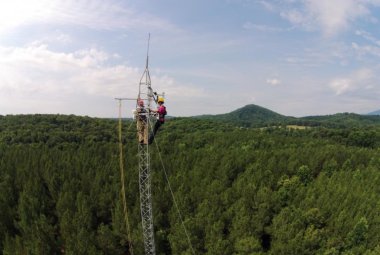
Working atop a 120-foot tower (Credit: Rob Alexander)
¶ Remember when the world was hoping we would never reach 400 ppm of CO2? Well, now we can wave 400 ppm goodbye, because it has come and been passed. Mauna Loa Observatory recorded its first CO2 reading greater than 410 ppm. To be precise, it was 410.28 ppm. Yes, this is bad and yes, it will have even worse consequences. [ZME Science]
World:
¶ Ocean Power Technologies has deployed its PB3 wave energy device off the Japanese coast as part of a lease agreement with Mitsui. The US developer’s first commercial PB3 PowerBuoy unit arrived in Tokyo on 18 March and was shipped to Kozu island for six months’ testing following months of testing off the coast of New Jersey. [reNews]
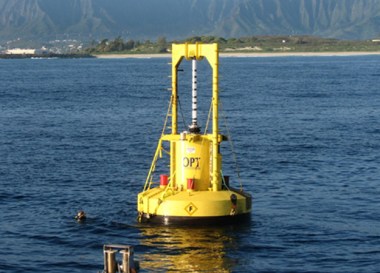
PB3 PowerBuoy (Ocean Power Technologies image)
¶ Plans by the UK Conservative Party for a cap on household energy bills will lead to fewer benefits for consumers, says one of the UK’s biggest providers. A cabinet minister said the Tories planned to intervene in the energy sector “to make markets work better.” But Scottish Power told the BBC that the move would “stop competition.” [BBC News]
¶ Solar-powered beer is the latest trend among hipsters in the Sydney suburb of Newtown. Punters are starting to see the benefit of solar power, with boutique beer producer Young Henrys hosting a 29.9-kW community solar array in Newtown which is owned by 54 local members of the Newtown community. [Energy Matters]

Solar powered beer (public domain)
¶ The University of Alberta is teaming up with research partners in China to develop low-carbon, sustainable energy solutions while tackling global environmental challenges. Officials from the university and Tsinghua University met in Beijing to sign an agreement to create the Joint Research Centre for Future Energy and Environment. [Korea IT Times]
¶ From Norway to the United Arab Emirates and Saudi Arabia, big oil producers are becoming big backers of renewable-energy. Now, Nigeria has signed two agreements with solar developers to guarantee payment risks for 50-MW and 70-MW solar farms. The oil and gas sector makes up 35% of Nigeria’s GDP and 90% of its exports. [ImpactAlpha]

Solar array (Credit: Africa Energy Digest)
¶ A Thai plan to build a coal-fired power plant in the coastal province of Krabi has once again been put on hold after the Prime Minister scrapped the previous environmental health impact assessment and ordered the Electricity Generating Authority of Thailand to conduct another with greater input from nearby communities. [Bangkok Post]
¶ Affluent countries like Germany and Japan are typically the ones associated with renewables. But the nation with the highest portion of solar generation in its electricity mix last year was not affluent. It was Honduras, a nation of 8 million people with a gross domestic product of only $5,000 per capita and serious social problems. [pv magazine USA]

PV plant in Honduras (Grupo Ortiz)
¶ Toshiba is still in the midst of a severe financial crisis caused by losses at its US nuclear unit Westinghouse Electric Co, which filed for Chapter 11 bankruptcy protection last month. Toshiba has sold its medical business and spun off its chip operation already. Now the company says four additional key operations will also be spun off. [The Mainichi]
US:
¶ Many US cities are setting green energy goals. Some, like Chicago, shoot for 100% renewable energy by the year 2025. Further south, Houston says, “We have NO problem,” with nearly 90% of its municipal electricity already being generated by renewable sources. Part of that comes from the recently built SolaireHolman plant. [ENGINEERING.com]

Rows of solar panels (SolaireDirect image)
¶ New Appalachian Power Co President Chris Beam says the utility doesn’t plan to build coal plants anytime soon and that potential business customers want electricity from renewable energy sources. Beam is a Wheeling native who understands the role of coal in West Virginia’s economy and culture, but he says times are changing. [Wheeling Intelligencer]
¶ Apple revealed it is the company behind two big renewable-energy projects in Oregon. One of them is Apple’s largest ever. Apple said it had signed power purchase agreements with a wind power project that’s set to begin construction in Gilliam County, and with what will soon be Oregon’s largest solar power plant, in Crook County. [Portland Business Journal]
geoharvey is free and without ads.
geoharvey is not tax-deductible.
Posted in nuclear power, renewable power, solar, wind | 1 Comment »
Tags: nuclear, nuclear power, renewable power, solar power, wind power
April 23, 2017
Opinion:
¶ “This Earth Day, 100 percent clean energy is 100 percent possible” • More than 25 US cities, 12 countries, and at least 89 companies have all committed to transition to 100% renewable energy. It is time to recognize that with the right mix of clean energy technologies and solutions, 100% renewable is 100% possible. [Environmental Defense Fund]
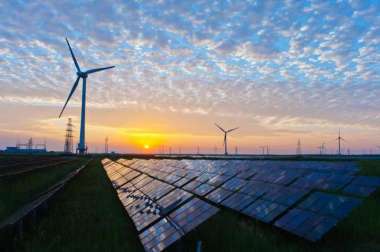
100% clean energy
¶ “Out of sight, out of mind: The energy department website shifts focus to the economy” • The US DOE’s pages on bioenergy and wind energy as well as transportation have both reduced their mentions of greenhouse gas emissions and reducing fossil fuel use in favor of language more geared toward jobs and energy independence. [Salon]
Science and Technology:
¶ And another vertical takeoff and landing (VTOL) aircraft takes to the sky, this time it was the first successful test flight of the Lilium Electric VTOL Taxi. The Lilium Electric VTOL Taxi will have a range of 187 miles and a top speed of 187 MPH. It would be an on-demand, all-electric airway taxi system that is quiet and free of traffic. [CleanTechnica]

Lilium Electric VTOL Taxi, from behind (Courtesy: Lilium)
¶ Coral reefs aren’t just threatened by pollution, acidification, and rising temperatures. In some places, erosion of the seafloor is undermining them, US Geological Survey scientists said in a new study that looked at reefs in Florida, the Caribbean and Hawaii. In some sites, the reefs can’t keep pace with sea level rise. [Summit County Citizens Voice]
World:
¶ As part of a local effort to increase alternative energy sources, the Japanese city of Kobe teamed up with Starbucks and researchers at Kindai University to carry out tests on producing biomass fuel generated from such things as used coffee grounds. The plan is to produce a solid fuel called “biocoke” that uses waste for fuel. [The Japan Times]

Biomass fuel to come from used coffee grounds (iStock)
¶ With the inauguration of a new entrance gate, solar panels, a 3-D website and a new sales counter, the 87-year-old Allahabad Museum can now boast of many new facilities. Governor Ram said that Allahabad Museum, by using solar PV technology, has become the first museum in India to be self-reliant in power generation. [ETEnergyworld.com]
¶ Seven renewable energy projects were cleared to proceed undertaking grid impact studies as of March, latest data from the Philippine Department of Energy showed. These projects are seen to generate 562 MW of power to the grid. They include three wind projects to be developed by Currimao Solar Energy Corp and three solar projects. [Philippine Star]

Solar project in the Philippines (Philstar.com | File)
¶ For more than four years, residents were barred from the hamlet of Naraha, in Fukushima, after the meltdowns at the Fukushima Daiichi nuclear power plant. This month, six years after the disaster, and over a year since the evacuation order was lifted, 105 students turned up at Naraha Elementary and Junior High School. [Pittsburgh Post-Gazette]
US:
¶ The Florida House and Senate are set to take up proposals to carry out a voter-approved expansion of a renewable-energy tax break, as bill language seems to be more agreeable to solar proponents. They are working on the proposals to carry out a renewable-energy constitutional amendment, which voters approved. [Orlando Weekly]
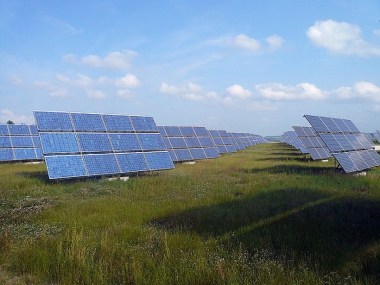
Solar array in Florida (Photo by Global Panorama via Flickr)
¶ Volkswagen AG has been sentenced to 3 years probation by a US federal judge in relation to the $4.3 billion diesel emissions cheating scandal. That includes independent oversight of the company. The company released a statement acknowledging fault and saying, “Volkswagen today is not the same company it was 19 months ago” [CleanTechnica]
¶ Macy’s has deployed 21 solar energy systems at a time on Earth Day. Altogether, there are 15 MW of solar energy stations distributed among the seven states of Bloomingdale’s locations. According to the Solar Energy Industries Association, Macy’s was ranked fourth for 2016 in terms of position in the world of renewable energy. [Ratings Alerts]
geoharvey is free and without ads.
geoharvey is not tax-deductible.
Posted in nuclear power, renewable power, solar, wind | 1 Comment »
Tags: nuclear, nuclear power, renewable power, solar power, wind power
April 22, 2017
Opinion:
¶ “Defend Science on Earth Day and Beyond” • On April 22, 1970, 20 million Americans participated in the first Earth Day – a nation-wide demonstration to advocate for a healthier planet. This marked the start of the modern environmental movement. Indeed, the first Earth Day led to the passage of a slew of environmental laws. [Huffington Post]

Earth Day 2010, Washington Mall
¶ “Even Nixon was a ’70s environmentalist: How bipartisanship made Earth Day a success” • Republican Representative Paul “Pete” McCloskey is largely a footnote in the history of the modern environmental movement. Yet his partnership with Wisconsin Democratic Senator Gaylord Nelson made the first one a success. [Idaho Statesman]
¶ “March for Science Chicago expects more than 45,000 to attend Saturday” • The first March for Science Chicago will take place on Earth Day on Saturday amid growing concern from environmental groups and scientists about climate change and other environmental issues. Similar events are scheduled around the world. [Chicago Tribune]

Chicago (Brian Cassella | Chicago Tribune 2015)
World:
¶ Britain went a full day without using coal to generate electricity for the first time since the Industrial Revolution, the National Grid says. Friday is thought to be the first time the nation has not used coal to generate electricity since the world’s first centralized public coal-fired generator opened in 1882, at Holborn Viaduct in London. [BBC]
¶ The lithium-ion battery manufacturer LG Chem has launched a residential battery systems line in the North American market, following completion of UL certification. Two different voltage options are available, a low-voltage 48-V option and a high-voltage 400-V option. Several different sizes are available, up to 9.8 kWh. [CleanTechnica]
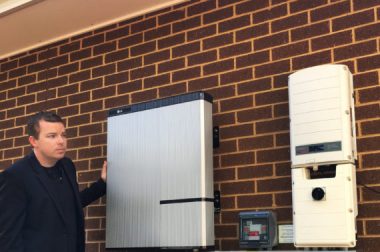
LG Chem home energy storage system
¶ French authorities have authorized plans for France’s largest offshore wind farm, over seven times the size of the current largest. The developer, Ailes Marines, will build off the coast of Brittany and has set the construction date for 2020. It will have a capacity of 493 MW, and will provide enough energy for 850,000 people. [The Local France]
¶ The Indian government plans to auction wind power projects of about 4 GW capacity in tranches this year, according to a senior official. The expectation is that five to six gigawatts of wind capacity will be auctioned off every year until 2022, to meet India’s commitment to have 60 GW of wind capacity installed by that date. [ETEnergyworld.com]
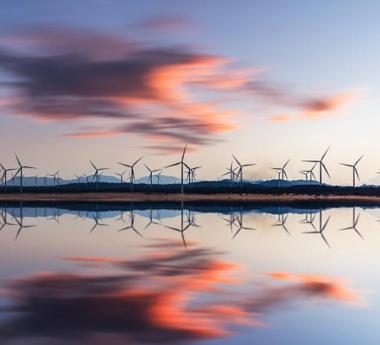
Indian wind farm
¶ Apple’s new data center in Denmark is set to distribute its heat into the local district heating network. The data center will be partly powered by recycling farm waste. Apple is working with Aarhus University on a system that passes agricultural waste through a digester to generate methane, which is then used to power the data center. [Decentralized Energy]
¶ Up to 200 jobs will be created as a Scottish dry dock comes out of a 23-year hibernation during the construction of what is said to be the world’s largest floating wind farm. Kishorn dry dock in the Highlands will be used to help build floating turbines for Kincardine Offshore’s 50-MW development off the coast of Aberdeen. [Aberdeen Evening Express]

Pumping out Kishorn dry dock (Kincardine Offshore | PA)
US:
¶ Oil giant Exxon Mobil will not be allowed to resume drilling in Russia after US President Donald Trump vowed to uphold sanctions. It had been reported that Exxon, the world’s largest publicly traded oil company, had sought a dispensation. The US and European Union imposed economic sanctions on Russia in 2014. [BBC News]
¶ Two natural-gas leaks in Rhode Island got the attention of the multinational companies that own the pipelines. But it’s unclear what is being done and what damage has been done. One leak, in South Providence, disrupted the gas service for National Grid customers. The other was in an Algonquin natural-gas pipeline in Burrillville. [ecoRI news]

Environmental crew (Tim Faulkner | ecoRI News)
¶ The Korea Electric Power Corp will enter the rapidly growing virtual power plant market in the US as part of efforts to find new growth engines. The state-run utility said it signed an agreement with KOKAM, a local lithium polymer battery maker for energy storage systems, and Sunverge, a renewable energy management firm. [koreatimes]
¶ NRG Energy, a power producer based in New Jersey, finished a 20-MW solar farm in California for leading IT and networking firm Cisco. The plant is on 60 hectares in the Lower Colorado River Valley region. It will generate power for use at the company’s San Jose headquarters under a 20-year power purchase agreement. [PV-Tech]

NRG solar farm (Source: NRG Energy)
¶ In 2015 the New Mexico utility PNM created a subsidiary to buy a coal mine that supplies its San Juan Generating Station. Now all of a sudden PNM has announced a new energy plan that shuts down part of the power plant in just a few months, with the remaining units following those into the dustbin by 2022. [CleanTechnica]
¶ Members of the planning commission in Vernon, Vermont, have drawn up a plan, “Re-energizing Vernon.” In it, they explore the possibility of a multi-fuel, clean-energy, affordable micro-grid on the site of the closed Vermont Yankee nuclear power plant. Important components would include the 32-MW Vernon dam and batteries. [Rutland Herald]
geoharvey is free and without ads.
geoharvey is not tax-deductible.
Posted in nuclear power, renewable power, solar, wind | 1 Comment »
Tags: nuclear, nuclear power, renewable power, solar power, wind power
April 20, 2017
Opinion:
¶ “Unsubsidized wind and solar now the cheapest source for new electric power” • Last year, the average “levelized cost” of electricity from solar worldwide dropped 17% percent, onshore wind costs dropped 18% and offshore costs fell 28%. Unsubsidized wind and solar can provide the lowest cost new electrical power. [Computerworld]

Italian village in a wind farm (NASA photo)
¶ “Rick Perry’s Memo Is A Minefield” • Rick Perry directed the Department of Energy to do a 60-day study of the US electric grid. The memo clearly tries to look innocuous. Nevertheless, it is a minefield full of hidden traps for those who do not parse it carefully and a groundwork for an attack on low-cost solar and wind power. [CleanTechnica]
¶ “Trump Admin. Outlines Global Solar Plan: 10 Terawatts By 2030” • President Trump talks a great game when it comes to coal jobs. But the latest item in the flood of renewable energy news from the Energy Department is a study that charts a do-able path for global energy producers to harvest 5-10 TW of solar power by 2030. [CleanTechnica]
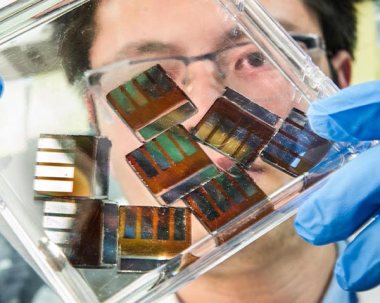
Hybrid perovskite solar cells (Photo via NREL, cropped)
¶ “Fusion reactors: Not what they’re cracked up to be” • After having worked on nuclear fusion experiments for 25 years at the Princeton Plasma Physics Lab, I began to look at fusion more dispassionately. I concluded that a fusion reactor would be far from perfect, and in some ways close to the opposite. [Bulletin of the Atomic Scientists]
World:
¶ According to analysts, China, home to the world’s largest installations of solar farms, will install fewer panels in 2017, taking a breather for the first time in five years, amid arrears in subsidies and bottleneck problems with the country’s power grids. Chinese solar farms will add between 26 GW and 28 GW of capacity this year. [South China Morning Post]
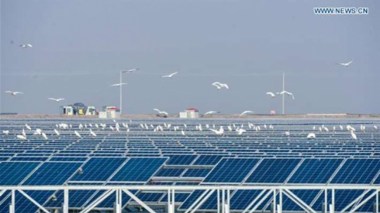
Zhejiang solar fish farm
¶ The long goodbye for coal in Europe is accelerating as the cost of shifting to green energy plunges. Companies including Drax Group Plc, Steag GmbH, and Uniper SE are closing or converting coal-burning generators at a record pace from Austria to the UK, as they are made obsolete by competition from cheaper wind and solar power. [BloombergQuint]
¶ The 240-MW Ararat wind farm in the Australian state of Victoria has been completed, with all 75 of its GE turbines now feeding energy into the grid. The project, powered by GE 3.2-103 machines, will provide the Australian Capital Territory with 40% of electricity produced from the site. Construction commenced in late 2015. [reNews]
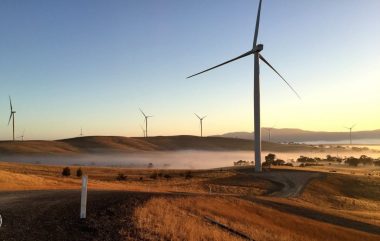
Ararat Wind Farm (courtesy photo)
¶ Niigata’s Governor said a longer period may be needed to verify safety at the Kashiwazaki-Kariwa nuclear power plant, destroying TEPCO’s schedule to restart reactors. He said it will take time to confirm that the nuclear plant can withstand major earthquakes, especially a building that would be headquarters in the event of a severe accident. [Asahi Shimbun]
¶ Prime minister Malcolm Turnbull has extended his vision of large-scale pumped hydro and storage to Tasmania, outlining plans to expand the island’s existing hydropower system, and possibly add 2,500 MW in pumped hydro, and describing the possibility that the state could become the “renewable energy battery” for Australia. [RenewEconomy]
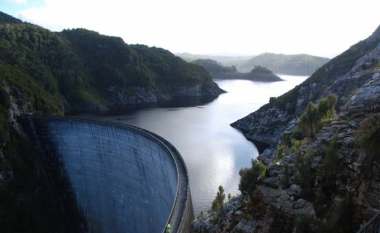
Gordon Dam in Tasmania
US:
¶ EPA Administrator Scott Pruitt has told oil and gas industry leaders that the agency will reconsider its methane emissions rule following a petition from industry leaders, a move decried by environmentalists. The move will reconsider an Obama-era regulation meant to curb methane emissions from new oil and gas wells. [CNN]
¶ South Lake Tahoe, California became the 26th municipality in the US and the latest in a growing coalition of communities to commit to 100% renewable electricity. The city council approved a measure that sets a goal to switch entirely to renewable sources of electricity by 2032. Winter tourism is the region’s leading industry. [Windpower Engineering]

Lake Tahoe
¶ San Francisco reached an ambitious goal to reduce greenhouse gases locally two years ahead of schedule, according to city officials. Recently compiled figures show the city’s overall greenhouse gas emissions had fallen to 28% below 1990 levels by 2015. The city’s goal, set in 2008, was to hit 25% below 1990 levels by 2017. [SFBay]
¶ Sound Transit has signed a 10-year agreement with Puget Sound Energy that will enable Seattle’s Link light rail network to operate on 100% renewable energy from 2019. Sound Transit will purchase electricity generated by wind turbines through PSE’s Green Direct Program, reducing its exposure to fluctuations in utility prices. [International Railway Journal]

Seattle Link light rail
¶ Thanks to another strong year for wind energy growth, US wind power added jobs over nine times faster than the overall economy in 2016, the American Wind Energy Association said. Installing more than 8 GW of new wind power for a second straight year, the industry supports a record-high 102,500 jobs in the country. [North American Windpower]
¶ As part of Governor Cuomo’s Reforming the Energy Vision program, the New York State Energy Research and Development Authority announced that $15.5 million in funding is available for energy storage projects that can support renewable energy technologies, save customers money, and ease peak electric demand. [LongIsland.com]
geoharvey is free and without ads.
geoharvey is not tax-deductible.
Posted in nuclear power, renewable power, solar, wind | 1 Comment »
Tags: nuclear, nuclear power, renewable power, solar power, wind power
April 19, 2017
Opinion:
¶ “The State & Promise of the Electric Airplane” • The electric airplane industry truly is the final frontier. Hauling a battery pack in a car for propulsion is fairly easy compared to dragging one around in the air. This article provides a glimpse of the state and promise of the electric airplane – the new wild frontier. [CleanTechnica]

Hamilton aEro
¶ “What America’s workers know about climate change” • Unions and environmental advocates have had our differences over the years, but increasingly we are finding common ground based on our shared concerns. And more than ever, union members are experiencing firsthand the threat the climate crisis poses to those core values. [CNN]
¶ “To Build A More Resilient Electric Grid, Many Believe The Answer Is Going Small” • Nearly half a million miles of high-voltage transmission lines cross the country, but the people planning the future of America’s electric grid are thinking small. They say we should build microgrids – small systems that can connect and disconnect. [WBUR]

Brooklyn substation, hit by Hurricane Sandy
(Bebeto Matthews | AP)
Science and Technology:
¶ The herbicide Paraquat became a household word for all the wrong reasons during the Vietnam War, but now it is helping solve an EV battery “dendrite” problem that has stumped researchers for 40 years. If all goes well, the result will be a new generation of lithium-based EV batteries with five to 10 times the range of today’s. [CleanTechnica]
World:
¶ Acciona has started building the 132-MW Mount Gellibrand wind farm in the Australian state of Victoria. The project, estimated to cost A$258 million ($194 million), will feature 44 Nordex AW125/3000 turbines mounted on 87.5 meter steel towers. The developer has an agreement to sell power into the wholesale electricity market. [reNews]

Waubra wind farm (Acciona image)
¶ Non-fossil fuels – renewables, nuclear and large hydroelectric power plants – will be 56.5% of India’s installed power capacity by 2027, according to a draft of the third National Electricity Plan. It notes that if India achieves its target for 2022, it will not need to begin construction of coal-fired capacity until after 2027, if then. [ETEnergyworld.com]
¶ Scottish Labour says its proposal to ban fracking was backed by 87% of the public in a recent consultation. A greater percentage worries over fracking. When asked if fracking poses “too many risks relating to pollution of the earth, water and air, and increased seismic activity”, 95% of respondents agreed, and 4% disagreed. [insider.co.uk]

No fracking (Getty image)
¶ According to a report in, the Financial Times, the fourth largest pension fund in Denmark divested itself of investments in five Canadian oil producers, and is assessing another 44 oil and gas companies. Its managers worry that fossil fuel companies are at risk of becoming stranded assets. The fund has assets worth €33.6 billion. [CleanTechnica]
US:
¶ A former strip mine would be converted into a solar farm under a proposal to use it for hundreds of thousands of panels. The Berkeley Energy Group, EDF Renewable Energy, and former Democratic state Auditor Adam Edelen said they are looking at two mountaintop removal sites in the heart of Kentucky’s coal country. [Paducah Sun]

Mountaintop removal site near Pikeville
(Kenny Stanley | Berkeley Energy Group via AP)
¶ A pro-Paris bloc within the administration recruited energy companies for support ahead of a high-level White House meeting, according to two people familiar with the effort who asked not to be identified. ExxonMobil and Royal Dutch Shell are among those endorsing the pact. So are Trump’s daughter Ivanka and her husband. [Livemint]
¶ Oklahoma Governor Mary Fallin signed legislation to end the state’s tax credit for new wind developments, StateImpact Oklahoma reported. One of the bill’s sponsors said the state can no longer afford the tax credit due to extraordinary budget challenges. Fallin also called for an end to the subsidy in her 2017 budget proposal. [Power Engineering Magazine]

Oklahoma wind farm
¶ Portland Commissioner Nick Fish is asking the Portland, Oregon, City Council to commit $12 million in sewer ratepayer funds to convert waste methane from the city’s sewage treatment process into renewable natural gas. The proposal calls for the fuel to be sold in Portland and elsewhere to replace diesel fuel in trucks. [Portland Tribune]
¶ Despite the hit that many investors in the shale oil industry have taken in recent years because of producers going bust, about $19.8 billion was invested in the sector by private equity funds during the first quarter of 2017, the financial data provider Preqin says. This is a roughly 3-fold increase, year on year, in private investment. [CleanTechnica]
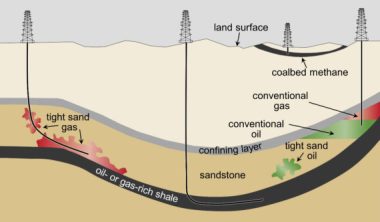
Oil and gas wells (Image via US EPA)
¶ Eagle Creek Renewable Energy, LLC, has struck a deal with now-defunct Madison Paper Industries to purchase the 8-MW Anson and 20-MW Abnaki hydroelectric projects in Maine. The pair of small hydropower plants on the Kennebec River had been used for power generation from 1978 until they were shuttered last year. [HydroWorld]
¶ Federal regulators ruled that the owners of Pilgrim Nuclear Power Station will not have to re-evaluate the risks of floods and earthquakes to the Plymouth nuclear plant or upgrade the vent system intended to prevent explosions in accident scenarios. The decision was blasted by the state’s two US senators, Warren and Markey. [Recorder]
geoharvey is free and without ads.
geoharvey is not tax-deductible.
Posted in nuclear power, renewable power, solar, wind | 1 Comment »
Tags: nuclear, nuclear power, renewable power, solar power, wind power
April 18, 2017
Opinion:
¶ “Rick Perry targets wind, solar after overseeing renewables explosion in Texas” • US Energy Secretary Rick Perry didn’t mention renewable energy by name. But his request for the DOE to investigate how federal subsidies boost renewables at the expense of baseload generation was clearly meant as a swipe at wind and solar energy. [RenewEconomy]

The Roscoe Wind Farm in Texas at sunrise
(Fredlyfish4, Wikimedia Commons)
¶ “How Trump could make US a climate pariah over Paris pact” • EPA Administrator Scott Pruitt is arguing to pull the US out of the Paris Climate Accord, but Secretary of State Rex Tillerson is arguing to stay. If Trump goes with Pruitt instead of Tillerson, he will create a worldwide consensus: to oppose the US for climate inaction. [KBZK Bozeman News]
World:
¶ Renewable energy has hit a new record in Germany. It made up just over 41% of Germany’s power supply last month, the most ever at around 19.5 TWh. It’s a good thing, too, because nuclear power production may have fallen to its lowest monthly level since the 1970s – even though no nuclear plant has been shut off since 2015. [CleanTechnica]
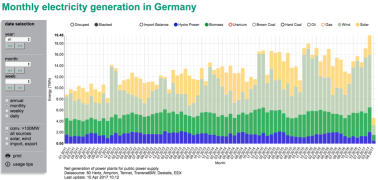
Generation from hydro, biomass, wind, and solar
Please click on the image to enlarge it.
¶ Fortum Corporation, based in Finland, recently announced that it commissioned its largest solar power project. The project, located in the Indian state of Rajasthan, is also among the cheapest solar power projects in the country. Fortum said it commissioned the 70-MW solar project under India’s National Solar Mission. [CleanTechnica]
¶ In March, Germany conducted successful tests of the world’s first “Hydrail,” a hydrogen powered, zero-emission train. “The new train is 60% less noisy than a traditional diesel train, completely emission free,” said Jens Sprotte of Alstom, train’s producer. “The only sound it gives off comes from the wheels and air resistance.” [CNN]

Screenshot
¶ The Middle East and North Africa will need investments of $302 billion over the next five years to cover the rising demand for electricity, estimates by APICORP Energy Research say. Of this, $179 billion, a little less than 60%, will be needed to add generating capacity. The rest, $123 billion, is for transmission and distribution. [Zawya]
¶ Gaza’s only power plant has run out of fuel, leaving 2 million residents of the coastal enclave with only four hours of electricity a day in what the UN cautions could be the tipping point to making Gaza “unlivable.” The Palestinian Authority in the West Bank and Hamas in Gaza blame each other for the energy shortage. [CNN]

Darkened street in Gaza
¶ Egypt aims to increase its use of renewable energy to 22% by 2020, according to its investment and international cooperation minister, Sahar Nasr. She discussed investments in Egypt with the regional director of Norway’s Scatec Solar, Morten Langsholdt. He said various investors were interested in making $3 billion in investments. [Ahram Online]
US:
¶ Energy Secretary Rick Perry ordered the DOE to conduct a study of renewable energy on the US electric grid. His Monday morning memo said that the review would assess whether federal environmental policies have hurt the power grid’s ability to supply baseload power, which depends on fossil fuels, over the past few years. [Washington Examiner]

Refinery
¶ President Donald Trump’s top advisors will meet today, April 18, to discuss whether to recommend that he withdraw the US from the Paris climate accord, a White House official said. The accord, agreed upon by nearly 200 countries in Paris in 2015, aims to limit planetary warming in part by slashing carbon dioxide and other emissions. [The Wire]
¶ As part of its carbon-reduction plans, Boston-based nonprofit Partners HealthCare signed a contract to buy power from a 28.8-MW wind project to be built in Antrim, New Hampshire. Partners will purchase 75% of the project’s capacity. The wind farm, owned by Walden Green Energy, is to be completed in 2019. [North American Windpower]

Visual simulation of the Antrim wind farm
(Courtesy of Partners HealthCare)
¶ Southern California Edison, General Electric Co, and Wellhead Power Solutions partnered to install 10-MW lithium-ion batteries at two of the utility’s gas generators. During periods of peak demand, the batteries can provide instant power while gas turbines ramp up. They are expected to reduce emissions by at least 60%. [BloombergQuint]
¶ Hearings for PG&E’s proposal to close Diablo Canyon nuclear power plant will begin Wednesday. The California Public Utilities Commission will begin hearing testimony at 10 AM in San Francisco. The Commission has scheduled a total of eight hearings from April 19 and April 28 to hear testimony. [The San Luis Obispo Tribune]

Diablo Canyon nuclear power plant
(Joe Johnston jjohnston@thetribunenews.com)
¶ Saving money is at the core of the business case for going green. And in a lot of places around the country, solar and wind are now the cheapest energy option. In coal-loving Kentucky, General Motors, Ford, Walmart, L’Oreal, and even the state’s beloved bourbon makers are starting to look at renewables. [Minnesota Public Radio News]
¶ With federal clean energy programs under attack, local environmental activists gathered in Beverly, Massachusetts, last week to launch a statewide campaign calling on cities and towns in Massachusetts to commit to 100% clean, renewable energy. Many worry about effects on the environment from burning fossil fuels. [Wicked Local Beverly]
geoharvey is free and without ads.
geoharvey is not tax-deductible.
Posted in nuclear power, renewable power, solar, wind | 2 Comments »
Tags: nuclear, nuclear power, renewable power, solar power, wind power
April 17, 2017
Opinion:
¶ “NREL is a driver of cutting-edge research and industry” • Thanks in part to a federally funded lab that does cutting-edge energy research, America is closer to energy independence than we’ve ever been in modern times. So it’s a shock that in the president’s proposed budget, that lab is on the chopping block. [The Denver Post]

Wind turbines at NREL’s National Wind Technology Center
south of Boulder (Helen H Richardson, Denver Post)
¶ “Grid unlocked: Consumers are driving Asia’s energy revolution” • All across Asia, rising expectations from consumers are driving the disruption of utilities, forcing well-entrenched electricity providers to change. Ahead of Asian Utility Week 2017, Eco-Business looks at the trend and its implications for the electricity supply. [eco-business.com]
Science and Technology:
¶ The Tesla Gigafactory produces lithium-ion batteries for Tesla vehicles and alternative energy sources. And, in a recent video, CEO and founder Elon Musk was actually quoted as saying: “We actually did the calculations to figure out what it would take to transition the whole world to sustainable energy. You’d need 100 Gigafactories.” [Futurism]

Leonardo DiCaprio at the Gigafactory (screen shot)
¶ Vermont is famous for its natural and mesmerizing landscape that includes a big forest. Unfortunately, a recent report has revealed a decrease in the bird population there. ABC News reported a sharp decline of 14.2% in the bird population over the last 25 years. Climate change, invasive species, and acid rain are among the causes. [Science Times]
World:
¶ Some Japanese farmers have begun looking to biogas technology to allow them to turn their properties into power plants, giving them a way to transform animal and other waste into profits. Biogas is consists mainly of methane that can be produced through fermentation of organic materials such as livestock waste or food waste. [The Japan Times]

A potato field using liquid residues from a
local biogas power plant as fertilizer (Kyodo)
¶ Indian mobile infrastructure and telecom tower companies are aiming to further cut their carbon footprint by reducing dependency on fossil fuel as a part of a ‘Go Green’ initiative. The sector has already deployed 90,000 diesel-free mobile sites, according to a lobby group Towers and Infrastructure Providers Association. [ETTelecom.com]
¶ Record low temperatures and unseasonable rainfall over the past week were a glimpse into the potential, intensifying effects of climate change in Cambodia, experts said, a phenomenon that studies suggest could seriously hinder future agricultural productivity through flooding, unpredictable rains and warming of up to 5° C by 2050. [The Cambodia Daily]

Storm-felled tree outside The Cambodia Daily’s office
in Phnom Penh (Douglas Steele | The Cambodia Daily)
¶ Three more Apple suppliers committed to using 100% renewable energy to manufacture its components, an executive of the company told Bloomberg Technology. Biel Crystal Manufactory, based in Hong Kong; Compal Electronics, of Taiwan; and Sunwoda Electronics, of Shenzhen City, China, have made the pledge. [Energy Manager Today]
¶ WWF, Greenpeace and other UK environmental groups urged the prime minister not to water down legislation on climate change and wildlife protection after Brexit. The UK government had promised it would leave the environment in a better state for future generations, but the groups expressed concerns about backtracking. [BBC]

Over half of UK wildlife is in decline. (Science Photo Library)
¶ Saudi Arabia will develop 30 solar and wind projects over the next 10 years as part of the kingdom’s $50 billion program to boost power generation and cut its oil consumption. The world’s biggest crude oil exporter will get 10% of its power from renewables by 2023, its Energy Minister said. It also plans to build nuclear plants. [Bloomberg]
US:
¶ The story of a solar push and pull in Florida goes on, this time with a good note: Floridians for Solar Choice writes that a Gulf Power settlement means customers will not have to face a huge fixed charge for having rooftop solar power. Gulf Power had proposed a charge was $50 every month, making it hard to save money with solar power. [CleanTechnica]
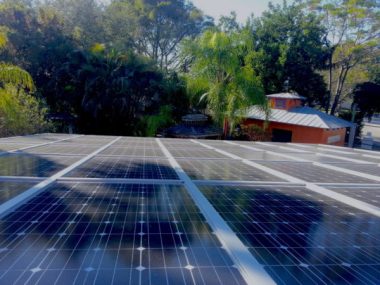
Rooftop solar in Florida
¶ Cities across the US are working to limit their emissions of climate-change gases, turning to solar power, and using other tactics. A report, Shining Cities 2017, rates cities for solar power. It says that solar-energy policies are more critical to successful solar adoption than any other factor, even including the number of days of sunshine. [Green Car Reports]
¶ Carbon fuels cause climate change and pollution, costing all of us money. The Citizens’ Climate Lobby is advocating for a fee to be charged against carbon at the point it enters the US economy. The group’s single mission is to lobby all 535 members of Congress each year for a carbon fee. Indiana has seven chapters working on that. [Terre Haute Tribune Star]
geoharvey is free and without ads.
geoharvey is not tax-deductible.
Posted in nuclear power, renewable power, solar, wind | Leave a Comment »
Tags: nuclear, nuclear power, renewable power, solar power, wind power
April 16, 2017
Opinion:
¶ “The Nuclear Industry Is Heading Into a Financial Black Hole That Threatens Any Future Expansion” • Any lingering hope that a nuclear power renaissance would help combat climate change appears to have been dashed by the Westinghouse bankruptcy. “There is no one left to invest anymore because renewables are just cheaper.” [Truthdig]

Sunset at the Sellafield nuclear plant (Dom Crayford | Flickr)
¶ “Why scientists are fighting back. We’ve had enough of Trump’s war on facts” • Next Saturday, in Washington, DC, and in rallies around the world, scientists and their supporters will stage what is likely to be the largest gathering of its kind in history. The March for Science has mobilised scientists and their supporters as never before. [The Guardian]
¶ “The de-electrification of the US economy” • The initial drop in electricity use in 2008 and 2009 could be attributed partly to the economic downturn. But the economy grew again in 2010, and every year since. Meanwhile, electricity use in the US is still below its 2007 level. Per-capita electricity use has fallen for six years in a row. [Livemint]

Transmission lines (Photo: Bloomberg)
World:
¶ India will add nearly 600 million new electricity consumers by 2040, according to the International Energy Agency. Taking the increasing population into account, along with a high policy priority to make power accessible across India, renewable forms of energy offer the best solution. DC solar products are seeing good traction in rural India. [Firstpost]
¶ Tawau Green Energy Sdn Bhd announced that it is on track to develop Malaysia’s first geothermal power plant project in Sabah, in 2019. The company has received all requisite approvals to develop, construct, operate, and maintain a geothermal power plant, exporting 30 MW to the Sabah Grid at a feed-in tariff of RM0.45/kWh (10¢/kWh). [ThinkGeoEnergy]

Geothermal project site in Sabah (source: Tawau Green Energy)
¶ The Energy Minister for the Indian state of Telangana said the state government will announce a new program to encourage solar power generation in every house. He inaugurated a 143-MW solar power generation project that was established ReNew Power, with an investment of ₹1,000 crore ($150.3 million). [The New Indian Express]
¶ Madhya Pradesh government will sign a power purchase agreement with the Delhi Metro Rail Corporation on April 17 to supply 24% of electricity generated from the Rewa ultra mega solar project to be set up in the state. The 750-MW project will have three units of 250 MW. They are planned be operational in 18 months. [Hindustan Times]

Delhi Metro (Reuters photo)
US:
¶ EPA administrator Scott Pruitt may have to back up his false claims on greenhouse gases and climate change in court. A lawsuit filed by the watchdog group Public Employees for Environmental Responsibility wants him to produce studies backing up his statements questioning the role of CO2 in climate change. [Summit County Citizens Voice]
¶ Several new jobs are coming to a power plant in Lynchburg, Virginia, that has sat dormant for five years, according to Eagle Creek Renewable energy. Appalachian Power transferred the Reusens hydroelectric plant, which had closed in 2011, to Eagle Creek. An Eagle Creek spokesman said the plant will provide about 40,000 MWh per year. [WSET]
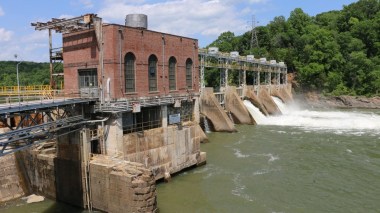
Reusens hydroelectric plant (Appalachian Power)
¶ Two Albuquerque City Council members announced that they will soon file legislation that will allow the city to issue $25 million in renewable energy bonds. The money will go toward installing solar panels on city buildings throughout the city. Albuquerque is committed to getting 25% of its energy from solar by 2025. [Albuquerque Journal]
¶ California’s famously congested freeways may soon do more than create headaches. State officials agreed last week to fund an initiative to generate electrical power from traffic, a plan that involves harnessing road vibrations with the intent of turning the automobile, like the sun and wind, into a viable source of renewable energy. [WatertownDailyTimes.com]
geoharvey is free and without ads.
geoharvey is not tax-deductible.
Posted in nuclear power, renewable power, solar, wind | 2 Comments »
Tags: nuclear, nuclear power, renewable power, solar power, wind power
April 15, 2017
Opinion:
¶ “Welcome to the post-apocalyptic National Parks” • National parks in the US are already seeing the effects of climate change. Glaciers are melting, whitebark pines are under attack by pests, and wildfires are eating away at acres of land across the US. What will happen to our treasured parks by 2050 if we don’t address climate change? [The Verge]

Please click on the image to enlarge it.
Science and Technology:
¶ The Arctic sea ice death spiral is continuing to accelerate, with March 2017 setting new record lows (for the month) with regard to extent and thickness, according to data released by the National Snow and Ice Data Center. In March, there was an area of about 452,000 square miles of open ocean that would have been ice in past years. [CleanTechnica]
¶ A study published in Nature Communications shows countries that have signed the Paris Climate Accord must reduce their carbon emissions much sooner than anticipated to reach the agreement’s goal. The authors, from the International Institute for Applied Systems Analysis, show that the shift must come well before 2040. [ColorLines magazine]
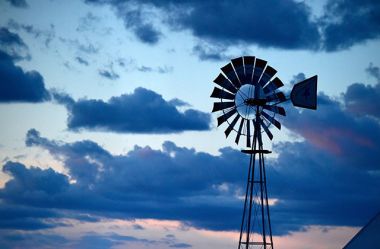
Old windmill (Frazer Harrison | Getty Images for Stagecoach)
World:
¶ The government of Punjab province in Pakistan has reiterated its commitment to install rooftop solar power systems on about 20,000 schools. The government-backed Khadam-e-Punjab Ujala Programme aims to set up rooftop solar power systems at schools, health centers, and higher education centers such as Bahawalpur University. [CleanTechnica]
¶ As Australia’s renewable energy industry awaits the outcome of the South Australian government’s inaugural large-scale energy storage auction, the CFO of the Australian Renewable Energy Agency has described two key competing technologies – large-scale battery systems and pumped hydro – as neck and neck on pricing. [CleanTechnica]

Tesla batteries at a sub-station
¶ ReNew Power Ventures Pvt Ltd, an Indian renewable energy independent power producer, commissioned a 143-MW solar farm in the village of Dichpally, Telangana. It is one of the first to use tracker technology at such a large scale. This increases electric generation by up to 20%. The project was finished three months ahead of the schedule. [Telangana Today]
¶ Australia’s energy debate seems to be focused on the ability of its generation fleet to meet peak demands next summer when the heat-waves are most intense. The lesson from the past summer is: Don’t count on fossil fuels keeping your air-con on when it is needed most. And unlike the sun and wind, fossil fuels’ failures are unpredictable. [CleanTechnica]
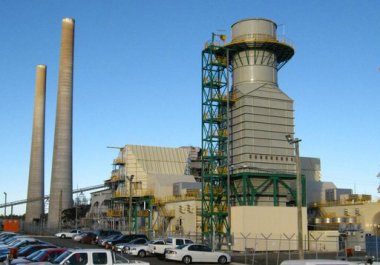
Australian coal-burning plant
US:
¶ Responding to what they see as “an all-out assault on our environment by the Trump administration,” a coalition of green-energy advocates launched an effort calling for Massachusetts communities to commit to 100% renewable energy while pressing the Legislature to get all its energy from sources like wind and solar. [Recorder]
¶ The official numbers from the EPA are in and the Tesla Model S 100D range came in at 331.1 miles in city driving, alongside a highway range of 337.2 miles and a combined rating of 335 miles. MPGe ratings are impressive as well – 101 city, 102 highway, 102 combined. The lowest price of the Model S 100D is $92,500. [CleanTechnica]

Tesla Model S (Image: Cynthia Shahan | CleanTechnica.pics)
¶ The US DOE unveiled a new version of its PV System Toolkit, a complete package of development tools designed to make it easier for cooperative utility companies in rural areas to transition to renewable solar power. Because they are non-profit organizations, co-ops are not eligible for the sizable federal solar power incentives. [CleanTechnica]
¶ The Central Arizona Project, which uses power to transport water to the desert areas of Arizona, will be turning away from coal plants, like the Navajo Generating Station, and looking towards a future of new energy solutions. Official decisions have not yet been made about how the Central Arizona Project will be powered. [Breaking Energy]

Arizona countryside (Photo by David Cannon | Getty Images)
¶ Senator Jeff Merkley (D-Ore) plans to introduce legislation outlining how the United States can completely wean itself off fossil fuels by 2050, his office said. The bill will be introduced during the week of April 24, shortly before the People’s Climate Movement. Senator Bernie Sanders (I-Vt) will co-sponsor the bill, called the “100 By ‘50 Act.” [Huffington Post]
¶ A lawsuit has been filed by a group of power suppliers saying that a deal reached to keep the Clinton nuclear power plant open is illegal. The lawsuit says the Zero Emissions Credits and the Future Energy Jobs Act aims to reverse wholesale energy markets, and that this new law would hurt the consumers, increasing their electricity rates. [WAND]
geoharvey is free and without ads.
geoharvey is not tax-deductible.
Posted in nuclear power, renewable power, solar, wind | 1 Comment »
Tags: nuclear, nuclear power, renewable power, solar power, wind power
April 14, 2017
Opinion:
¶ “Nuclear plant shutdown divides Great Lakes community” • There are nine nuclear plants on the US side of the Great Lakes, but cheaper energy sources are forcing some to shut down. About half of the funding for Covert Public Schools, in Covert, Michigan, comes from taxes on Palisades Nuclear Plant, but many residents want to see it close. [WBFO]
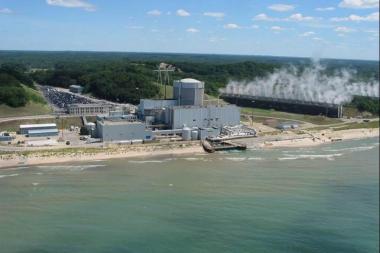
Palisades Nuclear Plant (NRC image)
¶ “EPA Administrator Scott Pruitt’s claim that China and India have ‘no obligations’ until 2030 under the Paris Accord” • The EPA administrator denounced the Paris Climate Accord as a “bad deal for America,” claiming China and India had no obligations until 2030. We have good news for him. That problem is solved! [Washington Post]
Science and Technology:
¶ A research paper examines a previously unknown influence of humans on extreme weather. Carbon emissions lead to warming of the atmosphere in polar regions, and this leads to the jet stream getting stuck in place. This, in turn, leads to extended periods in which the weather persists, producing drought and other extreme weather. [CleanTechnica]

Jet stream (NOAA image)
World:
¶ EnBW has secured the bulk of the 1.5-GW on offer with its 900-MW He Dreiht project in the German North Sea. The developer won with a bid of zero, which means it is pledging to build and operate the wind farm without the support of a feed-in tariff and relying instead on the market rate. The wind farm is expected to be operational in 2023. [reNews]
¶ Scotrenewables has produced full power from its 2-MW SR2000 tidal turbine off the north coast of Scotland. The 500-tonne floating device reached the milestone earlier this week at the European Marine Energy Centre on Orkney following a phased testing program. Device results to date are said to be in line with forecasts. [reNews]
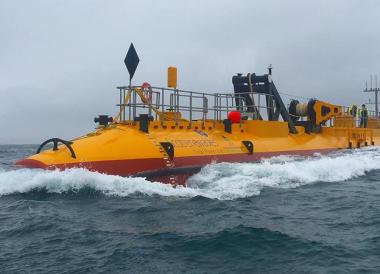
SR2000 tidal machine
¶ The number of solar panels being installed in the UK has fallen by more than 80%, according to an analysis of new figures. It is the latest sign that the industry is being strangled by government policies despite being one of the cheapest sources of electricity. The number of people putting solar panels on their homes is now at a six-year low. [The Independent]
¶ The Edge, a new 10 story office building in Edmonton, Alberta, will be covered with 500 solar panels on its south side. Together with daylight gathered from north facing windows, they are expected to supply 80% of the building’s electrical needs, says Dub Architects, the company responsible for the design of the building. [CleanTechnica]

The Edge (Credit: Dub Architects)
US:
¶ The Sierra Club’s Executive Director visited the Hanover, New Hampshire, Town Hall to describe national sustainability efforts. Next month, Hanover’s Town Meeting will vote on using 100% renewable energy by 2050. Hanover’s proposed goal, part of the “Ready For 100” campaign, would include electricity, heat and transportation. [Valley News]
¶ Sonnen, a battery company based in Germany, is planning to open a new innovation hub in Atlanta as part of its mission to become a supplier of residential storage batteries in America. The lithium iron phosphate chemistry used in the battery eliminates the risk of fire or explosion associated with traditional lithium-ion batteries. [CleanTechnica]

Sonnen residential battery (Sonnen Battery image)
¶ Tesla will unveil an electric articulated truck in September, Elon Musk has said, and an electric pick-up truck would be shown off in around 18-24 months. However, analysts are concerned the company will not meet demand for its current projects. Tesla has 400,000 pre-orders for the Model 3, which is yet to go into production. [BBC]
¶ Advanced Microgrid Solutions announced it will design, install and operate its Hybrid Electric Building systems for Walmart, providing 40 MWh of battery systems for 27 stores in Southern California. AMS says these will improve energy efficiency, guarantee the retailer electricity savings and provide grid services to local utilities. [Energy Matters]
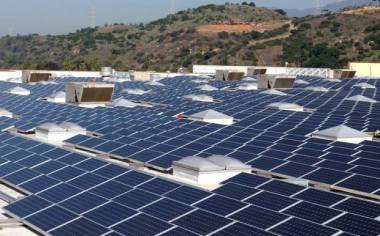
Solar panels on the roof of a Walmart store
¶ Leading US power company NRG has announced it will work with a leading provider of distributed ice battery storage, Ice Energy, to deploy Ice Bear storage systems on qualifying commercial and industrial buildings in Orange County. The Ice Bear system makes ice when grid demand is low and uses it for air conditioning. [CleanTechnica]
¶ Cloud computing giant Salesforce first committed to achieving net-zero emissions in 2015 as part of a “Net Zero by 2050” initiative led by the B Team, a group of global business leaders. The San Francisco firm just announced that said it has reached its 2050 environmental milestones and is offering a “carbon-neutral cloud” for its customers. [Mashable]

Turbine in a wind farm
¶ Microsoft could bypass Puget Sound Energy to secure clean power from another source under a tentative settlement. It is a striking shift in the relationship between Washington’s largest private utility and its largest corporate customer. It was spurred by Microsoft’s quest to combat climate freeing itself of energy from fossil fuels. [The Seattle Times]
¶ The Arizona Republic reports Peabody Energy is working to save the 2,250-MW Navajo Generating Station, the largest coal-fired power plant in the West, which purchases coal from the mining company. Peabody has offered coal at a lower fixed price through 2025, and believes new ownership could keep the plant running profitably. [Utility Dive]
geoharvey is free and without ads.
geoharvey is not tax-deductible.
Posted in nuclear power, renewable power, solar, wind | 1 Comment »
Tags: nuclear, nuclear power, renewable power, solar power, wind power


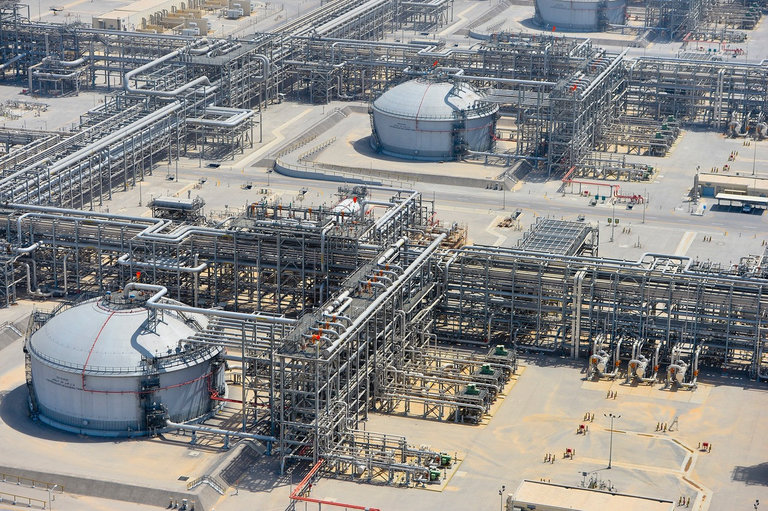
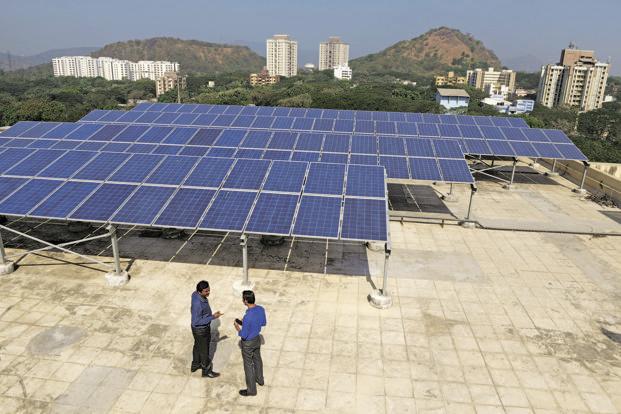
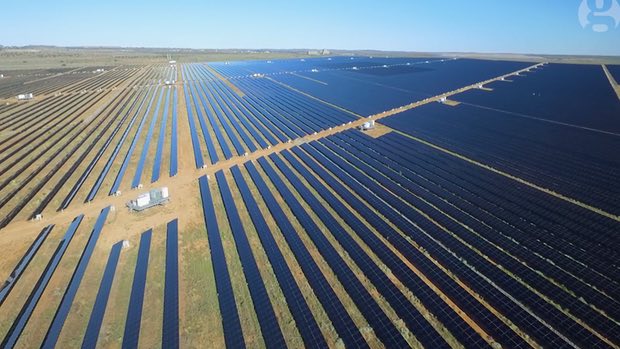
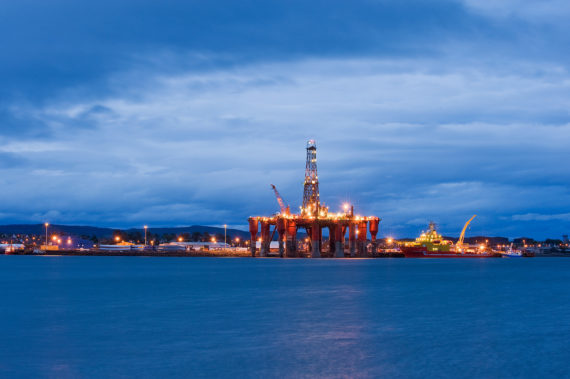
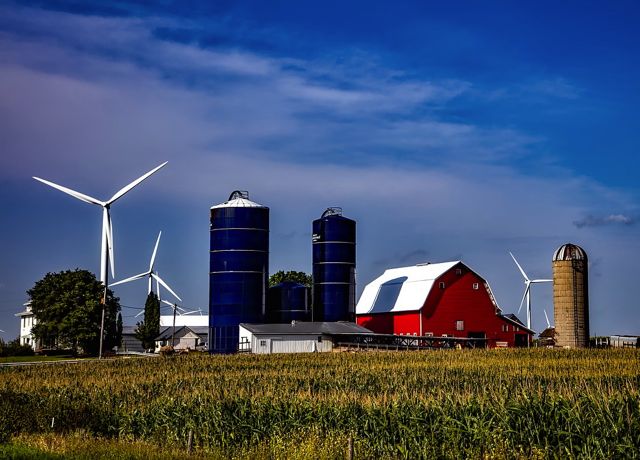
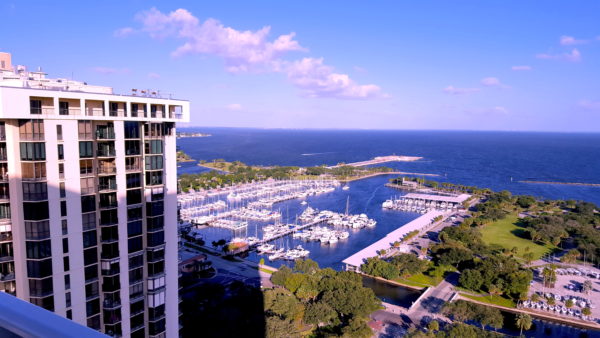

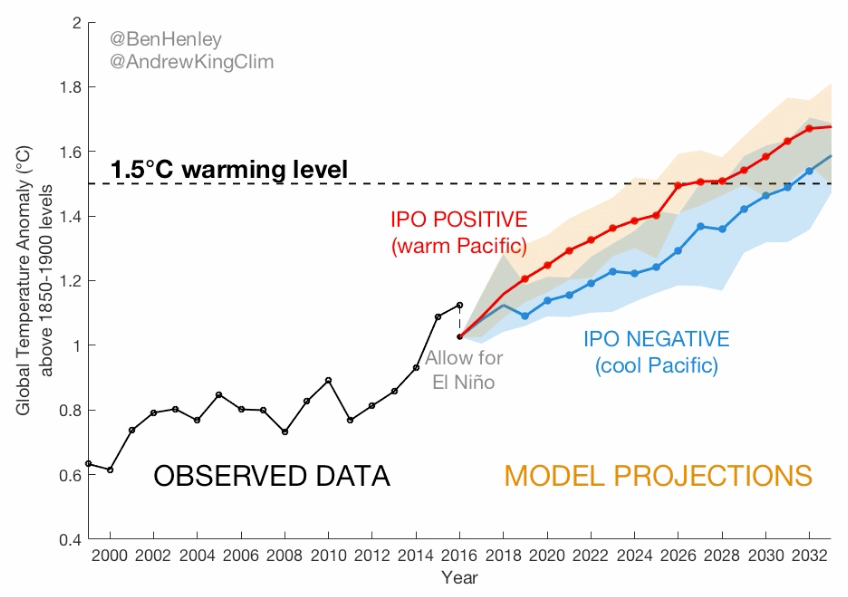

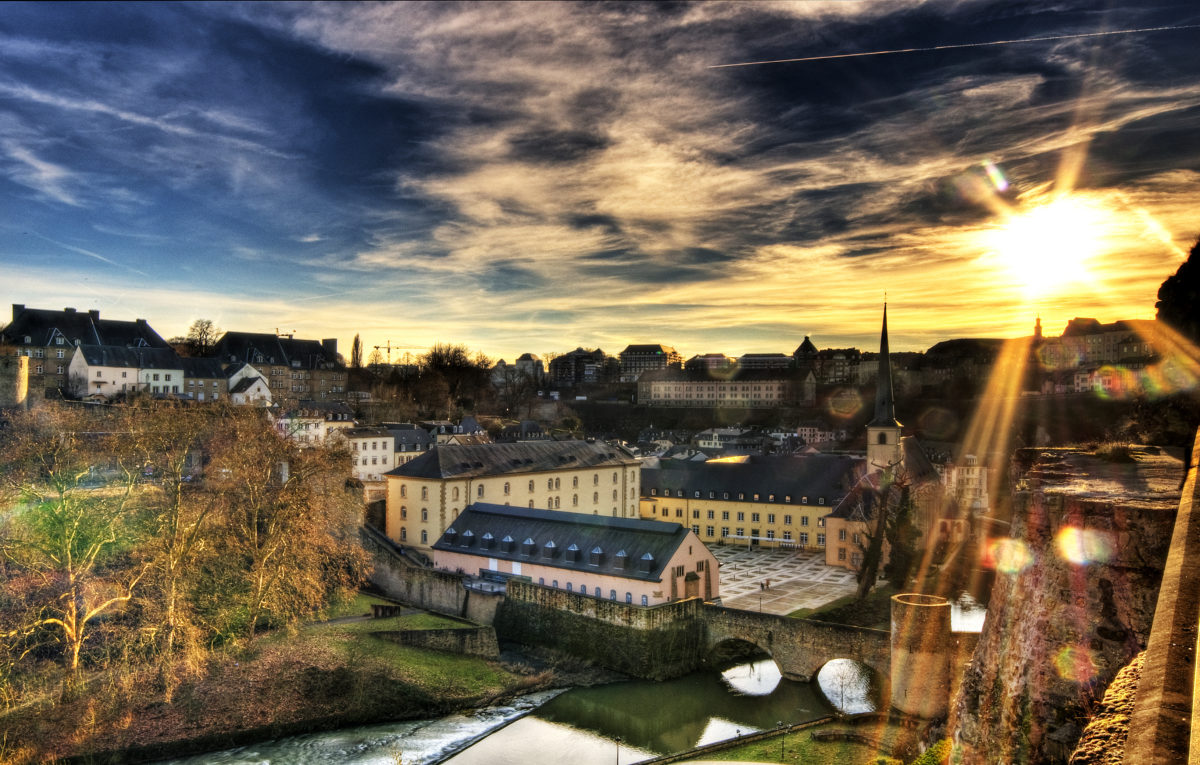

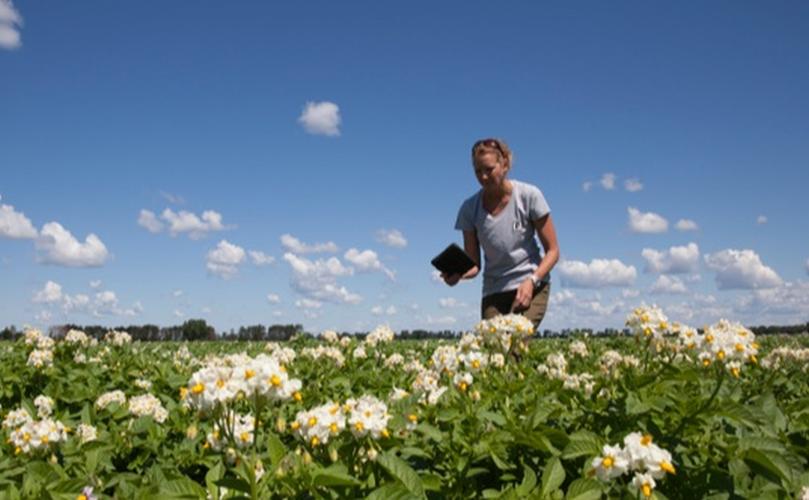


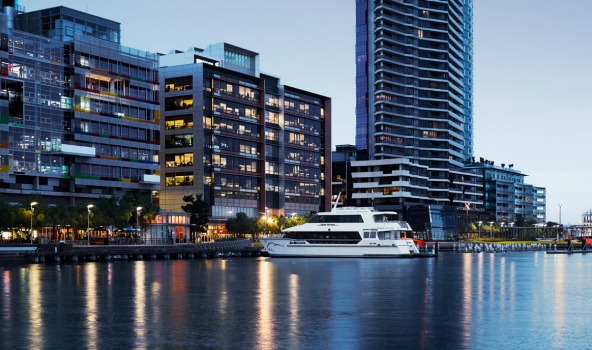
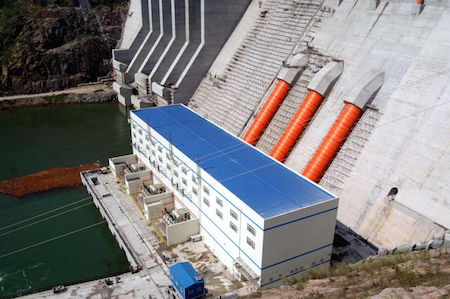





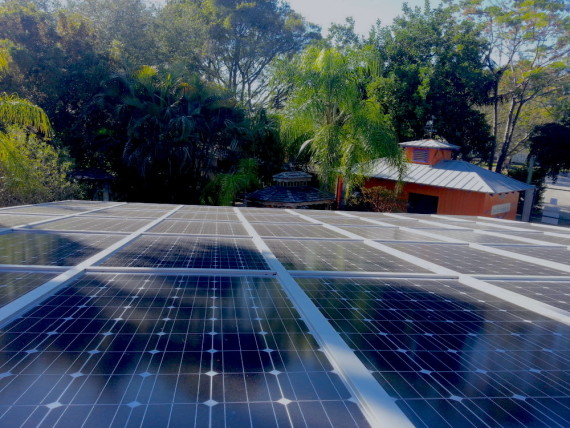


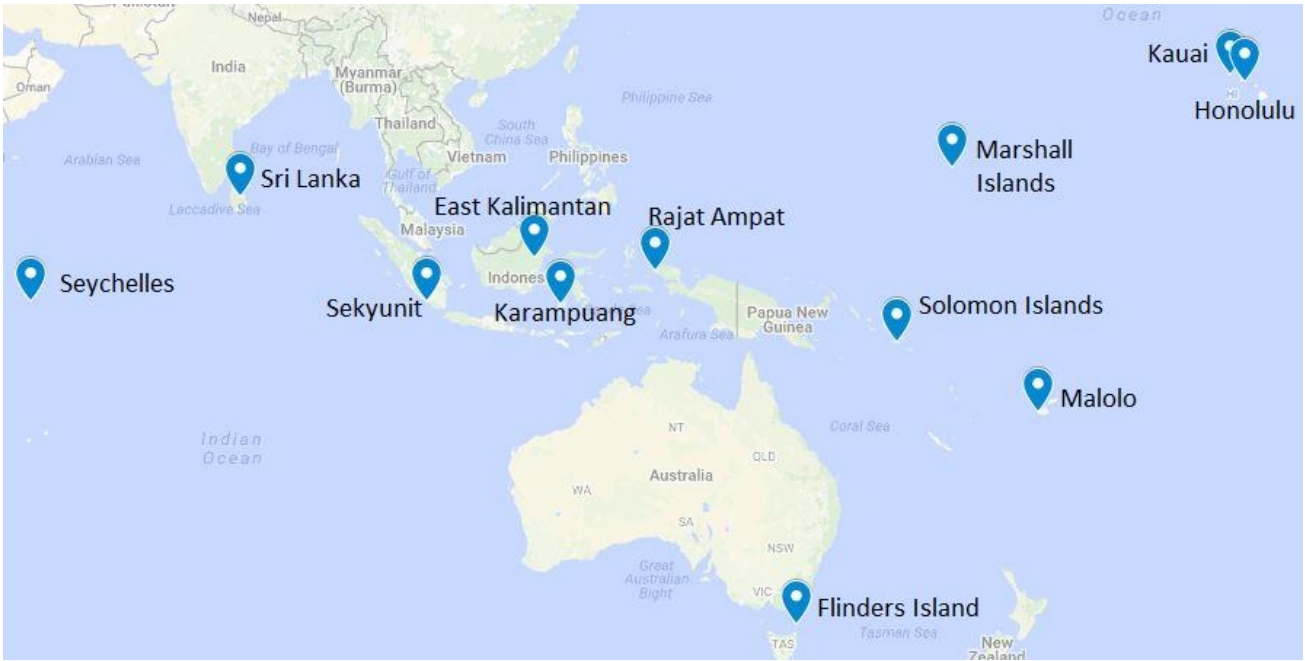


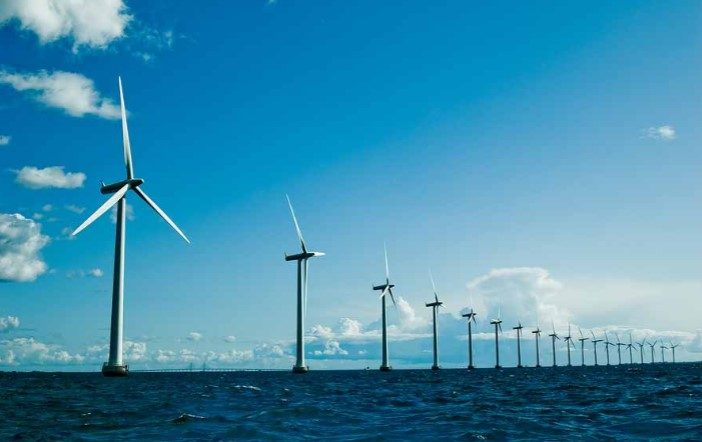


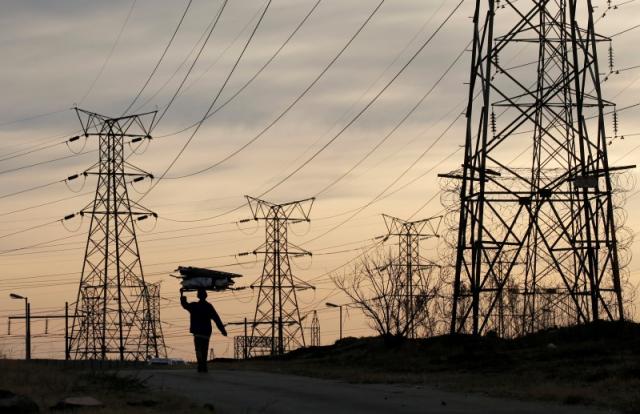




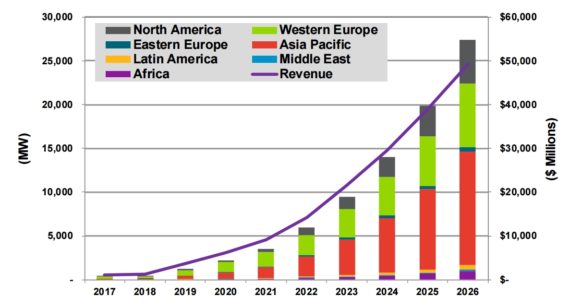
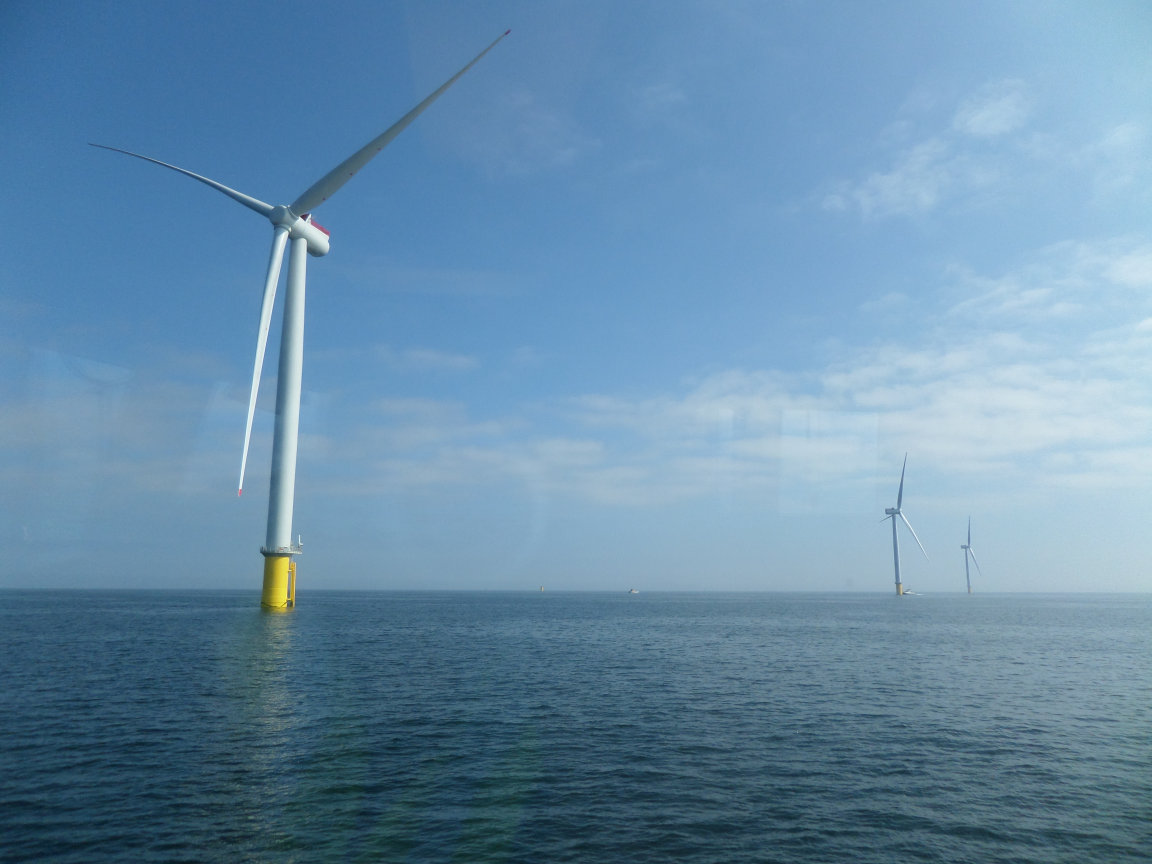

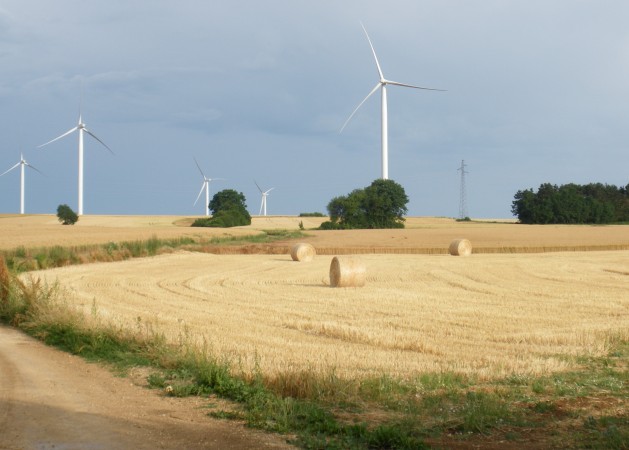

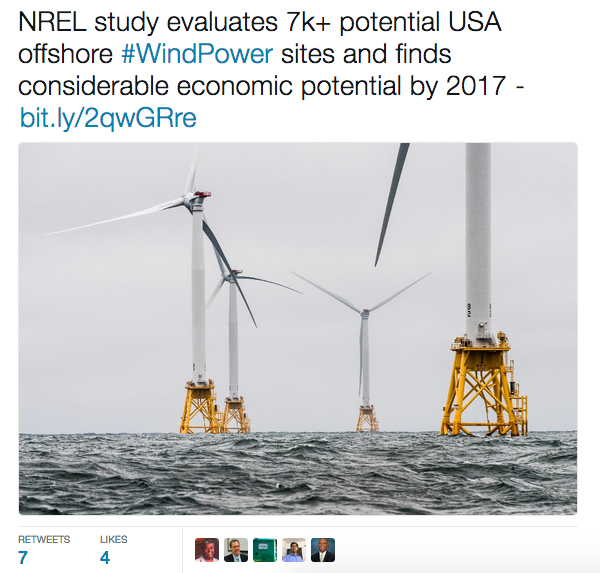
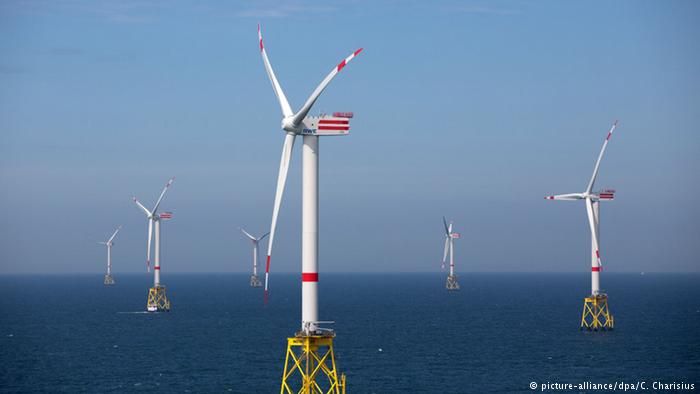
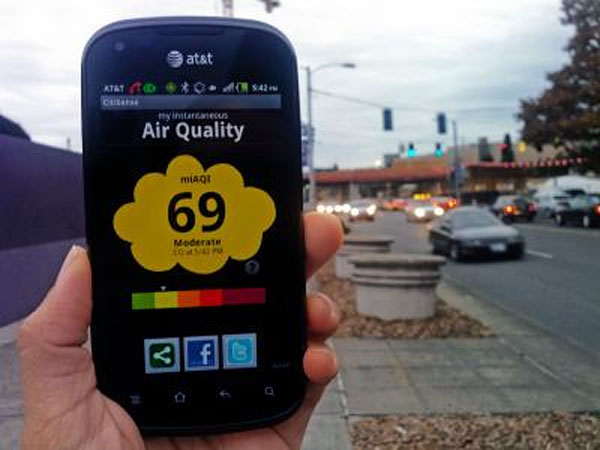

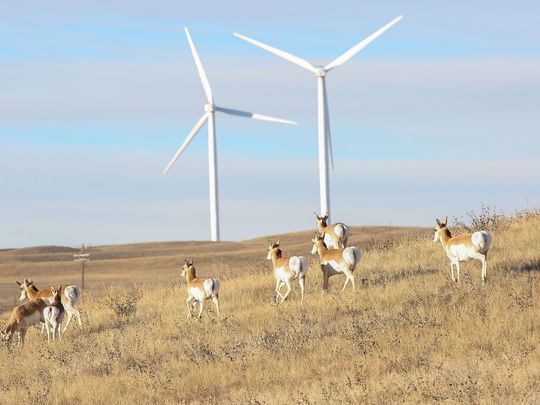

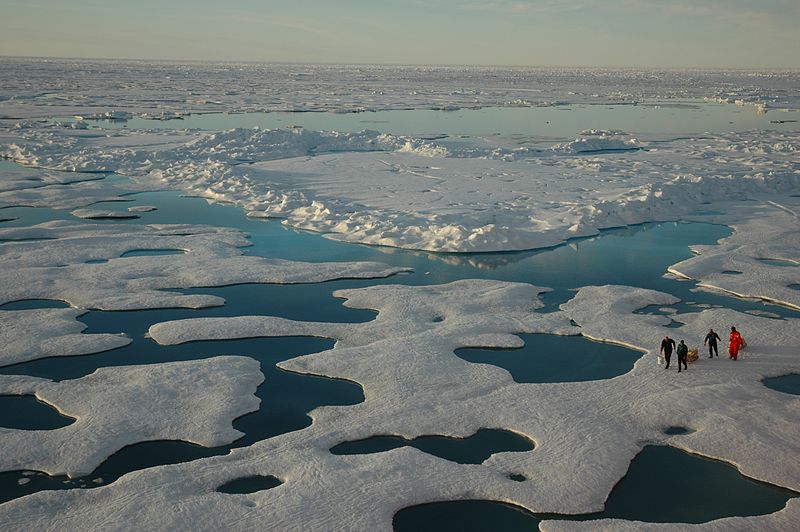

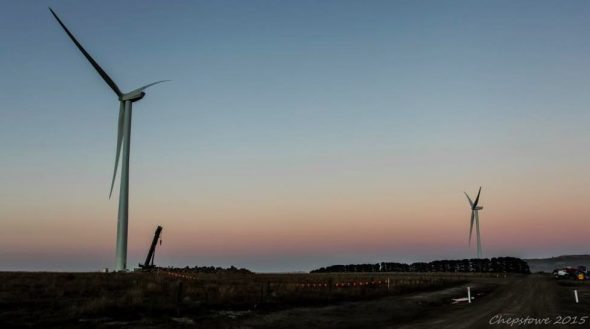
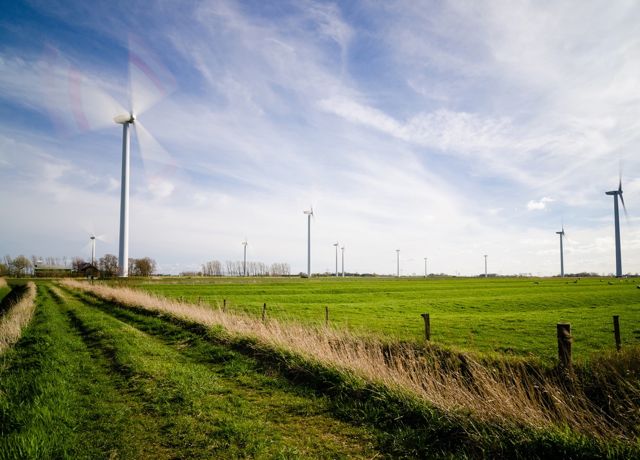
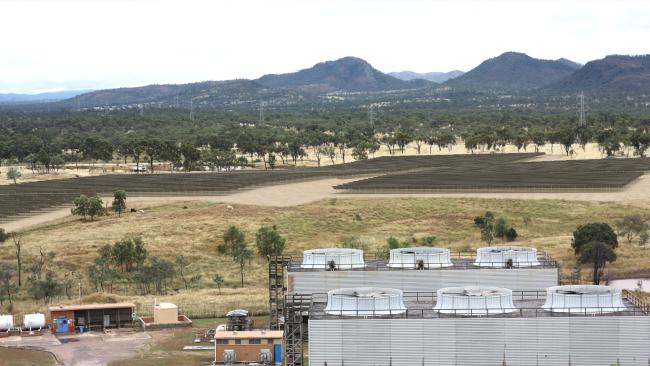

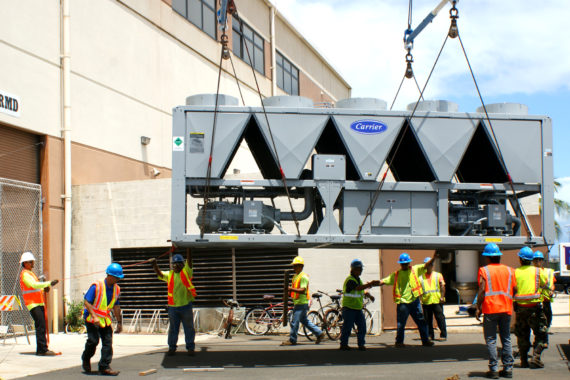
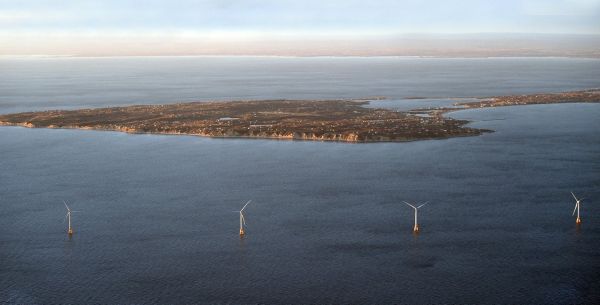
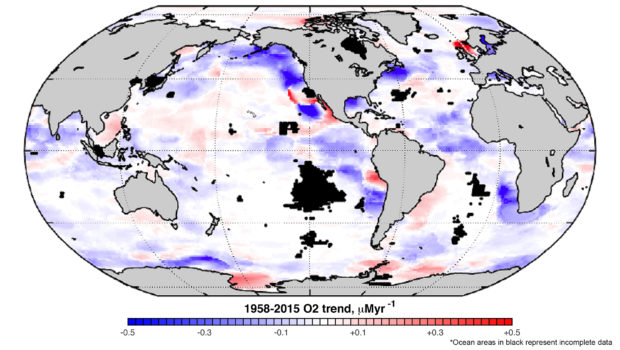
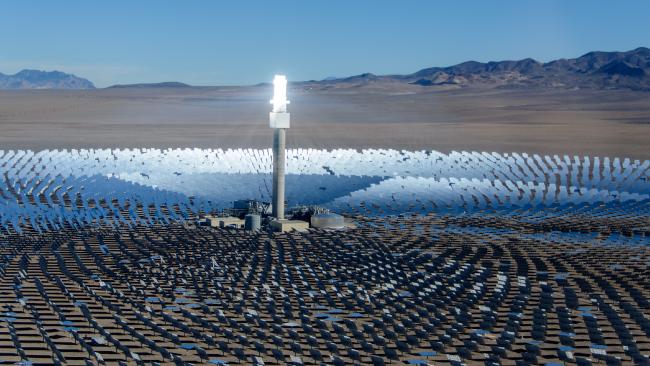

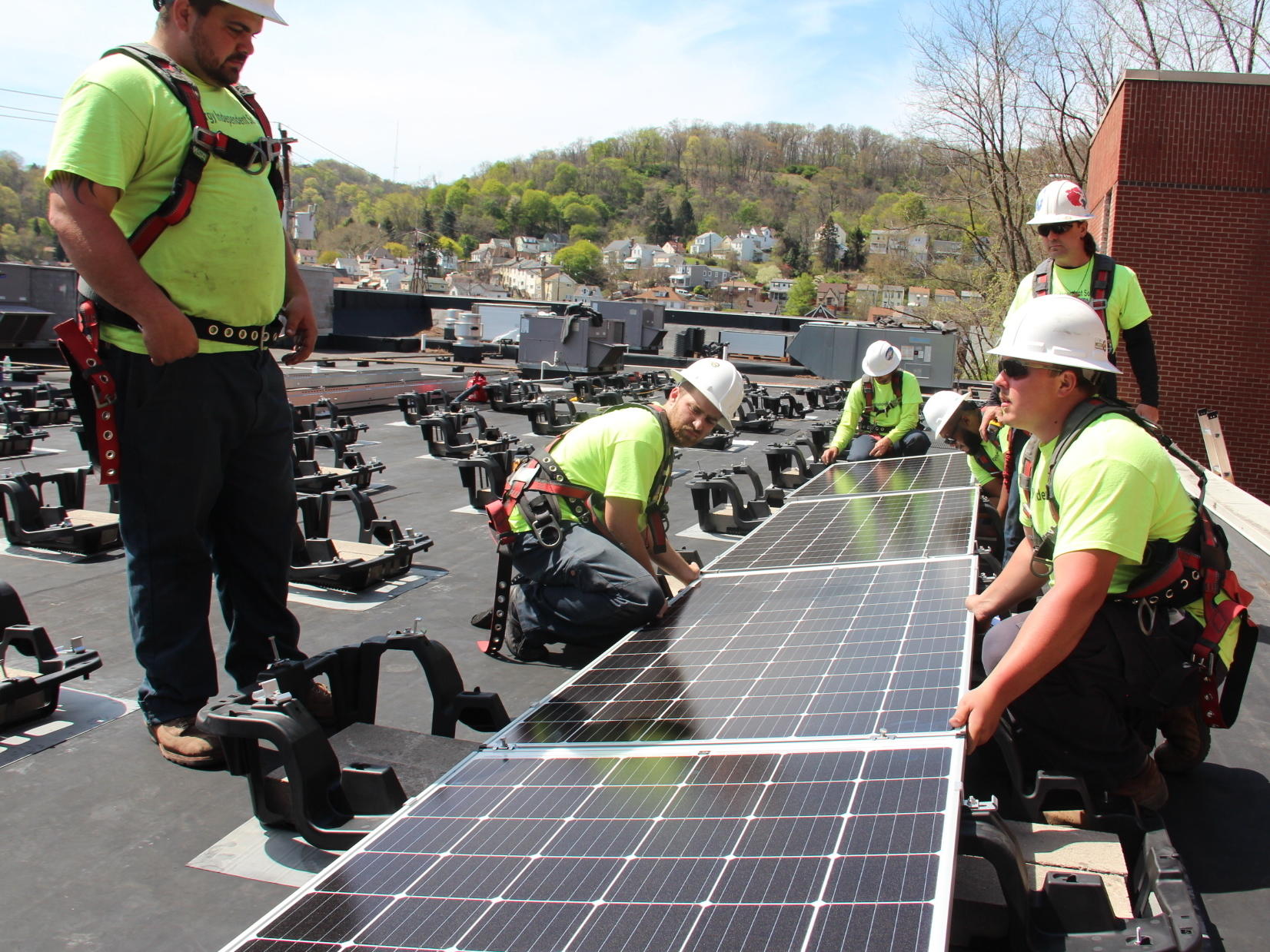


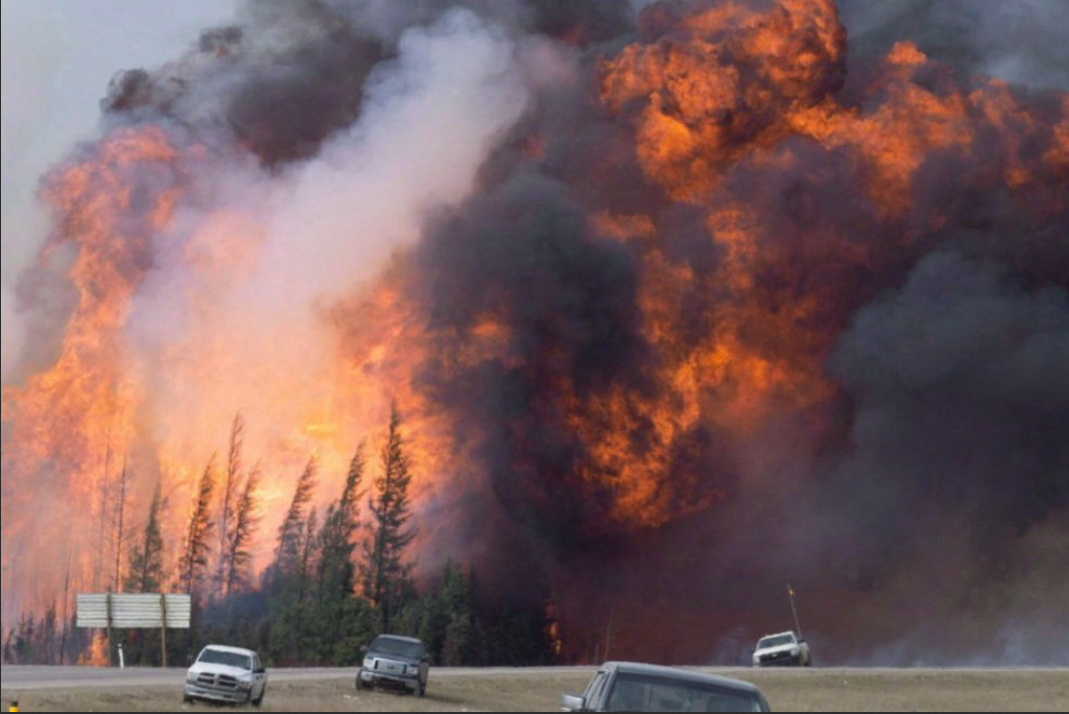


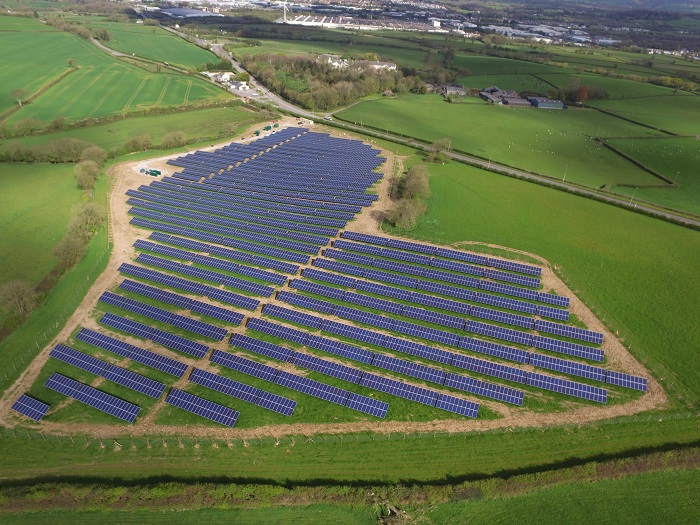

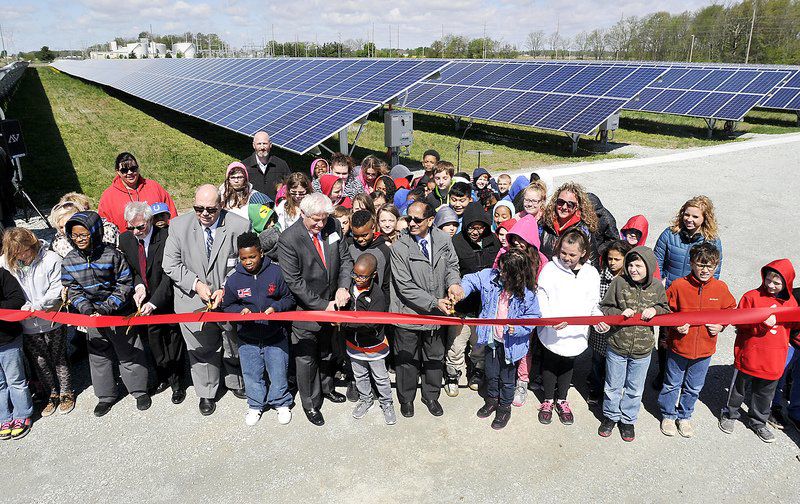

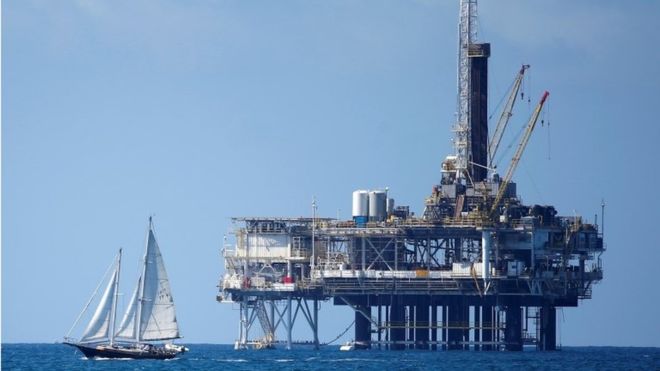

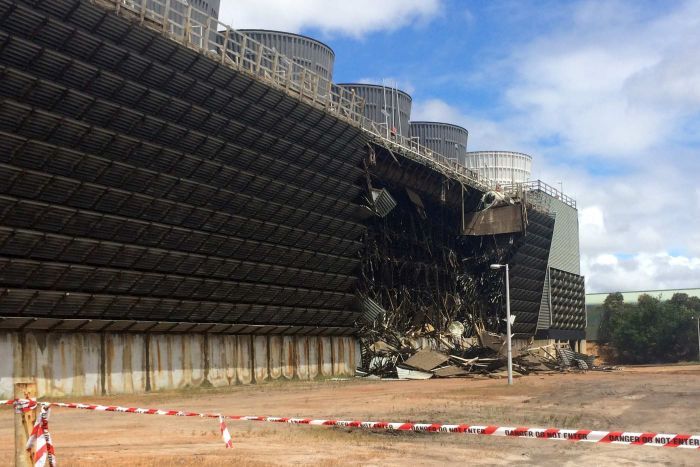

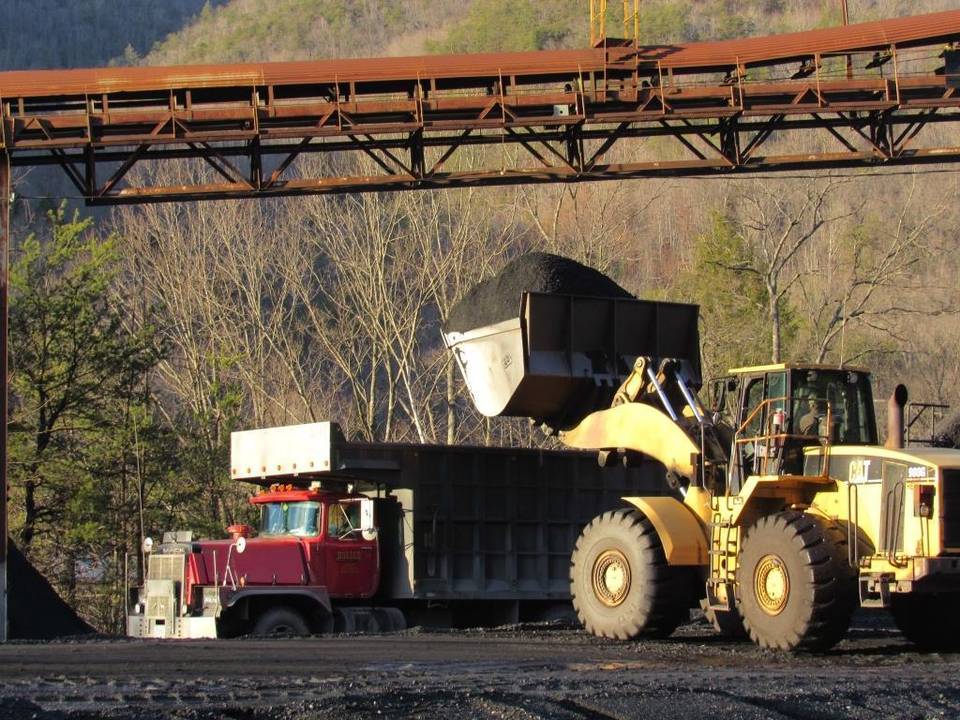
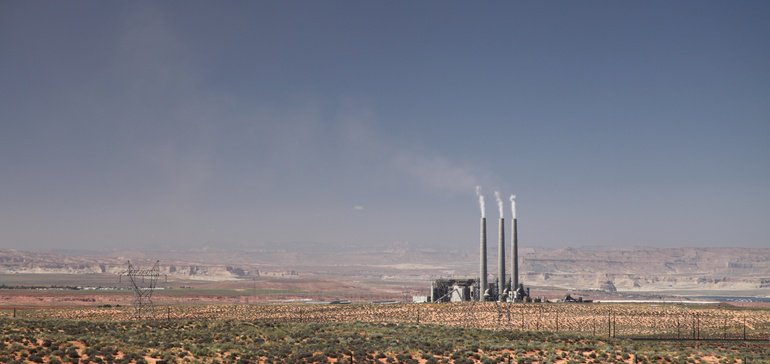










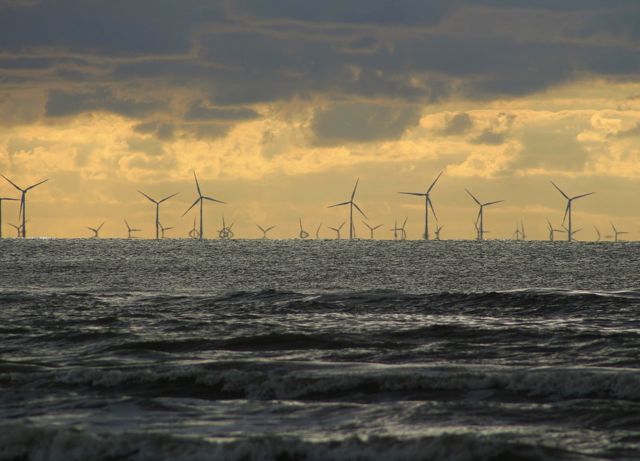


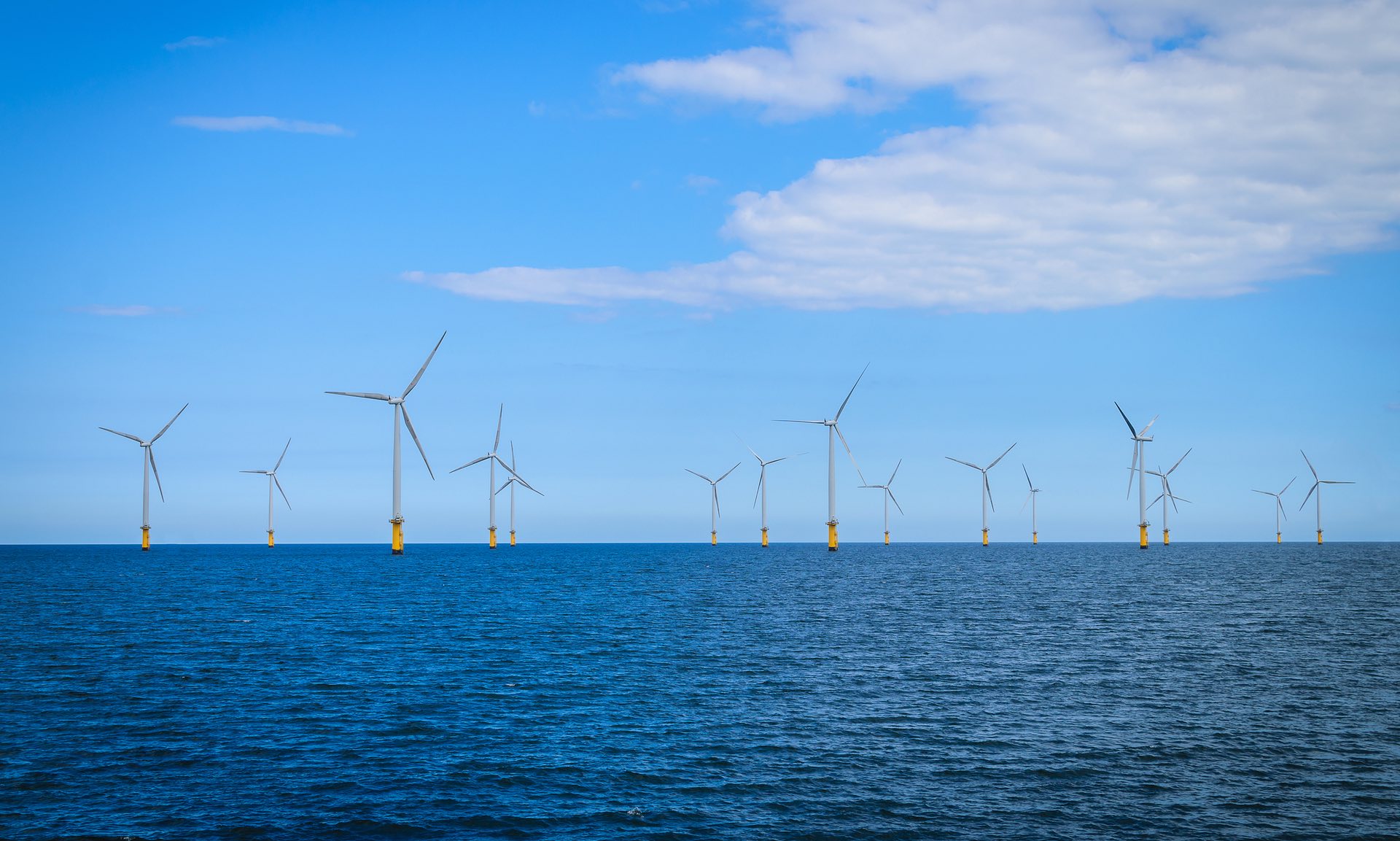
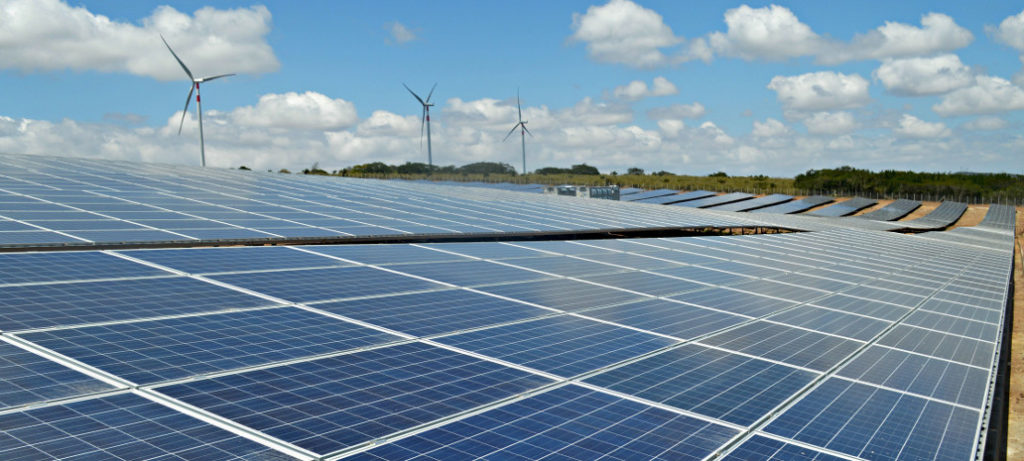


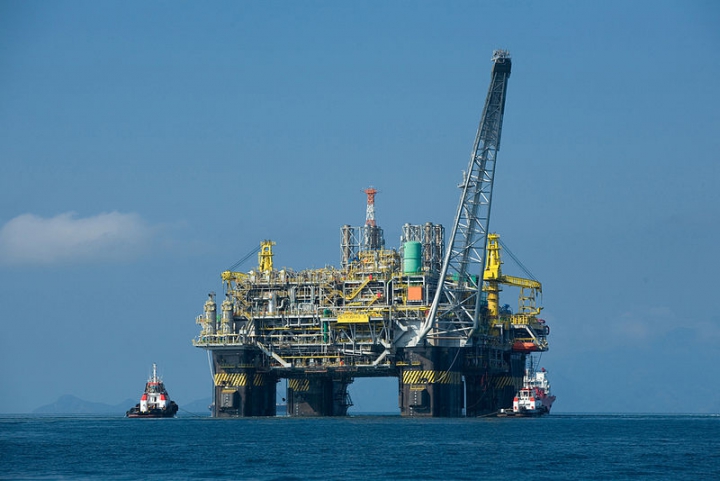


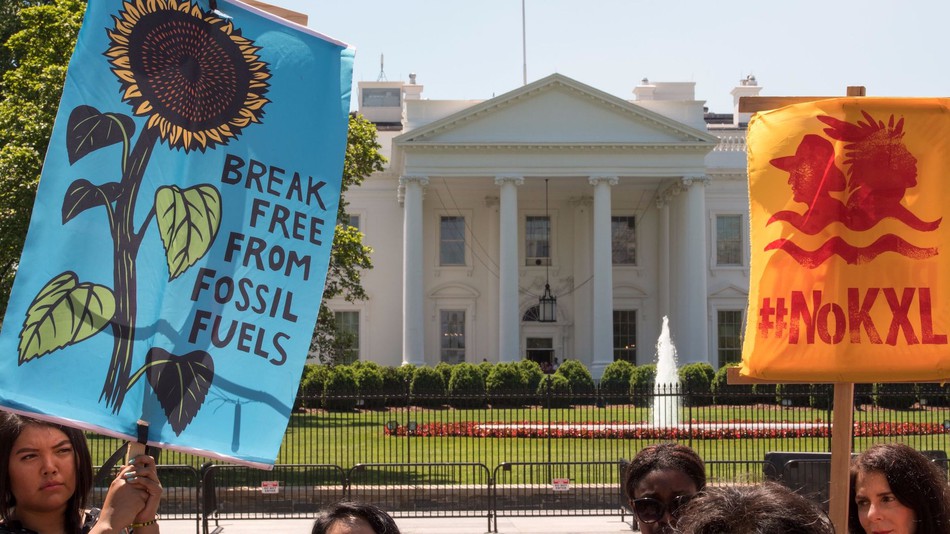

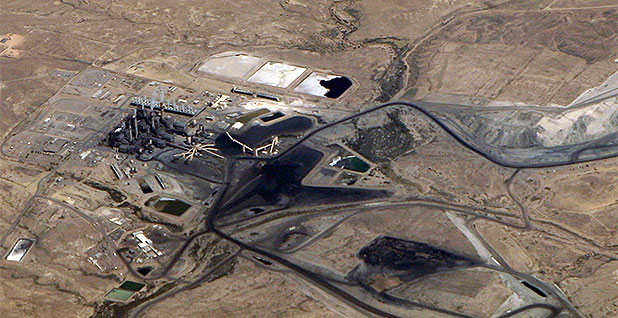



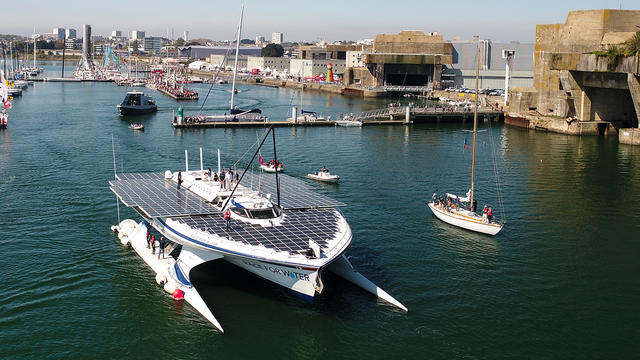

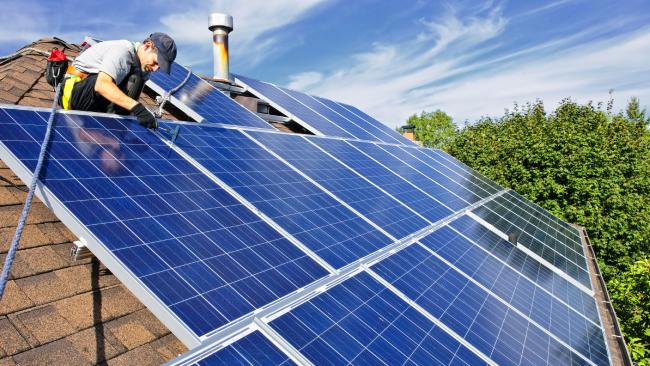

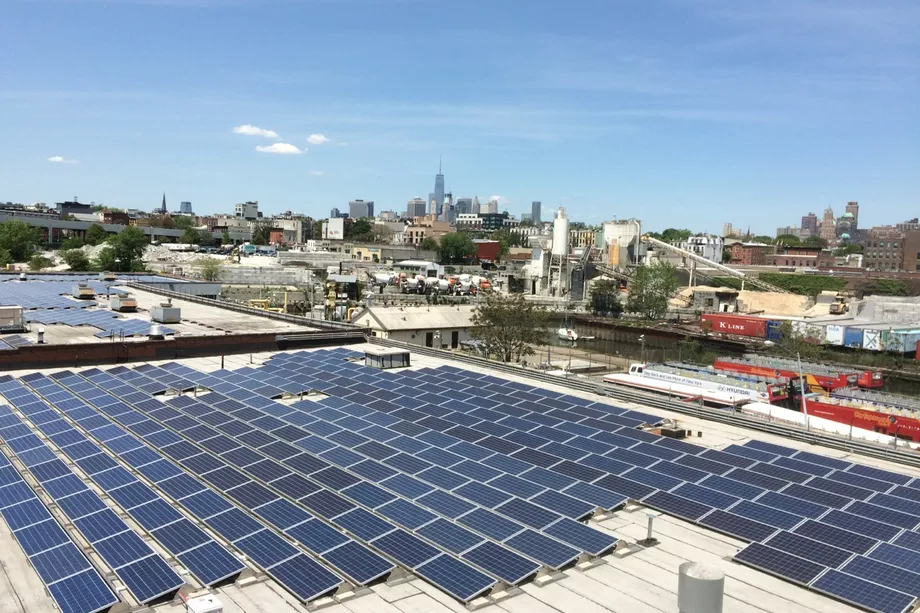


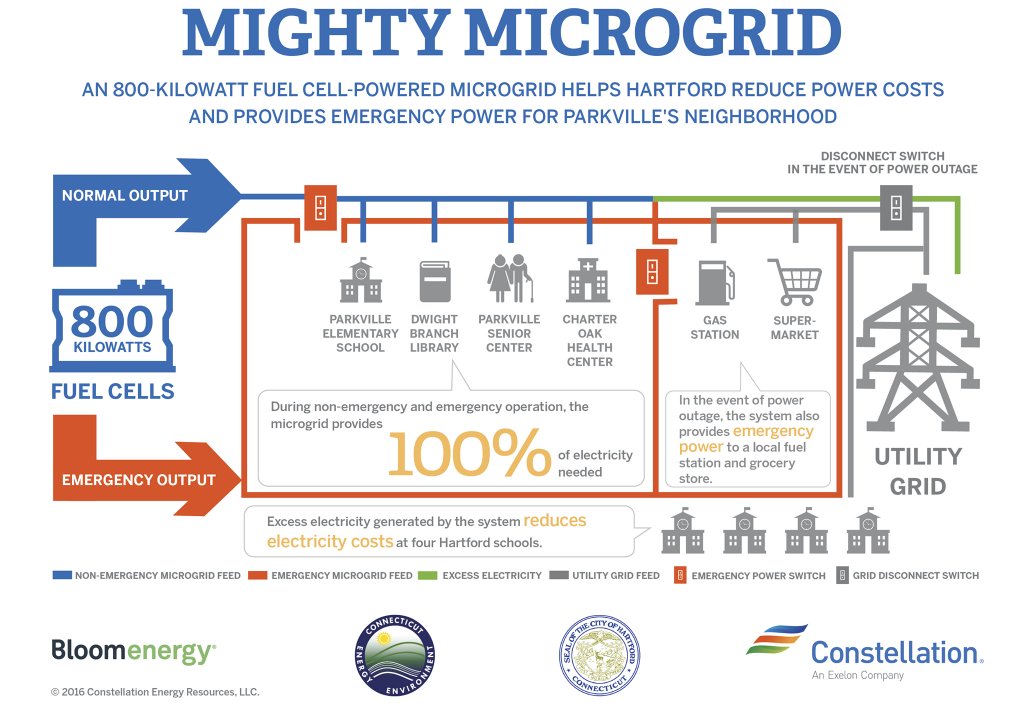
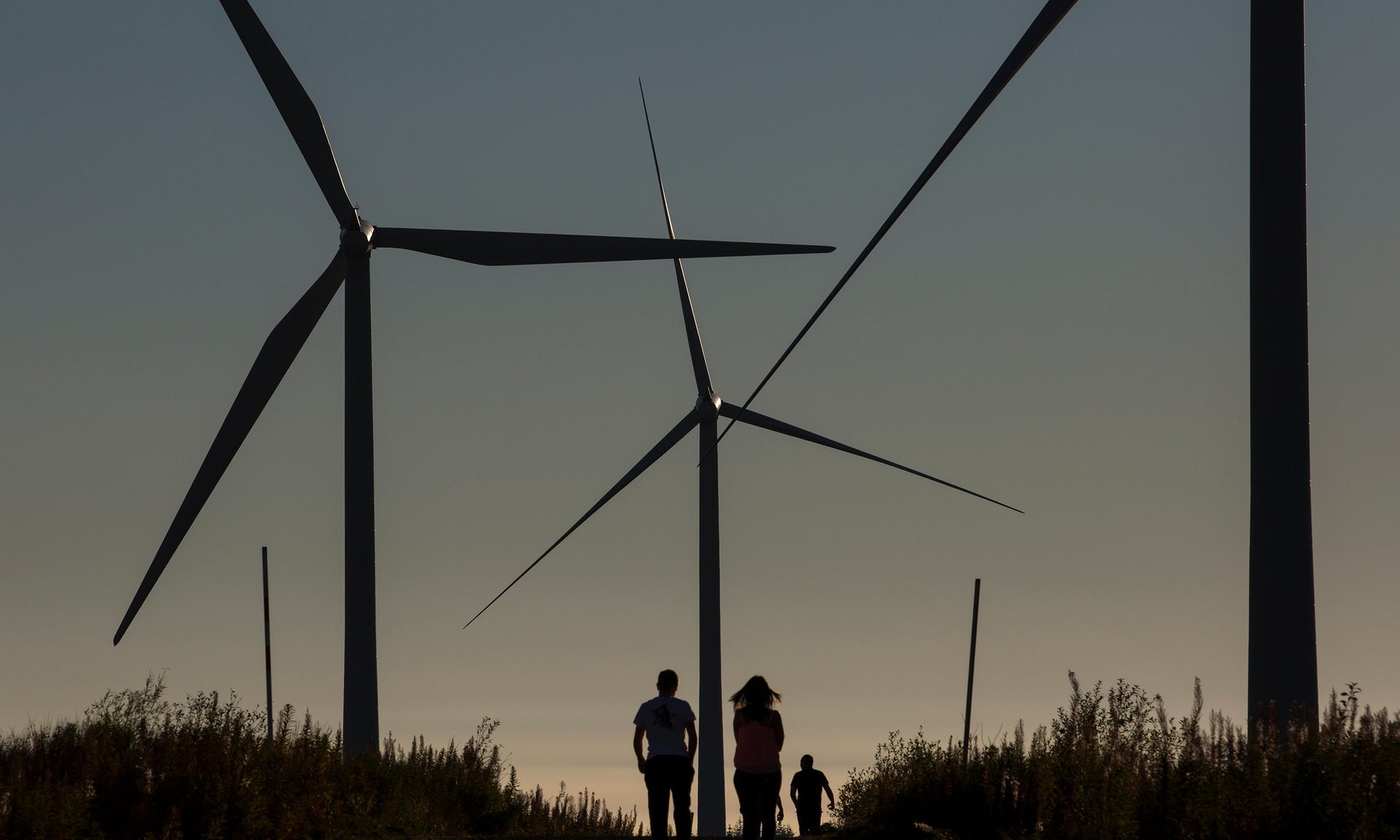


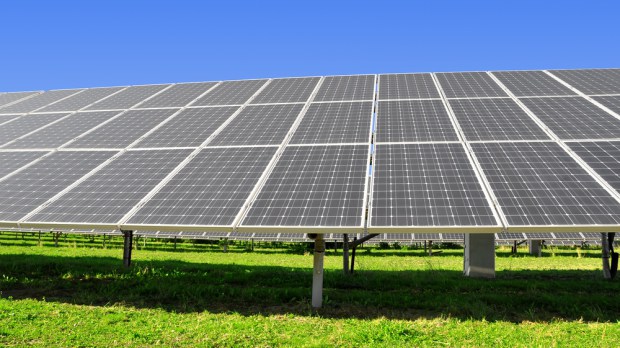
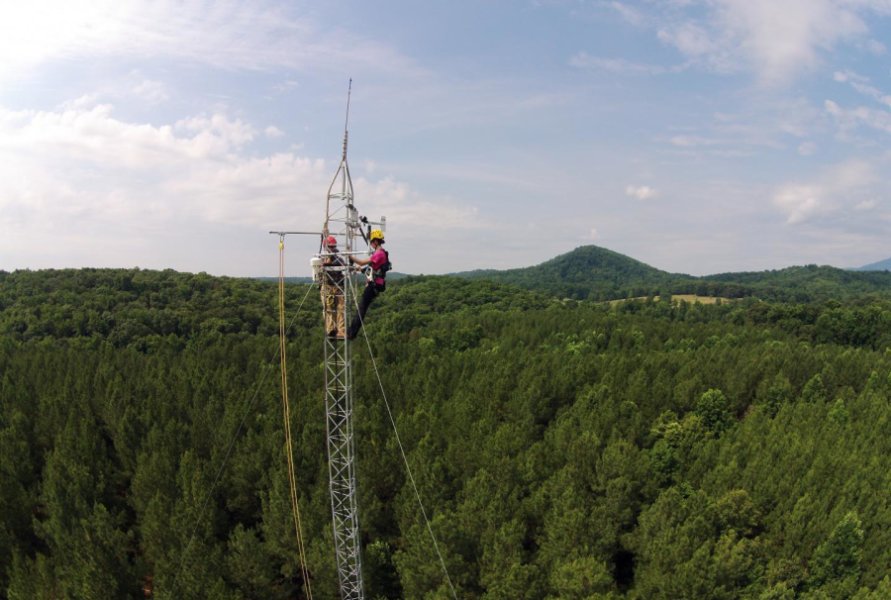

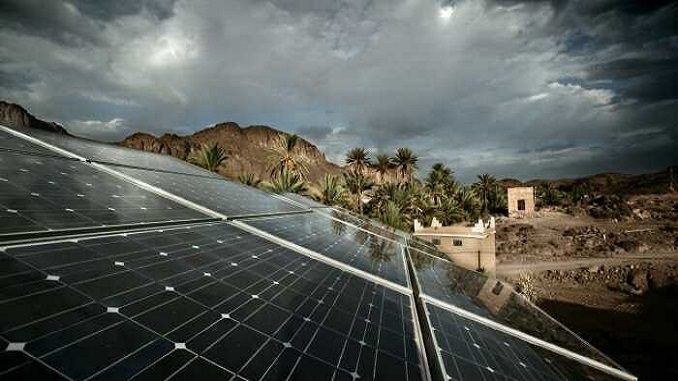

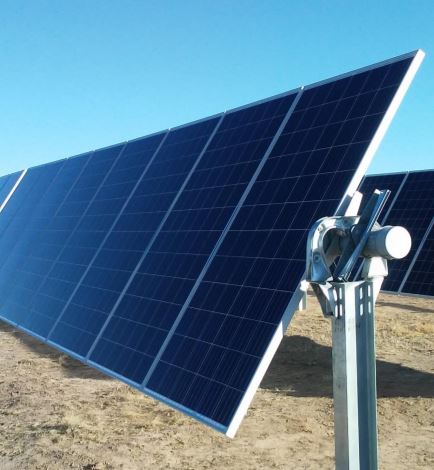



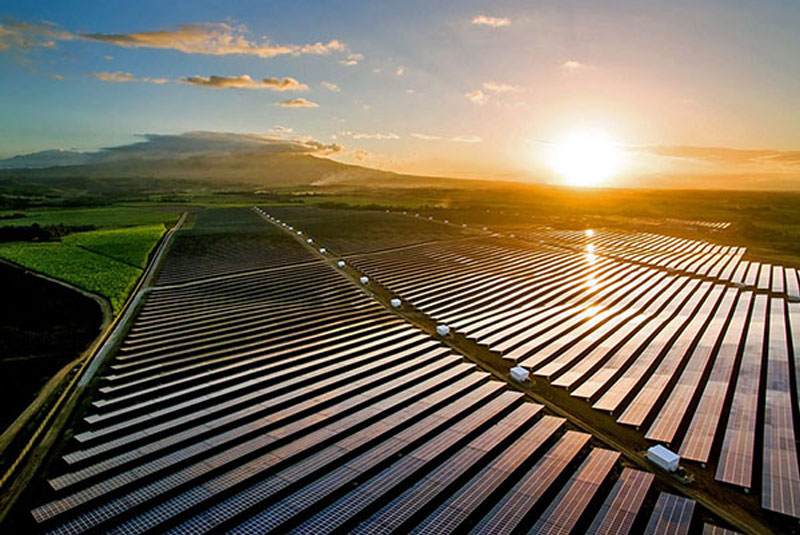






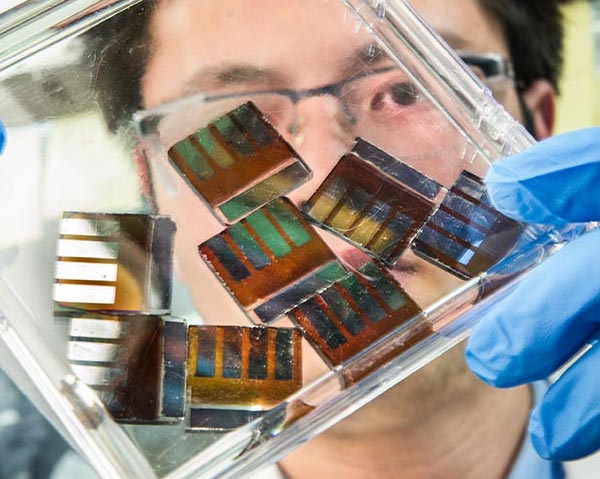






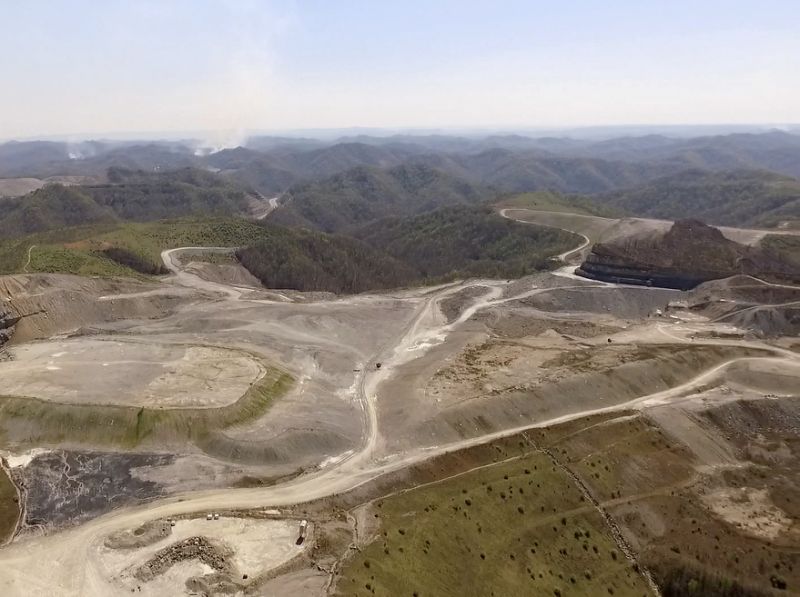

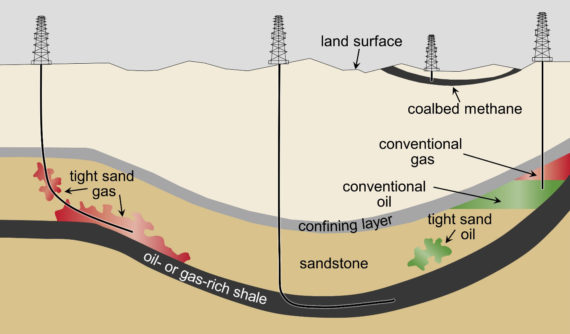

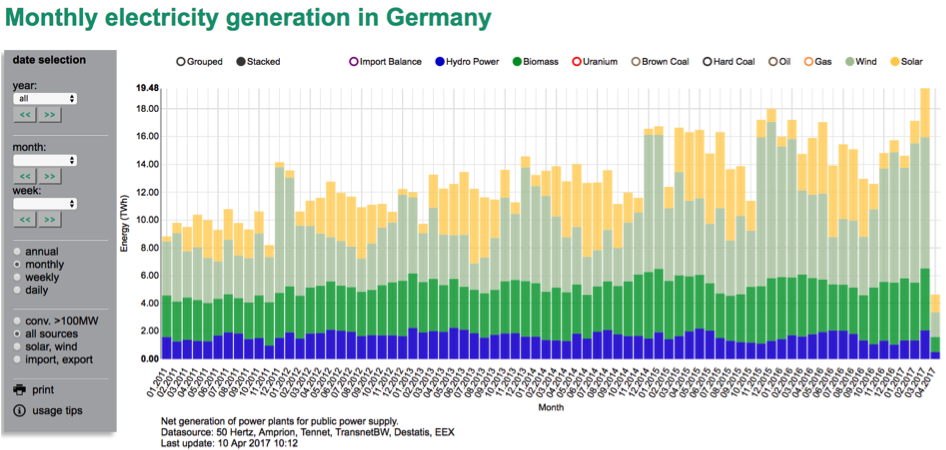


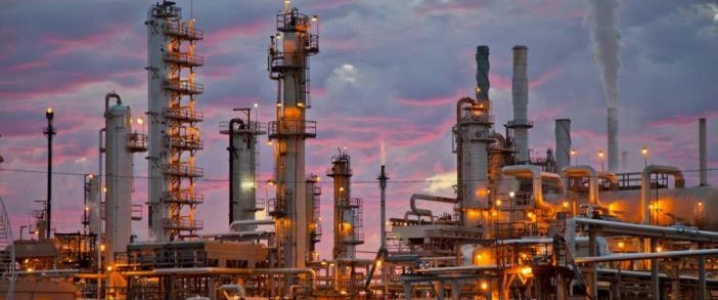

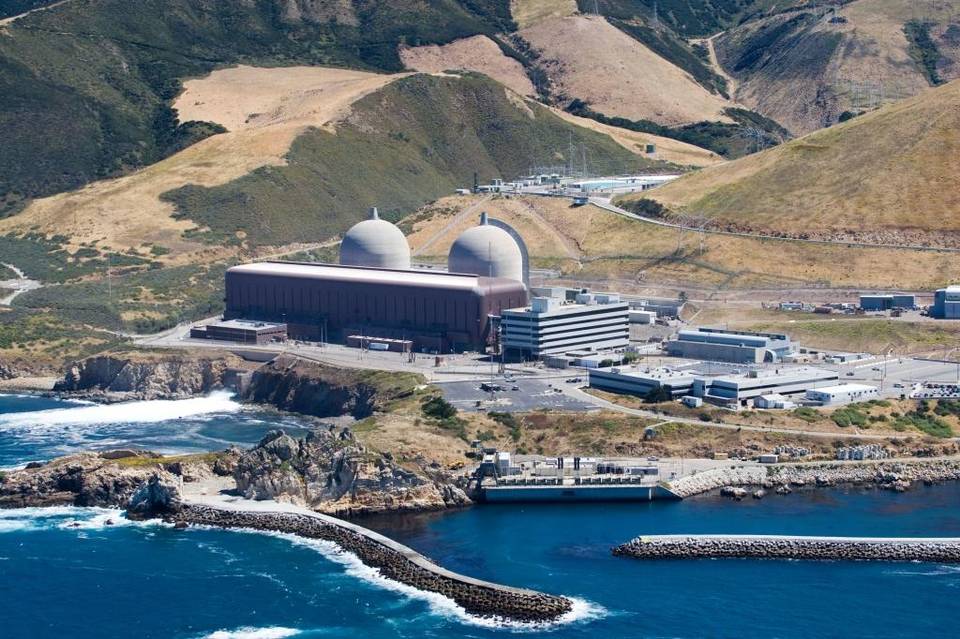

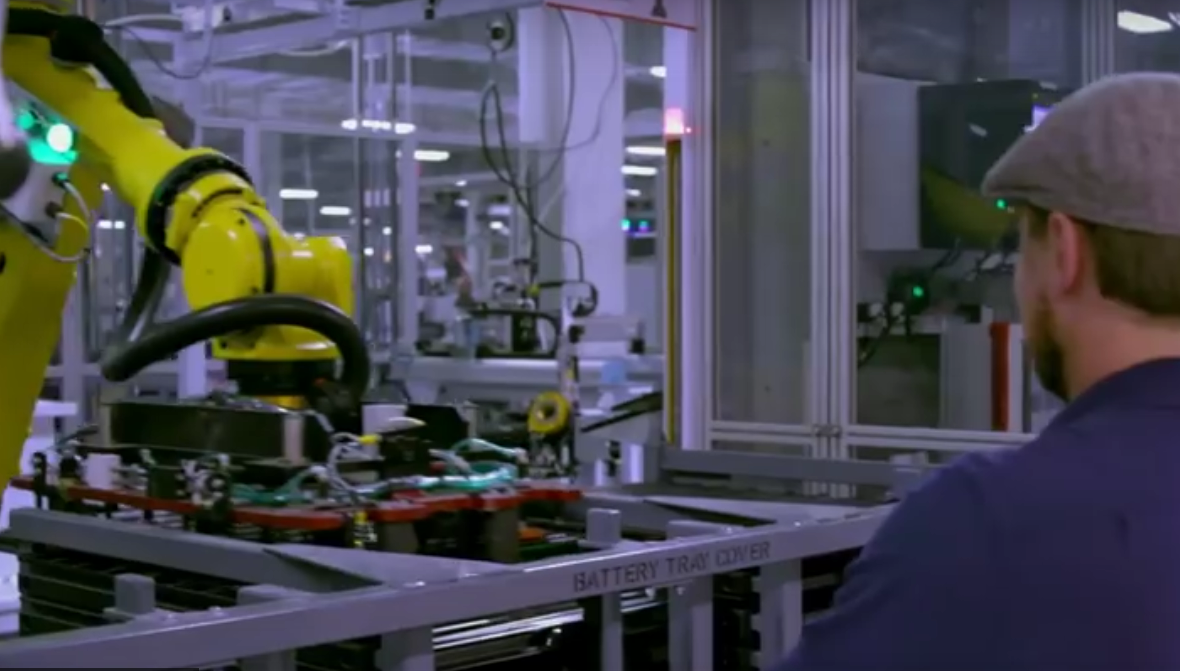

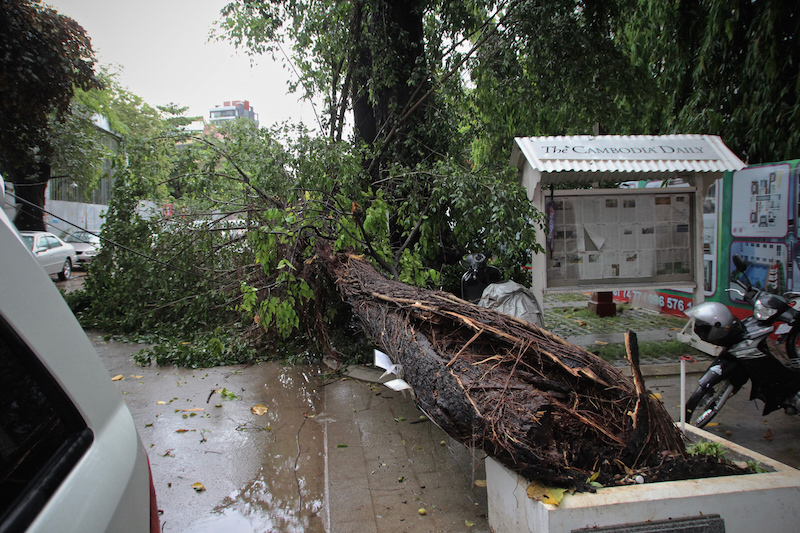




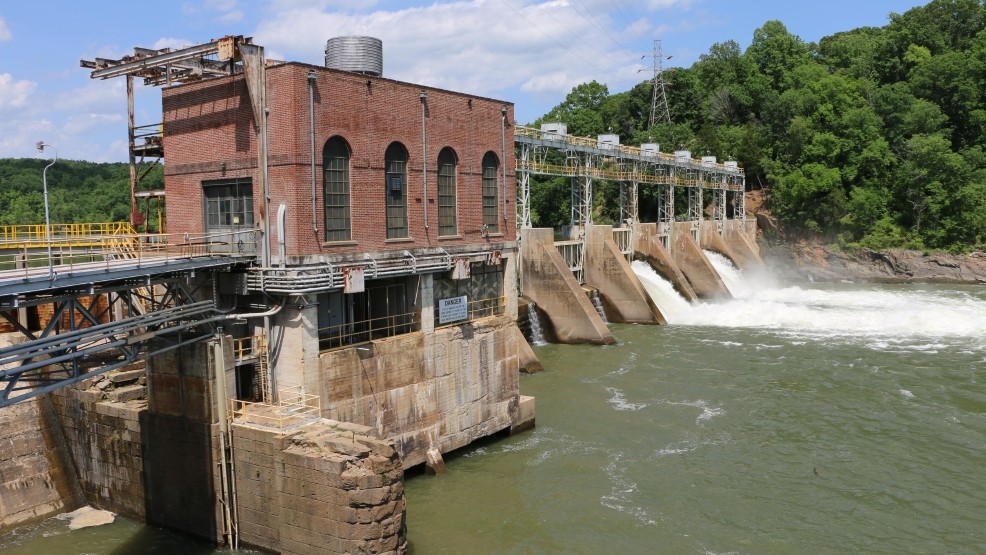
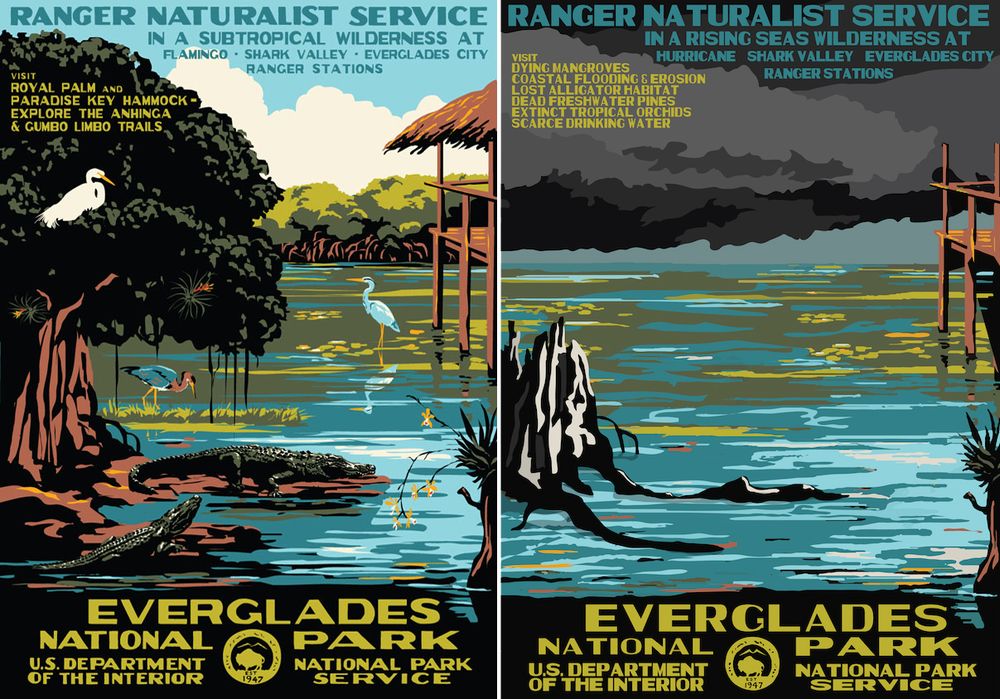
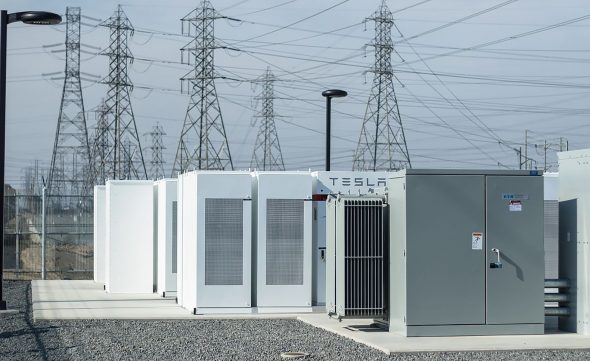
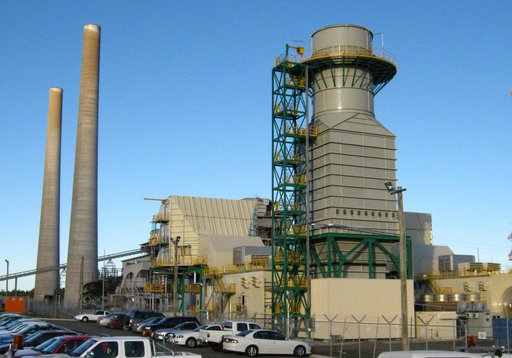


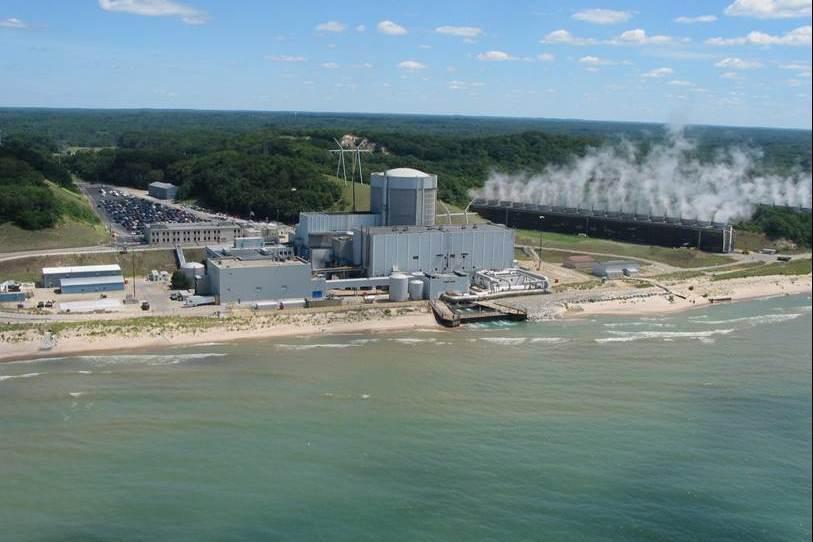



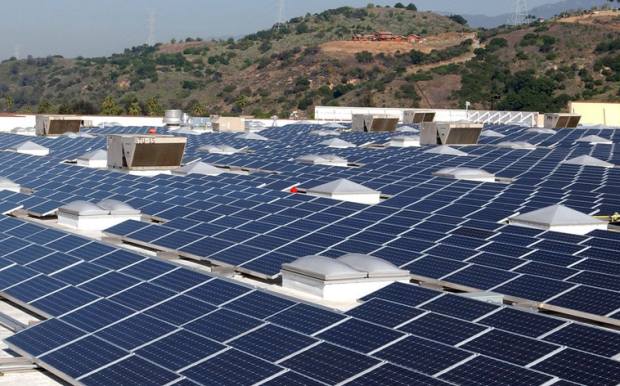
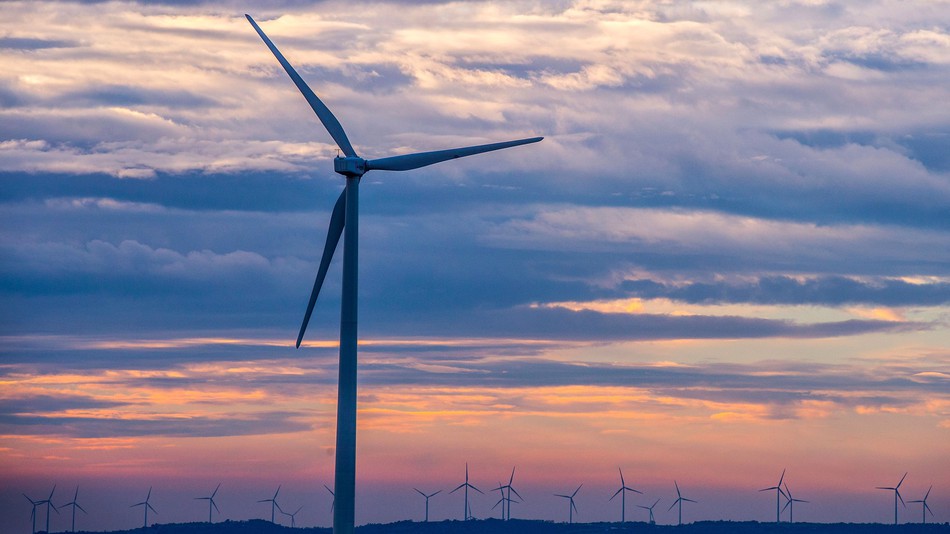
 geoharvey