August 23, 2015
World:
¶ Canadian company Beothuk Energy has kicked off the hunt for cash to support its proposed 180-MW offshore wind demonstrator in Newfoundland. Beothuk appointed renewables investment outfit Jacob Securities Inc to identify project financing for both equity and debt provision, and coordinate with other companies. [reNews]
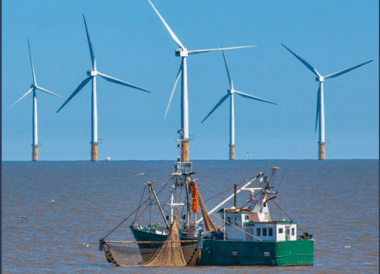
Image: Beothuk has big plans off Newfoundland (Beothuk)
¶ Visiting her counterpart Dilma Rousseff in Brasilia, Chancellor Angela Merkel of Germany cemented an important climate link between the largest economies in Europe and Latin America. Germany has had high-level relations with India and China, among nations in the emerging world, but now has put Brazil on the same level. [CleanTechnica]
¶ In the English county of Hampshire, Sparsholt college has unveiled plans to build a new renewable energy plant near Winchester. The anaerobic digester, a large boiler turning grass into gas, is expected to produce annual power for the equivalent of nearly 5,000 homes. But the plans have worried people in the area. [Daily Echo]
¶ Last year, Turkey’s Energy Minister said the government wanted 30% of its energy production in 2023 to come from domestic coal, up from 13% now. Locals in the Yırca district of Manisa province successfully fought expropriation of olive groves for coal mine development, but only after 6,000 olive trees had been felled. [Today’s Zaman]
¶ In Japan, the Kansai Electric Power Co has had trouble with competition, highlighted by the fact that 1,000 Seven-Eleven Japan Co Ltd stores in three Kansai prefectures are switching to competition in a new competitive environment. Kansai Electric says the only way it can compete is to restart its nuclear plants. [The Japan Times]
US:
¶ SmartPower, and its Solarize South Carolina campaign is trying to make answering questions about having solar PVs installed as easy as contacting them, via phone or Internet, for a free estimate and advice at its website. The initiative seeks to outfit 2,000 homes with solar in the state in the next 18 months. [Charleston Post Courier]
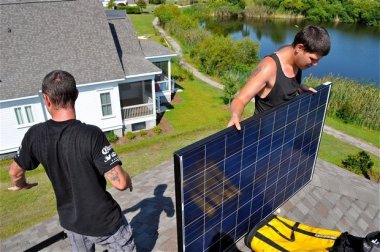
Workers from Sunstore Solar Energy Solution install solar panels. Photo by David Quick, Charleston Post Courier staff.
¶ Ameren, which uses wind farms in Iowa and out-of-state fuel to provide power in Missouri, is turning to the biomass to reduce Missouri’s reliance on non-local resources. It is partnering with ECAP, an organization of more than 500 Missouri farmers, and Enginuity, which will provide additional technology. [Jefferson City News Tribune]
¶ President Barack Obama and Nevada’s Senator Harry Reid are playing key roles in the National Clean Energy Summit in Las Vegas. The president will be the keynote speaker. The event will focus on public-private partnerships for clean energy and investments to move the grid beyond its reliance on fossil fuels. [Las Vegas Review-Journal]
¶ Opponents of a 900-MW gas-powered plant Invenergy is planning for Rhode Island say that the company’s claim that it will reduce greenhouse gas emissions is inaccurate because it only considers emissions from producing power and does not take into account the potentially substantial leakage of methane. [The Providence Journal]
¶ Minnesota and North Dakota have been fighting in federal court for two years over Minnesota’s cross-border restrictions on coal-based electricity. The Clean Power Plan, the federal government’s even-more-sweeping regulations to cut coal power plant greenhouse gas emissions, is pushing states to work together. [Minneapolis Star Tribune]
Posted in nuclear power, renewable power, solar, wind | Leave a Comment »
Tags: nuclear, nuclear power, photovoltaic, renewable power, solar power, wind power
August 22, 2015
World:
¶ DONG Energy has taken full control of the huge Hornsea offshore wind zone. This means the Danish giant will have project ownership for Hornsea Projects Two and Three, having already bought Project One in February. They have a combined potential for development of around 4.2 GW of capacity, and the potential to supply the electricity needs of more than four million UK homes. [Grimsby Telegraph]
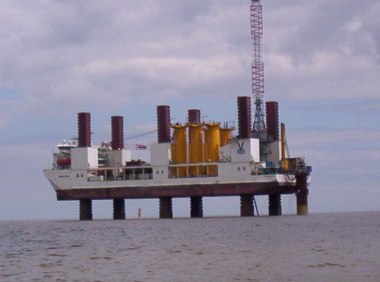
TIV Resolution raised out of the sea to install wind turbines. Photo by Ian Simons. CC BY-SA 2.0
¶ Publicly owned lignite mining and power generation company Neyveli Lignite Corp plans to set up 600 MW of solar projects across various states of India. The company is setting up about 50 MW of solar projects of 10 MW to 15 MW of capacity each in Tamil Nadu and Rajasthan. In addition, land identification is underway for a 100 MW solar project in Nevyeli. [CleanTechnica]
¶ Canberra is at the forefront of responding to climate change with Australian Capital Territory government pledging 100% renewables for the city by 2025. Canberra’s current target is 90% renewables by 2020, while the City of Sydney pledged to use 100% renewable energy by 2030. South Australia’s target is 50% by 2025, while Queensland is aiming for 50% by 2030. [Business Insider Australia]
¶ China’s economy has hit a rough patch. In Western countries, signs of economic insecurity can lead to panicky calls to toss pro-environmental policies. Is there a danger that China’s policymakers will take such a step backward? Probably not, say economists and environmentalists with an eye on China. In fact, China’s slowdown could even be helpful for the environment. [Grist]
US:
¶ The EPA unveiled a package of rules this week aimed at curbing methane and volatile organic compound emissions from sources all along the oil and gas production chain. The rules particularly target shale operations and are the centerpiece of the Obama administration’s effort to rein in methane emissions by 40% to 45% below 2012 levels in the next decade. [Pittsburgh Post-Gazette]
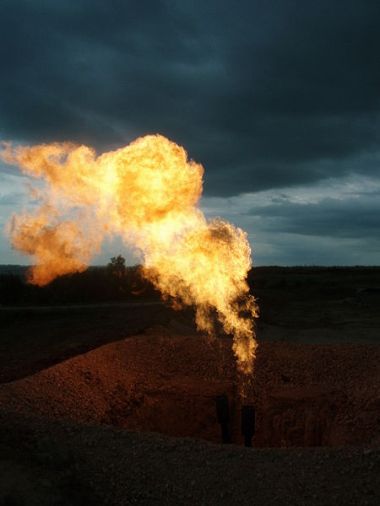
Bakken Flaring Gas at night. Photo by Joshua Doubek. CC BY-SA 3.0.
¶ The city of West Richland, Washington, completed an LED upgrade to its entire street lighting system. The project is expected to reduce the system’s electric consumption by 61% and save the municipality $67,000 per year in energy costs. More than 1000 high pressure sodium lights were replaced with energy-efficient LED models, and a wireless control system was installed. [CleanTechnica]
¶ The average household in the Tennessee Valley will pay about $1.50 more a month for electricity next year as TVA shifts to more nuclear, natural gas, and renewable power to replace aging coal plants. TVA directors adopted a $10.7 billion spending plan for fiscal 2016 that will raise electricity rates by 1.5%, the same amount as in each of the past two years. [Chattanooga Times Free Press]
¶ The world’s largest Ocean Thermal Energy Conversion power plant, completed by Makai Ocean Engineering, celebrated its connection to the electrical grid on Friday. Using temperature differences between the ocean’s cold deep water and warm surface water, Makai’s OTEC power plant is able to generate clean, renewable electricity that is available continuously. [Big Island Now]
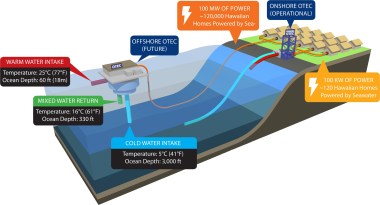
Makai Ocean Engineering image.
¶ Green energy creates jobs. For example, according to the 2014 North Carolina Clean Energy Industry Census, the state’s cleantech sector grossed nearly $5 billion in 2014, and is expected to grow between 30% and 35% this year. There are 1,208 cleantech firms in the state employing the equivalent of 22,995 full-time workers and generating $4.8 billion of economic activity. [Huffington Post]
¶ On June 7th, California’s grid operator reported that the state had hit a new record for solar PV and concentrating solar power generation, at 6.160 GW-AC. A little over a month later, a new peak was set on July 13th, just shy of 6.3 GW-AC. Since then, records have been falling like dominoes. Most recently, the plants reached a peak output of 6.391 GW-AC on August 20th. [pv magazine]
¶ Millions of dollars and hundreds of jobs rest with the results of an electricity auction. Exelon is reviewing the bids for power contracts in 2018 through 2019. If the Cordova nuclear power plant [Quad Cities] does not get a winning bid, the plant could face closure in mid 2017. Exelon says the power plant has been losing money for five years, and blames subsidies for wind power. [KWQC-TV6]
Posted in nuclear power, renewable power, solar, wind | Leave a Comment »
Tags: nuclear, nuclear power, photovoltaic, renewable power, solar power, wind power
August 21, 2015
Science and Technology:
¶ A team of scientists led by George Washington University chemistry professor Stuart Licht developed a new and potentially less expensive method to make carbon fibers. They capture carbon dioxide directly from the air and use an electrochemical process that converts it into carbon nanofibers and oxygen. Best yet, the desirable attributes of carbon fibers are enhanced. [TechSpot]

Carbon fibers.
¶ A new study shows how pollution making its way across the Pacific Ocean from China is impacting the United States’ atmosphere, and undoing much of the work done to eradicate unhealthy ozone pollution. Specifically, it answers long-held concerns that ozone levels on the west coast of the US remained constant despite significant reduction in ozone-forming chemicals. [CleanTechnica]
World:
¶ El Salvador’s National Energy Council announced plans to auction 150 MW of renewable energy projects, with targets for operation by 2018. The country conducted its last renewable energy auction in 2014, when it offered 100 MW capacity, of which 94 MW capacity was allocated to solar power projects. The largest of those built was 60 MW, providing power at 10¢/kWh. [CleanTechnica]
¶ The government of the Australian state of Victoria has set itself against the country’s federal government over renewable energy by fast-tracking plans for 50 new wind turbines worth $200 million. The premier revealed the plan at Keppel Prince Engineering, where 100 staff were made redundant in 2014 because of uncertainty over the federal government’s renewable energy target. [The Guardian]
¶ The initial substation has been successfully lifted into place at the 600-MW Gemini offshore wind farm in the Netherlands. The milestone was achieved on August 19 at the Northland Power project some 85 km from shore. The heavy-lift crane vessel Rambiz tackled the work. It completed installation of jacket foundations earlier this month. Gemini is due to be operational in 2017. [reNews]
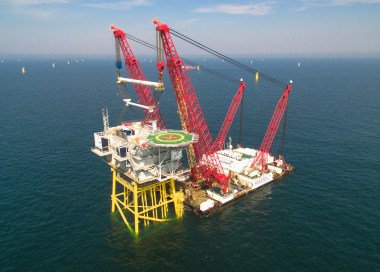
Image: Gemini
¶ France will double the size of its solar power tender for installations of over 250 kWp to 800 MW, French energy ministry announced yesterday. The initial 400 MW tender was announced in September 2014 with three batches: 200 MW for ground-mounted systems, 150 MW for rooftop or building-integrated power plants, and 50 MW for solar canopies on parking lots. [SeeNews Renewables]
¶ An exciting project by the German energy and IT company LichtBlick is currently underway in Hamburg. It is an apartment building being transformed into a power plant. A photovoltaics system is on the roof, a combined heat and power unit and a storage battery in the cellar, and two electric cars in front of the building. The project has an IT platform to optimize it all. [Asian Correspondent]
¶ The UK is considering using a loophole to escape fines for missing the 2020 EU renewable energy targets. It is getting 5% of its energy from renewables, but needs to raise that to 15% by 2020. Now it is cutting subsidies for green power, slowing things down. However, under the EU rules Britain could pay other EU countries that are overshooting their targets for credit. [E&T magazine]
US:
¶ The US DOE’s Energy Efficiency and Renewable Energy office has released the Wind Technologies Market Report. It shows that concerns over increasing penetration of windpower may be misplaced. in Texas, curtailment has been cut from 17% in 2009 to 0.5% in 2014. This was despite increased wind generation, in large part due to added transmission capacity. [CleanTechnica]
¶ GDF Suez (now Engie), a multinational energy company that owns and operates a variety of liquified natural gas import facilities in New England, commissioned a report by Energyzt Advisors LLC. The report says that a proposed natural gas pipeline is unnecessary and lays out a series of alternatives to meet the region’s recent winter-time natural gas shortfalls. [The Recorder]
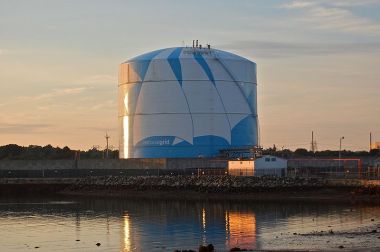
A liquefied natural gas storage facility in Massachusetts. Photo by Fletcher6. CC BY-SA 3.0.
¶ A new report published by Trillium Asset Management has found that California’s two public pension funds lost over $5 billion over the last year due to investments in the top 200 fossil fuel companies. Interestingly, this report comes at the same time that SB 185 is awaiting vote in the California State Assembly, a bill that would divest the same pension funds from coal. [CleanTechnica]
¶ GE announced it will provide Coachella Energy Storage Partners with a 30-MW battery to be used at the Imperial Irrigation District in California’s Imperial Valley, approximately 100 miles east of San Diego. The facility will provide solar ramping, frequency regulation, power balancing and black start capability for a gas turbine. The battery is GE’s largest to date. [InvestorIdeas.com]
¶ The information and communication technology sector’s power demand just keeps growing. But as the sector’s power demand grows, the amount supplied by renewable energy grows faster, and according to research by the National Renewable Energy Laboratory, renewables could supply a whopping 48% of the ICT industry’s electricity mix by 2020. [CleanTechnica]
¶ The recent failure of modular construction to deliver lower prices and shorter timelines will likely keep a cap on US nuclear development into the mid term, according to Fitch Ratings. However, the US Environmental Protection Agency’s Clean Power Plan, along with the rise in federally funded nuclear power research, could yield growth factors for the longer term. [Indiainfoline]
Posted in nuclear power, renewable power, solar, wind | Leave a Comment »
Tags: nuclear, nuclear power, photovoltaic, renewable power, solar power, wind power
August 20, 2015
Opinion:
¶ “What’s at stake in Maine’s power struggle over energy” The debate over energy policy has intensified as Maine has become one of the most oil-dependent states in the country on one hand and the site of an insurgency of renewable energy initiatives such as generating wind and biomass power on the other. It is seen as a question of lower prices versus lower impact. [RenewablesBiz]
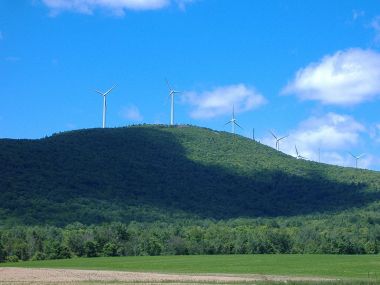
The Mars Hill Wind Farm atop Mars Hill (Maine) has 28 GE Energy 1.5 MW wind turbines. Photo by Michael Surran. CC BY-SA 2.0.
¶ “Another Clean Coal Scam Exposed” Mississippi Power was just downgraded by Moody’s as a result of its lack of permanent cost recovery provisions for its Kemper plant, which, since 2010, has promised to be the “first-of-its-kind” to employ gasification and carbon capture technologies at such a massive scale. To date, construction costs have soared to more than $6 billion. [Green Chip Stocks]
Science and Technology:
¶ They might not be driving them yet, but electric vehicles are definitely on the radar of some of the world’s top investment and market analysts. Last week, the US-based global investment bank Morgan Stanley named “alternative fuel vehicles” as one of seven key market and technology options it sees as well positioned to mitigate or adapt to climate change. [CleanTechnica]
World:
¶ The Scottish government unveiled a new financing scheme to expedite the uptake of electric cars by consumers and private companies and cut down on emissions from vehicles. Scotland’s Energy Saving Trust has allocated £2.5 million to the funding plan which provides businesses and individuals with easier access to loans that can cover the full cost of electric vehicles. [CleanTechnica]
¶ The Australian arm of French developer Neoen awarded Siemens a 100-MW contract to supply wind turbines for a new project there. Siemens will manufacture 32 of its 3.2-MW turbines for the Hornsdale project in South Australia. The power from the project will be sold to the Australian Capital Territory government at a fixed price of A$0.092/kWh ($0.067/kWh US) for 20 years. [Windpower Monthly]
¶ Islamic leaders issued a Climate Change Declaration calling for world governments to adopt a new international climate agreement to phase out fossil fuels and limit global warming to 1.5°C to 2°C. The statement of the leaders from 20 countries lays out a deadline for wealthy and oil-producing nations to phase out all greenhouse gas emissions by 2050. [International Business Times AU]
¶ UK green energy supplier Ecotricity submitted a planning application to the Scottish government for a wind project of up to 51.2 MW. The planned wind farm is to be located in the Scottish Borders and will consist of up to 16 wind turbines of up to 3.2 MW each. The machines are expected to produce almost 148 GWh of electricity per year, enough for over 29,000 households. [SeeNews Renewables]
¶ Renewable energy generated by South Africa’s first wind and solar projects helped ward off some load-shedding and saved around $310 million for the country during the first six months of 2015, according to a recent study by the Council for Scientific and Industrial Research. It also says 2.0 TWh of wind and solar PV replaced diesel and coal usage over the period. [ITWeb]
US:
¶ Rhode Island is in good shape when it comes to meeting the emissions reductions set earlier this month by President Obama. As one of nine Northeast states in the Regional Greenhouse Gas Initiative, a cap-and-trade energy program, Rhode Island is on track to meet its power-plant emission-reduction targets by 2020, 10 years ahead of the deadline set by the Clean Power Plan. [ecoRI news]
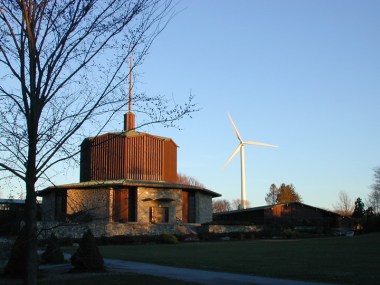
Portsmouth Abbey School wind turbine, in Rhode Island. US DOE photo. Public domain.
¶ SunEdison, Inc. has completed construction of a 6-MW solar power plant that will supply electricity to Lakeland Electric, the third largest public power utility in the State of Florida, through a 25-year power purchase agreement. The Bella Vista solar power plant is expected to generate approximately 14 GWh of electricity each year, enough to supply annual power for more than 1,300 homes. [pv magazine]
¶ A prototype in-river hydropower system is currently in operation at Igiugig in southwest Alaska. It’s part of a recent research that has pushed in-river hydro power closer to becoming a reality for rural communities as an alternative to diesel-based electricity. Communities in western and interior Alaska, most of which are on rivers, are interested in how the project does. [Alaska Public Radio Network]
¶ Senator Charles Schumer launched his push for an extension of the existing solar investment tax credit, which is scheduled to be reduced after next year. He encourages changing the rules to make the credits available when projects begin rather than when they’re finished. Schumer visited the 7-acre WilliamSun Solar Field, in Williamson, New York, to make his statement. [Victor Post]
¶ The city of Columbia, Missouri, plans to stop burning coal at its power plant this fall because of changing environmental regulations. Water and Light officials said they would cease operating the city’s remaining two solid-fuel-burning units by mid-October. The city had concluded in 2007 environmental regulations would shut down its coal burners by 2015. [Columbia Daily Tribune]
¶ Sempra’s Mesquite Solar 3 project will provide a third of the power for 14 military bases in California. This is the largest renewable energy purchase by a division of the US federal government to date. Today, August 20, a signing ceremony for a 25-year power purchase agreement to procure electricity from the third phase of Sempra’s Mesquite Solar project in Arizona. [pv magazine]
¶ The Justice Department has accused Energy Future Holdings, the bankrupt Texas power company, of trying to skirt its environmental liabilities through the bankruptcy court. The former TXU Corp’s environmental risks are huge, ranging from the millions of pounds of coal ash it disposes underground each year, to the Comanche Peak nuclear power plant. [Dallas Morning News]
Posted in nuclear power, renewable power, solar, wind | Leave a Comment »
Tags: nuclear, nuclear power, photovoltaic, renewable power, solar power, wind power
August 19, 2015
Science and Technology:
¶ Hybrid renewable technologies providing stable power for islands are test-beds for study. El Hierro, one of the Spanish Canary Islands, operates a stand-alone electric grid to serve its population of 11,000 and run power-hungry desalination plants. With a goal to be 100% renewably powered, Hawaii is the largest island to aim for a full-renewables grid strategy. [GreenBiz]

Hawaii, the Canary Islands and Alaska’s Kodiak Island are among the isles making waves with ambitious renewable energy goals. Shutterstock / Filip Fuxa
¶ Researchers from Australia’s Monash University used solar cells to power a device that splits water into a fuel with world record efficiency. The system, which is referred to as an emulation of photosynthesis, uses solar power to drive an electrochemical process that generates hydrogen fuel at more than 22% efficiency, breaking previous records of 18%. [Energy Matters]
World:
¶ Up to $44 trillion could be going up in smoke if the world does not act on climate change, according to the latest piece of research from US banking giant Citigroup. The study examines two scenarios: one is what Citi describe as an “‘inaction’ on climate change scenario”, and another scenario looks at what could happen if a low carbon, “different energy mix” is pursued. [CNBC]
¶ It probably surprises nobody to learn that coal produces more of the world’s electricity than any other fuel. But it many would be surprised to learn that renewables have taken second place. Electricity generation from renewable sources has overtaken natural gas to become the second largest source of electricity worldwide, the International Energy Agency has announced. [eco-business.com]
Electricity generation from renewable sources has overtaken natural gas to become the second largest source of electricity worldwide. Image: Shutterstock
¶ Scottish Renewables has revealed the latest figures for how the sector fares in the country. Around 42,000 solar schemes, 2,557 small wind projects, 204 hydro-electric schemes are amongst some of the renewable methods being used to power homes. Inverurie in Aberdeenshire is Scotland’s solar capital with the town boasting about 10,000 250-W solar panels. [Energy Voice]
¶ Installed solar power capacity in India grew to 3,744 MW by March 2015 from 14 MW in 2010, according to a study by Deloitte and Confederation of Indian Industry. It says less than 1% of India’s solar energy potential is being harvested. Solar power is growing quickly because it is the least expensive way to get power to many of the 300 million people who currently go without. [Greentech Lead]
US:
¶ The Northern Pass project would transmit power from hydroelectric plants in Quebec through New Hampshire. Eversource Operations, the firm proposing the 192-mile power line, unveiled a new plan. It includes burying an unprecedented 60 miles of transmission lines through the most fragile areas. It would also reduce the transmission capacity from previous goals. [Bangor Daily News]
¶ Nitrous oxide emissions from agricultural operations in the central United States may be greatly underestimated, and in some instances are as much as 40% higher than previously thought, according to a new study. It is a potent greenhouse gas. It is produced from nitrogen fertilizer and manure applications, evolving directly from fields and indirectly, as it gets into waterways. [CleanTechnica]

Image: eutrophication&hypoxia
¶ The North American unit of German inverter maker SMA Solar Technology AG announced an order to supply 700 MW of central inverters for solar power plants in California. SMA will provide 317 units of its Sunny Central 2200-US inverter, which has been designed specifically for the US market, for seven utility-scale systems that range in size from 50 MW to 150 MW. [SeeNews Renewables]
¶ Royal Dutch Shell has been granted a permit to commence deep-sea drilling in the Arctic Ocean. Drilling shallow wells in the area had already begun, but a lack of documentation and precautionary equipment prevented drilling deep enough to strike oil. The US Bureau of Ocean Energy Management predicts the possibility of one or more oil spills in the next decade. [Business Finance News]
¶ Florida Power & Light got pushback Tuesday from South Florida officials and other critics as it requested $34.2 million from customers to continue planning a pair of nuclear reactors at its Turkey Point complex. The request, if approved by the Florida Public Service Commission in October, would add a cost for new nuclear power of 34¢ on a typical residential bill. [CBS Local]
Posted in nuclear power, renewable power, solar, wind | 1 Comment »
Tags: nuclear, nuclear power, photovoltaic, renewable power, solar power, wind power
August 18, 2015
World:
¶ A new study has found that China’s air pollution is linked to the death of over 1.6 million people a year or 4,400 people a day. The study was carried out by Richard Muller and Robert Rohde, researchers at Berkeley Earth. They mapped the concentrations of six major pollutants across eastern China, using data from China’s national air quality reporting system. [The Next Digit]
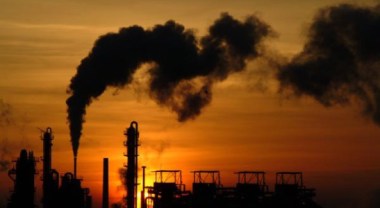
Chinese industrial pollution.
¶ The Ghanaian Minister for Power has launched the rollout of a PayGo home solar power in the Assin district of Central region, Ghana. Starting with households in the area of Assin Sienchem, the first phase of the program will deliver power to over 100,000 households, with particular focus on Cocoa growing regions in Central, before being rolled out more widely. [CleanTechnica]
¶ Sojitz Corporation of America reached an agreement with Grupo T-Solar Global SA and invested in two solar power plants in Peru, becoming owner of a 49% equity interest. With a total output of over 44 MW, the project is the first mega-solar project in Peru. The project has 20-year fixed-price power purchase agreements guaranteed by the Ministry of Energy and Mines. [pv magazine]
¶ Engie, the French utility giant formerly known as GDF Suez SA, is said to have plans to sell more than $1 billion of stakes in Asian coal-fired power plants. Engie, a sponsor of the Paris climate-change talks later this year, has shut gas plants and capped coal-fired installations as Chief Executive Officer Gerard Mestrallet steers the company toward renewable energy sources. [Bloomberg]
¶ ScottishPower confirmed it is to close the giant Longannet coal-fired power station next March 31. It said a combination of high carbon taxes and high transmission charges made the plant uneconomical. It also said since the same issues make any thermal power plant in Scotland challenging, it will not pursue plans for a combined cycle gas turbine plant at Cockenzie. [Business Green]

Longannet Power Station 2012
¶ RWE AG has officially commissioned a power-to-gas plant, rated at 150-kW, as part of a system linking together the supply of electricity, natural gas, and district heating in North Rhine-Westphalia. The power-to-gas plant turns unused renewable power into hydrogen, which is then injected into the natural gas network. The gas will be used at a co-generation plant. [SeeNews Renewables]
US:
¶ Opponents to the offshore wind farm under construction near Block Island, off the coast of Rhode Island, have filed a case in federal court seeking to overturn a critical agreement under which developer Deepwater Wind will sell power to utility National Grid. The complaint was filed by several long-standing opponents of the five-turbine wind farm. [The Providence Journal]
¶ In a recent survey, while 71% of the Southern Californians queried stated that they were highly interested in getting an EV, it seems an additional 13% already had one. All things considered, it is not a shabby percentage (and a reflection of the relative wealth of those queried, I assume). Only 16% of those asked were not interested in EVs, according to the results. [CleanTechnica]
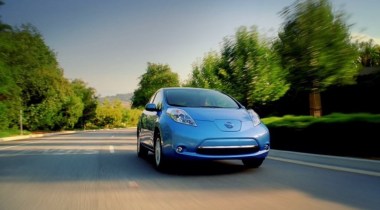
Image Credit: Nissan
¶ Google has announced a tool for finding an easy answer to one of the most difficult questions for climate-conscious homeowners: Should I install solar panels? Project Sunroof is an application of Google Maps that aims to cut through the complicated calculations that go into whether your house is well-suited to generate its own power from that giant nuclear furnace in the sky. [Slate Magazine]
¶ Additional degradation of concrete related to alkali-silica reaction at Seabrook Station nuclear power plant was found in a Nuclear Regulatory Commission inspection this summer. NRC officials downplayed concerns, however. Concrete degradation was discovered in Seabrook Station in 2010 and may be the last hurdle in Seabrook’s attempt to renew its license. [Seacoastonline.com]
Posted in nuclear power, renewable power, solar, wind | Leave a Comment »
Tags: nuclear, nuclear power, photovoltaic, renewable power, solar power, wind power
August 17, 2015
World:
¶ Ontario’s Environmental Review Tribunal last week dismissed appeals of two wind projects developed by Capstone Infrastructure Corp with a combined capacity of 28 MW. Canada-based Capstone says the decision upholds the renewable energy approvals granted previously to the 18-MW Ganaraska and 10-MW Grey Highlands ZEP projects in Ontario. [SeeNews Renewables]
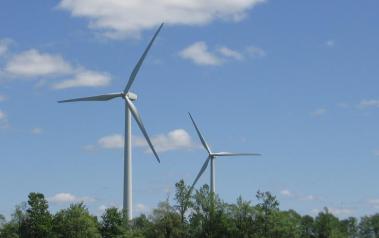
Wind farm in Ontario. Author: John Vetterli. License: Creative Commons, Attribution-ShareAlike 2.0 Generic
¶ PT Energi Angin Indonesia and the government of South Sulawesi today signed a memorandum of understanding to develop a 62.5-MW wind farm. It will be tied to the South Sulawesi electricity grid and should produce over 200 GWh per year. This is enough to supply to more than 450,000 local people and help avoid 120,000 tons of carbon dioxide emissions per year. [The FINANCIAL]
¶ Conergy, based in Hamburg, Germany, and ATC Enviro Co Ltd, a member of the Symbior Solar group, a solar PV developer based in Bangkok, announced plans to build three solar PV plants in Thailand having a total capacity of 19 MWp. Symbior Solar currently is developing an additional 100 MW in solar projects across Asia for implementation in 2015/16. [The Tide]
¶ Renewable power is becoming a political force in Australia. Australian Solar Council launched its latest campaign, on the weekend, urging people to “vote solar” in an upcoming by-election in Western Australia, as the Coalition government has repeatedly broken promises on renewable energy. A recent poll found that the Coalition would lose on the back of a 7.5% swing. [RenewEconomy]
¶ In New Zealand, the Greens want the Government to set a target for 10% renewable energy generation, following Contact Energy’s decision to close its Otahuhu B gas-fired power station at the end of next month. The Government’s renewable energy target is 90% 2025. Green Party energy spokesman Gareth Hughes says the time has come to set a goal of 100% renewable energy. [3News NZ]
¶ Scotland’s ambitions to become a zero waste nation were today bolstered with the start of construction of Viridor’s new £177 million energy recovery facility in East Lothian. The site will process 300,000 tonnes of post-recycling ‘residual’ waste per annum to generate 30 MW directly to the grid, enough to power 39,000 homes, and will also offer up to 10 MW of heat. [Process & Control Today]
¶ German firms may sign contracts with the Iranian Energy Ministry to build power plants in Iran. Lifting sanctions will pave the way for resuming energy projects. Transferring technology by German companies to Iranian companies, improving efficiency of existing thermal power plants, and building new wind and solar power plants in Iran are all under discussion. [Tehran Times]
¶ Four and a half years after the Fukushima Disaster began, and as Japan tentatively restarts nuclear power elsewhere, legal challenges are mounting for the crippled plant’s operator. They include a judge’s forced disclosure of a 2008 internal document prepared for managers at TEPCO warning of a need for precautions against an unprecedented nuclear catastrophe. [The Japan Times]
US:
¶ Wind energy prices have hit an all-time low and the cost of installing turbines has fallen 20% to 40% in the last five years, according to the DOE. Its new report says last year’s wind-power price contracts with utilities averaged under 2.5¢/kWh, down from 7¢/kWh in 2009. In the Northwest, that could mean a resurgence of interest and investment in wind farms. [Public News Service]
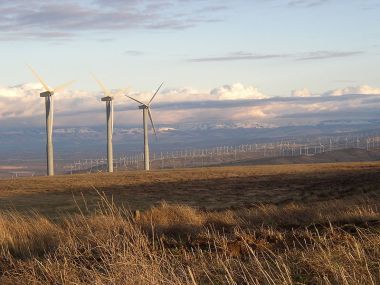
Oregon ranks sixth among states for installed wind capacity. A new national report citing lowest-ever prices for wind power could spark more investment in the industry. Photo credit: Umptanum/Wikimedia Commons.
¶ A bill to augment New Jersey’s clean energy market by encouraging residents to generate their own electricity using renewable energy sources is now law. It increases the electric power net metering cap established in the “Electric Discount and Energy Competition Act” to 2.9% of the total annual energy sold in New Jersey, effectively quadrupling the state limit on net metering. [TAPinto.net]
¶ The wind and solar energy industries in Michigan are expected to continue steady growth and add hundreds of jobs over the next decade, regardless of what the legislators and Governor Rick Snyder come up with in a final energy bill package this year. Part of the optimism comes from a regulatory announcement earlier this month by the EPA, the Clean Power Plan. [Crain’s Detroit Business]
Posted in nuclear power, renewable power, solar, wind | Leave a Comment »
Tags: nuclear, nuclear power, photovoltaic, renewable power, solar power, wind power
August 16, 2015
Science and Technology:
¶ Climate change makes some organisms go extinct, but increases others. According to the author of a newly released study, “it is not so easy to determine the number of wild boars in Europe.” However, in the recent decades, more and more boars have wound up as road kill and in hunting bags – a strong indication that local populations are growing and gaining ground. [Nature World News]

A possible beneficiary of climate change. Photo: pixabay
¶ According to the Taskforce on Extreme Weather and Global Food System Resilience, worldwide food shortages, dramatic price increases, and volatile market conditions may take place every 30 years in about 25 years from now, instead of taking place once a century. To cover this and population increase, food production may need to improve by over 60%. [Modern Readers]
World:
¶ Kuwait has approved the construction of a series of power plants, desalination facilities and other infrastructure projects worth up to $9.9 billion, according to Kuwait’s finance ministry. While no timeline has been set for most projects, which are expected to add 3,580 MW to the country’s electricity capacity, a planned sewage plant will commence by the year 2020. [Construction Week Online]
¶ Opponents of onshore wind farm developments across Lincolnshire have expressed surprise at the results of a survey which has claimed that only 8% of people are against turbines on farmland. The Good Energy poll also found just 4% of the public opposed solar farms, and 7% were against biomass plants. For the poll, 2,000 people were asked their views on renewables. [Lincolnshire Echo]
¶ Asked for fact checking, the Saudi agency responsible for developing renewable energy, with a budget of $109 billion, confirmed the kingdom’s plan of 41 GW solar power by 2032 and added it would be composed of 25 GW of solar thermal and 16 GW of photovoltaics, starting from almost nothing in 2012. But it has also announced the plan’s target date may be 2040. [gulfnews.com]
¶ The transportation sector accounts for 29% of the Uruguay’s energy use, according to the Industry, Energy and Mining Minister. She said studies by her portfolio indicate that by 2030, 40% of the public-transport fleet, and 60% of taxis, will be powered by renewable energy sources. The change has already started, and the first four electric cars have been added to the capital’s taxi fleet. [La prensa]
¶ Residents near the Japan’s Sakurajima volcano evacuated to safer places after the government raised its alert level to 4 on a 5-point scale, indicating a major eruption could be imminent. The Sendai nuclear power plant, which is the first to restart under tighter safety rules adopted in the wake of the Fukushima Disaster, is just 50 km from the volcano. [South China Morning Post]
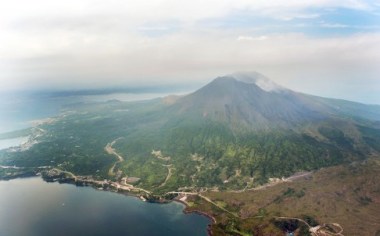
An aerial view shows Mt. Sakurajima in Kagoshima, southwestern Japan. Photo: Kyodo
¶ Cochin International Airport is set to become the first airport in India to be operating on solar power. This will make the airport ‘absolutely power neutral’ in terms of energy consumption. A 12-MW solar power project will be inaugurated August 18. Photovoltaic cells have been laid across 45 acres. Electricity from the solar power plant will be used for airport operations. [Skymet Weather]
¶ Australia’s federal government has been marked down on climate change in a new poll that shows most voters believe it has done too little to address the problem. The poll comes as the government’s official climate change policy adviser accuses the Tony Abbott-led government of shirking its part of the collective global task of avoiding dangerous climate change. [The Australian Financial Review]
US:
¶ The Obama administration’s Clean Power Plan requires the nation to use a lot more renewable energy by 2030, and a lot less coal. And right on time, two new reports published last week by the Department of Energy find that one key renewable sector, wind, is booming, a development that can only help matters when it comes to reducing carbon emissions. [Memphis Commercial Appeal]
¶ As wildfires burn throughout California, there the latest forecast says there will be an unusually strong El Niño, which typically brings heavy winter rainfall to California. The National Oceanographic and Atmospheric Service released data late last week that showed surface temperatures in the Pacific Ocean off South America to be nearly 4° Fahrenheit above normal. [Times of San Diego]
Posted in nuclear power, renewable power, solar, wind | 1 Comment »
Tags: nuclear, nuclear power, photovoltaic, renewable power, solar power, wind power
August 15, 2015
Science and Technology:
¶ Twenty-five years ago, the Passive House certification system raised the bar for energy efficiency by introducing a rigorous performance-based standard. Now, the Passive House Institute has raised the bar higher with certification of two residential projects under a new category, “Passive House Plus,” that incorporates evaluation of on-site renewable energy. [Architectural Record]

A 16-unit apartment building in Innsbruck, Austria, is the first of its kind to be certified under Passive House Plus. Passive House Institute photo.
World:
¶ Fears are growing in South Africa that agreements to build nuclear power plants will made behind closed doors, without the necessary public scrutiny. Among those voicing concern, two government sources say the Treasury is not being included in procurement discussions, despite the massive budgetary implications of a project that may cost as much as $100 billion. [Daily Times]
¶ According to the IEA, almost all of Greece’s oil is imported, and it accounts for a highly significant 45% of the country’s energy supply. The Greek government is spending €800 million each year on oil subsidies. At the same time, an estimated 6 in 10 Greek homes are struggling to pay their energy bills. Greenpeace is undertaking efforts to solarize Greece and install heat pumps. [Inhabitat]
¶ Brazil’s Ministry of Mines and Energy approved four renewable energy projects for the national Incentive Regime for Infrastructure Development in the state of Bahia. The combined capacity of 96.9 MW will include 36.9 MW of wind power to be completed in 2016 and 60 MW of solar to be put online in2017. The projects represent investments of approximately $133 million. [SeeNews Renewables]
US:
¶ SunEdison announced it will partner with Dominion to create a joint venture around the 420-MW Four Brothers solar project in Utah. The project is currently being developed and constructed by SunEdison, and is expected to become fully operational by mid-2016. Dominion will invest approximately $500 million to acquire 50% of the cash equity and 99% of the tax equity. [CleanTechnica]
¶ A Hawaii agency is moving ahead with its plan to go entirely off the electrical grid by developing its own microgrid system. The Hawaii Foreign Trade-Zone No 9 is a five-acre facility on seven acres of land. It has more than 75 offices and a warehouse, and includes 200,000 square feet of total rooftop space. It is estimated that a system of over 500 kW is needed. [Pacific Business News (Honolulu)]
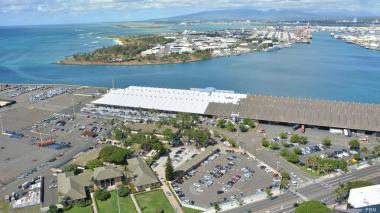
The Hawaii Foreign Trade Zone No. 9 at Honolulu Harbor. PBN File.
¶ The utility firm, Maui Electric Company, is aiming to purchase electricity from two newly proposed large-scale solar energy projects, which will be the first of their kind on Maui, according to a press statement from Maui Electric Company. The two projects are expected to provide up to 5.7 MW of solar PV generated electricity for the relatively low price of 11.06¢/kWh. [CleanTechnica]
¶ Massachusetts Governor Charlie Baker and members of Bristol Community College revealed the largest solar canopy in New England on Friday, a 3.2-MW installation that covers 800 parking spaces over two hectares of land on the college’s Fall River Campus. The installation will churn out 34 million kWh of energy annually and will save over $1.75 million over 20 years. [PV-Tech]
¶ Public Service Company of New Mexico and parties opposed to its plans to keep the coal-powered San Juan Generating Station in operation reached a deal that could phase out the plant after 2022. PNM will commit to a Public Regulation Commission review in 2018 over whether the San Juan plant should be shut down after 2022, when current contracts expire. [Albuquerque Business First]
¶ With construction of the Watts Bar Unit 2 nuclear reactor mostly complete, the Tennessee Valley Authority announced it has asked the Nuclear Regulatory Commission to issue a license for the reactor. The TVA sent documentation to the NRC informing the organization that construction of the Watts Bar reactor is substantially complete with only a few details left to finish. [Knoxville News Sentinel]
Posted in nuclear power, renewable power, solar, wind | 1 Comment »
Tags: nuclear, nuclear power, photovoltaic, renewable power, solar power, wind power
August 14, 2015
Science and Technology:
¶ Ask electric vehicle drivers what they don’t like about their electric car experience and the chances are most of them would say charging their vehicles away from home is their least favorite thing. Now, researchers in England are exploring the possibility of making wireless recharging available on some motorways, the English equivalent to our interstate highways. [CleanTechnica]
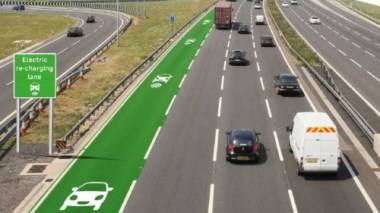
The possibility of EV recharging lanes is being explored in the UK.
World:
¶ India’s Ministry of New & Renewable Energy shared annual capacity addition targets for the National Solar Mission. India aims to install a solar power capacity of 100 GW by 2022, including 40 GW of rooftop solar power capacity and 57 GW of utility-scale. Earlier this year, when it had 3 GW installed, it increased the targets to those levels from a target of 22 GW by 2022. [CleanTechnica]
¶ The Indian state of West Bengal has asked the central government to fund 40% of a planned 1-GW pumped storage hydroelectric facility, which will store power from a 1.2-GW solar park nearby. Constructing the Turga pumped storage system will require an investment of about ₹110 billion ($1.7 billion), compared to the solar power station’s cost of ₹60 billion. [SeeNews Renewables]
¶ In Australia, ANZ Bank has released a report it commissioned by consulting firm Port Jackson Partners which provides a detailed explanation of why smaller-scale renewable energy technologies, such as solar PV, can represent a better economic choice than conventional options for newly developing countries with poorly developed grid infrastructure. [Business Spectator]
¶ Technology to dip the voltage of electricity delivered to homes was trialled in one region of the UK. Half a million households part in the trial that was set to test increasing the capacity of the grid without costly new infrastructure. The trial is now at the end of its year lifespan, and shows promise as an option for increasing use of renewables with no complaints recorded. [uSwitch.com]
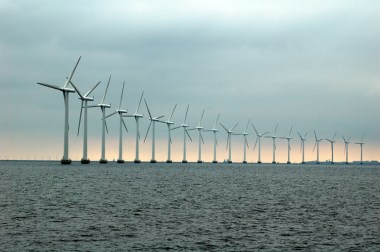
Offshore wind farms have production that varies depending on the weather.
¶ Existing coal plants in Indonesia cause an estimated 7,100 premature deaths every year according to research by Harvard University and Greenpeace Southeast Asia, the first to look at illness and deaths associated with Indonesia’s coal-fired plants. The number could be over 28,000 if the country goes ahead with a rollout of over 100 new coal-fired power plants. [Dominican Today]
¶ India, the third-largest carbon emitter and a country very vulnerable to climate change, is a key player in global climate negotiations. Now, in the run-up to the Paris climate negotiations in October and November of this year, its negotiating position might be evolving dramatically. An internal document suggests that India should abandon old positions and seek new allies. [CleanTechnica]
¶ Plans were announced in November 2012 for a cover to be constructed to encase the Fukushima Daiichi’s Unit 3 building, protecting it from the weather and preventing any release of radioactive particles during decommissioning work. Almost three years later, TEPCO says it can start installation as soon as the removal of rubble from the reactor building is completed. [World Nuclear News]
US:
¶ The authors of a new environmental report say Massachusetts is falling short of its carbon reduction goals, but could get on track by increasingly embracing emerging energy technologies. Increased adoption of energy storage technology, offshore wind power, solar energy can help the state on its goal of reducing carbon emissions to 80% of 1990 levels by the year 2050. [Barnstable Patriot]
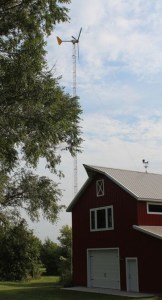
Alan and Kris Miller’s wind turbine. Photo by Alan Miller.
¶ When Alan and Kris Miller installed the 140-foot-high wind turbine in their back yard near Stewartville, Minnesota, their electric utility tacked on a $5-per-month charge. Their letter of complaint to state regulators blew open a controversy, which led to the Public Utilities Commission ordering all of the state’s utilities to report whether they charge similar fees. [Minneapolis Star Tribune]
¶ New regulations limiting mercury and other pollutants plants can emit are an issue for a 60-year-old coal-burning plant in Lansing, Michigan. As it happens, the plant is old enough it’s also difficult to find parts to make repairs. And there are too many hurdles to switch it over to burn natural gas. Plus, it’s technically in a flood zone. The city is looking into alternative choices. [Michigan Radio]
¶ New analysis shows Minnesota is the only state in the Midwest on track to exceed federal targets for reducing climate change. The report from the Union of Concerned Scientists, which supports the US EPA’s Clean Power Plan, said early investments in renewable energy and energy conservation will help the state surpass the targets set for 2022 and 2030. [Minnesota Public Radio News]
¶ Even as President Obama hails the campaign against climate change, he’s opening the Arctic and Atlantic oceans to drilling and is on track to lease massive amounts of coal in the West. Renowned climate scientist James Hansen said he plans to write an analysis of the president’s policies “probably entitled ‘Delusions at 1600 Pennsylvania Avenue,’ or something like that.” [Alaska Dispatch News]
¶ Ohio and 14 other states led by West Virginia Attorney General Patrick Morrisey this afternoon asked the DC federal appeals court to block the US EPA from putting its Clean Power Plan into place until the courts decide whether the EPA can legally force states to limit CO2. This is unusual because a suit has not yet been filed on the legality of the EPA’s enforcement. [cleveland.com]
Posted in nuclear power, renewable power, solar, wind | 1 Comment »
Tags: nuclear, nuclear power, photovoltaic, renewable power, solar power, wind power
August 13, 2015
World:
¶ Egypt has invited bids for the development of 500 MW of renewable energy projects, including one solar PV, one concentrating solar power (CSP), and one wind power project. The Egyptian Electricity Transmission Company and the New and Renewable Energy Authority announced separate tenders for 250 MW of wind, 200 MW of PV and 50 MW of CSP capacity. [SeeNews Renewables]
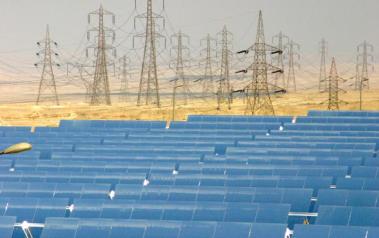
Kuraymat solar-natural gas power plant in Egypt. Author: Kuraymat. License: Creative Commons.
¶ Solar energy generation surged by around 153% over the last year in the UK, according to analyst company EnAppSys. The new report also notes that, while solar PV generation currently accounts for only 4% of the UK’s electricity supply, that growth in the industry was already causing “oversupply” to the grid, thus contributing to negative market prices during some periods. [CleanTechnica]
¶ French utility Engie, formerly GDF Suez, has started construction work on the 10-MW Cairnborrow wind farm in Scotland. Completion is expected by late 2016. The five-turbine facility is located near Huntly in Aberdeenshire. Once up and running, it is expected to generate enough electricity to supply power for about 6,300 homes. [SeeNews Renewables]
¶ Indian Railways is planning to set up a renewable energy capacity of 1,200 MW and a transmission system to carry the power generated in an attempt to cut its power costs. The national carrier is also conducting an energy audit to estimate the amount of savings that can be made. Railways consumption is growing at about 5% a year. [Livemint]
¶ The Fukushima Prefectural Federation of Fisheries Cooperative Associations has approved TEPCO’s plan to release water into the ocean after it has been decontaminated. Under the plan, TEPCO will pump up water from subdrains around reactor buildings at the plant. This water will then be treated and discharged into the sea. [The Japan News]
US:
¶ The average price of adding solar to a home or business has dropped by more than 50% over the past years, according to Lawrence Berkeley National Laboratory’s eighth-annual “Tracking the Sun” report. Solar prices are falling across America, largely due to industry efforts to reduce solar soft costs (non-module project costs) as government incentives taper off. [CleanTechnica]
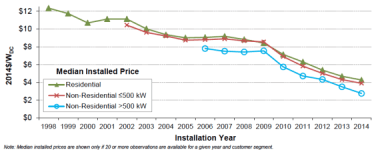
US solar PV prices 1998-2014 graph via LBNL/SunShot.
¶ First Solar has already sold out of solar photovoltaic (PV) module capacity for 2015, and for most of 2016, according to the most recent figures. Overall, the company beat analyst predictions pretty handily, coming in with net sales of $896 million for the second quarter, accompanied by a 1:1 book-to-bill ratio. This amounts to a rise from the first quarter of nearly $427 million. [CleanTechnica]
¶ After a very successful debut in Northern California, in March of this year, Neste’s NEXBTL renewable diesel is now also available to drivers in Southern California at retail stations. Propel Fuels is the first retailer in the world to sell essentially neat NEXBTL renewable diesel to consumers under the brand name Diesel HPR. [IT Business Net]
¶ New York and Connecticut recently joined at least 13 other states, including Hawai’i and Maryland, in establishing measures that could significantly expand access to renewable energy generation in those states through community-based renewable energy programs. Community solar projects expand access through virtual net metering [JD Supra]
¶ It’s the first, and likely won’t be the last member-owned solar farm in Maine. The Edgecomb Community Solar Farm Association began providing electricity to the grid on July 31 and held a ceremony Aug. 6 celebrating its beginning. The association is using electricity produced from 182 solar panels attached to a farm in Edgecomb. [Boothbay Register]
¶ Tucked inside the Obama administration’s groundbreaking greenhouse gas reduction scheme are some even more significant opportunities for smart grid technologies, not just to indirectly boost the grid’s green power capacity, but to actively serve as a compliance tool for states’ carbon-cutting and carbon-trading plans. [Greentech Media]
Posted in nuclear power, renewable power, solar, wind | 1 Comment »
Tags: nuclear, nuclear power, photovoltaic, renewable power, solar power, wind power
August 12, 2015
World:
¶ Taiwan’s Ministry of Economic Affairs announced that it will begin a development plan to harness geothermal energy from the Tatun Volcano Group by building a station in New Taipei’s Jinshan District. It would generate up to 68.5 million kWh of electricity per year and would also reduce over 42,000 metric tons of carbon dioxide emissions every year. [Focus Taiwan News Channel]
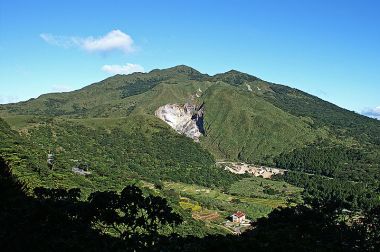
Chihsingshan (七星山), the highest peak of the Tatun volcanoes. Photo by peeliden. GNU Free Documentation License, Wikimedia Commons.
¶ Turkey will expedite an auction for wind energy projects as it looks to speed up its renewable energy program. Turkey’s Energy Market Regulatory Authority announced that it will call for bids on 2 GW of wind energy projects in October next year, with the auction becoming a big part of the country’s target to have 20 GW worth of installed wind energy capacity by 2023. [CleanTechnica]
¶ Spain signed an agreement with Iran to boost cooperation in Iran’s renewable energy industry, and will extend cooperation in designing and manufacture of renewable energy equipment. The agreement was signed between Iran’s Sunir, an electrical equipment exporter and Spain’s Bestern, a renewable energy project developer, which will do consulting for Sunir. [CleanTechnica]
¶ China is now adding one idle coal power plant per week. State-owned power companies have continued adding new coal-fired power plants to the grid at a feverish pace, and in the first half of 2015, 23.4 GW of thermal power plants were brought online. But at the same time, thermal power generation dropped 3.2%, and their capacity utilization fell to just below 50%. [Business Spectator]
¶ The M5BAT is a modular, 5 MW, multitechnology medium voltage battery storage system under construction at RWTH Aachen University, Germany. It combines different battery technologies to deliver a significant upgrade in system stability and modularity. A group of businesses are working on it, and the German Ministry for Economic Affairs has granted it €6.7 million. [pv magazine]
¶ The Scottish and Welsh Governments have united to urge Westminster to act on renewable power to stop community projects falling into “hiatus.” The devolved administrations have written a joined letter to UK Energy minister Amber Rudd warning community energy projects are at risk of failure following the decision to withdraw state support a year earlier than planned. [The National]
US:
¶ Wind power keeps chugging along, with prices falling over time, though not as dramatically as solar, and installed capacity going up. Every new turbine that goes up will keep producing clean power for decades to come at very little cost (basic maintenance, no fuel costs unlike fossil fuel power plants). The US added 4.8 GW of windpower in 2014, 24% of our new capacity. [Treehugger]

Public Domain. National Renewable Energy Laboratory photo.
¶ Microsoft has invested significantly in wind power over the past two years, building up contracts to deliver 285 MW of power to its data centers from two wind energy projects built offsite. It’s a progressive move for Microsoft to turn toward renewable energy reliance, and the support of a company with as much influence and reach as Microsoft could be an immense boost. [Energy Digital]
¶ Jiminy Peak Mountain Resort, the largest ski resort in southern New England, will soon be home to the largest community solar project in the northeastern United States, thanks to the construction by Nexamp of a 2.3-MW solar installation on 12 acres of the facility’s property. This project will supply Jiminy Peak with enough energy to offset 90% of its annual needs. [CleanTechnica]
¶ For 15 years, Sunflower Electric Power Corporation has been trying to expand its coal-fired power plant near Holcomb, Kansas. Even though the project has been designed and redesigned, for a variety of reasons the site is still just bare dirt. And with the new federal greenhouse gas rules for power plants, there’s serious doubt that construction will ever take place. [The Garden City Telegram]
¶ A long-planned 21.5-MW biomass plant being built on the Big Island of Hawaii, expected to generate 10% of the island’s energy needs, is currently scheduled to be operational in 2016, according to public documents. Hu Honua Bioenergy has had problems completing the plant, mostly in the form of labor disputes, but the project is making progress. [Pacific Business News (Honolulu)]
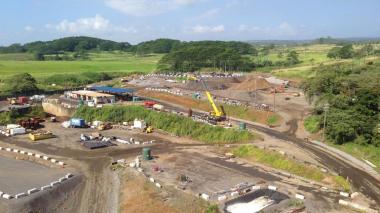
Hu Honua Bioenergy’s biomass plant being built on the Big Island of Hawaii. Courtesy of Hu Honua Bioenergy.
¶ While opponents of the Clean Energy Plan are preparing for all-out war against it (“I will not sit by while the White House takes aim at the lifeblood of our state’s economy,” vowed Senate Majority Leader Mitch McConnell of Kentucky) the rule shines a light on a key renewable fuel for Iowa: wind. And wind power is booming, [The Gazette: Eastern Iowa Breaking News and Headlines]
¶ The US subsidiary of the Real Assets Energy Fund has signed an agreement with WElink Energy and China Triumph International Engineering Co to jointly develop new North American renewable projects totaling $1 billion. Planned investments will be primarily in solar PV and windpower generation, but other clean technologies will be considered. [North American Windpower]
¶ The Tennessee Valley Authority has successfully completed its testing of key operating equipment for its Watts Bar Unit 2 nuclear reactor, clearing the way for additional tests of safety and containment systems before fuel is scheduled to be loaded in the new reactor this fall. TVA expects to begin generating power from the new reactor by the end of 2015. [Chattanooga Times Free Press]
Posted in nuclear power, renewable power, solar, wind | Leave a Comment »
Tags: nuclear, nuclear power, photovoltaic, renewable power, solar power, wind power
August 11, 2015
World:
¶ Abengoa and Toshiba Corporation have been picked to build the Tees Renewable Energy Plant, a 299-MW CHP project to be sited in Teeside, UK. The project will have a capacity of 299 MW from electricity and steam to be used in combustion and exported to nearby industrial facilities and consumers. The engineering, design, and construction contract is worth over €600 million. [reNews]
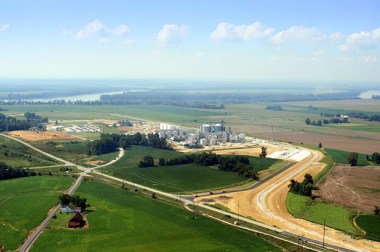
Image: an Indiana-based biogas plant (Abengoa)
¶ Kyushu Electric Power has restarted the first nuclear reactor to operated under new Japanese safety rules following the 2011 Fukushima Disaster. All Japan’s nuclear plants were gradually shut down after a series of meltdowns at the Fukushima plant sparked by the tsunami and earthquake. But after passing stringent new safety tests the Sendai plant restarted on Tuesday morning. [BBC]
¶ Australia plans to cut greenhouse gas emissions by 26% to 28% from 2005 levels by 2030, PM Tony Abbott says. It is less than cuts pledged by countries such as Canada and the US. Australia’s previous target was to cut emissions by 5% by 2020, based on emissions in 2000. Australia is still largely powered by carbon-polluting coal and is one of the world’s biggest coal exporters. [BBC]
¶ AGL Energy, which has committed to stop generating electricity from coal by 2050, called for bipartisan support for a national carbon budget designed to limit global temperature increase to within 2°C. Investors said the targets fail to provide certainty for the sector because they don’t put Australia on a path to limiting global warming to 2°C. [The Australian Financial Review]
¶ Iran’s deal on its nuclear program means it can sell fossil fuels. It may be the world’s third largest gas producer, but it faces several challenges in exporting the its most abundant commodity to Europe. These include a looming oversupply; growing competition from other producer countries; demand weakness in the continent; and infrastructure troubles at home. [Financial Times]
¶ The recent turmoil in China’s stock market has sent shockwaves through the country’s corporate sector, including its mighty solar power industry which in recent years has grown to dominate the world market. Seven out of the world’s top ten manufacturers of solar panels are China-based companies, together providing about 40 per cent of global solar supplies. [eco-business.com]
¶ Thai renewable energy company Impact Energy Asia Company Limited will develop a 600-MW Monsoon wind farm power project in southern Laos under an agreement signed with the Lao government. The wind farm will be located near the Mekong River across from Ubon Ratchathani. The developer is a project company of Impact Electrons Siam Company Limited. [SeeNews Renewables]
US:
¶ Could the United States be on the verge of a wind energy renaissance? It’s quite possible, now more than ever before. According to a new report produced by Lawrence Berkeley National Laboratory and funded by the U.S. Department of Energy’s Office of Energy Efficiency and Renewable Energy, the price of wind energy in the United States is at an all-time low. [Energy Digital]
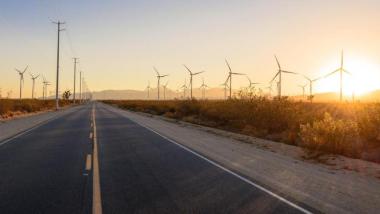
Competitive wind energy prices could help the U.S. increase interest in renewables.
¶ The price of gasoline in some parts of the US could go below $2 per gallon by fall, according to some analysts. The price of crude oil is being pushed lower by concerns about a slowdown in Chinese economic growth, strong oil output from North America and the Middle East, as well as the tentative nuclear deal with Iran, which could bring more of that country’s oil to the market. [CNN]
¶ SNL Energy compared projections of what each state’s emissions rate would have been in 2020 without the Clean Power Plan with its goal in 2030 under the new rule. The analysis found that Pennsylvania will have to cut its emissions rate by 26% from where business-as-usual behavior would put the commonwealth in 2020 in order to meet the EPA plan’s target. [Pittsburgh Post-Gazette]
Posted in nuclear power, renewable power, solar, wind | 1 Comment »
Tags: nuclear, nuclear power, photovoltaic, renewable power, solar power, wind power
August 10, 2015
Opinion:
¶ “Clean Power Plan Protects the Health – And Pocketbooks – Of Latino Families” California remains in a four-year-old extreme drought; Texas saw record flooding and rain after a record drought; and sea-level rise is already threatening Florida’s infrastructure and freshwater supply. It should not be surprising that 82% of Latinos are concerned about climate change. [Huffington Post]
World:
¶ Nova Scotia has ended a program giving citizens an incentive to produce renewable energy. The decision, which may initially lower prices for energy users, is at odds with widespread warnings that renewable energy must rapidly replace fossil fuels. The scheme is the Nova Scotia Community Feed-in Tariff, which encouraged community-based renewable energy projects. [Truthdig]
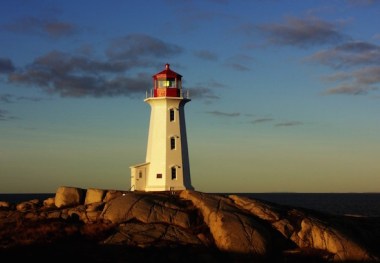
Peggys Cove lighthouse: Nova Scotia’s long Atlantic coastline is ideal for tidal power. (Bob Jagendorf via Wikimedia Commons)
¶ Enel Green Power has commissioned the world’s first geothermal-biomass hybrid power plant in Italy. Enel Green Power announced that it has added 5 MW of biomass-based generating capacity to an existing 13-MW geothermal plant in Tuscany. The biomass unit was added to the geothermal unit to increase overall efficiency and power generation of the project. [CleanTechnica]
¶ The UK’s government wants to kick-start its nascent shale gas industry, with a pointed reminder to planning authorities that ministers wish to see fracking planning applications fast-tracked. Stressing an “urgent need” for development, the guidance will give the energy minister more freedom to intervene in hearing appeals against planning decisions on shale gas projects. [Business Green]
¶ EDF, the electricity utility owned by the French government, does not have £25 billion needed to build the two huge nuclear reactors in England that it has agreed to construct, because it is in debt and its partners have pulled out. China’s President, Xi Jinping, is due in London in October and is expected to agree with Prime Minister David Cameron to fund the deal. [eco-business.com]
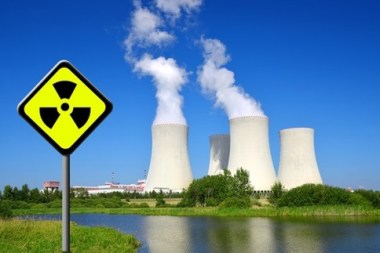
The UK government is keen to push for new nuclear stations as essential for Britain’s energy supply. Image: Shutterstock
¶ Since 2007, The Climate Institute has produced Climate of the Nation research capturing Australian opinions on climate change, its impacts and solutions. This year’s results show an increasing awareness about the cause and impacts of climate change, strengthening support for renewable energy and carbon pollution regulation, and a greater call for government action. [Business Spectator]
¶ The EU greenhouse gases emission savings due to renewable electricity generation, cooling/heating, and transport sectors rose at a compound annual growth rate of 8.8% from 2009 to 2012, according to a report of the European Commission’s Joint Research Center. Nearly two-thirds of the savings was due to renewable energy in Germany, Sweden, France, Italy and Spain. [InterAksyon]
¶ As about 100 demonstrators massed in front of company headquarters, Kyushu Electric Power Co announced on August 10 that it was about to resume operations at its Sendai nuclear power plant in Kagoshima Prefecture the following day. At about 10:30 AM on August 11, control rods at the No 1 reactor of the Sendai plant will be removed to begin nuclear fission. [Asahi Shimbun]
US:
¶ Anaerobic digesters capture both the smell and the greenhouse gases of manure, providing fuel in the process. The EPA estimates that more than 3 million tons of greenhouse gas emissions were eliminated last year by 247 US livestock farms with biogas recovery systems. There are about 8,000 farms in the US large enough to make a biogas recovery system viable. [Capital FM Kenya]
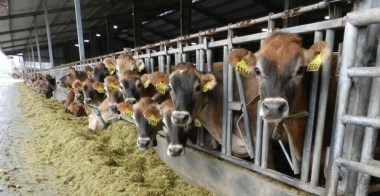
Cows need no encouragement to make cowpower.
¶ A deal that paves the way to build what will eventually be one of the largest solar arrays in the state of Vermont was finalized by the Windham Solid Waste Management District and developer Pristine Sun LLC. The 25-year agreement will have the solar development firm leasing land over a capped landfill from the waste district and financing the 5-MW solar project. [vtdigger.org]
¶ Entergy Arkansas intends to pay a little more than 5¢/kWh for electricity from a proposed solar farm. Entergy will buy power from NextEra, which plans to build an 81-MW solar energy farm on a 475-acre site about 7 miles southeast of Stuttgart, Arkansas. NextEra will spend more than $120 million to develop and build the solar farm, according to a spokesman for NextEra. [Arkansas Online]
Posted in nuclear power, renewable power, solar, wind | Leave a Comment »
Tags: nuclear, nuclear power, photovoltaic, renewable power, solar power, wind power
August 9, 2015
Science and Technology:
¶ A new system combining lithium-iodine batteries and solar cells, an aqueous lithium−iodine solar flow battery, has been created by researchers at Ohio State University. The new battery system promises energy savings of nearly 20%, compared to conventional lithium-iodine batteries. The new work may serve as a design basis for other metal-redox flow batteries. [CleanTechnica]
Not Energy or Climate Change, but Noteworthy:
¶ Scotland is to ban the growing of genetically modified crops, the country’s rural affairs secretary has announced. Richard Lochhead said the Scottish government was not prepared to “gamble” with the future of the country’s £14 billion food and drink sector. Under European Union rules, genetically modified crops must be formally authorised before they can be cultivated. [BBC News]
World:
¶ Coal India Ltd (CIL), the largest producer of the fuel in the country, will invest over ₹62,500 crore ($9.8 billion) in the next five years with an aim to ramp up annual production to 908 million tonnes by 2019-2020, the government has said. The State-run miner in 2014-15 had produced 494 million tonnes of coal, though this was 3% lower than the targeted 507 million tonnes. [The Hindu]

CIL registered a growth of 12.3 per cent in production at 121 million tonnes — the highest growth for any quarter in its history.
¶ It is understandable that Nigeria, as a major oil producer, generates 80% of its electricity hydrocarbon powered turbines. However, it is very difficult to understand why, in the face of the failure of the fuel-powered systems to provide the needed electricity in Nigeria, other available easy-pick energy sources, especially solar power, have remained significantly unharnessed. [THISDAY Live]
¶ French Minister of Ecology, Sustainable Development, and Energy, Ségolène Royal, has called for increased investment in renewable energy. Ms Royal said in Lusaka, Zambia on Friday that to reduce deforestation, to mitigate effects of climate change, and to give access to electricity to those who do not have it, there is need to focus on alternative sources of energy. [Zambia Daily Mail]
¶ Japan’s nuclear regulator said an accident on the scale of the 2011 Fukushima disaster would not occur under new safety rules imposed on reactors such as Kyushu Electric Power’s Sendai No. 1, set to be the first to restart since Fukushima, Japan’s Nikkei business daily reported on Saturday. The Sendai No 1 reactor is may be restarted as early as next week. [The Nation]
US:
¶ Whenever the wind blows or the sun shines, a first-of-its-kind renewable power plant near Willcox, Arizona will help power thousands of Tucson homes. The project was dedicated under cloudy skies with gusty winds in the rolling grasslands about 15 miles west of Willcox, despite lingering concerns of some over the impact of its massive wind turbines on birds and other wildlife. [Arizona Daily Star]
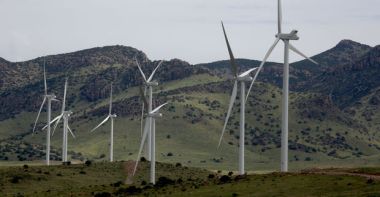
The combined wind and solar project is expected to provide enough electricity for 13,500 homes in Tucson Electric Power’s territory. A.E. Araiza / Arizona Daily Star
¶ Agriculture Secretary Tom Vilsack announced $63 million in loans and grants for 264 renewable energy and energy efficiency projects nationwide that USDA is supporting through its Rural Energy for America Program. These REAP projects are expected to generate and/or save 207.8 million kWh of energy, enough to provide power demands for more than 13,600 homes. [Imperial Valley News]
¶ Kansas had the third-highest amount of wind power capacity under construction in the country in the second quarter, with buyers including in-state utilities and an internet search company. There were over 1,070 MW of wind power capacity under construction in Kansas as of the second quarter of 2015. That will increase state’s 2,967 MW in existing capacity by over 36%. [Topeka Capital Journal]
¶ The method of manure treatment called anaerobic digestion benefits the environment because it enables capturing methane to be burned for renewable heat and electricity instead of allowing the methane to be released into the atmosphere. During the last few years, however, the price of natural gas has been low, making anaerobic digestion less economical. [Minneapolis Star Tribune]
Posted in nuclear power, renewable power, solar, wind | 1 Comment »
Tags: nuclear, nuclear power, photovoltaic, renewable power, solar power, wind power
August 8, 2015
World:
¶ A British company has announced plans for an array of unique marine turbines that can operate in shallower and slower-moving water than current designs. Kepler Energy says the turbines will eventually produce electricity more cheaply than off-shore wind farms. It hopes to install its new design in what is called a tidal energy fence, one kilometre long, in the Bristol Channel. [RTCC]
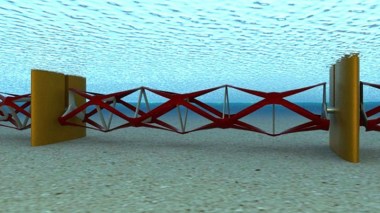
How the rotor blades look installed in a tidal fence configuration (Pic: Kepler Energy)
¶ Figures released on Thursday show that electricity production in the 34 member states of the OECD fell 0.8% to 10,712 TWh, a decrease of 86 TWh on 2013’s figures. The International Energy Agency point out that this decline was driven by lower fossil fuel and hydro production, but a decline which was partially offset by a growth in non-hydro renewables and nuclear. [CleanTechnica]
¶ Azar Mobaraki is a benefactor who has taken advantage of solar energy to supply electric power to the nomads living in Hamoun County, in the eastern Iranian province of Sistan-Baluchestan, the Fars news agency reported recently. She supplied 115 solar panels, 230 unbreakable light bulbs, power adapters, and other electronic equipment so children could read in the evening. [Tehran Times]
¶ Solar and onshore wind are supported by 76% and 59% of Brits, respectively, a survey commissioned by UK renewable power supplier Good Energy Group Plc says. The findings were published after the Department of Energy and Climate Change released its latest attitudes tracker, which omitted questions about support for specific renewable technologies. [SeeNews Renewables]
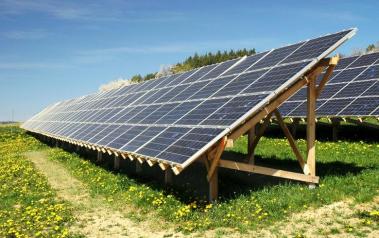
Solar panels. Featured Image: Martin D. Vonka/Shutterstock.com
US:
¶ Customers in Oahu, Hawaii, may soon have the option of buying into a local community solar program, thanks to a recent proposal to the Hawaii Public Utilities Commission from Hawaiian Electric Company, which aims to create a long-term pilot program. The proposed community solar program would be open to about 50 Oahu utility customers, whose electric bills would be lower. [CleanTechnica]
¶ Mary Nichols, the chair of the California Air Resources Board, said she hopes to implement new rules in the state that would eventually prohibit the sale of new cars that are equipped with internal combustion engines. The zero-emissions vehicle program California now has in place requires that 2.7% of new cars purchased in the state in 2015 be free of greenhouse gas emissions. [CleanTechnica]
¶ Adding to a hydropower bill that he already laid before the Legislature, Massachusetts Governor Charlie Baker has filed a bill to accelerate solar power industry growth in Massachusetts and then adjust incentives. The administration says its bill will help the state meet “well ahead of schedule” its goal of 1,600 MW of solar power by 2020, while lowering costs. [Wicked Local Brookline]
¶ Federal regulators have rejected contentions that California’s Diablo Canyon nuclear power plant is unsafe and should not be relicensed. The Atomic Safety and Licensing Board dismissed four contentions filed by San Luis Obispo Mothers for Peace. The NRC is evaluating 20-year extensions to the plant’s reactor’s operating licenses, which expire in 2024 and 2025. [89.3 KPCC]
¶ Entergy Arkansas Inc proposed what it called “a more reasonable” approach to deal with regional haze in Arkansas, in response to the Environment Protection Agency’s rejection of the state’s earlier plan to improve visibility in wilderness areas. Entergy would shut down its coal-fired operations at the White Bluff Electric Station instead of spending over $2 billion on scrubbers. [KUAR]
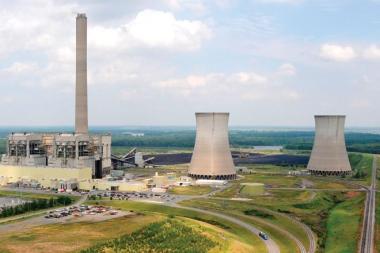
Entergy’s White Bluff power plant near Redfield. Credit: Arkansas Business
¶ California Governor Jerry Brown signed a bill Friday that allows BART [the rapid transit system in the San Francisco Bay area] to purchase renewable energy directly from wholesale suppliers as the rail system looks to further reduce its carbon footprint. Under the new law, BART officials would no longer have to go through a third party to buy renewable energy on their behalf. [SFGate]
¶ Southern California has missed a long-standing federal deadline to reduce toxic soot and other small particle air pollution because unhealthful levels of such pollutants persist in northwest Riverside County. The Bush administration set rules for communities in Southern California’s ocean-to-mountains air basin to meet the goal by 2015. The standard has been missed, however. [Press-Enterprise]
¶ One of the Vermont’s most prominent renewable energy developers is proposing to build more wind power in a region of Vermont that has been divided over such projects for years. David Blittersdorf wants to erect two wind turbines on a Northeast Kingdom ridgeline in the 1,100-person town of Irasburg and produce enough electricity to power more than 2,000 homes. [vtdigger.org]
¶ When the EPA issued its Clean Power Plan, it exempted the two non-contiguous states of Alaska and Hawaii from the need to set emissions targets because of a lack of sufficient information or analytical tools for measuring in these states the means whereby emission targets may be achieved.The territories of Guam and Puerto Rico have been similarly exempted. [Petroleum News]
Posted in nuclear power, renewable power, solar, wind | 1 Comment »
Tags: nuclear, nuclear power, photovoltaic, renewable power, solar power, wind power
August 7, 2015
Opinion:
¶ “Cost of EPA’s Climate Plan? Minor Compared to the Benefits” – The good news is that cutting carbon turns out to be not just affordable, but smart: the Clean Power Plan’s public health and climate benefits, worth an estimated $34 billion to $54 billion in 2030, far outweigh the estimated costs of $8.4 billion. [The Equation: Blog of the Union of Concerned Scientists]
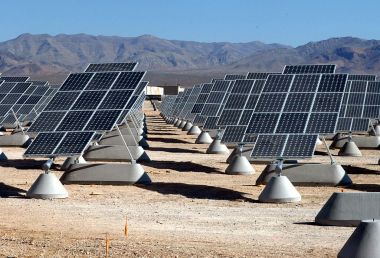
Solar array at Nellis Air Force Base. USAF photo. Public Domain. Wikimedia Commons.
World:
¶ China’s public sector companies continue to support the development of renewable energy infrastructure in Pakistan. HydroChina Investment Corporation will invest $115 million for the implementation of a 50 MW wind energy project near Karachi. The project is expected to be operational by September producing enough power for 100,000 households, with an 8-year payback. [CleanTechnica]
¶ Australian electricity companies have offered solar and battery systems for lease in a bid to keep customers and lower their own costs. Battery technology has been billed as the next “big phenomenon” by energy analysts — but too expensive for most people to install. But according to John Grimes of the Energy Storage Association power companies are trying to adapt. [ABC Online]
¶ UN chief Ban Ki-moon has voiced appreciation for US President Barack Obama’s personal engagement with India, China and Brazil on climate change, saying he counts on his strong leadership to reach an agreement on the issue in Paris in December. He commended Mr Obama’s “strong commitment” on climate change and said he counts on his continuing leadership. [Kashmir Images]
US:
¶ President Obama’s determination to reduce US carbon emissions by 32% below 2005 levels by 2030 sends a message to the rest of the world’s leaders that the UN climate talks in Paris could succeed, saving the planet from overheating. Past talks have foundered on a range of excuses, but now the world’s two largest polluters have committed to far-reaching changes. [eco-business.com]

Coal barge on the Kanawha River in Charleston, West Virginia. Image: Joseph Sohm, Shutterstock.com
¶ The Business Renewables Center (BRC), an initiative convened by the Rocky Mountain Institute and a member-led platform, is working to accelerate corporate procurement of off-site renewable energy such by bringing together corporate buyers, project developers, and service providers. Microsoft has contracted for 285 MW of wind power over the past two years. [CleanTechnica]
¶ SunEdison will be supplying solar energy to the entirety of the Rialto Unified School District in Belmont, California, the company announced earlier this week. The agreement will see the renewable energy developer install a total of 8.4 MW of solar canopies at car parks at the district’s 28 schools, and then sell the clean power back to the schools over the course of 20 years. [Business Green]
¶ The United States installed a record of 845 wind turbines, totalling 1,661 MW, in the second quarter of 2015. The turbines were spread out across 12 separate projects in five different states, however it was the state of Texas that blew the competition away in the second quarter, installing a total of 1,226 MW. This brings Texas’ total installed capacity up over 15,000 MW. [CleanTechnica]
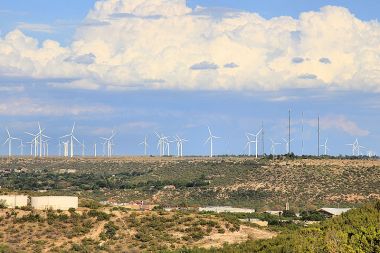
Part of the Panther Creek Wind Farm in Howard County, Texas. Larry D. Moore CC BY-SA 3.0. Wikimedia Commons.
¶ Demand for Tesla Energy’s revolutionary battery “has been crazy,” according to the company’s founder and CEO Elon Musk. He said there have been more than 100,000 reservations (roughly worth $1 billion) for the batteries, which have sold out through 2016. Musk said, “You can basically, in principle, shut down half of the world’s power plants if you had stationary storage.” [EcoWatch]
¶ A letter signed by 16 states opposes the EPA’s recently unveiled Clean Power Plan, requesting an “immediate stay” on a program the opposition says “unlawfully exploits Section 111(d) of the Clean Air Act.” The Clean Power Plan is opposed by states whose economies are heavily reliant on coal, which fear that conversions to cleaner sources might increase energy rates. [HydroWorld]
¶ Topeka-based Westar Energy Inc has been seeking to increase its rates by $152 million a year, but agreed instead to an increase of only $78 million. Westar said higher electric rates are needed to cover costs for improvements at coal-burning plants, mandated by federal air pollution standards, and for upgrades at the Wolf Creek nuclear power plant outside Burlington. [Daily Journal]
Posted in nuclear power, renewable power, solar, wind | 1 Comment »
Tags: nuclear, nuclear power, photovoltaic, renewable power, solar power, wind power
August 6, 2015
Science and Technology:
¶ The world’s fastest charging electric bus is operating in the eastern Chinese port city of Ningbo. Local transportation authorities say that the public bus, which was manufactured in Ningbo and runs along an 11 kilometer route, takes as little as 10 seconds to charge up and be ready for the next leg of its journey. The bus also recaptures 80% of its potential energy on breaking. [CleanTechnica]

Electric bus charging in Ningbo.
World:
¶ A new survey from the International Monetary Fund shows that the UK government is still providing billions of pounds in subsidies to fossil fuels, while on the other hand cutting support for renewables, for the UK doled out more than £26 billion in subsidies this year. Estimates for global energy direct and indirect subsidies in 2011 have been revised to $4.2 trillion. [CleanTechnica]
¶ France’s Environment and Energy Management Agency has opened a tender for pilot offshore wind projects with floating turbines. Projects must be in one of four designated areas in three regions: Brittany, Languedoc-Roussillon et Provence-Alpes-Cote d’Azur. The areas were announced by the Ministry for Ecology, Sustainable Development and Energy last month. [SeeNews Renewables]
¶ General Electric Co has received its first French order for the low-wind 2.75 MW-120 turbine. GE will supply five turbines to a 13.75-MW wind farm project near Crosey Le Grand, in the Franche Comte region of France, the company said in a press release on Wednesday. Turbines will be shipped this summer and commercial operation is expected for late 2015. [SeeNews Renewables]
¶ Coal-fired electricity generation in New Zealand will end by 2018, when the Huntly power station closes. This is possible as a result of having a world-leading renewable energy industry, the government says. The Greens say it is the beginning of the end for the use of coal in New Zealand and the party is calling on other industries to switch to renewable energy sources. [3News NZ]
¶ SkyPower announced receiving an award for 200 MW in the Telangana, India solar competitive tender process. Telangana is embracing solar energy and is forward thinking in efforts to adopt solar to help grow its economy and provide families with lower-cost electricity. The 200-MW award from Telangana follows a 150-MW award from Madhya Pradesh in July. [AltEnergyMag]
¶ Planning consent has been given for the construction of the next stage of the giant Dogger Bank offshore wind farm in the North Sea, the biggest offshore wind project in the world. Dogger Bank Teesside A and B will boast up to 400 wind turbines and have an installed capacity of up to 2.4 GW, enough to power the annual electricity needs of two million British homes. [Click Green]
US:
¶ Heat-trapping pollution from US power plants hit a 27-year low in April, the Department of Energy announced Wednesday. A big factor was the long-term shift from coal to cleaner and cheaper natural gas. More renewable fuel use and energy efficiency also had effects. Power plants emitted 141 million tons of carbon dioxide in April, the lowest for any month since April 1988. [Press Herald]
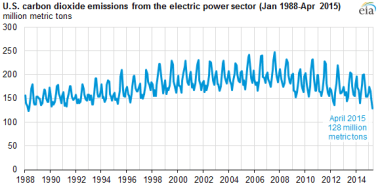
US Energy Information Administration graph
¶ Most of the cost for burning fossil fuels is not paid when that electricity or fuel is purchased. Most of the cost comes from the tremendous health problems the resulting air pollution (and climate change, if you are brave enough to include that) creates. The EPA created a graph showing the cost of the Clean Power Plan versus the health and life benefits of the plan. [CleanTechnica]
¶ A recent poll of Republican presidential primary voters in the early voting states of New Hampshire and South Carolina finds an unexpected result for the seventeen candidates campaigning there. Most of those likely to vote in the Republican primaries in each of these states support regulating carbon pollution, and even support using President Obama’s Clean Power Plan. [ThinkProgress]
¶ Don’t believe the naysayers who claim the Clean Power Plan is bad for business. Because when you talk to businesspeople, people creating jobs, fostering innovation and driving economic growth all across America, they’re likely to say the opposite. In poll after poll after poll, small business owners, executives and others express widespread support for the Clean Power Plan. [Huffington Post]
¶ Electric utilities, oil companies and their allies spent $502 million on lobbying in the year since the EPA proposed new regulations on carbon emissions from power plants, according to disclosures reviewed by Bloomberg. That’s 22 times what renewable energy companies and environmentalists spent. But many other businesses support the plan. [Sydney Morning Herald]
¶ A judge ruled that Southern California Edison executives engaged in improper talks with California utility regulators related to the now-closed San Onofre nuclear plant. They could face millions of dollars in penalties. The judge found that Edison executives or attorneys engaged in ten unreported, improper communications with agency commissioners or advisers. [Paradise Post]
Posted in nuclear power, renewable power, solar, wind | Leave a Comment »
Tags: nuclear, nuclear power, photovoltaic, renewable power, solar power, wind power
August 5, 2015
World:
¶ The city of Oslo intends to become “an example for the world” in cutting greenhouse-gas emissions from transportation. Walking, cycling, and public transit come first. Public vehicles will be emissions-free. All municipal vehicles will be electric this year. But private vehicles are a fact of life, and so private emissions-free vehicles will be given a huge menu of incentives. [Green Car Reports]
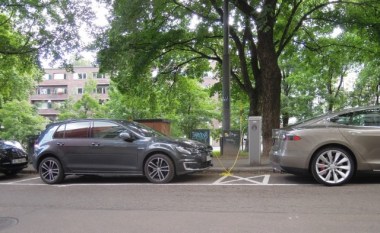
Oslo street scene: Nissan Leaf, Volkswagen e-Golf, Tesla Model S, July 2015
¶ A major report published by the Australian Renewable Energy Agency predicts a 40% to 60% price plunge for certain battery technologies by 2020. The 130-page report says that we will see the costs of lithium-ion batteries fall by 60% in less than five years, and by 40% for flow batteries. The change is driven by market demand by everyone from producers to ratepayers. [CleanTechnica]
¶ At least three utility companies are hoping to capitalize on hydroelectric energy opportunities along the Trent Severn Waterway in Selwyn Township, Ontario, and the surrounding area. The utilities are proposing to put the facilities at three of the waterway’s locks. The plants will not be large, but one utility’s proposal for two plants could produce a total of 6 MW. [Kawartha Media Group]
¶ Scientific American reports that by 2030, total energy consumption in France is to be reduced by 30%, while the share of renewables is to more than double to 32%. Repeated large increases in the carbon tax could go a long way toward achieving this goal. The interesting part about France, however, is that it’s the country’s nuclear mix that’s going to lose out the most. [Green Chip Stocks]
¶ The largest contiguous solar farm in Canada has begun producing electricity for the power grid in Ontario. The 100-MW Grand Renewable Solar Project has ability to power approximately 17,000 homes in the province. It incorporates 445,000 high-performance solar modules, covering 736 Ontario acres and is Canada’s largest photovoltaic project. [CanadianManufacturing.com]
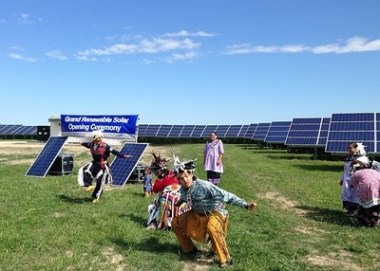
Photo: CNW Group/s2e Technologies
¶ China has reportedly started construction of its first commercial large scale solar power plant located in the Gobi desert. The plant, spreading across 25 square kilometres of abandoned land in the Qinghai province, will generate 200 megawatts of power, enough to supply one million homes with electricity. The development underlines China’s commitment to renewable power. [E&T magazine]
¶ A £25-billion contract to build the UK’s first new nuclear power plant in 25 years is expected to be signed within weeks. Ministers in the Department of Energy and Climate Change have reached an agreement with the French energy company EDF to develop Hinkley Point C, near Bridgwater in Somerset, and are ready to approve the project after parliament’s summer recess. [The Guardian]
US:
¶ The National Renewable Energy Laboratory recently released data showing that the capacity factor for wind power can reach 65%, which is close to that of fossil fuel based generation. NREL’s new report suggests wind could become a dominant and possibly the primary source of electricity in the US because it implies reduced need for storage and peaking power. [CleanTechnica]
¶ Official EPA ratings for the 2016 Chevy Volt are out. GM lived up to its promise that its electric range would be at least 50 miles, as the EPA has rated its range at 53 miles. That is more than enough for about 80% of people on any given day, so a lot of owners might drive on electricity almost all the time. GM is anticipating that 90% of trips will be entirely on electricity. [CleanTechnica]
¶ Colorado environmental advocates are confindent the state can cut the state’s carbon dioxide emissions by 40% by 2030, compared to 2012 levels. The state is about 75% toward the 2030 goal, based on actions already taken and programs implemented and expected, according to John Nielsen, the clean energy program director for Western Resource Advocates. [Denver Business Journal]
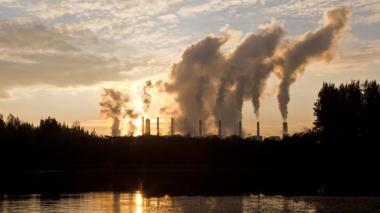
Thinkstock
¶ One of the largest tech companies in the US soon will power its five Texas data centers with 100% renewable energy. Hewlett-Packard recently announced a 12-year contract to buy 112 MW of wind power from a SunEdison wind farm in Texas. The purchase means HP will reach its 2020 operational greenhouse gas emissions reduction goal five years ahead of schedule. [GreenBiz]
¶ Hawaii’s Public Utilities Commission approved four utility-scale solar projects on Oahu, placing conditions to make sure residents won’t have to pay if developers miss out on a federal tax credit. The power purchase agreements approved for the four projects could produce 137.2 MW. Developers want to proceed quickly to take advantage of federal incentives. [RenewablesBiz]
¶ Alpha Natural Resources, once a powerhouse of American coal industry, filed for bankruptcy protection under Chapter 11 to get relief from a $3 billion debt, particularly with utilities switching to natural gas and coal prices moving south. It had borrowed heavily to acquire assets it hoped would increase in value as China’s coal use continued to grow, a strategy that failed. [The Market Business]
¶ Ameren Missouri has dropped plans to build a second nuclear unit at its Callaway Energy Center, citing shaky economics in the context of cheaper renewables, low demand, and other factors for its decision. During an earnings call, the CEO said the company is moving to a “cleaner, more diverse generation portfolio,” such as a new 13-MW solar facility west of St. Louis. [POWER magazine]
Posted in nuclear power, renewable power, solar, wind | Leave a Comment »
Tags: nuclear, nuclear power, photovoltaic, renewable power, solar power, wind power
August 4, 2015
Opinion:
¶ “EPA’s carbon rules are catching up with the market” The President rolled out Monday the much-anticipated centerpiece to his climate change plan. It envisions an overhaul in power plants, what they burn, and the broader electricity system. It’s ambitious. But to people in and around the power sector, this revolution is already well underway. Not because of the EPA, but the market. [WBFO]
Emissions spew out of a large stack at the coal-fired Morgantown Generating Station in Newburg, Maryland. Scott Tong
¶ “Busted: 3 myths about Obama’s climate plan” If you live, work or breathe in the United States, Obama’s new national Clean Power Plan is good news for you. Unfortunately, you would never know that if you listened to all the big polluters screaming bloody murder about it. President Obama set a clear goal, but he is leaving it to the states to decide how best to get there.[CNN]
¶ “Should the UK really be putting its money into nuclear power in 2015?” Hinkley Point C was announced in 2008, with predictions it could produce a sizeable chunk of the UK’s future energy, a safe and reliable low-carbon electricity source for five million homes. Today, the Government has yet to announce a final decision on whether to proceed with the £25 billion project. [The Independent]
World:
¶ Wind energy powered almost three quarters of Scotland’s houses in July of this year. Figures from from WeatherEnergy, reveal that wind turbines powered 72% of Scottish households last month, providing more than 660,000 MWh of electricity to the national grid. This represents an increase of 58% compared to July 2014, when wind turbines generated 417,000 MWh. [edie.net]
¶ Insurance giant Aviva announced plans to increase investments in low-carbon assets. It will also reduce exposure to sectors that face risk of regulatory action to reduce greenhouse gas emissions. Aviva CEO Mark Wilson recently stated that the company will invest around $780 million every year in renewable energy and energy efficiency assets over the next 5 years. [CleanTechnica]
¶ US solar service giant Sungevity has decided to quit the Australian market, a victim of investor nervousness about constantly changing policy for clean energy in Australia. Ironically, this news came on the same day Sungevity announced a major expansion into the UK market, which installed 2.4 GW of solar in 2014, three times more than the Australian market. [CleanTechnica]
¶ Scottish Green MSP Patrick Harvie has written to the heads of two Holyrood committees calling for an inquiry into the impact of UK Government decisions on renewable energy and climate change targets in Scotland. The Glasgow MSP said Tory ministers had announced a range of measures in recent weeks, making it more difficult to develop wind and solar projects or achieve efficiencies. [The National]
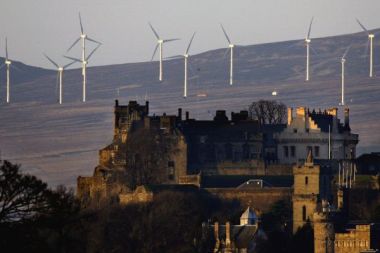
Patrick Harvie called for the probe into how policies will affect renewables such as the Braes O’Doune farm by Stirling
US:
¶ President Obama formally announced unprecedented limits on greenhouse emissions from power plants Monday, but the measures are expected to have limited impact on electricity generation facilities in Maine. While the plan will produce cleaner air in the region, Maine has none of the coal-burning power plants considered the primary target of the emissions reductions. [Press Herald]
¶ Vermont, Alaska and Hawaii are the only states exempted from rules the Environmental Protection Agency that require other states to cut power plant emissions by 32% by 2030. Chris Recchia, commissioner of Vermont’s Public Service Department, and Deb Markowitz, secretary of the Agency of Natural Resources, said the plan appears to apply longstanding Vermont policies nationwide. [Sioux City Journal]
¶ In Washington, the American Lung Association describes the Environmental Protection Agency’s new regulations as lifesaving. Utah Senator Orrin Hatch calls them job-killing. Rocky Mountain Power generates around 80% of the electricity used in Utah from coal, but spokesman Paul Murphy says his company is already making the changes the EPA wants away from fossil fuels. [KUER]
¶ Invenergy is proposing a $700-million natural gas-fired power plant in Burrillville, Rhode Island, which it claims would be the most efficient generator of electricity that burns fossil fuels in New England. If all goes as it plans and the project is approved, construction of the 900-MW combined-cycle generator would start next year and the facility would be up and running by 2019. [The Providence Journal]

Artists rendering of the Clean River Energy Center, the 900-MW power plant proposed for Burrillville.
¶ Dominion Virginia Power, the state’s biggest power generator, was cautiously optimistic, commending the US EPA for making “critical changes” to the Clean Power Plan draft to make compliance targets more achievable. Virginia Governor McAuliffe said Monday the EPA apparently made changes to the final plan that addressed his original concerns about equity and flexibility. [Daily Press]
¶ The Obama administration has unveiled its clean power plan. The first-of-their-kind limits on carbon pollution from existing power plants will require slightly tougher cuts than the original proposal. The EPA is calling for a 32% reduction in greenhouse gas emissions from power plants below 2005 levels by 2030. That is up from the 30% target as part of last year’s proposal. [OilPrice.com]
¶ The Obama administration unveiled the final version of its Clean Power Plan on Monday, establishing for the first time federal limits on carbon emissions for the nation’s power plants, but apparently through the embrace of renewables, solar and wind power, rather than natural gas. Coal, of course, took the greatest beating. But supporters of natural gas power also were not happy. [Natural Gas Intelligence]
¶ Consternation continues to fester about the nearly $5 billion settlement over the San Onofre nuclear power plant. The pact forces customers to pay 70% of the costs to shutter the facility following a 2012 radiation leak, without a full investigation by state regulators into who was at fault. That is about one third of a $10.4 billion bill customers must cover over a period of decades. [KPBS]
Posted in nuclear power, renewable power, solar, wind | Leave a Comment »
Tags: nuclear, nuclear power, photovoltaic, renewable power, solar power, wind power
August 3, 2015
World:

Market on Rusinga Island, Lake Victoria, Kenya. 1% of the people have electricity. Photo by Ryan Harvey. CC BY-SA 2.0. Wikimedia Commons.
¶ Tanzanian renewable power firms Rex Energy secured a grant from the US Trade and Development Agency for a mini-grid project in the Lake Victoria Islands. Only 1% of the islands’ populations having access to electricity. The grant supports the development of a full-scale business model and financing plan necessary to implement a 2-MW hybrid solar PV mini-grid. [Daily News]
¶ In India, officials of the New and Renewable Energy Development Corporation of Andhra Pradesh and AP Power Distribution Company are motivating farmers to rely on solar agricultural pumps to irrigate their fields. The government has a goal to set up 6,000 solar pump sets across the State in the current fiscal year to reduce power consumption. [The Hindu]
¶ In an opinion piece, the most recent head of the National Australia Bank made revelations about the backlash from government to business that dared speak out in support of sensible climate change and renewable energy policies. Cameron Clyne lamented the government’s economically reckless policies, “willful ignorance,” and retribution to those who did speak out. [RenewEconomy]
¶ North Africa has exceptional wind energy and is seeing a surge in large-scale wind projects. Egypt aims to generate 7.2 GW of wind energy by 2020 and Morocco has plans to develop 2 GW of wind capacity by 2016 and a further 2.7 GW by 2030. Tunisia is also planning to double its installed wind capacity with a target of 505 MW by 2016 and 2.7 GW by 2030. [EIN News Zimbabwe]
¶ Ethiopia is bursting with a feeling of unprecedented economic optimism owing to its high economic growth in the last twenty years, and the Ethiopian people are upbeat about their country’s future. And after more than a decade of heavy investments in its renewable energy, Ethiopia is emerging as a leading producer and exporter of clean electricity. [Somaliland Sun]
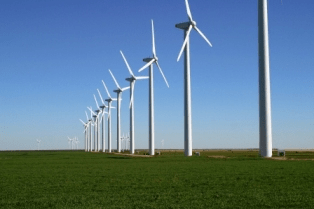
Ethiopia with large hydro power and wind farm projects like pictured Green Mountain Wind Farm Fluvanna looks to become the renewable energy powerhouse of Africa.
¶ More than half of medical and nursing-care facilities within 30 kilometers of nuclear power plants across Japan have not compiled mandatory evacuation plans in the event of an accident, an Asahi Shimbun survey shows. The Sendai nuclear power plant could resume operations as early as August 10, but just two of 85 medical institutes near it have developed evacuation plans. [Asahi Shimbun]
US:
¶ The Obama administration unveiled its Clean Power Plan, which is aimed at a large reduction in greenhouse gas emissions. The President will next begin selling it to the public at a White House event. The Clean Power Plan is the final version of EPA regulations, which President Barak Obama called “the biggest most important step we’ve ever taken to combat climate change.” [CNN]
¶ The wind and solar industries cheered while coal companies vowed to kill President Barack Obama’s new limits on climate-change pollution as details of the historic regulations emerged on Sunday. The rules include tougher limits on carbon emissions and more incentives for renewable energy than expected. That may also mean fewer benefits for natural gas. [theday.com]
¶ There is plenty of potential for electricity in Quebec’s rivers and reservoirs, promising relief for the Northeast, where power costs are high. But getting that power to Boston, Hartford and New York City is another matter. Five large-scale hydropower proposals are being considered. They could pump thousands of megawatts into the Northeast and ease prices as supplies increase. [Valley News]
Daniel-Johnson’s Manic 5 dam in Quebec, the largest arch and buttress dam in the world. Photo by Pierre cb. This image was placed into the public domain by the author.
¶ Hillary Clinton promised to make the US a clean energy superpower, but many knowledgeable critics see her climate goals as inadequate. James Hansen, who first told congress about the “cause and effect relationship” between climate change and human emissions, said, “It’s just plain silly … No, you cannot solve the problem without a fundamental change.” [CleanTechnica]
¶ Sungevity will be partnering with the University of California, Berkeley, for a 10-year program involving the solar energy company working with students across a wide number of different fields of study, according to a recent press statement. As part of the partnership, Sungevity will also be working to help UC Berkeley achieve its goal to be carbon neutral by the year 2025. [CleanTechnica]
¶ Over recent years, West Virginia has slowly become home to a growing number of solar energy co-ops. Charleston is now gearing up to become home to one, giving residents in the area an easier and simpler way to go solar. Since 2007, Community Power Network has launched over 30 solar energy co-ops in West Virginia, Virginia, Maryland, and Washington, DC. [CleanTechnica]
Posted in nuclear power, renewable power, solar, wind | Leave a Comment »
Tags: nuclear, nuclear power, photovoltaic, renewable power, solar power, wind power
August 2, 2015
World:
¶ Western Australia is about to get its first solar powered mine site, with work starting next week on a $40 million solar array to supply Sandfire Resources’ DeGrussa copper mine with a substantial portion of its power. Under a deal with Juwi, the builder, Sandfire will buy power for at least six years, with further agreements if Sandfire keeps the mine going. [The West Australian]
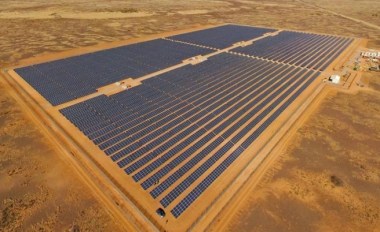
A Juwi Energy project in East Africa similar to the one proposed for Western Australia.
¶ It appears people power may have won the day for villagers in Dudleston Heath, Shropshire, who are claiming victory in their campaign to stop developers digging up the countryside hunting for gas. IGas Energy, which acquired Dart Energy last year, confirmed it is no longer interested in operating an exploratory borehole to drill for coal-bed methane on the site. [shropshirestar.com]
¶ Eku, a town located in southern Nigeria, is an impoverished area that faces poor service from the local utility daily. Power is intermittent or restricted for periods lasting days, or sometimes weeks. A church, in the US city of Athens, Georgia, looks to change an Eku orphanage’s power problems by donating $25,000 to help build it a system providing solar power. [Online Athens]
¶ Plans for Britain’s first nuclear reactor in almost 30 years have come under sustained attack from politicians and City bankers. A report from a top bank this weekend warned that the cost of the £25 billion Hinkley Point C plant was “becoming harder to justify.” HSBC concluded: “We see ample reason for the UK Government to delay or cancel the project.” [This is Money]
¶ Several power generation companies have committed to establishing renewable energy power plants to supply electricity and water for the Philippine province of Aklan and other nearby provinces. These companies will build a 50-MW wind power project in Aklan, a 18-MW hydropower project in Aklan , a water project on Boracay Island, and a solar power project. [Philippine Star]

Boracay island is considered as one of the top tourist destinations in the Philippines.
¶ TEPCO has removed a 20-ton piece of debris from a nuclear fuel storage pool, a small but critical step in decommissioning the crippled Fukushima Daiichi nuclear power plant. It was the largest piece of debris left in the No. 3 reactor building’s storage pool, which is holding 566 nuclear fuel assemblies. The reactor building was heavily damaged by a hydrogen explosion. [Asahi Shimbun]
US:
¶ In its initial version, the Clean Power Plan called for cutting the country’s power plant emissions 30% from 2005 levels by 2030, with different targets for each state. The current plan accommodates many of the objections raised initially, but White House Chief of Staff Denis McDonough said this week that the final rule will be “stronger in many ways than the proposed rule.” [Yahoo! Maktoob News]
¶ The Obama administration will reduce the differences among state goals in its climate change rule, addressing complaints from states such as Arizona and Florida. The EPA’s initial proposal would have forced states like Arizona, which have a lot of natural-gas plants and scope for renewable power growth, to make cuts in emissions of more than 50 percent by 2030. [Bloomberg]

A bottle and frosty mug of Magic Hat No. 9. Photo by George Chriss. GNU Free Documentation License. Wikimedia Commons.
¶ Purpose Energy is a company on a mission: “Changing the world, one beer at a time.” Eric Fitch, co-founder and CEO of Purpose Energy, has made a breakthrough in waste remediation, renewable energy, and beer brewing. The company’s patented “tribrid bioreactor,”installed at Magic Hat Brewery in South Burlington, Vermont, has changed the game. [Wicked Local Woburn]
¶ One opportunity for the governor of California to meet his goal for renewable energy is to partner with other Western states to coordinate of electricity systems across the West. According to a study by the California ISO, a functional Western grid using the state’s renewable requirement could lower pollution levels by nearly 2.6 million metric tons annually. [Sacramento Bee]
¶ Several Arizona utilities are set to meet a goal of 6% of renewable energy use next year thanks to utility-scale and rooftop solar projects. Arizona Public Service, Tucson Electric Power and UNS Electric all expect to reach or surpass their annual benchmarks. The state-regulated utilities must get 15% of their energy from renewable sources by 2025, through annual 1% increases. [SFGate]
¶ The National Association for Stock Car Auto Racing Green (NASCAR Green) is an innovative and holistic environmental awareness platform in the US. Its mission is to reduce the sport’s environmental footprint by championing sustainable behavior to millions of fans. Clean energy company SunEdison is now NASCAR Green’s official solar energy partner. [Greentech Lead]
¶ Plant Vogtle’s proposed nuclear expansion with new units 3 and 4 will cost an estimated $65 billion, former Georgia Public Service Commissioner Bobbie Baker says, based on his analysis of information he received when cross-examining the PSC staff witness at the June 23, 2015 PSC hearing. The hearing was for the 12th Vogtle Construction Monitoring Review. [Atlanta Progressive News]
Posted in nuclear power, renewable power, solar, wind | Leave a Comment »
Tags: nuclear, nuclear power, photovoltaic, renewable power, solar power, wind power
August 1, 2015
Science and Technology:
¶ Dr James L Powell, director of the National Physical Sciences Consortium, examined titles and abstracts of more than 24,000 peer-reviewed scientific articles on climate change published during the past couple of years. He identified 69,406 authors named in the articles. Only four of them rejected the fact that human emissions cause climate change. [CleanTechnica]
World:
¶ Linlithgow, the birthplace of Mary Queen of Scots, is developing a natural grid, with the aim of disconnecting from the National Grid. Linlithgow Natural Grid has been examining doing this using a combination of solar and wind power, along with the innovative “Heat from the Street” project, which has received £25,000 of funding from the Local Energy Challenge Fund. [The National]

Linlithgow could be powered by various forms of green energy.
¶ Private investors in Honduras have installed 233 MW in eight PV parks through July 30, on time to benefit from extra incentives per kWh of solar energy, daily El Heraldo said Thursday. A bonus incentive of $0.03 per kWh, valid for up to 300 MW of PV plants to be installed by July 31, 2015, increases the price to $0.18 per kWh. The standard incentive is 10%. [SeeNews Renewables]
¶ The UK increased power generation from on-site biogas plants by 40% in 2014, according to a survey by the Department of Energy and Climate Change. DECC’s annual Digest of United Kingdom Energy Statistics found that the farming sector led the country’s surge in on-site biogas capacity, from 164 MW in 2013 to 216 MW last year. [Cogeneration & On-Site Power Production Magazine]
¶ Siemens Wind Power and Renewables Division has been awarded orders from three different customers to construct, install a total of 52 units of its D3 direct drive wind turbines at projects in Ireland and Scotland. Together the wind projects are expected to supply clean renewable energy for nearly 100,000 households. All the orders include long-term service contracts. [evertiq.com]
¶ The French Geothermal Cluster GEODEEP and its sister organisation – the Iceland Geothermal Cluster Initiative, agreed to cooperate on a framework of standardized model licenses for exploring and developing geothermal energy resources. The signing was witnessed by energy ministers from the two countries, Segolene Royal and Ragnheidur Elin Arnadottir. [SeeNews Renewables]
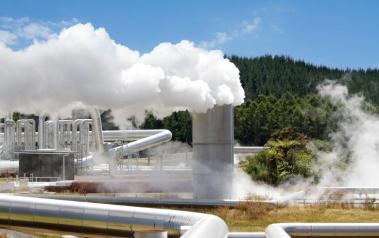
Geothermal power station. (That is steam, not smoke.) Featured Image: N.Minton/Shutterstock.com
US:
¶ A report from the University of Georgia says states can reduce greenhouse gas emissions by combining of renewable energy sources and energy-saving strategies. Complying with the Clean Power Plan would also produce substantial collateral benefits such as lower electricity bills, greater GDP growth, and significant reductions in SO2, NOx, and mercury emissions. [CleanTechnica]
¶ The Orlando Utilities Commission on Friday announced plans to construct new solar arrays consisting of more than 41,000 panels on 31 acres of land at the Curtis H. Stanton Energy Center in east Orange County, Florida. The solar farm will produce nearly 13 MW of clean, renewable energy, enough electricity to power about 1,500 homes.[MyFoxOrlando.com]
¶ Broad, bipartisan energy legislation that would allocate federal funding to grid technology research and demonstration along with a number of other initiatives, including cybersecurity and the energy-water nexus, has cleared the Senate Energy and Natural Resources Committee with an 18–4 vote. Among other previsions is allocation of funds for grid-scale storage research. [POWER magazine]
¶ A Maine company that’s developing tidal power and river power systems says it’s successfully connected one of its units to the power grid in an Alaskan village. Ocean Renewable Power Company says its 25-kW RivGen Power System has been successfully deployed in the remote river village of Igiugig. This is to reduce the village’s reliance diesel-powered generators. [PennEnergy]

ORPC’s RivGen Power System in Igiugig before being submerged for operation.
¶ In an unprecedented show of business support for tackling climate change, 365 companies and investor groups sent letters today to more than two dozen governors across the United States voicing their support for the EPA’s Clean Power Plan for existing power plants and encouraging the state’s “timely finalization” of state implementation plans to meet the new standards. [Sustainable Brands]
¶ In every decade since the 1970s, the US has added less hydropower capacity than the decade prior. But now energy experts say that new ways of thinking about hydropower has placed the energy source on the verge of a resurgence in the US. Hydropower production is anticipated to grow by more than 5% in 2016 alone, according to the US Energy Information Administration. [TIME]
¶ The US nuclear industry has made a last-minute push to urge the Obama administration to protect the country’s 99 nuclear units in its forthcoming carbon rule and prevent the early retirement of several plants. The industry said eight plants, producing about 8,000 MW, struggle to compete in competitive electricity markets, and claims nuclear plants have zero carbon emissions. [Town Hall]
Posted in nuclear power, renewable power, solar, wind | Leave a Comment »
Tags: nuclear, nuclear power, photovoltaic, renewable power, solar power, wind power
July 31, 2015
Opinion:
¶ “The $7 trillion solar tsunami in our midst” Solar power providing the lowest cost electricity in much of the world. With $7 trillion of investment piling into the sector, the momentum is now unstoppable. While world leaders have been talking a lot but doing little in the run-up to the UN climate conference in December, the private sector has been tackling climate change. [The Ecologist]
Science and Technology:
¶ Carnegie Wave Power has notched 12,000 hours of operation of its Ceto 5 wave power array off Western Australia’s coast. The 720-kW array features three 240-kW fully submerged buoys anchored to the seabed, which transmit energy through hydraulic pressure onshore to drive a generator for electricity and fresh water. Survey findings are due in coming weeks. [reNews]
A diver works on a Carnegie CETO installation off Western Australia. (Image by Carnegie Wave Power)
¶ There is an assumption that when a supply-demand imbalance incident happens, there will be an automatic response within 5-6 seconds from conventional (gas, coal, hydro) generators to stabilize the power supply. This has been an important talking point in an argument against having too much renewable power. But the assumption turns out to be simply wrong. [CleanTechnica]
World:
¶ Europe’s offshore wind industry has shattered previous installation records in the first half of 2015, installing 2,342.9 MW of electricity generation capacity, triple the same time last year. Installations for the first half of 2015 had reached 2,342.9 MW, tripling the grid-connected capacity of the same period in 2014 and bringing Europe’s operating capacity up to 10,393.6 MW. [CleanTechnica]
¶ GE is to supply Pattern Development with 61 wind turbines for its 180-MW Meikle wind project in British Columbia. The Meikle Wind project will be the largest in the province. It will generate enough energy to power the equivalent annual energy needs of 54,000 average British Columbian homes and increase the installed wind power capacity in the province by 38%. [reNews]
35 of GE’s 3.2-103 wind turbines will be installed at the site.
¶ A substantial increase in renewable energy by 2030 would result in far cheaper electricity than if South Africa persists in its bid to build 9,600 MW of nuclear power, a study by Stellenbosch University has found. The study broadly confirms the findings of two other recent expert analyses which warn that nuclear energy will be the most expensive of the options available. [BDlive]
¶ Three former TEPCO executives will stand trial over the 2011 Fukushima nuclear disaster after an independent judicial panel of citizens on July 31 again decided that mandatory indictments are warranted. It will be the first time for TEPCO or government officials to stand formally accused of professional negligence resulting in death and injury in the nuclear crisis. [Asahi Shimbun]
US:
¶ Utility scale solar has grown so in the US that utilities are now longer fighting it, with large scale solar likely to be competitive even if tax credits are removed. That is the view of SunPower, one of the biggest solar module manufacturers and project developers in the US, which just bought out the 1.5-GW solar portfolio in the US built up by Australia’s Infigen Energy. [CleanTechnica]
¶ The losses are continuing to mount as more coal companies report their second quarter earnings. Cloud Peak Energy announced a $53 million loss for the quarter Wednesday, and Arch Coal reported a $168 million dollar loss Thursday, following a $1 billion loss Peabody Energy reported Monday. The losses result largely from competition from natural gas and renewables. [Wyoming Public Media]

Open pit coal mine. Credit Stephanie Joyce
¶ When the US Environmental Protection Agency announced the Clean Power Plan last summer, the agency hinted that natural gas would play a big role in reducing the nation’s dependency on coal for power generation. That scenario has already been playing out, but as EPA prepares for final rule making, it looks like the natural gas industry is in for a rude awakening. [CleanTechnica]
¶ Alabama Power proposed to the state’s public utilities commission this month to build or contract to buy 500 MW of renewable energy. The proposed 500 MW would represent about 5% of the utility’s total capacity. The package that the utility presented to the commission includes several 80-MW projects. The power would be sold at a premium to corporate customers. [Clean Energy Authority]
¶ In New York state, sheriff’s deputies arrested 10 protesters, including several yoga practitioners and a cello player, in front of Crestwood Midstream’s gates Wednesday. They were protesting Crestwood’s plans for a gas storage facility. They arrived at 8 am, unrolled yoga mats, and blockaded the company’s north entrance, performing a series of poses to cello music. [Finger Lakes Times]
¶ Republican presidential candidate Jeb Bush said in an email interview with Bloomberg BNA,”The climate is changing; I don’t think anybody can argue it’s not. Human activity has contributed to it.” Jeb Bush has made varying statements on climate change this year, including saying that it is arrogant to claim science is settled on the issue, an argument he has made since 2011. [Huffington Post]
Posted in nuclear power, renewable power, solar, wind | Leave a Comment »
Tags: nuclear, nuclear power, photovoltaic, renewable power, solar power, wind power
July 30, 2015
World:
¶ Israel’s largest PV field has been commissioned, after six years’ effort. The 40-MW Ketura Solar field contains 140,343 panels spread over 54.2 hectares (133.4 acres) in the southern Arava Valley. In its first six days, it supplied 1.5 million kWh to the grid. The field is owned by Arava Power Company and Électricité de France Energies Nouvelles Israel. [Jerusalem Post Israel News]
Aerial view of the 40-megawatt Ketura Solar field. (photo credit:EGE)
¶ Big Six utility, E.ON UK and US solar installer Sungevity have partnered to launch a residential solar programme in the UK. The ‘Go Solar’ programme will initially target homeowners in the midlands and the north of the country before being expanded into other regions. The installer’s 20-year ‘SunSure’ guarantee insures the systems’ continued performance. [Solar Power Portal]
¶ Despite the UK government making moves to scale back the level of support given to solar technology, Scotland remains committed. In the aftermath of proposals to scrap support for most renewable sources, Scottish Energy Minister, Fergus Ewing said: “Scotland is at the forefront of the renewables industry and solar is an important part of our renewable mix.” [Solar Power Portal]
¶ Iran’s quest to rejuvenate its energy industry after decades of sanctions is attracting renewable energy developers eager to plant turbines on windy ridges across the country. Iran’s government plans to bolster wind as a way of preserving crude oil for export, while providing the electricity needs of its people. Its ambition is to install 5 GW of renewable capacity by 2020. [Bloomberg]
¶ The coal industry and its supporters often argue that coal is still a relevant energy source because it’s cheap, and cheap electricity reduces energy poverty. But on Tuesday, Oxfam Australia directed an entire report to Australia’s government, saying that for the one billion people living without electricity, coal is more expensive than renewable energy sources. [ThinkProgress]
¶ Kimberley, British Columbia, announced that SunMine is commercially operational. The 1.05 MW solar farm is the province’s first grid-connected solar facility and the largest in Canada to use solar trackers. SunMine consists of 4,032 solar-cell modules mounted on 96 trackers which follow the sun’s movement, providing 38% more energy than a fixed system. [Your Renewable News]
US:

A lava lake inside Kilauea’s overlook crater in 2008.
¶ The island if Hawaii gets about 50% of its energy from a mixture of renewable sources. A lot of that is thanks to the state’s only geothermal plant, Puna Geothermal Venture, which sits on the eastern rift zone of the Kilauea Volcano. The plant generates about 38 MW, according to the Hawaii Electric Light Co, enough to power up to 4,400 typical Hawaiian homes. [Business Insider]

¶ GTM Research’s latest report explored the current and future residential solar market. The US residential solar market has grown 15 out of the last 17 quarters, saw more than 50% growth in 2014, and outperformed and out-installed the non-residential solar market for the first time. But of the 1.2 gigawatts of residential solar installed in 2014, 72% was third-party owned. [CleanTechnica]
¶ Concrete and steel columns going up atop the economy parking garage at Tampa International Airport will soon anchor the largest solar array Tampa Electric Co has ever installed. The 7,000 panels will perch atop 130 columns across the rooftop and are expected to collect enough sunshine to produce 2 MW of electricity, enough to power 250 homes on an average day. [Suncoast News]
¶ Indianapolis Power & Light Company received approval to convert a portion of a coal-fired plant to run on natural gas. The company plans to reduce its dependence on coal from 79% in 2007 to 44% 2017. The company is also adding advanced battery-based energy storage to its fleet, which will increase efficiency, and support the integration of renewable power sources. [WFYI]
¶ SolarCity introduced a new solar energy service that will make it possible for many small and medium-sized businesses to pay less for solar electricity than they pay for power from their local utility for the first time. SolarCity will initially offer its SMB service to owner-occupied business locations in California, but expects to expand it to other territories in early 2016. [AltEnergyMag]
¶ Gains in Tennessee’s robust manufacturing sector accounted for nearly half of new clean-energy jobs over the past year, and the state is among the best nationwide for overall growth in the industry, according to a new report from the national nonpartisan business group Environmental Entrepreneurs. About 2,600 jobs were created last year in the clean energy sector. [Knoxville News Sentinel]
¶ New York Governor Andrew M. Cuomo announced that the three state-operated ski resorts at Belleayre, Gore, and Whiteface Mountain have committed to using solar power to operate their ski lift and snowmaking operations. A 25-year power purchase agreement with Borrego Solar is the most recent of several environmental initiatives the state and ORDA have undertaken. [NEWS10 ABC]
¶ Wind energy developer Iberdrola Renewables has signed a power contract to underwrite construction of an array of industrial-scale turbines along the McCain Valley of San Diego County. Southern California Edison has agreed to buy electricity from up to 67 turbines. The Tule Wind Power project should supply enough power for about 40,000 typical homes. [The San Diego Union-Tribune]
¶ Exelon’s Quad Cities nuclear plant may be a goner come September. Chris Crane, CEO of the company, which is the largest nuclear plant operator in the country, made clear on a conference call with analysts that he doesn’t see a way to keep money-losing Quad Cities open without a state law charging Illinois ratepayers more to support nuclear plants. [Crain’s Chicago Business]
Posted in nuclear power, renewable power, solar, wind | Leave a Comment »
Tags: nuclear, nuclear power, photovoltaic, renewable power, solar power, wind power
July 29, 2015
World:
¶ ABB has commissioned and handed over the DolWin1 offshore wind grid connection to the Dutch-German transmission system operator TenneT. The 800 MW link connects offshore wind farms around 75 kilometers off the German coast with the country’s transmission grid. The DolWin1 grid connection can integrate enough power to supply around one million households. [PennEnergy]
ABB wind energy grid connection.
¶ A surprise backer of a 50% renewable energy target at the Labor Party’s weekend conference was Australia’s largest coal mining and energy union. The president of the Construction Forestry Mining and Energy Union supports Labor’s energy policy, on the condition a Labor government provide assistance for thousands of workers who might lose their jobs. [The New Daily]
¶ A New South Wales start-up plans to become Australia’s first community-owned renewable energy retailer, as well as its cheapest. Enova Energy, which was formed last year by residents from the Northern Rivers Region, aims to retail renewable electricity, while providing advice and professional services for those who want to install solar or leave the grid entirely. [CleanTechnica]
¶ SunEdison announced they have financing and started construction of the 110-MW Quilapilun solar power plant in Chile. It is expected to be its largest solar power generation facility in Latin America. The plant is forecast to generate 242 GWh annually, enough to power 117,000 homes. It will avoid about 125,000 tons of carbon dioxide emissions each year. [Energy Matters]
¶ Seeking clarity and stability, six large oil and gas companies based in Europe are calling on all world governments and the United Nations Framework Convention on Climate Change, to introduce carbon pricing systems. The companies include the UK’s BG Group, BP, the Italian multinational Eni, Royal Dutch Shell, Norway’s Statoil and France’s Total. [Environment News Service]
¶ Germany’s transition from coal-fired and oil-fired power to carbon-free electricity hit a new milestone on July 25, when solar, wind, and other sources of renewable energy met 78% of the day’s energy demand. That beat the old record of 74%, made in May 2014, according to Craig Morris, a journalist who has covered Germany’s energy scene for more than a decade. [TakePart]
¶ ScottishPower Renewables Ltd, a unit of Iberdrola SA, started building a £300 million ($468.5 million) wind farm in South Ayrshire, Scotland. Once complete, it will generate enough electricity for 130,000 homes. It will comprise 96 turbines for a capacity of as much as 239 MW, ScottishPower said in a statement on its website. It’s expected to start working in 2017. [Bloomberg]
US:

OPT PB40 PowerBuoy
¶ Ocean Power Technologies Inc announced it has successfully deployed its PB40 PowerBuoy off the coast of New Jersey about 30 nautical miles southeast of New York City for a year-long test period. The operational buoy will provide the company with key performance data to accelerate ongoing product commercialization and technology development efforts. [HydroWorld]
¶ The Obama administration has decided to give states more time to comply with proposed regulations requiring dramatic cuts in greenhouse-gas pollution from power plants, people familiar with the plans have said. The EPA will give states an additional two years, until 2022, to begin phasing in pollution cuts, even as the agency toughens the standards for the states. [Washington Post]
¶ One of the provisions of the energy bill Vermont passed this spring is creation of a ten-member task force charged with sorting out issues related to siting solar projects. Tensions around renewable energy development surfaced at the task force’s first meeting. Members of the public criticized the task force for being stacked with government officials and industry developers. [Vermont Public Radio]
¶ Moody’s Investors Service issued a report, “Coal-fired Power Plants Won’t Soon Be Replaced by Alternative Sources.” It says coal-fired electricity generation capacity was roughly 27% of total electric supply in 2014, and unless carbon regulations are accelerated, it will continue to be a leading US fuel source in the foreseeable future, [Hellenic Shipping News Worldwide] (What are they smoking?)
¶ Massachusetts lawmakers are considering bills that would add a new tax to help pay for expanded monitoring of Seabrook’s nuclear power plant and greatly extend the size of the emergency zone. One bill would defray the costs of the state’s radiation control monitoring program. The other would increase the zone to a 50-mile radius, from its current 10-mile radius. [The Daily News of Newburyport]
Posted in nuclear power, renewable power, solar, wind | Leave a Comment »
Tags: nuclear, nuclear power, photovoltaic, renewable power, solar power, wind power
July 28, 2015
World:
¶ Norway is hoping to become the “green battery of Europe” by using its hydropower plants to provide instant extra electricity if production from wind and solar power sources in other countries fade. Engineers believe they could use the existing network to instantly boost European supplies and avoid other countries having to switch on fossil fuel plants to make up shortfalls. [Climate News Network]
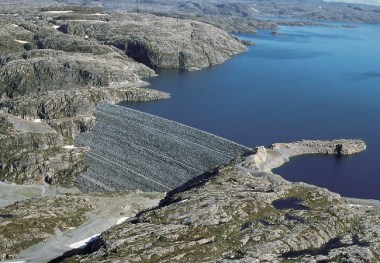
Norwegian dam. Statkraft photo.
¶ Much of the new electric capacity in Italy is in small installations. There were 190.1 MW of wind farms in the first half of 2015, spread among 384 installations. The 127.4 MW of new solar capacity included 46 MW in systems of 3 kW to 6 kW, and 27.86 MW in systems in the 20 kW to 200 kW range. The 53.9 MW of hydropower was spread among 95 plants. [SeeNews Renewables]
¶ Solar power company Canadian Solar is close to complete construction of a 100-MW project Grand Renewable Solar Project, in Haldimand county, Ontario, with 445,000 of the company’s CS6X MaxPower high-performance modules. GRS is expected to produce approximately 170,000 MWh of electricity per year. And the solar energy will help power about 17,000 homes. [Greentech Lead]
¶ Gamesa, a leader in wind technology, will supply nine wind turbines to repower a wind farm in the UK, developed by a joint venture between utility E.ON and renewable generator Energy Power Resources Ltd. Old turbines commissioned in 1993 will be updated with modern technology to produce twice as much power using fewer than half as many turbines. [Windpower Engineering]
¶ Japan approved an increase in compensation payments for the Fukushima Disaster to ¥7.07 trillion ($57.18 billion), as tens of thousands of evacuees remain in temporary housing more than four years after the disaster. TEPCO, the operator of the wrecked Fukushima Daiichi nuclear station, will also receive ¥950 billion more in additional public funds. [Reuters India]
¶ Statkraft has started construction on a 3-MW battery project at a run-of-river power plant in Dörverden, Lower Saxony, Germany. Three batteries of 1-MW installed capacity are being mounted on site. The aim of the pilot project is to deliver control reserve power to the German transmission grid. The company expects the batteries to be in operation by the end of the year. [reNews]
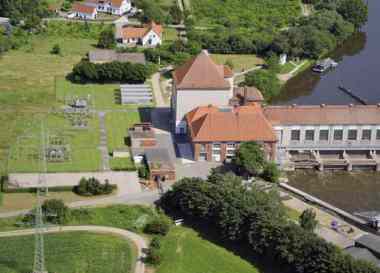
Image: Site of Statkraft run of river battery project (Statkraft)
US:
¶ FERC issued its monthly report on new US generating capacity. CleanTechnica added a careful estimate of new rooftop solar capacity, and here are the numbers: 44% of new capacity came from wind power, 41.5% came from solar power, 13% was biomass, and 2% was natural gas. Overall, for the first half of 2015, renewables accounted for 78.4% of new capacity. [CleanTechnica]
¶ Warren Buffett joined leaders of a dozen major US businesses at the White House in calling for robust action on global warming. Berkshire Hathaway, Apple, Walmart, General Motors, Cargill, Bank of America and others announced over $140 billion in investments in low-carbon projects and other actions as they shift toward greater reliance on renewable energy. [Omaha World-Herald]
¶ The Clean Power Plan is expected to be finalized soon, and two new reports refute opponents’ claims that the plan will increase electric bills. A Synapse Energy Economics scenario includes investments in renewables and energy efficiency. It finds the average US household participating in energy efficiency programs should save $35 on its electric bills in 2030. [Morrow County Sentinel]
¶ A study released Monday by the University of Wyoming Wind Energy Research Center presents a case for California regulators to turn to Wyoming wind power to help offset the natural ups and downs of wind and solar power generated in their state. The report says Wyoming wind could help California over a billion gallons of water annually and help Californians reduce utility bills. [KOLO]
¶ Installation of the turbine foundations for Deepwater Wind’s 30-MW Block Island project started Sunday and will take about eight weeks. Submarine cable installation is to commence in the spring of 2016, followed by turbine installation in the summer. With completion of grid connection, the wind farm is planned to be producing power in the final quarter of 2016. [SeeNews Renewables]

Alstom Haliade wind turbines. ©Alstom / Nicolas Job
¶ Pumped hydro storage has potential on Oahu. It uses cheap solar energy during the day to pump water uphill to a reservoir, and then releases that water at night, running down a pipe, turning a turbine and making electric power. The Kauai Island Utility Cooperative has decided against battery technology, and has opted to implement pumped-hydro storage. [Pacific Business News (Honolulu)]
¶ Southern California spot wholesale power prices slumped to negative levels, a signal for generators to cut output, after wind production surged above forecast. Wind turbines, primarily in the lower half of the state, produced an estimated 1,981 MW in the hour ending at 10 a.m. local time, 73% more than the California Independent System Operator Inc had predicted. [Bloomberg]
¶ A Texas company is moving forward with an effort to build a massive wind power project in Aroostook County, Maine, that would be the largest of its kind in New England. Applications in, EDP Renewables awaits the green light from the state before it can begin building the 250-MW wind project in northern Maine that could power roughly 70,000 homes. [Fort Worth Star Telegram]
¶ Bill Fehrman, CEO of MidAmerican Energy, said Monday the company could get up to 57% of its energy from wind with its latest renewable energy project. Wind’s growing presence in MidAmerican’s portfolio is encouraging, and so is news that the utility is looking to invest in Iowa solar projects; both community solar and utility-sized solar are being considered. [DesMoinesRegister.com]
Posted in nuclear power, renewable power, solar, wind | Leave a Comment »
Tags: nuclear, nuclear power, photovoltaic, renewable power, solar power, wind power
July 27, 2015
Opinion:
¶ “Why Bigger Is No Longer Better In Energy” A product, technology, or energy source that is both cost-effective and bankable will scale, and this is the key to victory. The good news for photovoltaics is that nothing scales like silicon. And the earth’s silicon supply is virtually infinite. Silicon Valley is not called Germanium Valley for a reason (though it could have been). [OilPrice.com]
Science and Technology:
¶ An Entrade Energiesystems E3 micro-scale biomass CHP plant has passed 1000 hours of operation (nearly seven weeks), with almost no human interference. The plant produces 22 kW of electrical energy and 55 kW of thermal energy, and plants can be connected in series. The unit fits in a standard shipping container, and can be installed in less than a day. [Renewable Energy Focus]
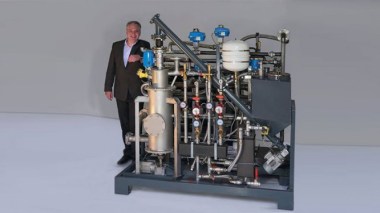
Photo: © ENTRADE Energiesysteme AG
World:
¶ Tougher national caps on the emissions of common air pollutants may soon be headed to the European Union, following the approval of European Commission proposals by the Environment Committee of the European Parliament. The new caps call for the emissions in question to be reduced by 70% by 2030 (saving an estimated €40 billion in air pollution costs). [CleanTechnica]
¶ New Delhi-based ACME Solar Energy Pvt Ltd commissioned two solar power plants in the Indian state of Rajasthan with a combined capacity of 150 MWp, it announced on Friday. The complex consists of five PV plants in the Thar desert. ACME Solar is a joint venture of ACME Cleantech Solutions Ltd, EDF Energies Nouvelles, and EREN Renewable Energy. [SeeNews Renewables]
¶ The latest challenge at the Fukushima Daiichi nuclear power plant is to remove a 20-ton piece of debris from a pool holding over 500 spent fuel rods. More than four years after the plant was hit by a massive earthquake and tsunami, Fukushima Daiichi’s operator TEPCO said it would start work on the critical task this week using a crane especially designed for the work. [Wall Street Journal]
US:
¶ Schneider Electric, S&C Electric Company, and Oncor, which does transmission and distribution, teaming up to put together a microgrid featuring nine separate distributed generation sources along with energy storage infrastructure. Oncor says the project is the “most advanced microgrid in North America,” and will provide insight into optimization strategies. [CleanTechnica]
¶ Although Kodiak Island relied on hydropower for 80% of the electricity, it also burned 2.8 million gallons of diesel oil, costing $7 million, per year. Kodiak Electric Association set a goal of producing 95% of the community’s electrical needs with renewable energy by 2020. They actually arrived there well ahead of time, and are now 99.7 % renewably powered. [GreenBiz]
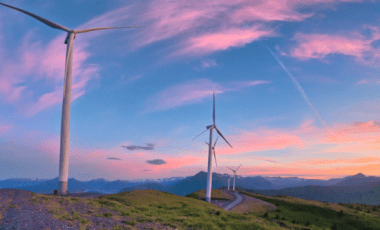
Alaska’s Kodiak Island has switched from diesel fuel dependence to relying almost entirely on renewable energy. Flickr/Mandalit.
¶ A bipartisan energy bill that includes a 50-GW National Geothermal Goal is awaiting the Senate Finance Committee’s markup on Tuesday. The bill would have federal agencies identify priority areas for geothermal development, and facilitate new discoveries by allowing limited non-competitive leasing of adjacent lands where a new discovery has been made. [SeeNews Renewables]
¶ Developers of a plan by a Swanton family for what could become Vermont’s latest large-scale wind power project want to ask for state approval before the end of the year in hopes that construction can begin on what may be a seven-turbine, 20-MW installation before the end of 2016. The Swanton Wind project would be on a ridge northeast of St. Albans. [Barre Montpelier Times Argus]
¶ Southern California Edison has launched its sixth renewable energy solicitation for renewable electricity as part of a program to procure resources sized between 3 and 20 MW. The company is seeking a total of 104.8 MW, 54.8 MW to meet the its RAM procurement targets, and 50 MW of solar resources to support launching the company’s Green Rate program. [AZoCleantech]
¶ New Jersey is making good progress toward achieving the goals its four-year-old Energy Master Plan, lowering costs to consumers, promoting a diverse set of in-state generation, and supporting renewable energy, the state Board of Public Utilities says. The BPU is gearing up for a series of public hearings on the plan, and some people are likely to contest its opinion. [NJ Spotlight]
¶ General Electric Co wants to be a “sizable” player in the market for systems that store energy to manage power volatility, a sector the company expects to quadruple to $6 billion by 2020. Demand for industrial battery systems is being driven by increasing reliance on renewable energy sources and the potential to add energy to the grid quickly when power needs spike. [BusinessDay]
Posted in nuclear power, renewable power, solar, wind | Leave a Comment »
Tags: nuclear, nuclear power, photovoltaic, renewable power, solar power, wind power
July 26, 2015
Opinion:
¶ “Coal is losing the war” While coal industry supporters blame the EPA for its decline, coal’s enemies also include the vast natural gas industry, rising renewable energy, decreased global demand, Wall Street and deep-pocketed nonprofits that deem coal a public-health threat. And they have recently notched a host of victories that show the war is becoming a rout. [Pittsburgh Post-Gazette]
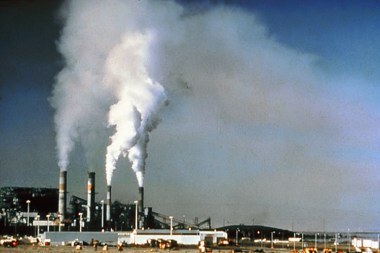
Air pollution at a power plant, in the old days before EPA-required improvements. US National Park Service photo. This photo is in the public domain because it was prepared by a federal employee for the US government.
Science and Technology:
¶ Researchers at the University of Massachusetts Amherst are trying to create an ultrasonic device to keep bats away from wind-turbine blades. The scientists want to reduce the number of bats killed by wind turbines by designing a whistle that would attach to a blade and imitate a bat call. The ultrasonic sound produced would alert bats to danger. [WPRI 12 Eyewitness News]
¶ Boeing has a new patent for nuclear engines that use lasers, with the US Patent and Trademark Office’s approval of an application earlier this month. Boeing’s concept for an engine would provide energy-efficient thrust by firing lasers at radioactive material to produce a fusion reaction and could be used to drive spacecraft, rockets and missiles. [International Business Times UK]
World:
¶ An IMF study says worldwide energy subsidies are much greater than previously known. The combination of direct and indirect subsidies is projected at $5.3 trillion in 2015, or 6.5% of global GDP. Most of this arises from countries setting energy taxes below levels fully reflecting damage to the environment associated with fossil fuel consumption. Country-level estimates are available. [imf.org]
¶ Glasgow-based Start Renewable Energy has won a £350,000 contract to supply heat pumps for a system which will, for the first time in the UK, see solar thermal panels used to power district heating. Star will design and build a large-scale heat pump system connected to a solar energy farm to be built in the new town of Cranbrook, now under construction near Exeter. [Herald Scotland]
¶ China’s solar power industry depends on subsidies from the government, but the money available, which the government derives from coal-fired power generation, is dropping as coal prices fall. The government owes 10 billion yuan ($1.6 billion) to fifteen solar energy companies. Industry representatives say the sector will be stunted as payments are delayed. [WantChinaTimes]
![Solar PVs on Chinese rooftops. Photo by Ismoon. GNU Free Documentation License. [Wikimedia Commons]](https://geoharvey.com/wp-content/uploads/2015/07/7-27-solar-in-china.jpg?w=380&h=285)
Solar PVs on Chinese rooftops. Photo by Ismoon. GNU Free Documentation License. [Wikimedia Commons]
¶ Chinese solar module manufacturer Suntech has supplied Indian utility Adani Power with 36,470 modules for development of a 9.3-MW peak solar power project in Mundra, Gujarat. The solar power project is expected to generate 13 GWh of electricity each year, which would be adequate to meet the electricity requirements of about 32,000 households in Mundra. [
Greentech Lead]
¶ Canadian solar company SkyPower Global is to sign an agreement with the energy ministry of Kenya to develop 1-GW of solar power in that country. The project will be developed over five years and is expected to cost $2.2 billion. Africa has recently been getting attention of renewable power developers worldwide, and the SkyPower’s deal is one of many. [Greentech Lead]
US:
¶ The state of Hawaii submitted testimony opposing Hawaiian Electric Industries’ merger with NextEra Energy Inc, as currently proposed. Governor David Ige outlined the reasons for this. “Although I welcome capital investment in Hawaii with respect to energy, any merger or investment must align with the state’s 100 percent renewable energy goal,” Ige says. [North American Windpower]
¶ Village Green Ventures, is building a 1-MW anaerobic digester at the Brunswick Landing business park in Brunswick, Maine. It will have three steel tanks, the largest of which will stand 75 feet tall. Digesters can eat most any kind of organic material, including food waste, sludge, manure and cooking grease. This one is going to need roughly 180 tons of waste each day. [WGME]
Posted in nuclear power, renewable power, solar, wind | Leave a Comment »
Tags: nuclear, nuclear power, photovoltaic, renewable power, solar power, wind power
July 25, 2015
World:
¶ Grid-connected wind generation capacity in the EU reached 129 GW in 2014, meeting 8% of Europe’s demand for electricity. A report by the European Commission’s in-house science service, projects that at least 12% of electricity will be from wind by 2020, a significant contribution to the European energy goal that 20% of energy come from renewable sources by 2020. [E&T magazine]
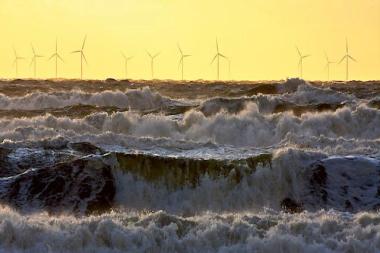
Wind power makes a valuable contribution to renewables targets. Photo credit: EU.
¶ Up until mid-last year, oil prices hovered over $100 per barrel, but with its excessive production paired with falling demand, the prices have declined by half and stayed low. The coal industry has also been struggling. Years of buildup in the mining capacity have forced global coal prices to tumble and there’s little hope that the industry will be back firmly to its knees. [CleanTechnica]
¶ The United Arab Emirates’ Energy Ministry has decided to terminate gasoline subsidies, as the country’s economy is being negatively affected by low oil prices. The average cost of gasoline in the UAE is equivalent to $1.78 per gallon and the policy change should increase the cost closer to global prices. The policy change is also very likely to reduce waste.[CleanTechnica]
¶ Kenya has outpaced its African peers in renewable energy production, and is ranked top in the five globally in geothermal energy investments. A renewables global status report 2015 shows Kenya increased its green energy output by 358 MW last year, more than doubling its stock to about 600 MW. The report said future policies need to respond to emerging opportunities. [The Star]
¶ Insurance giant Aviva has announced new targets to invest £500 million a year for the next five years in low-carbon infrastructure, in a move that will prevent 100,000 tons of carbon dioxide emissions each year. The investments will be made in renewable energy and energy efficiency infrastructure in Europe. They will include investment in solar PV and wind power. [Business Green]
¶ Swedish utility Vattenfall AB says preparatory works on its 54.4-MW Ray wind farm near Kirkwhelpington, northern England, will begin this month. The £90 million ($139.6 million) wind park will start generating power in early 2017. Once fully operational, the facility is expected to produce enough power to meet the annual needs of over 30,000 UK households. [SeeNews Renewables]
Source: News Oresund. License: Creative Commons, Attribution 2.0 Generic.
US:
¶ US solar manufacturer SunPower has announced that it will build a 100-MW solar PV power plant for NV Energy in Nevada. SunPower made the announcement on Thursday, revealing that it had signed a 20-year Power Purchase Agreement with NV Energy in Nevada to build a 100-MW solar PV power plant in the Eldorado Valley of Boulder City, Nevada. [CleanTechnica]
¶ The state of Massachusetts has a goal to produce 1,600 MW of solar power by the year 2020. To do this, the state Senate voted on Thursday to raise the maximum amount of solar power permitted to be resold by consumers to the main grid. This is part of a far larger bill intended to fight against climate change, called the Climate Change Preparedness Bill. [Apex Tribune]
¶ An Arizona utility can burn trash and claim the electricity it generates is coming from renewable resources, the state Court of Appeals has ruled. The judges rejected arguments by the Sierra Club that the Arizona Corporation Commission acted illegally in concluding the Mohave Electric Cooperative could meet part of its renewable-energy mandate through trash. [Arizona Daily Star]
¶ Almonds, which have been vilified during the current drought for being one of California’s thirstier crops, have a surprisingly small carbon footprint compared to other nutrient-rich crops, according to a report from a team of researchers at the University of California, Davis, and UC Agriculture and Natural Resources. California grows about 80% of the world’s commercial almonds. [UC Davis]
¶ North Carolina is just beginning to explore offshore wind development. The federal government has identified possible sites off Kitty Hawk, Wilmington and Bald Head Island, but North Carolina’s offshore wind farms are years away. Still, with more uniform winds, offshore wind energy will be “the game changer,” as we transition from our use of dirty fuels. [News & Observer]
¶ A valve that failed during three inspections over the last five years was cited by the NRC as the reason water leaked into an electrical equipment room after the transformer explosion and fires at Indian Point in May. About half an inch of water was found on the floor of the switchgear room, warranting a special inspection by the NRC leading to a green-level violation. [Westfair Online]
Posted in nuclear power, renewable power, solar, wind | Leave a Comment »
Tags: nuclear, nuclear power, photovoltaic, renewable power, solar power, wind power
July 24, 2015
Science and Technology:
¶ The competition in the nascent battery storage market continues to intensify, with South Korean LG Chem launching a new 6.4-kWh battery storage system that approaches the key $1,000/kWh mark. The system is already bringing costs down at the top end of the market, matching the pricing of the Tesla Powerwall, with the advantage that it is actually in the market. [CleanTechnica]
World:
¶ In June, Dutch district court ordered the Netherlands to cut greenhouse gas emissions to 25% lower than 1990 levels by 2020. This is several percentage points deeper than the 17% reduction the country had been envisaging. The same reasoning used by the Dutch judges for declaring tort law valid for dealing with climate change could be applied elsewhere. [CleanTechnica]
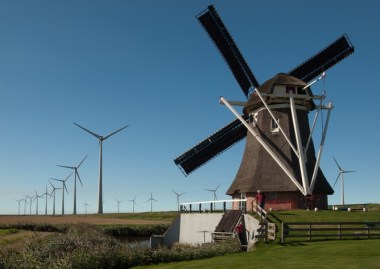
The Netherlands has long embraced renewable energy, but some judges say it must do more. Uberprutser, CC BY-SA.
¶ In a ruling welcomed by Gaz Métro and the City of Saint-Hyacinthe, the Régie de l’énergie du Québec has authorized the utility company to purchase the renewable natural gas (RNG) produced by the city and build the infrastructure required to connect the output to its distribution network. Up to 13 million cubic metres per year of RNG may be produced. [Your Renewable News]
¶ According to a recent announcement, Indian solar PV manufacturer Rolta Power signed a memorandum of understanding with Chinese firm Zhenfa New Energy Science and Technology to develop solar power projects in India. The companies would together install 2 GW of solar power projects by 2020, which is expected to generate revenue of around $2.03 billion. [CleanTechnica]
¶ Japan’s foreign aid arm Japan International Cooperation Agency (Jica) plans to fund solar power parks in the country, giving a fillip to India’s green energy plan. To start with, Jica is ready to invest $500 million in the proposed solar parks. Other institutions such as Germany-based KfW Bankengruppe and World Bank also want to invest in solar parks. [Livemint]
¶ US renewable energy development company SunEdison Inc says it signed a long-term power agreement with the Tata Power Delhi Distribution to provide 180 MW of solar power. This is the largest deal SunEdison has signed under the open access solar framework that allows renewable energy firms to sell power directly through the national grid to end-user. [mydigitalfc.com]
¶ As many as fifty-five cities in twenty-seven Indian states and union territories are currently being developed as solar or green cities, parliament was told on Thursday. The fifty-five solar cities are being developed under ‘Development of Solar Cities programme’, Power and New and Renewable Energy Minister Piyush Goyal told the Lok Sabha in a written statement. [Greentech Lead]
¶ French lawmakers passed legislation that included a last-minute amendment initially rejected by the government to increase the target price of carbon to €56 ($61.48) a ton in 2020 and €100 a ton in 2030. The rate, now €14.50 a ton, climbs to €22 a ton in 2016 and is integrated in a levy on fossil fuels. This fulfills a campaign pledge of President Francois Hollande. [Bloomberg]
US:
¶ The Benefits of Transit in the United States: A Review and Analysis of Benefit-Cost Studies, a report from the Mineta Transportation Institute, has found that public transit systems in the US provide very notable and varied net benefits to the regions where they operate. The report considers studies on economic benefits and costs of US public transit system. [CleanTechnica]

Image Credit: Charlotte Lynx
¶ Developers in Oklahoma and other windy states are ramping up construction on wind farms in the wake of a last-minute renewal of a key federal tax credit that took place at the end of 2014. The American Wind Energy Association said 13,600 MW of capacity was under construction across 101 projects in 24 states. Oklahoma is expected to add another 1,440 MW. [NewsOK.com]
¶ Colorado officials are planning for an expected EPA rule next month that could require a 30% reduction in carbon-dioxide emissions nationwide by 2030. The director of the Colorado Air Pollution Control Division said a number of options are being considered, including updating coal plants, shifting to natural-gas, more renewable energy, and conservation. [Colorado Springs Gazette]
¶ The earlier revenue-neutral New York State Carbon Tax proposal has now transformed into a combined tax credit and investment proposal, according to the Network For Sustainable Financial Markets. The proposal would allow for tax credits to low-income groups, in addition to encouraging investments for reduced carbon emissions or climate change mitigation. [CleanTechnica]
¶ According to federal officials the application for a combined construction and operation license for the Calvert Cliffs 3 nuclear reactor, has been withdrawn by UniStar Nuclear Energy. When it was first proposed late last decade, a modern European-style reactor at Calvert Cliffs was targeted to go on-line in 2015. Instead, July of 2015 marks the plan’s official demise. [Bay Net]
Posted in nuclear power, renewable power, solar, wind | Leave a Comment »
Tags: nuclear, nuclear power, photovoltaic, renewable power, solar power, wind power
July 23, 2015
Opinion:
¶ “Nuclear Almost As Good As Solar, Says Report Prepared For Nuclear Group” Nuclear power helps lower the selling price of electricity, according to a recent report prepared for a nuclear advocacy organization, but it seems to fall short of renewables on the same score. The report is an economic analysis on nuclear power prepared by the Brattle Group for Nuclear Matters. [Forbes]
World:
¶ A 50% renewable energy share in Australia by 2030 is “entirely achievable”, the head of the Clean Energy Council said in response to media reports that the Australian Labor Party would adopt such a target. He said meeting the target would require an energy and climate change policy that would facilitate shutting down old coal-fired plants. [SeeNews Renewables]
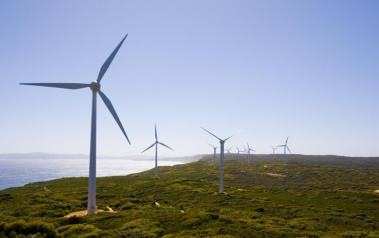
Wind Farm in West Australia. Author: Lawrence Murray. License: Creative Commons. Attribution 2.0 Generic
¶ Given the availability of solar power at 4¢ per kWh, a price with which crude oil could only compete if offered below $7 per barrel, the ‘carbon bubble’ is expected to burst, Wermuth Asset Management has warned. According to the company, this will have profound implications for the Middle East’s oil producing countries, global financial markets and the world. [Trade Arabia]
¶ China will develop a renewable energy micro-power grid policy, to promote sustainable development of energy resources, according to the National Energy Administration. Micro-power, a paradigm that is the opposite of large, centralized power stations, has electricity sources that are small, mass producible, quick to deploy, cost competitive and rapidly scalable. [eco-business.com]
¶ Deutsche Bank has painted a sunny picture for solar in India, stating annual investments in the clean power technology could surpass investment in coal by 2019. In its India 2020: Utilities & Renewables report, the bank says that by 2020, renewables could account for 20% of the nation’s power generation capacity – and the electricity will be cheaper than coal. [Energy Matters]
¶ Environment Victoria’s new report, Six Steps to Climate Leadership: The Path to a Cleaner, Healthier and More Prosperous Victoria, outlines changes the state could make to transform into a “renewable energy heavyweight on the global stage”. A seven-star housing standard, low-income retrofits, a vision for reaching zero net emission, are just parts of the vision. [The Fifth Estate]
¶ Scottish Power reported a 24% drop in its coal-powered electricity generation in the first half of this year. The Spanish-owned energy giant, which is based in Glasgow, is preparing for the likely shut-down of the massive Longannet station in Fife next year. Renewable energy generation was up 27%, to reach half of the coal-powered figure of more than 4 GWh. [BBC News]
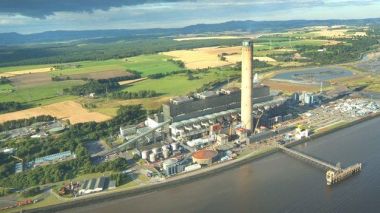
Longannet is one of the biggest coal-fired power stations in Europe.
¶ Renewable energy company SunEdison announced that it has signed a power purchase agreement with Tata Power Delhi Distribution. The agreement was signed for supplying electricity from a 180 MW solar plant that it would build in Madhya Pradesh. SunEdison will sell electricity to Tata Power for 20 years. It is said to be the largest such agreement ever signed. [PrepSure]
US:
¶ According to the recently-released BP Statistical Review of World Energy 2014, the US was the world’s largest and most diverse energy producer in 2014. But things are not as simple as BP’s calculations. Different grades of oil and gas are not the same. BP may have been correct, according to their methods of evaluation, but based on the energy content of the fuel, it is not. [Energy Collective]
¶ SunEdison Inc completed a 4.1-MW solar power plant for the City of New Bedford, Massachusetts. The solar power plant, located in Dartmouth, Massachusetts, will supply the municipality and Cape Cod Community College under a 20-year power purchase agreement. SunEdison and partner BlueWave Capital have installed 16 MW of solar for New Bedford. [Solar Industry]
¶ With 1,661 MW of newly installed wind turbines coming online during the second quarter of 2015 and more than 13,600 MW under construction, American wind power continues to grow. Florida’s first purchase of wind energy, from a wind farm in Oklahoma, shows a growing trend in the Southeast, as does a new utility-scale wind farm in North Carolina. [Windpower Engineering]

There are now 67,870 MW of installed wind capacity in the US and over 49,000 wind turbines online.
¶ Renewable energy sources accounted for nearly 70% of new electrical generation placed in service in the US during the first six months this year. According to the Federal Energy Regulatory Commission’s Energy Infrastructure Update, wind alone accounted for nearly 2 GW of new generating capacity – or 50.64% of all new capacity year-to-date. [North American Windpower]
¶ US developer Swaggart Wind Power has unveiled plans for a 500-MW wind farm in northern Oregon. The company anticipates constructing the project in phases, a site certificate application says. The project will consist of up to 292 turbines divided into two areas, Wheatridge West and Wheatridge East, linked via a 230 kV transmission line up to 35 miles long. [reNews]
¶ Scituate is the first community in Massachusetts to generate 100% of its power for public buildings from green energy sources. The town installed the solar farm at the former landfill 2 years ago and the wind turbine was erected 3 years ago on the Driftway. The vice-chair of the Scituate Board of Selectmen said each project has earned the town over $250,000 annually. [95.9 WATD-FM]
¶ A proposal by Kansas’ largest electric utility to raise its rates by $152 million a year is drawing strong criticism, particularly as parts of it could discourage consumers from installing solar panels or increasing efficiency. Westar says it needs rate increases to cover costs to meet a federal air pollution standard and for upgrades at the Wolf Creek nuclear power plant. [Salina.com]
Posted in nuclear power, renewable power, solar, wind | Leave a Comment »
Tags: nuclear, nuclear power, photovoltaic, renewable power, solar power, wind power
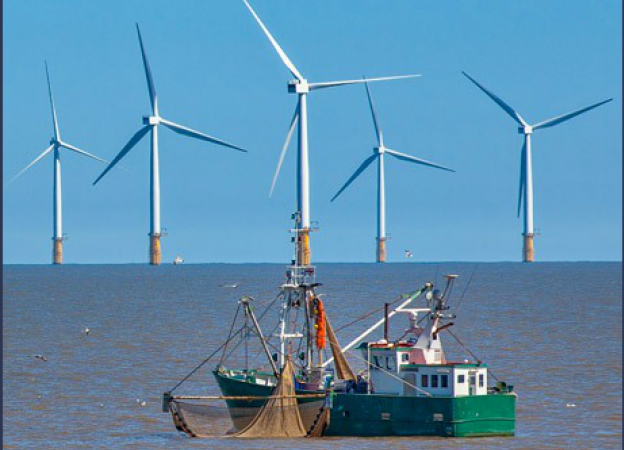

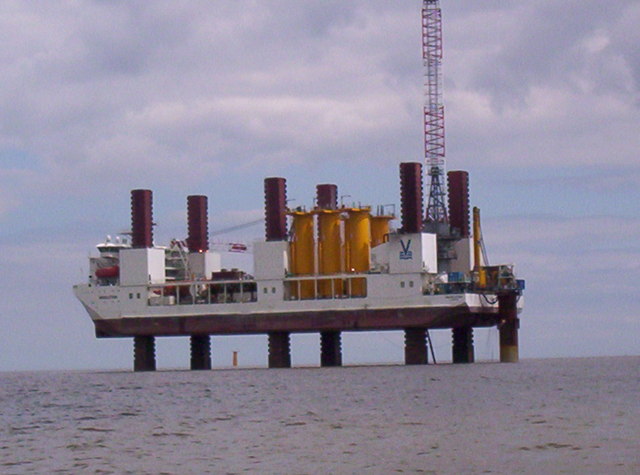
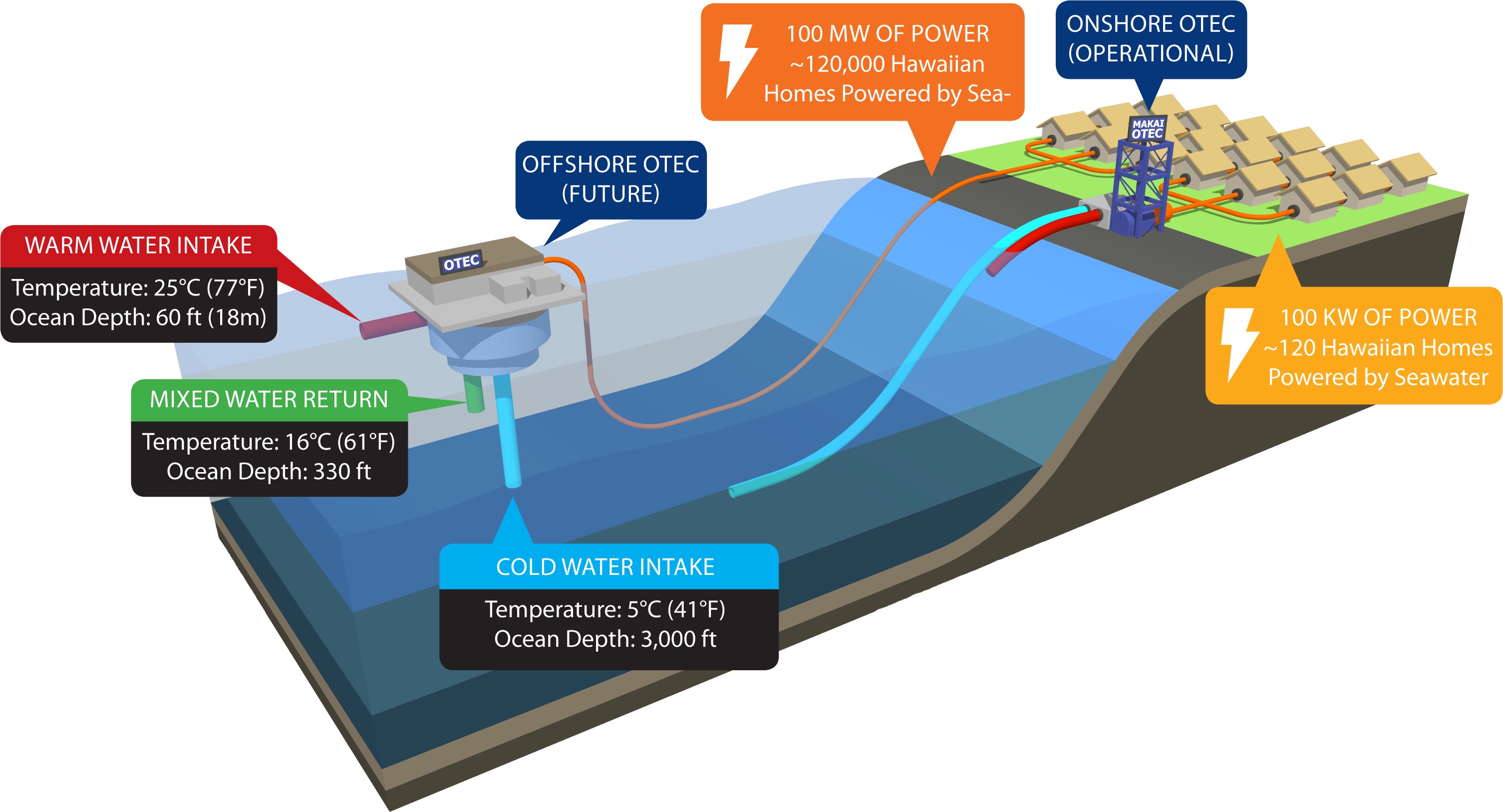
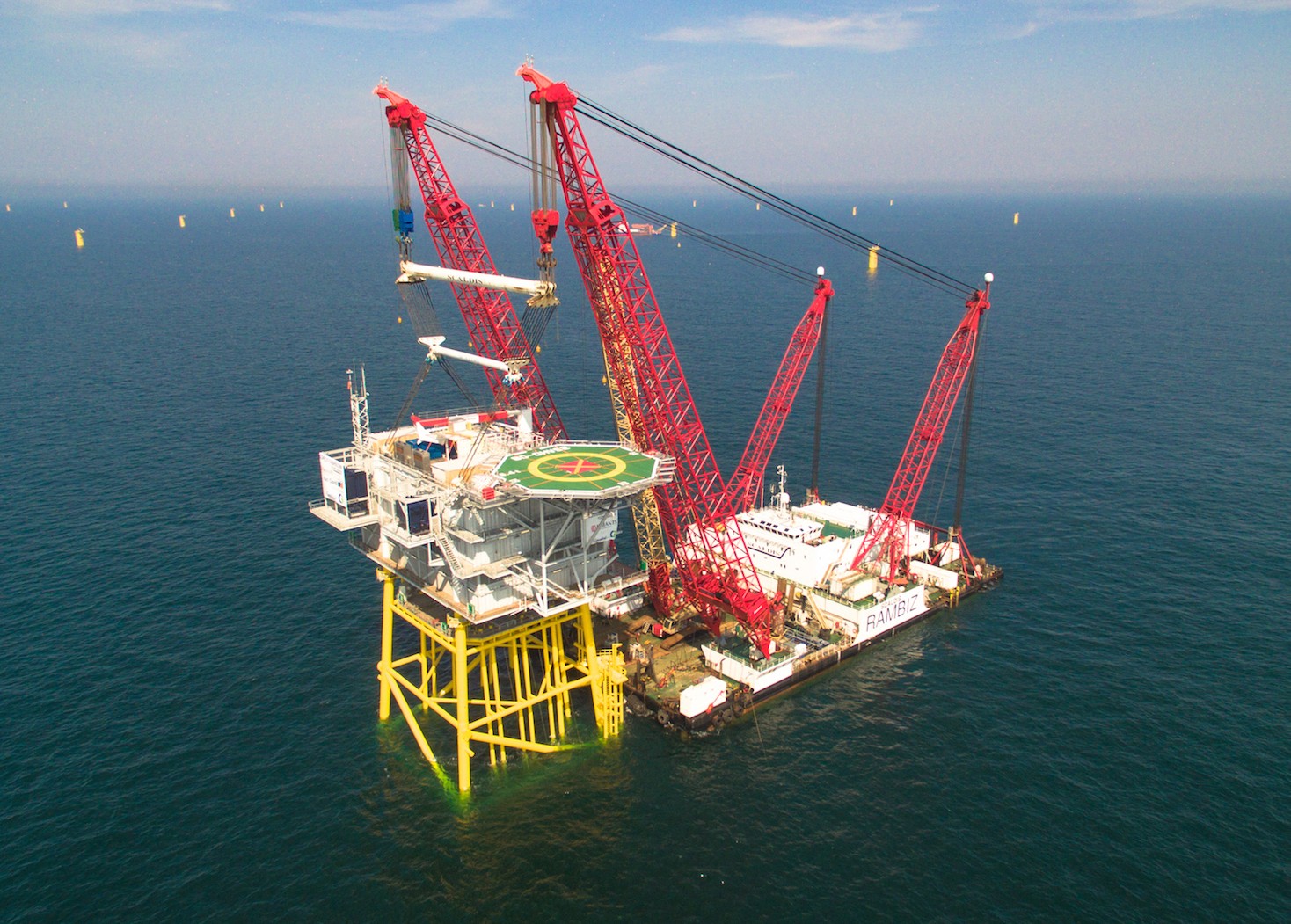

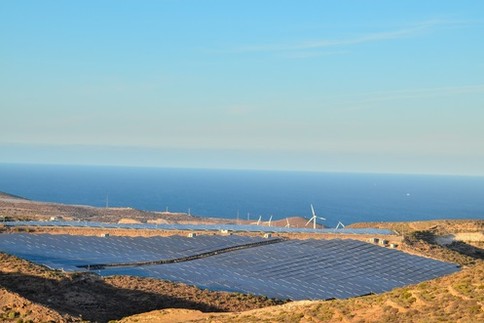
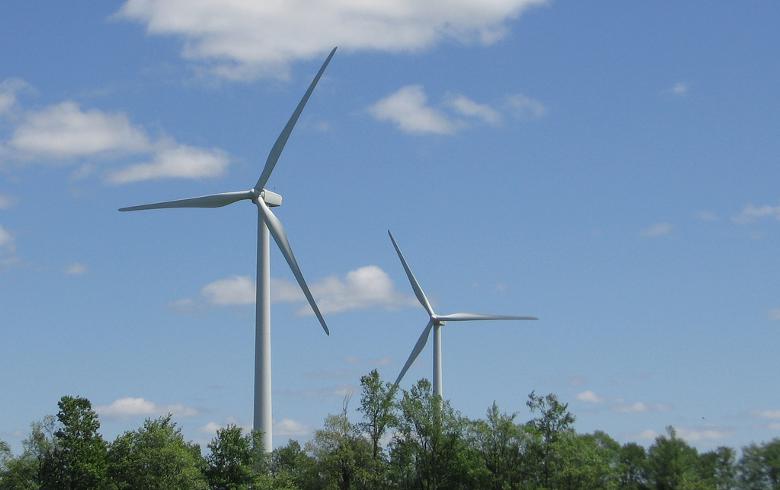

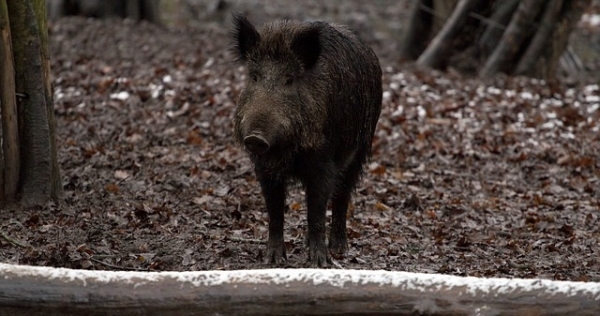
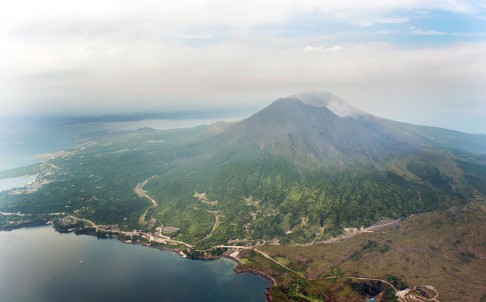

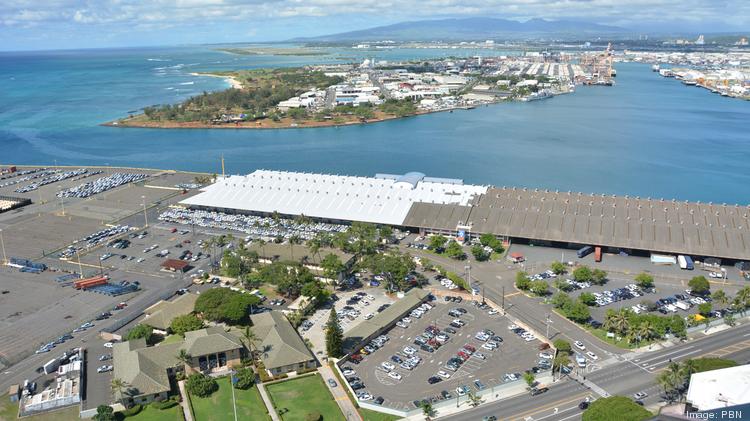

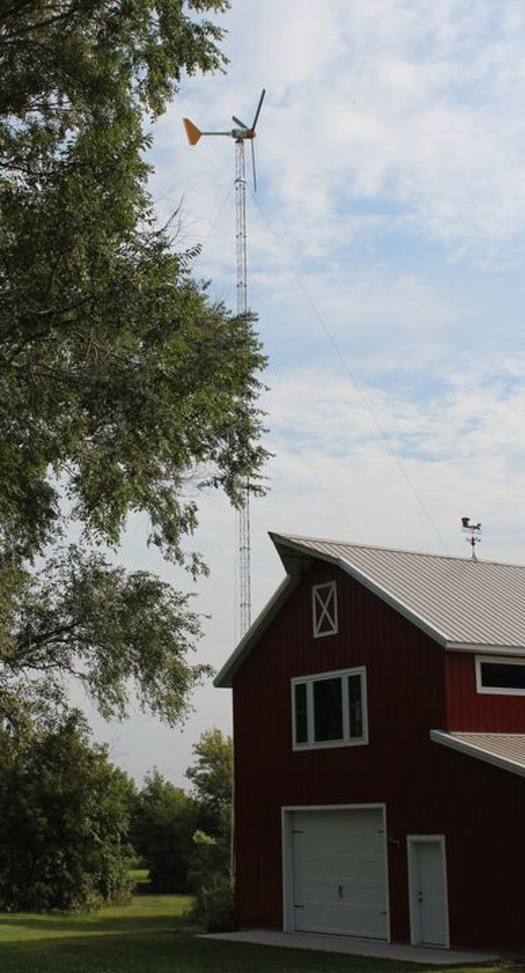
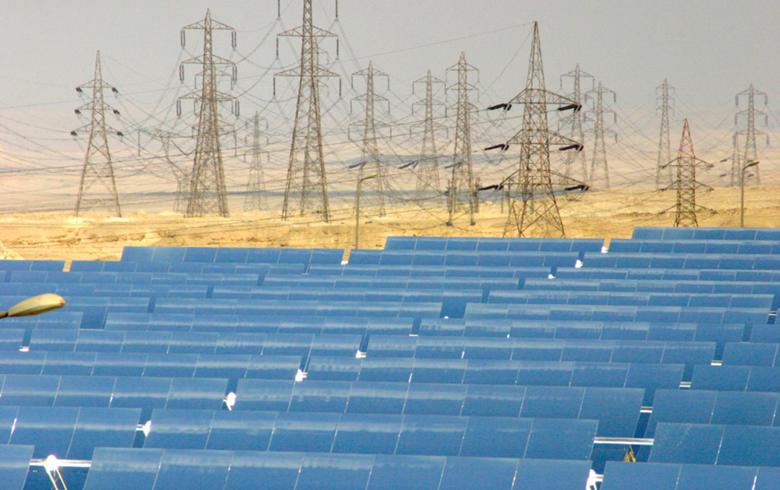
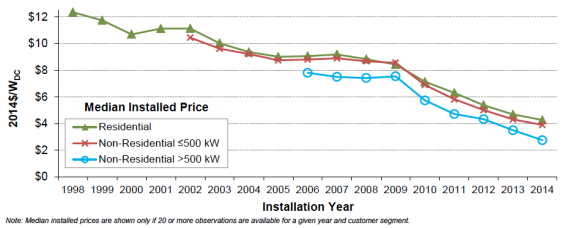

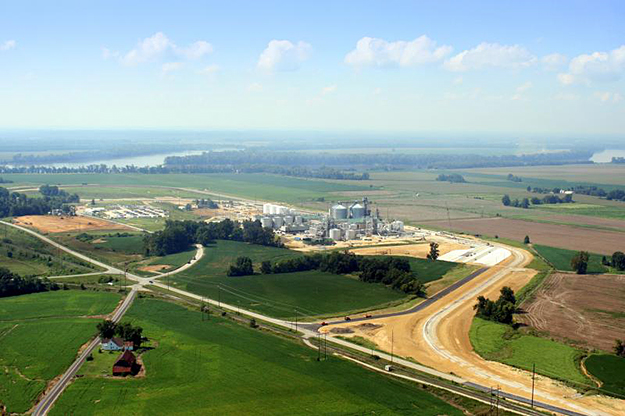
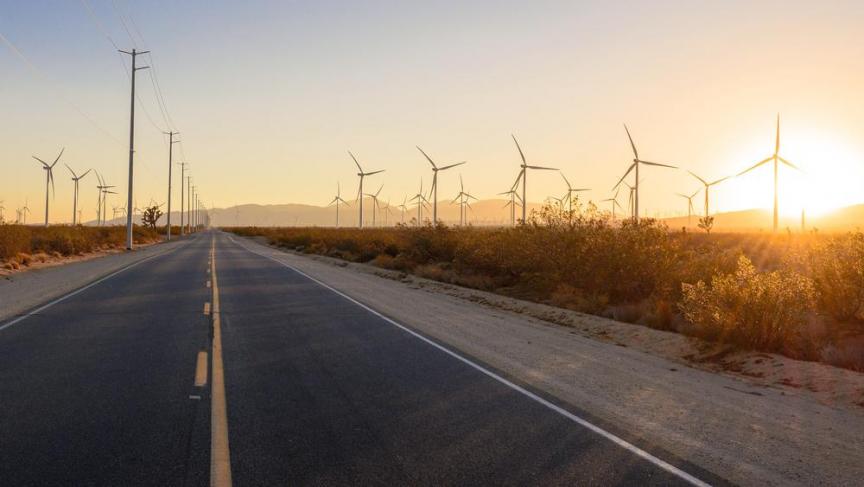

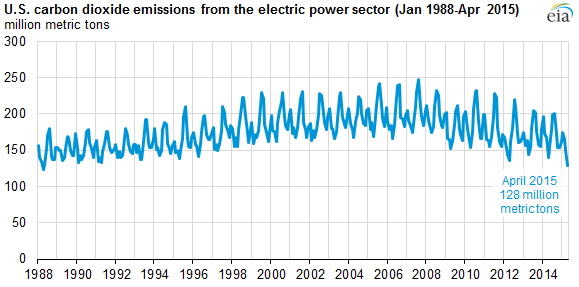
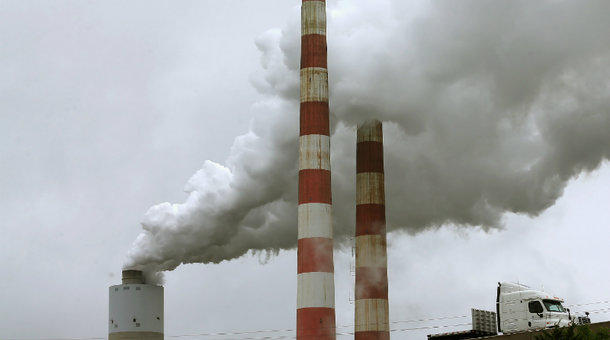
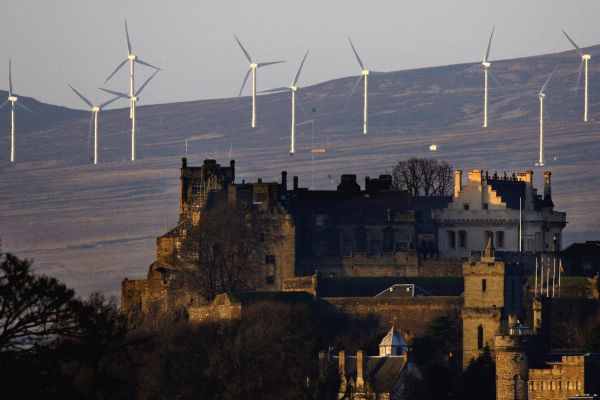

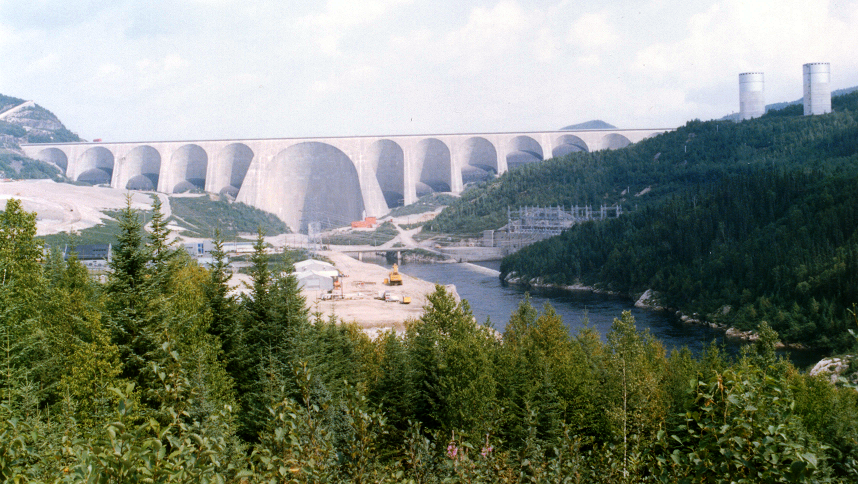


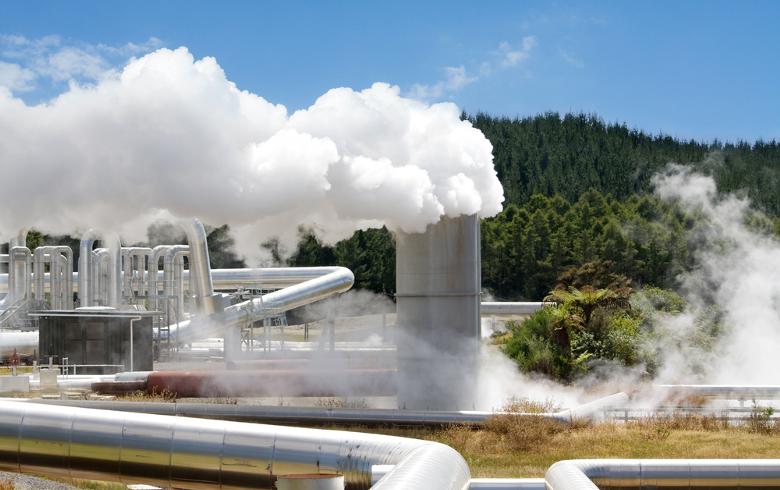
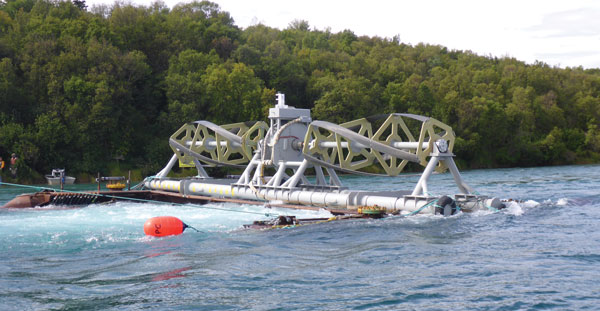


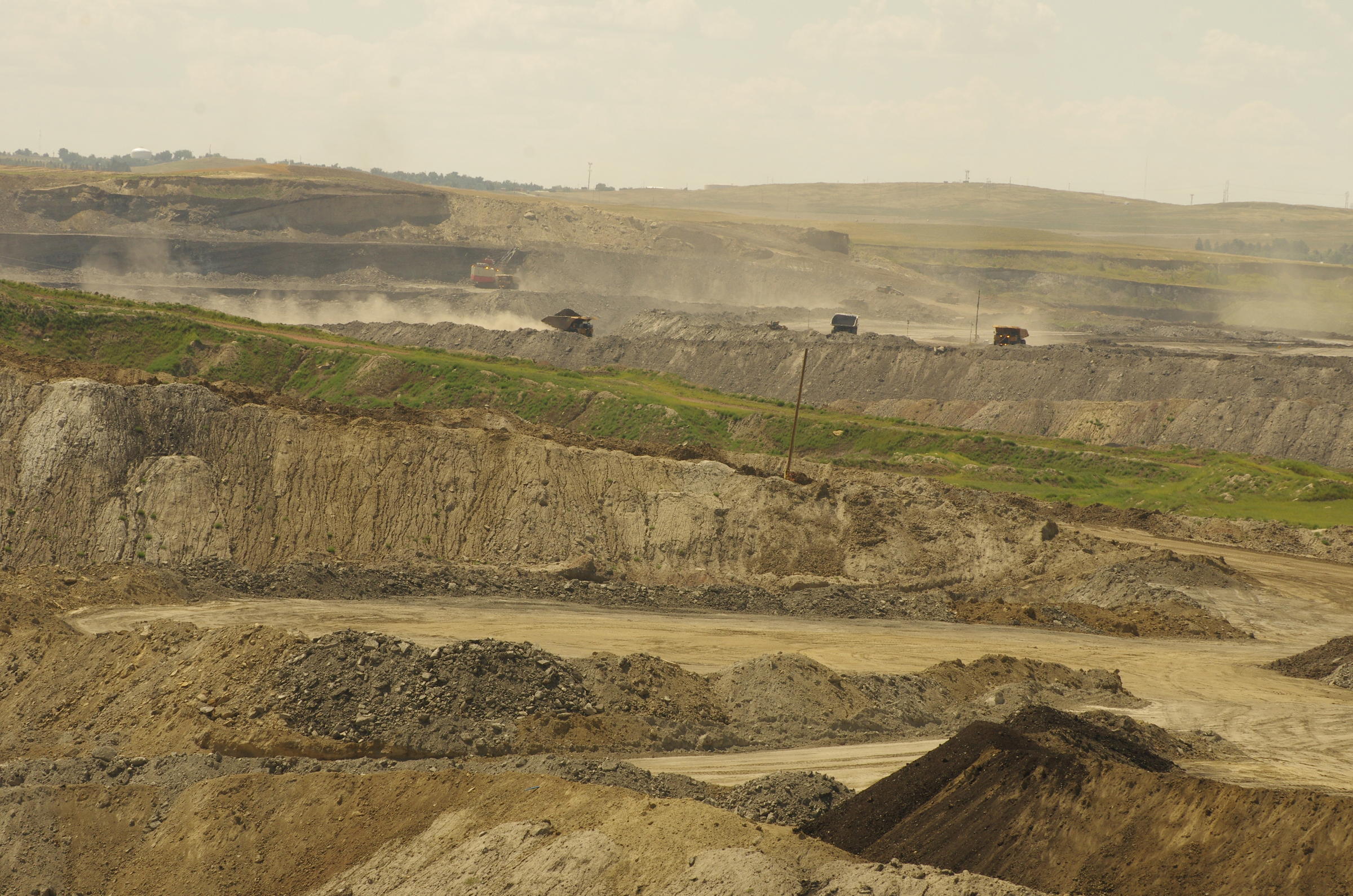
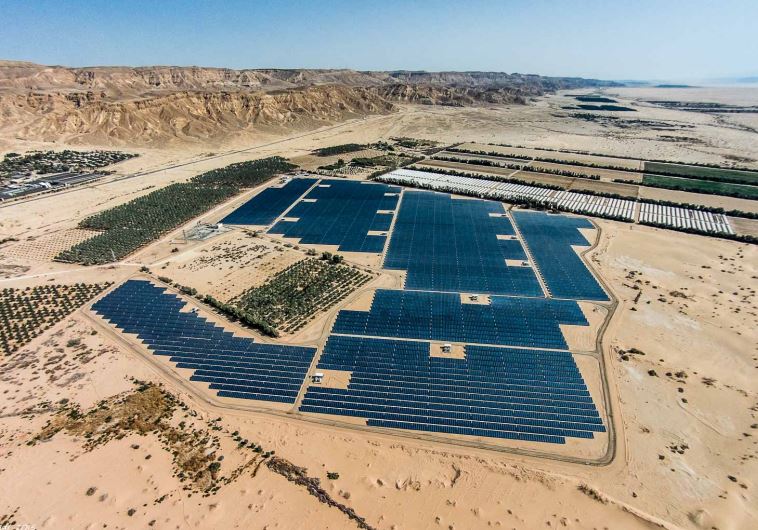

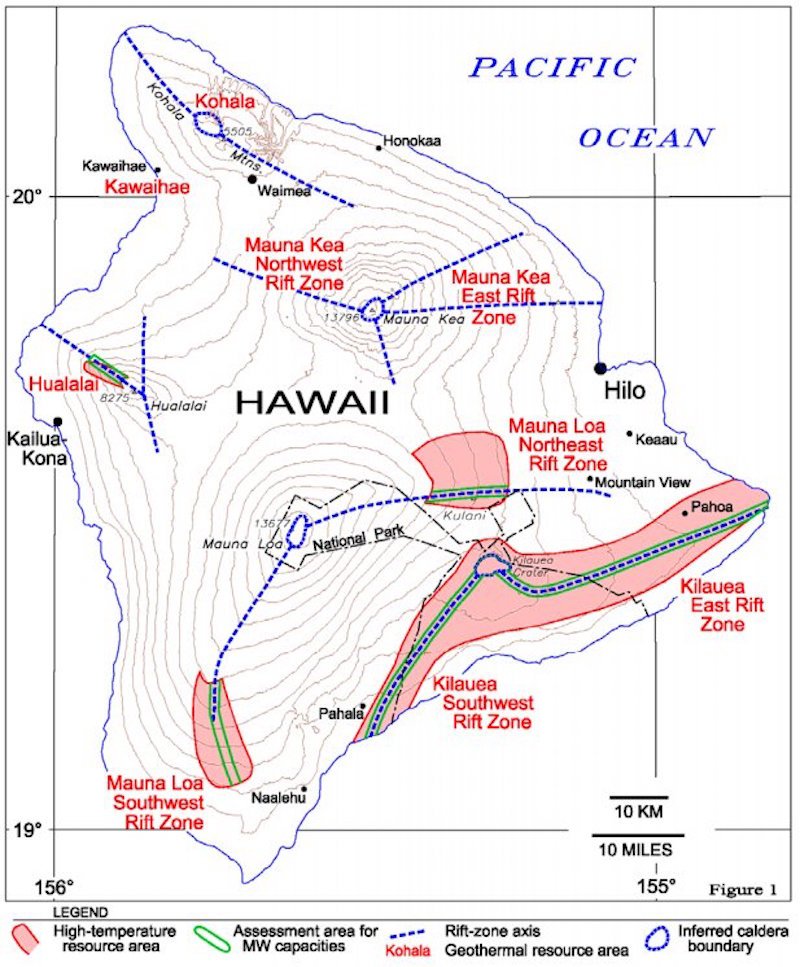
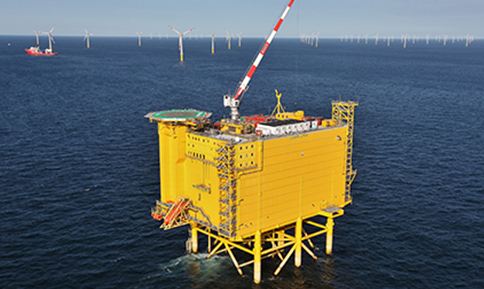

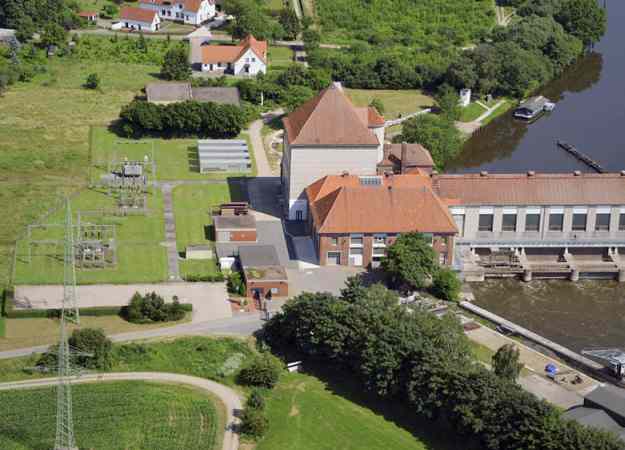
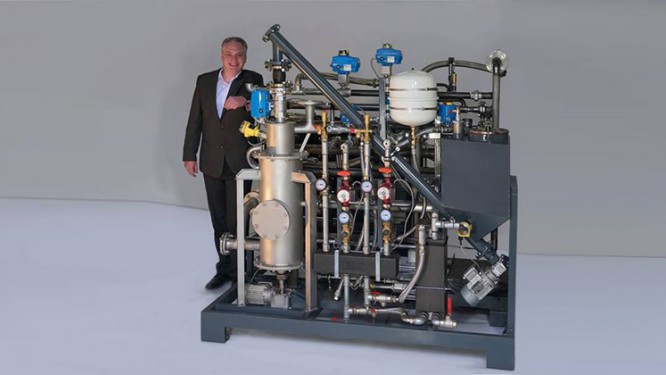
![Solar PVs on Chinese rooftops. Photo by Ismoon. GNU Free Documentation License. [Wikimedia Commons]](https://geoharvey.com/wp-content/uploads/2015/07/7-27-solar-in-china.jpg)
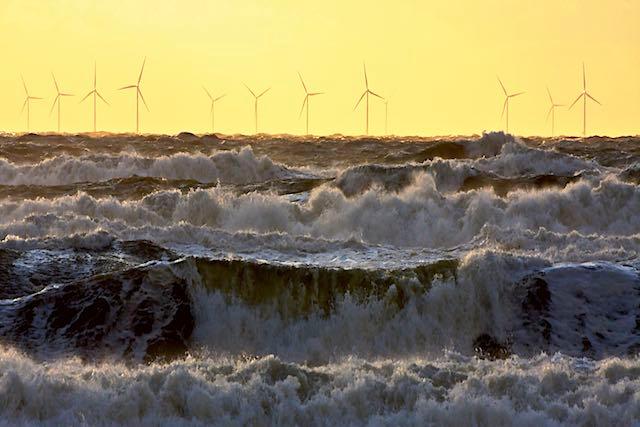
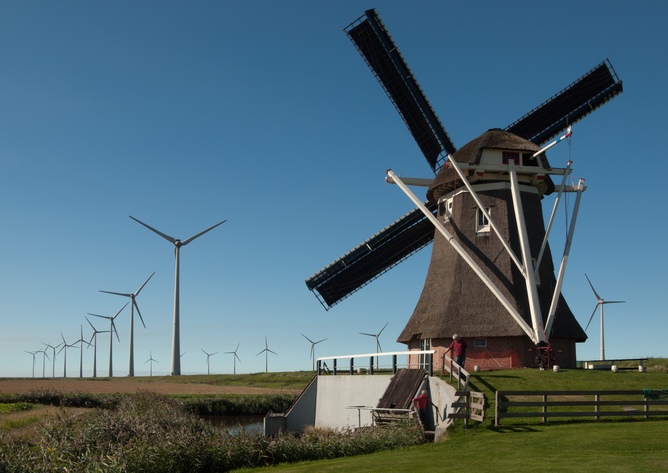
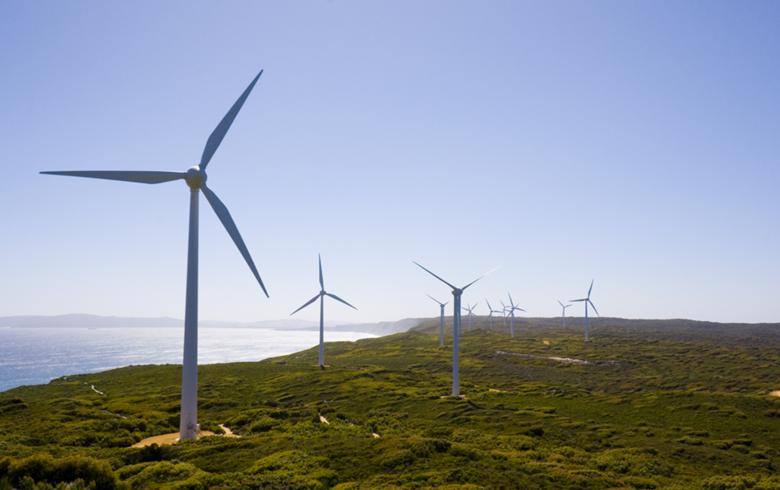
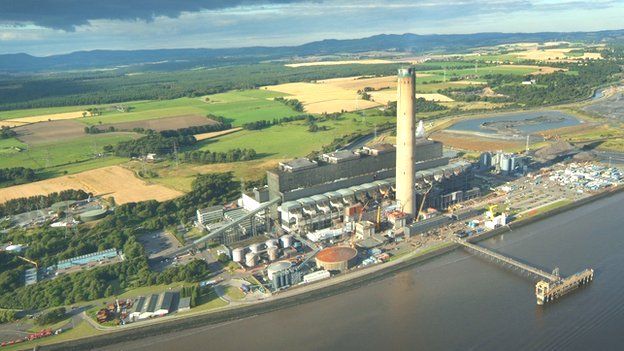
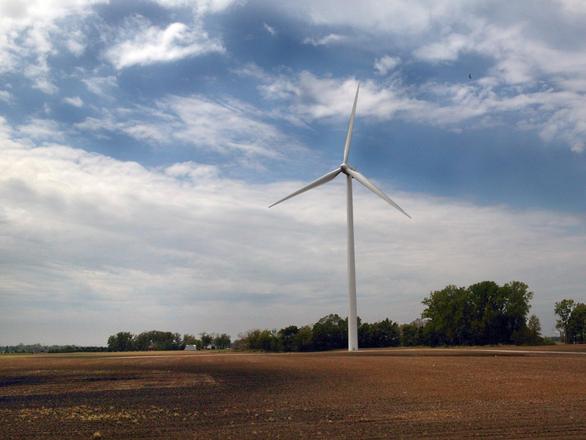

 geoharvey