
World:
¶ Researchers may soon be able harness the power of undersea waves. Carnegie Wave Energy and Western Power are working together to create the first wave energy island microgrid in Australia. This technology, known as the CETO 6 Project, will be built six miles off the coast of Garden Island, a small Australian Island near Perth. [Nature World News]

CETO 6 units (one of which is pictured here) may be able to harness the energy of undersea waves. (Photo : Carnegie Wave Energy)
¶ The UK’s rating for the security of its energy supplies has been cut. In its latest ‘trilemma’ report, the World Energy Council reduced the UK’s rating from AAA to AAB. It also warned that recent ‘unexpected’ moves by the Government to remove subsidies for wind and solar power would hinder future investment in the sector. [This is Money]
¶ It was widely reported last month that Chinese President Xi Jinping and UK Prime Minister David Cameron had struck a deal to try to reinvigorate UK’s stalling nuclear ambitions. But the reality is nothing has been signed yet, despite the huge financial incentives being offered by the Treasury to French and Chinese nuclear corporations. [The Ecologist]
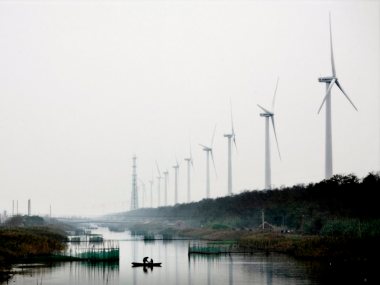
Xioa Yan Kou Farm, China. Photo: Danish Wind Industry Association / Vindmølleindustrien via Flickr (CC BY-NC).
¶ A newly signed deal will create of Kuwait’s first solar-thermal energy generation station. The $385m solar-fuelled plant will be built close to the border with Saudi Arabia and Iraq. With the capacity to produce up to 50 MW, the station is expected to be integrated into Kuwait’s existing electrical network by December 2017. [Oxford Business Group]
¶ Scotland will miss its 100% renewable electricity target without further investment in onshore and offshore wind, according to a report by Scottish Renewables. It shows Scotland is on course to generate the equivalent of 87% of its power from renewables by 2020, and highlights the need for further support from the UK government. [reNews]
¶ Governments should ban inefficient coal power plants, according to the chief of the International Energy Agency. They also need to boost support for renewables, regulate to improve energy efficiency and crack down on methane leaks from oil and gas production. Those were the top four recommendations to limit global warming. [Climate Home]

Low oil prices choke investment, increasing reliance on Middle East suppliers (Flickr/Paul Lowry)
US:
¶ SunEdison announced that it has completed construction on New Hampshire’s largest solar power plant, a 942 kW solar power plant for the town of Peterborough. SunEdison will supply solar energy generated by this system to the town over the next 20 years, saving taxpayers an estimated $250,000 per year on energy. [AltEnergyMag]
¶ This 17th straight month of low oil prices has remained a boon for drivers, manufacturers and refineries, but the International Energy Agency warned it will also likely force importers like the US, EU, China, and India to rely increasingly on low-cost producers in the Middle East at a scale not seen since the 1970s. [U.S. News & World Report]
¶ Strata Solar will start in the first quarter of 2016 installation of two 10.6-MW solar plants for Alabama Power at the Anniston Army depot and Fort Rucker Army base. The build date was set following the go-ahead from the Alabama Public Service Commission. Alabama Power awarded Strata Solar the contract for the projects. [reNews]
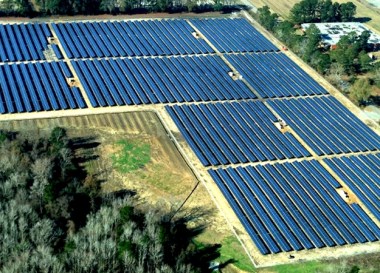
The McKenzie solar project (Strata Solar)
¶ Denmark-based DONG Energy said it plans to build a wind farm with up to 100 wind turbines and capable of generating as much as 1,000 MW of electricity on a leased site, south of Martha’s Vineyard, that the federal government put up for bid in January for development of offshore wind power. [Martha’s Vineyard Times]
¶ A sweeping plan to regulate development of renewable energy in Southern California deserts designates 388,000 acres for potential solar, wind and geothermal plants and millions more acres for conservation and recreation. Much of it is along Interstate 10 west of Blythe near the Arizona border and in Imperial Valley. [Manteca Bulletin]
¶ An Entergy spokesman, speaking of the decision to close the FitzPatrick nuclear plant near Oswego, New York, said “This decision, we view it as a final decision.” He went on, “It’s one the company made reluctantly, because the plant is very well run. It’s just not economically viable.” Operating the plant has cost $60 million. [WRVO Public Media]
 geoharvey
November 12, 2015 at 2:22 pm
Reblogged this on nuclear-news.