
Opinion:
¶ “The fantasy of cheap, safe nuclear energy” Back in the 1970s and 80s, solar and wind energy were expensive and were criticised by the nuclear industry for dreaming of a renewable energy future. Nowadays countries are on their way to their targets of 80%-100% renewable electricity while global nuclear energy fails to grow. [InDaily]
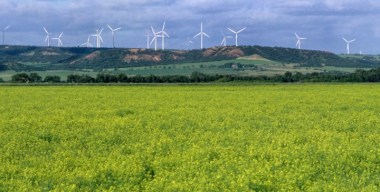
Australia’s national electricity market could be operated 100 per cent on renewable energy, argues Mark Diesendorf. AAP image
World:
¶ Jan De Nul Group has won an order to produce and install the foundations for the 50 MHI Vestas turbines and the high-voltage substation at Belgium’s 165-MW Nobelwind offshore wind farm. The project will be the first offshore wind job for the group’s newly acquired offshore jack-up heavy lift vessel, Vidar. [SeeNews Renewables]
¶ A VW engineer warned the company about cheating over its emission tests as early 2011, a German newspaper reports. Separately, Bild am Sonntag said the internal inquiry had found that parts supplier Bosch had warned Volkswagen not to use its software illegally. VW said they would not comment on “newspaper speculation.” [BBC]
¶ In a surprise announcement, Royal Dutch Shell said it would end exploration off Alaska “for the foreseeable future.” Shell said it did not find sufficient amounts of oil and gas in the Burger J well to warrant further exploration. The company has spent about $7 billion on Arctic offshore development in the Chukchi and Beaufort seas. [BBC]
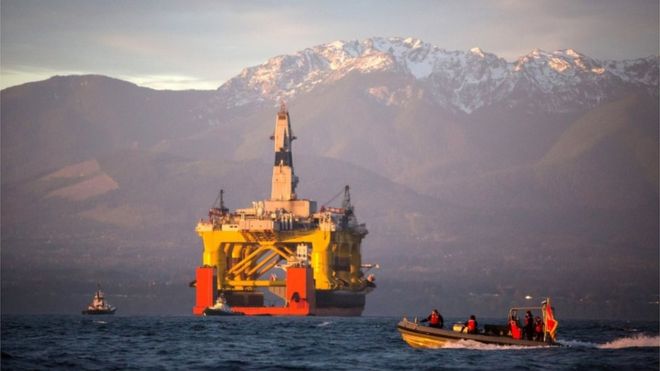
Off-shore oil rig.
¶ Industry body Scottish Renewables has taken steps to complement the country’s growing renewables sector with a new Storage Network. The Network aims to revolutionise the way that energy is stored through the use of storage technologies such as batteries, electric vehicles, flywheels, supercapacitors, hydrogen and hydro. [edie.net]
¶ Jacking up Alberta’s carbon tax is the best way to reduce the province’s greenhouse gas emissions from power generation, says a government-funded analysis obtained by The Canadian Press. Charging large emitters up to $50 a tonne for carbon emissions – an almost 70% increase – would produce the best result, according to the report. [Stockhouse]
¶ The US Trade and Development Agency awarded a grant to NextGen Solawazi Limited to support the development of a 60-MW solar photovoltaic power plant in Shinyanga, a city in northwestern Tanzania. The project is critically important to Tanzania’s economic growth as only 15% of its population has access to electricity. [Your Renewable News]

Why Are Customers Ditching the Big Six Energy Companies?
¶ A new green energy scheme, Clean Energy Switch, was launched earlier this month and attracted tens of thousands of British households to ditch the Big Six energy companies in the first 48 hours. More than 42,000 homes signed up for the scheme, which will use collective bargaining for affordable renewable energy. [International Environmental Technology]
¶ One of the UK’s biggest food manufacturers is turning to the power of the potato as it seeks new sources of energy to run its factory. 2 Sisters Food Group has installed a £50 million anaerobic digester to produce 3,500 MWh per year. Waste ranging from potato peelings to damaged cottage pies will be used in the five-story plant. [Financial Times]
¶ More than 70% of the nuclear fuel in one of the reactors at TEPCO’s Fukushima Daiichi nuclear power plant is highly likely to have melted in the wake of the massive 2011 earthquake and tsunami, according to a research team at Nagoya University. The team used special film that can detect muons, which bounce off uranium. [The Japan Times]
US:
¶ Twenty-one new hydroelectric projects that will utilize already-existing dam infrastructure in Ohio, West Virginia, Indiana, Pennsylvania, and Mississippi, are set to be developed, following closure of a senior loan facility between Free Flow Power New Hydro and Crestline Investors. They are expected to produce over 200 MW. [CleanTechnica]
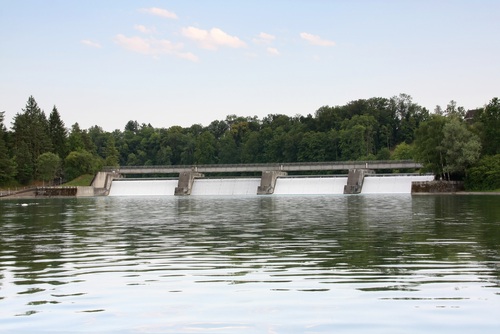
Many small dams already in place can be developed for power generation.
¶ Fourteen US mayors made a historic commitment last week to take action to reduce climate risks and protect the future of their communities. The mayors, many from the Midwest, signed the The Path to Positive Proclamation to pledge their leadership, prepare for climate change, and promote solutions that advance prosperity. [CleanTechnica]
¶ More than 4 million tons of New Jersey’s biomass, fuel derived from organic materials like plants and waste, could be used to produce electricity or propel transportation each year. The resource, largely underutilized, could help the state achieve important policy goals, including reducing dependence on fossil fuels. [NJ Spotlight]
¶ Four wineries in New York’s Finger Lakes region are working together to turn to solar power. Each winery has its own collection of solar panels, which, depending on the winery, are designed to produce 50% to 100% of their electrical needs. The systems range from 51 kW to 250 kW, and total 472 kW. [Rochester Democrat and Chronicle]
 geoharvey
September 29, 2015 at 5:06 pm
Reblogged this on nuclear-news.