
World:
¶ Australians in Melbourne have been negotiating for four years with various government bodies of the state of Victoria for an entirely solar-powered tram network in Melbourne. The network would be the world’s largest, and it would make the capital city of Victoria become a world environmental leader. [CleanTechnica]
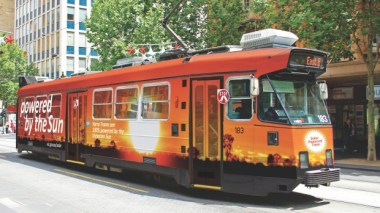
Digital visualization by Australia Solar Group.
¶ Ben van Beurden, the chief executive of Shell, has endorsed warnings that the world’s fossil fuel reserves cannot be burned unless some way is found to capture their carbon emissions. The oil boss has also predicted that the global energy system will become “zero carbon” by the end of the century. [The Guardian]
¶ Over 2,000 business leaders, political leaders, and senior climate negotiators at the Business & Climate Summit pledged to lead a global transition to a low-carbon, climate-resilient economy. The question is “who will lead?” Policymakers call for business leadership, and business leaders call for well-founded policy. [CleanTechnica]
¶ Vestas has confirmed industry reports that it has signed on as supplier for an offshore project in the UK with a potential to be up to 970 MW. Navitus Bay Development Limited will receive up to 970 MW of Vestas V164-8.0 turbines, in a contract that may be worth an estimated £1.6 billion, or $2.5 billion. [CleanTechnica]
¶ How large are global energy subsidies? The answer: quite a lot larger than we thought, according to new estimates from the International Monetary Fund. They say subsidising fossil fuels costs an enormous $5.3 trillion a year, or around $10 million a minute. The fund says the figures are “extremely robust.” [CleanTechnica]
¶ Japan’s nuclear regulator has approved Kyushu Electric Power Company’s ‘construction plan’ for unit 2 of its Sendai nuclear power plant. The company hopes to restart unit 1 of the plant in July, with unit 2 following within months. New safety requirements meant the reactors needed greater security. [World Nuclear News]
¶ Inspections of containers holding contaminated water at the Fukushima Daiichi nuclear power plant found that at least 10% have leaks, which could trigger a hydrogen explosion. The owner, TEPCO, reported its findings at a meeting with a study group from the Nuclear Regulation Authority on May 22. [Asahi Shimbun]
US:
¶ According to a recently released report by the North Carolina Clean Energy Technology Center, grid parity was coming much quicker than expected. It has already been met in six major cities, and in 2017 the population at parity is likely to be 71 million instead of the 51 million projected in 2012. [CleanTechnica]

Hoboken. Photo by Jawny80. Wikimedia Commons.
¶ Since hurricane Sandy, New Jersey utility PSE&G has made significant investments to harden the grid in Hoboken. Even so, the City of Hoboken is exploring the possibility of building a microgrid for the community, to support critical facilities and the most vulnerable residents, should the grid go down. [CleanTechnica]
¶ Citing financial risks of climate change and carbon-intense coal assets, shareholders with billions of investment dollars voted in favor of carbon reduction targets at FirstEnergy and Great Plains Energy, showing strong support for of shareholder proposals put forth a non-profit and an investment group. [IT Business Net]
¶ UPS recently announced an agreement to purchase renewable natural gas for its delivery vehicle fleet from Clean Energy Fuels Corp, making it the largest user of RNG in the shipping industry. UPS has a goal of driving one billion miles using its alternative fuel and advanced technology fleet by the end of 2017. [Justmeans]
¶ West Warwick is on the path to becoming the first community in Rhode Island that uses renewable energy to offset all of the electricity used by its municipal and school facilities. Town voters approved issuing $18 million in bonds to pay for three large wind turbines that would be installed on private land. [The Providence Journal]
¶ Following their ambition always to be that little bit different, the guys at Intel decided to build a mini wind farm on the rooftop of their headquarters in Santa Clara, California. A micro-turbine array is being installed. It is comprised 58 wind turbines, each just under 7 ft (~2m) tall, and weighing 30 pounds (13 kg). [The Green Optimistic]
 geoharvey
May 26, 2015 at 4:39 pm
Reblogged this on nuclear-news.