
Science and Technology:

Solar Impulse 2 during its landing
¶ Pilots of the world’s first circumnavigating solar plane, which landed in Ahmedabad on Tuesday, are now preparing for the most challenging legs of their journey crossing the Pacific and Atlantic oceans. Stopping in a number of places, they will fly the solar-powered aircraft across the Pacific and Atlantic oceans. [Mid-Day]
World:
¶ Figures from the China Electricity Council indicate that non-fossil fuel sources of energy accounted for more than a quarter of the country’s electricity generation in 2014. China’s total generation reached 5550 TWh in 2014; non-fossil fuel generation was 1420 TWh, rising by 19.6% year-on-year. [CleanTechnica]

Taro Kono in a 2011; Bloomberg News file photo.
¶ Japanese ruling-party lawmaker Taro Kono, a longtime critic of nuclear power, is using a document privately prepared for the Environment Ministry by Mitsubishi Research Institute to encourage the government to set a more ambitious target for renewable energy, a 30% goal by 2030. [Wall Street Journal]
¶ Renewable development and management company Enel Green Power announced that it had commenced construction of three solar PV plants in South Africa. The Aurora, Paleisheuwel and Tom Burke PV plants, located in different areas across the country, will have a combined generation capacity of 231 MW. [ESI Africa]
¶ A project in the Australian Outback that will more than double the country’s large-scale solar output should begin generating its initial power as early as this week, according to First Solar Inc. The Nyngan solar plant in New South Wales state will start at 25 MW before increasing to full capacity of 102 MW. [Bloomberg]
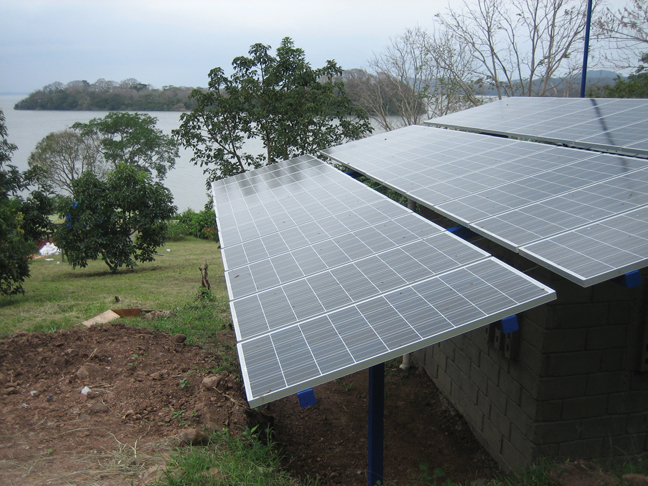
Solar panels in Nicaragua. Photo by Max L. Lacayo. Downloaded from Wikimedia Commons.
¶ Nicaragua produces no oil, but is a land of fierce winds, tropical sun and rumbling volcanoes. In other words, it’s a renewable energy paradise. Now it’s moving quickly to become a green energy powerhouse, and the vast majority of Nicaragua’s electricity will come from hydroelectric, geothermal, and wind. [NPR]
¶ The European Union continues to march toward its renewable energy goals for 2020, but some countries aren’t content to wait until then to meet their targets. Newly released data show that four countries, Sweden, Bulgaria, Estonia and Lithuania, have met their renewable energy target ahead of schedule. [Climate Central]
¶ Independent Electricity System Operator has launched a 565-MW renewable energy request for proposals, approved by Canadian Wind Energy Association. This will include the launch of 300 MW of wind energy. It is the first of three RFPs under IESO’s Large Renewable Procurement competitive process. [Greentech Lead]
¶ China is reviving growth of its nuclear power industry with approval of its first new project in two years. The Cabinet’s planning agency approved construction of two additional reactors at a power plant in the northeastern province of Liaoning, a unit of state-owned China General Nuclear Power Corp said. [Asahi Shimbun]
US:
¶ Concluding their US Solar Market Insight, 2014 Year-in-Review report, the authors from GTM Research and the Solar Energy Industries Association predict that installations will increase 31% in 2015, reaching 8.1 GW by the end of the year, with fastest growth coming from the residential sector. [CleanTechnica]
¶ As part of the US Solar Market Insight, 2014 Year-in-Review report, the authors provided national solar PV system pricing. Solar system costs fell by 9–12% over the course of 2014, depending on market segment. Total costs for utility-scale and large commercial-scale systems fell below $2.00/W DC. [CleanTechnica]
¶ If solar energy gained widespread use in Maine it would have a greater total value than conventional power generation, according to a state-sponsored study that analyzes the costs and benefits of generating power from the sun. The report also said that solar power would help lower costs at peak demand times. [Press Herald]
¶ Connecticut regulators Wednesday signaled they won’t shut down Vermont utilities’ sale of renewable energy credits to power companies in Connecticut, especially if Vermont passes changes to its renewable energy program now pending in the Legislature. House Bill 40 has passed and is before the Senate. [Rutland Herald]
¶ A bill moving through the New Mexico Legislature would remove higher renewable-energy requirements for utilities in the state in the future. House Bill 445 would roll back the requirement that 20% of retail sales for public utilities come from renewable-energy sources by 2020, to the current level, 15%. [Public News Service]
¶ What Michigan’s staunch conservatives want is a commitment to continue moving power production to green sources such as wind and solar at the rate of 1% to 1.5% a year; encouragement of micro-grids powered by solar panels and windmills, and a reduction in reliance on out-of-state fuel sources, namely coal. [The Detroit News]

Giant miscanthus, photo by Kreg8, downloaded from Wikimedia Commons
¶ Biomass industry leader, Repreve Renewables LLC, has been chosen to provide the agricultural and business development services for the University of Iowa’s Biomass Fuel Project. This project will reduce the use of coal, all part of the university’s sustainability goal of 40% renewable energy in 2020. [Biomass Magazine]
 geoharvey
Leave a comment