Archive for the 'solar' Category
March 12, 2017
World:
¶ India’s solar generating capacity saw a multi-fold surge, as it crossed the 10,000 MW mark on March 10, 2017. It stood at 2,650 MW in mid 2014. Crossing the 10-GW milestone is a stepping stone to a goal of 100 GW solar power capacity by 2022. India is to bring its overall renewable energy generating capacity to 175 GW by 2022. [The Dollar Business]
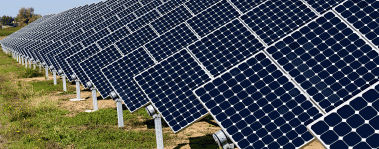
Tracking solar system
¶ Tesla’s Elon Musk may have put large scale battery storage on the national agenda with his offer to solve South Australia’s power crisis for free if he did not deliver a large system with 100 days of signing a contract. Both the Prime Minister and South Australia’s Premier are looking for more details on the offer. [The Sydney Morning Herald]
¶ A meeting this month will look at whether Guelph, Ontario, should join 1,000 communities worldwide that have declared their intent to have 100% renewable energy by 2050. The venue has been changed to meet the registration demand. Solar power generation in Guelph, with a demand of 300 MW, has already reached 11 MW. [GuelphMercury.com]

Rooftop solar system in Guelph
¶ Thousands of citizens took to the streets in Taiwan demanding that nuclear plants close and that citizens be allowed to be involved in decisions on radioactive waste storage. Over 60 anti-nuclear groups rallied in the anti-nuclear demonstrations, and they advocated moving toward adopting more sustainable forms of energy. [ETEnergyworld.com]
¶ The European Bank for Reconstruction and Development is to provide a financial injection aimed at developing the Greek renewable energy sector. EBRD is to provide €300 million ($318 million) in funding for renewable energy projects in Greece, aimed at mobilizing investment and commercial financing. [Power Engineering International]
¶ Former Japanese Prime Minister Junichiro Koizumi repeated his call for Japan’s complete departure from nuclear energy as the country marked the sixth anniversary of the Fukushima Disaster. “Nuclear power plants will become a negative legacy for future generations,” Koizumi said at an event organized by a civic group in Sapporo. [The Mainichi]
¶ The South African government lost the country’s first climate change lawsuit. The high court ruled against its plans for a coal-fired power station, the latest in a rising tide of international climate litigation. EarthLife Africa challenged the government’s approval of the proposed Thabametsi coal-fired power station. [Yahoo News]

Cooling towers in fog at Cape Town (Reuters)
US:
¶ EPA Administrator Scott Pruitt’s phones have been ringing off the hook since he questioned the link between human activity and climate change. The calls to Pruitt’s main line, 202-564-4700, reached such a high volume by Friday that agency officials created an impromptu call center, according to three agency employees. [Salt Lake Tribune]
¶ When it comes to the adoption of solar power, K-12 schools across the US are leading the way. While less than one percent of all US homes, businesses, and government agencies rely on solar energy, the 3,700 schools around the country with solar installed represent nearly three percent of the all of K-12 schools in the country. [Times of San Diego]

California school parking lot (Courtesy Alta Energy)
¶ Kansas Electric Power Cooperative Inc built Prairie Sky Solar, a 1-MW solar facility near Andover. Mark Barbee, KEPCo’s vice president of engineering, explained that the solar system will not cause energy rates to increase because costs of solar power have declined. He said it “gave us the experience and gets us exposure to solar.” [Topeka Capital Journal]
¶ Colorado energy provider Holy Cross Energy is planning its largest solar-power project. The company, which provides electricity for much of the Roaring Fork Valley and most of Eagle County, issued a request for proposals for a solar generation facility that could provide enough renewable energy to power about 600 homes. [Aspen Daily News]
geoharvey is free and without ads.
 geoharvey is not tax-deductible.
Posted in nuclear power, renewable power, solar, wind | 1 Comment »
Tags: nuclear, nuclear power, renewable power, solar power, wind power
March 11, 2017
Science and Technology:
¶ The rate of ocean warming has nearly doubled since 1992 compared with the previous three decades. And the warming has reached deeper waters, scientists reported Friday. The findings are important because the world’s oceans provide one of the best records of the excess energy trapped on Earth by increased greenhouse gases. [InsideClimate News]
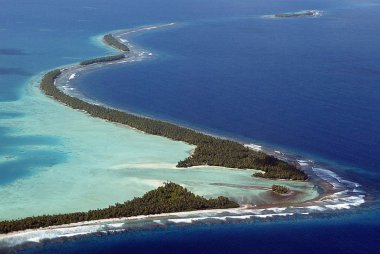
Ocean environment at risk
(Credit: Torsten Blackwood / AFP / Getty Images)
¶ Climate change may be increasing the footprint of Lyme disease. Higher temperatures encourage the reproduction of mice, which are both natural reservoirs for the bacteria that cause Lyme disease and carriers of the ticks that spread the infection to humans. People also spend more time out doors, increasing exposure risks. [Huffington Post]
World:
¶ A unanimous vote of the Ottawa city council approved a proposal to build a new cross-town rapid transit corridor. The system will start with 24 new stations along Baseline and Heron roads. The stations are to be built about 600 meters apart. The goal is to make cross-town travel more convenient and faster on mass transit than driving. [CleanTechnica]

Rapid transit corridor (City of Ottawa)
¶ The Netherlands’ PV market has probably set another growth record in 2016. The country is expected to have installed around 525 MW of PV installations last year, according to provisional figures. If this is confirmed, the country’s cumulative PV capacity will have reached about 2,040 MW as of the end of December 2016. [pv magazine]
¶ The next UK government auction setting prices for new renewable power projects will open in April. Clark MacFarlane, managing director for offshore wind for Siemens, said it could see offshore wind costs fall below new nuclear. The cost of producing electricity from UK offshore wind farms has fallen 32% in the past four years. [Yahoo Finance]

British offshore wind power (Reuters / Toby Melville)
¶ Researchers at Lappeenranta University of Technology in Finland say that major oil-producing countries in the Middle East and North Africa region could use renewable energy resources to develop lucrative energy systems within two decades. Iran could benefit financially from a transition to a fully renewable electricity system by 2030. [CleanTechnica]
¶ The UK’s first domestic vehicle-to-grid unit was installed at a home in Loughborough to research the potential for hooking up electric vehicle batteries to the national electric system. Cenex, the UK’s Centre of Excellence for low carbon and fuel cell technologies, said it is the first car-to-grid bi-directional charging. [www.businessgreen.com]
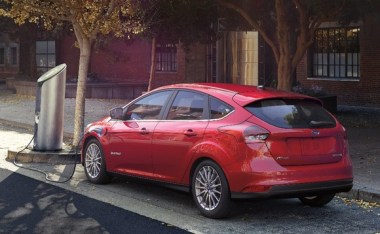
Electric car charging
¶ Saturday, March 11, 2017 marks the sixth anniversary of the Fukushima Disaster. It’s staggering to learn that more than 70,000 people still have not gone home due to contamination concerns and that clean-up efforts at the nuclear facility continue to fail while the price tag rises, with some estimates nearing $200 billion. [Clean Energy News]
US:
¶ A proposed White House budget for NOAA could put coastal communities around the nation at a major disadvantage as they struggle to adapt to threats from sea-level rise, severe storms and other climate-related events, scientists and other experts said. Many of the coastal communities are in states that voted for Trump. [The Providence Journal]

Abandoned house in Cedarville, New Jersey
(Bloomberg / Christopher Goodney)
¶ Volkswagen has pleaded guilty to three charges, conspiracy to commit fraud, obstruction of justice, and entry of goods by false statement, as part of a $4.3 billion agreement with the US regulators over the diesel emissions scandal. VW general counsel Manfred Doess said the criminal acts occurred in both Germany and the United States. [BBC]
¶ Wastewater and drinking water treatment plants are usually major energy hogs. So when St Cloud, Minnesota, wanted to trim utility bills, it took look at a wastewater treatment plant. Now solar panels and methane gas from a digester are used to produce electricity. And other cities are paying attention. [Minnesota Public Radio News]
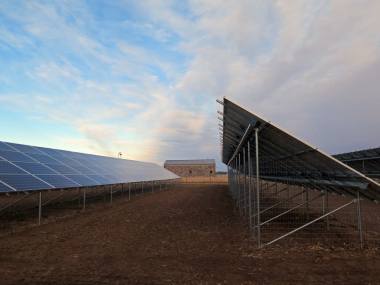
Solar panels at St Cloud (Kirsti Marohn | MPR News)
¶ An important committee of the New Mexico House of Representatives voted on a bipartisan basis to advance Senate Bill 227, which would require the state government to install solar energy panels on its 750 buildings, so long as it would provide a net savings on utility costs and not require any upfront costs. [Silver City Sun-News]
¶ Analysis by the Sierra Club’s Beyond Coal campaign backs up Michael Bloomberg’s assertion that the US will meet its climate commitments: Coal retirements and new clean energy through 2025 will reduce US carbon emissions by at least 437 million metric tons. That accounts for 60% of America’s commitments under the Paris agreement. [Triple Pundit]

Chicago is one of a number of US cities that have set climate goals. (Image credit: Pixabay – no attribution required)
¶ A new analysis of the US wind energy sector by Navigant Consulting could see the sector drive up to 248,000 jobs and $85 billion in economic activity over the next four years. Navigant believes that number will only increase, with 35,000 MW of new wind power capacity through 2020. And that is with Trump as president. [CleanTechnica]
¶ At an international energy conference held in Houston last week, Trump officials disparaged climate science. But the Saudi Arabian energy minister called on his colleagues to find ways to “minimize the carbon footprint of fossil fuels.” He was not alone, as he was joined by CEOs of ExxonMobil and Royal Dutch Shell in the position. [Houston Chronicle]
geoharvey is free and without ads.
geoharvey is not tax-deductible.
Posted in nuclear power, renewable power, solar, wind | 1 Comment »
Tags: nuclear, nuclear power, renewable power, solar power, wind power
March 10, 2017
Opinion:
¶ “What Is Wrong In Washington?” • Under the Donald Trump administration, the United States is like a train, running at high speed down a track, against a signal, on a collision course on climate change. The person at the throttle, blinded by incompetent arrogance of his advisers, is making every indication of increasing speed. [CleanTechnica]
¶ “Toshiba US nuclear power unit liquidation may flare into diplomatic dustup” • Toshiba is considering bankruptcy protection for Westinghouse in an apparent bid to eliminate risks of losses by canceling unfavorable contracts. But the US government guaranteed $8.3 billion in loans for Westinghouse reactors at Vogtle. [The Mainichi]
Science and Technology:
¶ Australia’s Great Barrier Reef is seeing an unprecedented second straight year of mass coral bleaching, scientists said March 10, warning many species would struggle to fully recover. The 2,300-km (1,400-mile) reef suffered its most severe bleaching on record last year due to warming seas during March and April. [Rappler]

Bleaching of the Great Barrier Reef (File photo: Ray
Berkelmans / Australian Institute of Marine Science / AFP)
World:
¶ After a series of blackouts in South Australia, Elon Musk said Tesla can help solve the state’s power crisis within 100 days. Asked on Twitter how serious he was about the offer, Mr Musk responded, “Tesla will get the system installed and working 100 days from contract signature or it is free. That serious enough for you?” [BBC News]
¶ Hundreds of radioactive wild boars moved into deserted towns after the Fukushima nuclear disaster. Now they scour the empty streets and overgrown backyards of the Namie town for food, an unexpected nuisance for those returning home from evacuation shelter six years after the meltdown. The boars have been known to attack people. [Voice of America]

Wild boar in Namie (Reuters image)
¶ Indian solar power generation costs are set to dip further during third and fourth quarter of 2017-18, helped by expected softening of interest rates and a drop in solar panel prices due to a supply glut in the market, analysts say. Average solar power prices are expected to become significantly lower than thermal power. [ETEnergyworld.com]
¶ A growing number of studies point to renewables as the most affordable and secure, in addition to environmentally-friendly, options for energy in Australia. One says wind and solar would contribute an estimated 90% of Australia’s total electricity demand, with hydroelectricity and biomass supplementing for the remaining 10%. [Climate Action Programme]

Renewable power in Australia
¶ All of Japan’s nuclear power plants were shut down for safety checks after the Fukushima Disaster. Six years later, only three of 45 operable reactors are online: Kyushu Electric’s Sendai 1 and 2, and Shikoku Electric Power Co’s Ikata 3. Two of Kansai Electric’s reactors were restarted but were idled by a court injunction. [POWER magazine]
¶ The Kincardine Offshore Windfarm, which will feature eight floating turbines, will support the creation of about 110 jobs during assembly, installation and maintenance, and could power over 50,000 homes. Planning consent for the development was granted and announced by Holyrood’s minister for business, innovation and energy. [Energy Voice]

Kincardine Offshore Windfarm from the north-east coast (If you click on the image to enlarge it, you can see the turbines.)
US:
¶ EPA chief Scott Pruitt has said he “would not agree” carbon dioxide is a primary contributor to global warming. He told CNBC that measuring human impact on the climate was “very challenging” and there was “tremendous disagreement” about the issue, contradicting his own agency’s findings on greenhouse gas emissions. [BBC News]
¶ The Hawaiian island of Kauai is now home to the largest integrated solar and battery facility in the world. The 52-MWh Tesla Powerpack plus SolarCity solar farm is the first utility scale solar-plus-battery storage system of its kind. It will bring Kauai Island Utility Cooperative’s renewable energy generation to more than 40%. [Thegardenisland.com]

Commissioning ceremony at a Hawaiian solar farm
(Dennis Fujimoto / The Garden Island)
¶ Vermont state regulators have proposed new sound limits for wind turbines. Some renewable energy proponents say they would effectively ban most new wind turbines and may preventing the state from reaching its renewable energy goals. The rules say turbines could produce no more than 35 decibels at night, measured outside nearby homes. [vtdigger.org]
¶ According to new figures published today by GTM Research and the Solar Energy Industries Association, the US solar market installed a total of 14,762 MW of solar PV in 2016, nearly doubling the 7,501 MW installed in 2015. This set the stage for what analysts expect could be a tripling over the next five years. [CleanTechnica]

Colorado Court Affordable Housing, Santa Monica, California
(Photo: CalderOliver, Wikimedia Commons)
¶ The Las Vegas Review-Journal reports that GTM Research and the Solar Energy Industries Association told legislators that Nevada more than doubled its solar capacity over the course of 2016. The Nevada Legislature is considering increasing the state’s renewable portfolio standard to 50% by 2030 and 80% by 2040. [Elko Daily Free Press]
¶ The US will meet its climate agreement goals, UN special envoy for climate change Michael Bloomberg said in Paris. President Trump’s team is reportedly divided over whether the US should withdraw from the Paris climate accord, negotiated under Barack Obama. Bloomberg said he hopes Trump will be a leader on the issue. [Rappler]
geoharvey is free and without ads.
geoharvey is not tax-deductible.
Posted in nuclear power, renewable power, solar, wind | 1 Comment »
Tags: nuclear, nuclear power, renewable power, solar power, wind power
March 9, 2017
Opinion:
¶ “The business benefits of using renewable electricity” • The business sector is the largest consumer of power in the UK, buying around 56% of the electricity. Even a modest switch to renewable power could take a big step towards the government’s 2020 renewable target, and the switch can produce savings that outweigh the cost. [Telegraph.co.uk]
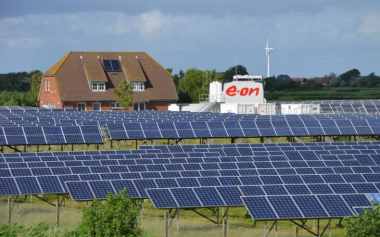
Eon solar farm
Science and Technology:
¶ According to the energy market analysis firm RepuTex, “clean” coal technologies will not be commercially viable before 2030 without government subsidy. In Australia, the rising price of gas, coupled with the falling cost of energy storage, has made renewable energy the least expensive source of reliable power generation. [The Guardian]
World:
¶ Just months after launching its residential battery storage offering in Australia, Germany battery maker Sonnen has introduced a household solar and storage deal that threatens to disrupt the traditional retail electricity model. The deal offers free power to households using the company’s integrated solar and storage system. [CleanTechnica]

Sonnen battery (Sonnen image)
¶ The Australian energy market is set for a major shake-up with the launch of a major new government-backed initiative to create an open marketplace, the Decentralised Energy Exchange, for locally generated and stored rooftop solar power to be traded between households, businesses, communities and network utilities. [CleanTechnica]
¶ Apple announced that supplier Ibiden has committed to using 100% renewable energy to manufacture Apple components, the first partner to do so in Japan. To meet the renewable energy promise, Ibiden will invest in over 20 new facilities, including a floating “island” solar photovoltaic system at a converted lumber yard. [ZDNet]

Floating solar array (Apple image)
¶ With lower costs for solar power, the Nigerian government is considering a $30 million allocation for off-grid solar projects. According to a report in Bloomberg solar panels are an “economic option” for cutting fuel costs in Nigeria, compared to the small diesel generators that currently form the backbone of off grid power generation. [CleanTechnica]
¶ TenneT TSO BV (Netherlands), Energinet.dk (Denmark) and TenneT TSO GmbH (Germany) will sign a trilateral agreement that will press ahead on developing a large renewable European electricity system in the North Sea. Central to the plan is the construction of one or more islands in the middle of the North Sea at Dogger Bank. [Windtech International]
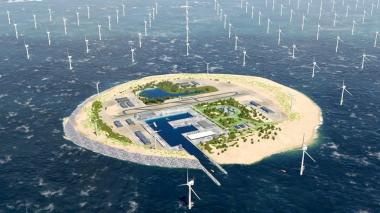
Power link island
¶ Work could start next year on a £160 million hydro power plant in Llanberis, Gwynedd, Wales, its developers have said. The Snowdonia Pumped Hydro project received consent from the UK Planning Inspectorate. Abandoned slate quarries, Glyn Rhonwy and Chwarel Fawr, will be turned into pumped storage reservoirs. [BBC News]
¶ Globally, solar power capacity has reached 305 GW spurred largely by increasing demand in China and the US. In 2016, installations of new solar PV capacity increased 50%, from 51.2 GW in 2015 to over 76 GW. The 305 GW of installed solar capacity worldwide represents a great increase from just 50 GW in 2010. [Climate Action Programme]
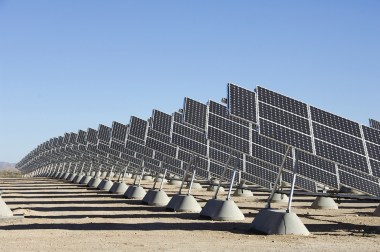
Solar panels at Nellis air force base
¶ A growing crisis in the Australian electricity market led to wholesale power prices more than doubling in a year, to at least twice what they were under the much-maligned carbon price. Analysis by the University of Melbourne’s Climate and Energy College said it nearly tripled in coal-reliant Queensland and New South Wales. [Daily Advertiser]
¶ Across Europe, the price of building an offshore wind farm has fallen 46% in the last five years, 22% percent last year alone. Costs now average $126/MWh, according to Bloomberg New Energy Finance. That’s below the $155/MWh price for new nuclear developments in Europe and closing in on the $88/MWh price tag on new coal plants. [Bloomberg]

Block Island wind turbine (Photo: Eric Thayer / Bloomberg)
US:
¶ In Hawaii, the Kauai Island Utility Cooperative is now drawing energy from 272 Tesla power packs to provide electricity after dark. The Tesla’s power packs are expected to save KIUC 1.6 million gallons of diesel fuel annually, cutting costs from 15.5¢/kWh to a price fixed at 13.9¢/kWh for the next 20 years. [South China Morning Post]
¶ Georgetown, Texas, is now one of the first cities in the US to run on 100% renewable energy. The milestone is met after the city ended a long-term power contract in 2012, and found new options from power suppliers in West Texas and the Panhandle that would provide renewable energy, such as solar and wind power. [Austin American-Statesman]

Georgetown (Photo: Georgetown CVB)
¶ A new report from the Environment America Research & Policy Center says US colleges and universities can be leaders for a transition to 100% renewable energy. The report, “Renewable Energy 100: The Course to a Carbon-Free Campus,” cites a number of factors that make educational institutions suited to lead the country’s efforts. [Solar Industry]
¶ Westinghouse Electric Co LLC, the US nuclear power plant developer owned by troubled Japanese electronics giant Toshiba Corp, has brought in bankruptcy attorneys from law firm Weil Gotshal & Manges LLP, people familiar with the matter said. The move comes after a $6.3 billion write-down at Westinghouse. [The New Indian Express]
geoharvey is free and without ads.
geoharvey is not tax-deductible.
Posted in nuclear power, renewable power, solar, wind | 1 Comment »
Tags: nuclear, nuclear power, renewable power, solar power, wind power
March 8, 2017
Opinion:
¶ “This Is Why Winter Is Important” • In normally cold regions, the record-setting heat – and the opportunity to wear shorts and drink iced tea in February – might seem like a blessing. But for the ecosystems we depend upon, the shortened winter threatens turmoil. Climate change is causing what is called “season creep.” [CleanTechnica]
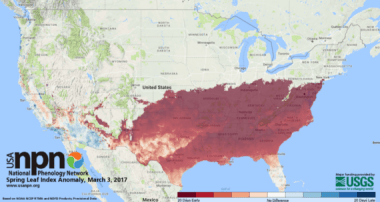
Plants are regrowing leaves weeks ahead of schedule.
(Source: National Phenology Network)
¶ “Reasons for Japan to dump nuclear power more obvious now than ever” • It has been nearly six years since three reactors melted down at the Fukushima Daiichi nuclear plant. The disaster has stolen so much from so many, and it is clear that real recovery will be a decades-long struggle with reconstruction and decommissioning. [The Mainichi]
¶ “Why US corporations are buying into home-grown wind power” • North Carolina first commercial-scale wind farm is just one example of a broader shift to wind power and clean energy across corporate America in recent years – including a host of leading companies that you’ve probably heard of before. [Windpower Engineering]

Please click on the image to enlarge it.
¶ “Trump’s Sisyphean Coal Revival Requires A Battle With The Free Market” • The US coal sector was in free fall when Donald Trump was elected president. Now he’s vowing to turn it around. Unfortunately for coal, government regulations have very little to do with coal’s problems. King Coal us up against natural gas and wind power. [Forbes]
Science and Technology:
¶ Permafrost, or frozen soil, is rapidly collapsing across a 52,000 square mile area in northwest Canada – about the size of the entire state of Alabama. New research from the Northwest Territories Geological Survey finds the permafrost thaw is intensifying, a dramatic disintegration that could speed up climate change. [Inhabitat]

Permafrost collapse
¶ Australia has seen one weather record broken after another over this summer. Now scientists have confirmed what anyone who lived through the heat knows to be true – climate change is driving hotter and longer summers. They are becoming “the new normal”, with worse to come unless tough decisions are made. [The Sydney Morning Herald]
World:

Hornsdale wind farm
¶ French renewable energy firm Neon completed financing of the 109-MW Hornsdale 3 wind farm, now being built in South Australia. It signed an agreement last year with the Australian Capital Territory to provide electricity at $73/MWh for 20 years. The company has plans to install 1,000 MW of wind and solar facilities across Australia. [CleanTechnica]
¶ Australian solar power is headed for a “huge year” in 2017, on the back of a boom in the large-scale market and a home solar and storage market, a report said. In fact, the market is expected to treble. The Climate Council’s State of Solar 2016 said solar is now the cheapest form of new large-scale power generation. [CleanTechnica]
¶ According to Carbon Brief, a UK-based site dedicated to covering climate science, climate policy, and energy policy, UK CO2 emissions fell by 5.8% in 2016, putting the country’s overall emissions around 36% below 1990 levels. The drop was partly due to a massive fall in coal use, which was down 52% in 2016 alone. [CleanTechnica]
¶ The Australian government needs to put a price on carbon to unlock new investment in the electricity sector and drive an orderly transition to low-emissions power sources, according to the Investor Group on Climate Change. The group represents major institutional investors in Australia and New Zealand. [The Guardian]
¶ Pattern Energy Group has closed C$263 million in project financing for the 147-MW Mont Sainte-Marguerite wind farm in Quebec. The Mont Sainte-Marguerite wind farm, which is about 50 km south of Québec City in the Chaudière-Appalaches region, will consist of 46 Siemens 3.2-MW direct drive wind turbines. [reNews]

Meikle wind farm (Credit: Pattern Energy)
US:
¶ A Bloomberg report says that, Consol Energy, a Pennsylvania-based energy producer that has billed itself as “one of the largest independent natural gas exploration, development, and production companies,” has hired advisers from Credit Suisse Group AG and Bank of America Corp in an effort to move ahead on divesting its coal business. [CleanTechnica]

Blue Creek Wind Farm in Van Wert, Ohio (Plain Dealer file)
¶ The Republican majority in the Ohio House is moving again to get rid of the state’s renewable energy rules. In a bill sponsored by a Cincinnati Republican, the House would make voluntary the mandates that now require power companies to generate or buy and sell a percentage of power from wind, solar and other renewable technologies. [cleveland.com]
¶ State tax credits enacted in 2003 for renewable energy production have helped to create an industry in New Mexico, generating more than 11,000 jobs and $1.6 billion in economic activity, according to a new study. It says, “Taxpayers are getting a huge return on their investments …” The tax credits are set to expire in 2018. [Santa Fe New Mexican]
¶ The Arkansas congressional delegation introduced legislation that could effectively block construction of a new power line stretching from Oklahoma to Tennessee, potentially halting the $2 billion project. If approved, federal officials would need permission from state officials and Indian tribes to use eminent domain for transmission lines. [Arkansas Online]
geoharvey is free and without ads.
geoharvey is not tax-deductible.
Posted in nuclear power, renewable power, solar, wind | 1 Comment »
Tags: nuclear, nuclear power, renewable power, solar power, wind power
March 7, 2017
Opinion: Interview:
¶ “What Rural Alaska Can Teach The World About Renewable Energy” • In many remote Alaskan villages, the cost of electricity is the highest in the nation, reaching a wallet-emptying $1/kWh in some communities (the national average is 12¢/kWh). The price is due to the cost of hauling fossil fuels by plane or barge to these remote areas. [Ensia]
Alaskan renewable power (Photo © Adina Preston Photography)
World:
¶ More than 130,000 solar households in Victoria will benefit from a steep increase in their solar feed-in tariff in 2017/18, to a minimum 11.3¢/kWh for their exports back to the grid, up from 5¢/kWh currently. The new price is based on an increase in the wholesale costs, with 3.5¢/kWh added for network, climate and other benefits. [CleanTechnica]
¶ Solar firm WElink Energy, based in the UK, has signed an EPC agreement with China Triumph International Engineering and will develop a 220-MW solar plant in southern Portugal. The £200-million Solara 4 solar project, spread over 800 hectares in the region of Algarve, will produce enough energy for the equivalent of 200,000 homes. [PV-Tech]
¶ Norway is a country with a lot of oil and a relatively low solar radiation, in theory not an Eldorado for solar pioneers. Last year, however, the country’s PV market showed it first signs of real growth. Around 11 MW of new PV capacity was installed in Norway in 2016. The volume of new installations grew by 366% compared to 2015. [pv magazine]
¶ Mining and power firm NLC India is setting up a 5-MW floating solar PV plant in the Andaman and Nicobar islands. This comes as part of plans for an overall total of 50 MW solar deployment on the islands. The 5-MW of floating solar will be installed at the Kaplong Hydro Electric Project in North Andaman. [PV-Tech]
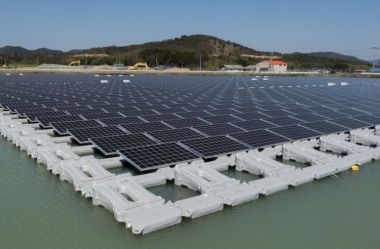
Floating solar array (Credit: Kyocera)
¶ The Zambian Government and a firm based in France, Neoen SAS, the preferred bidder under the Scaling-Up Solar Project, have completed negotiations on taxation, land provision and equity financing. Neoen SAS will construct a 100-MW solar power plant from the planned 500 MW under the Scaling-Up Solar Project. [AllAfrica.com]
¶ A £4.5 million investment will be used to create a solar farm on council owned land in Monmouthshire. The Welsh Government approved the repayable investment for the Oak Solar Farm in Crick, which could generate enough electricity to power around 1,400 homes, while saving 2,000 tonnes of carbon dioxide per year. [Free Press Series]

The Oak Solar Farm in Crick
¶ European regulators have cleared Hungary to expand its Paks nuclear plant. Doing so, they have approved a project that will extend Russia’s influence over the energy policy of a state that has actively promoted its interests within the EU. Budapest signed a €12 billion ($12.7 billion) deal for two reactors in 2014, to be built by Rosatom. [Voice of America]
¶ Senior executives from AGL Energy have given evidence at an inquiry in Melbourne that the main issue causing problems with reliable energy supply in South Australia is “dysfunction” in the gas market, not too many windfarms making the grid unreliable. Many witnesses blame a lack of a clear policy direction from Canberra. [The Guardian]
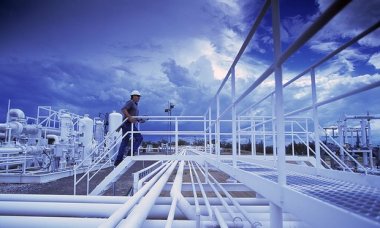
Queensland gas processing facility (Photo: AFP / Getty Images)
US:
¶ US electric car sales jumped approximately 68% in February 2017 versus February 2016. Fully electric car sales were up 74%, while plug-in hybrid sales were up 61%. One of the standout points this month is that the estimates for Tesla Model S and Model X sales put the two high-end EV models in first and second place. [CleanTechnica]
¶ Even in the red states of the US Great Plains, local leaders of communities of all sizes are already grappling with the issue of climate change. Though their actions are not always couched in terms of addressing climate change, their strategies can provide insights into how to make progress on climate policy under a Trump administration. [CleanTechnica]
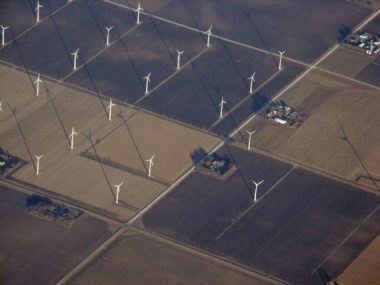
Wind power on farms (paytonc / flickr, CC BY-SA)
¶ After the federal government approved the Dakota Access pipeline last week, Catholics came together to call the project “morally unacceptable.” It’s not the first time the federal government dismissed the rights and health of the native American people. The Trump administration continues a federal tradition of oppression. [CleanTechnica]
¶ A number of major milestones occurred on the electric grid in 2016, almost all of them involving wind power. Now the Energy Information Administration is confirming that’s because of a big overall trend: wind power is now the largest source of renewable energy generating capacity, passing hydroelectric power in 2016. [Ars Technica UK]
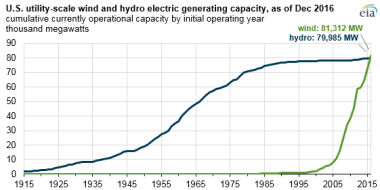
Please click on the image to enlarge it.
¶ The Virginia Department of Environmental Quality has unanimously approved Rocky Forge Wind’s “Permit by Rule” application, a wind project being developed by Apex Clean Energy in Botetourt County, Virginia. This marks the first PBR approval for a wind-power project in the Commonwealth of Virginia. [Windpower Engineering]
¶ Kentucky may lift a decades-old moratorium on nuclear power plants, with supporters of the move hoping to perhaps attract a smaller modular facility to the commonwealth to help diversify its coal-dominated generation fleet. Senate Bill 11 easily passed the full Kentucky Senate on a bipartisan 27-8 vote last week and has gone to the House. [Platts]
geoharvey is free and without ads.
geoharvey is not tax-deductible.
Posted in nuclear power, renewable power, solar, wind | 1 Comment »
Tags: nuclear, nuclear power, renewable power, solar power, wind power
March 6, 2017
Science and Technology:
¶ A Reversible Solid Oxide Cell device uses electricity to split water into hydrogen and oxygen gas by a process more efficient than the technologies in current use. ReSOC is particularly interesting because the exactly same device can also be operated “in reverse” to produce power from the hydrogen it produced. [EETE Power Management]

Please click on the image to enlarge it.
World:
¶ Each year, environmental pollutants cost an estimated 1.7 million lives among children under 5, one in four deaths of children 1 month to 5 years old, according to World Health Organization reports released Monday. More than 90% of the world’s population is thought to breathe air that violates quality guidelines set by the WHO. [CNN]
¶ Abu Dhabi’s government-owned power utility aims to close a financing package for a 3.2 billion dirham ($872 million) solar power plant in April, a senior official at the utility said. The plant will be the world’s largest, with a capacity of 1,177 MW, and is expected to be operational in 2019, providing electricity for 2.42¢/kWh (US). [Utilities-ME.com]

Shams solar power station in Morocco
¶ More than 100 Canberra homes and businesses have installed battery storage systems through the ACT’s Next Generation Renewables Energy Storage Grants program. The program aims to see 5,000 energy storage systems installed by 2020, and provides discounts of around $2900 for an average home battery system. [Energy Matters]
¶ Blackouts were averted in South Australia after an incident that saw more than 600 MW of electricity generation capacity suddenly lost. A transformer at a power plant exploded, resulting in units at the Pelican Point Power Station tripping. The loss was taken up by power transmitted from Victoria, solar PVs, and wind generators. [Energy Matters]
¶ UK electricity and natural gas prices in February fell from winter highs as supply and demand concerns eased, according to S&P Global Platts data. Demand for natural gas from power stations fell to a six-month low on weaker electricity demand, while both nuclear and renewable energy generation picked up. [Hellenic Shipping News Worldwide]
¶ At the opening of the annual National People’s Congress, Chinese Premier Li Keqiang pledged to make the country’s smoggy skies blue again and “work faster” to address pollution caused by the burning of coal for heat and electricity. China’s middle class is growing increasingly vocal with greater awareness of the dangers of pollution. [CBC.ca]

Temple of Heaven park (Wang Zhao/AFP/Getty Images)
¶ MHI Vestas is looking to recruit 414 employees for its nacelle and blade manufacturing facilities in Denmark, almost doubling the workforce at the company’s Lindø and Nakskov factories. The recruitment drive follows the company’s production ramp up at its UK facility on the Isle of Wight, where it hired over 100 employees. [reNews]
¶ Wind turbines generated enough energy to cover two-thirds of Scotland’s total electricity consumption last month, according to industry figures. WWF Scotland described the WeatherEnergy data as “amazing progress” and urged politicians to maximise renewable opportunities. Wind power output increased 43% from February, 2016. [The Scotsman]
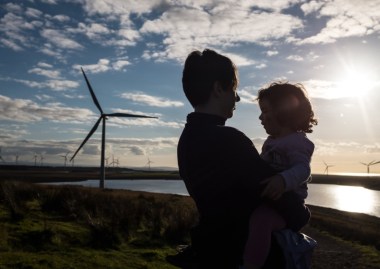
Wind power in Scotland (Photo: John Devlin)
US:
¶ California utilities are testing new ways to network solar panels and battery storage to create “virtual power plants” that manage green power and feed it into the power grid as needed. Solar farms in California create so much power during daylight hours that they often drive real-time wholesale prices in the state to zero. [The Australian]
¶ Scientists are warning that super floods and aging dams in the West could be a dangerous combination. An expert paleo-hydrologist of the University of Arizona found that floods much larger than any in recorded history are routine occurrences, and the historic record, which dates back only to the late 1800s, is inadequate for understanding risks. [Yahoo News]

Rushing water at the Oroville Dam
(Dale Kolke / California Department of Water Resources / Reuters)
¶ The Renewable Fuels Association has reported that President Trump will direct the EPA to make a big change to the country’s Renewable Fuel Standard (RFS). The change is one that has been long sought by refiners, who loathe the biofuel mandates that are in place, but it has been resisted by the country’s biofuel industry. [Forbes]
¶ One way or another, come next year, FirstEnergy Corp is getting rid of the Beaver Valley nuclear power station in Shippingport, Pennsylvania. It will shut down the 1,800-MW plant two decades ahead of schedule unless it can sell it. Selling it is a nonstarter unless legislators in Pennsylvania and Ohio give the plant a boost. [Pittsburgh Post-Gazette]
geoharvey is free and without ads.
geoharvey is not tax-deductible.
Posted in nuclear power, renewable power, solar, wind | Leave a Comment »
Tags: nuclear, nuclear power, renewable power, solar power, wind power
March 5, 2017
World:
¶ With the Irish Government in a race against time to avoid a potential €360 million fine from the EU for failing to hit renewables targets, 2017 looks set to be a defining year for the country’s energy sector. The EU’ s fine is €120 million for each 1% the country is below target, and the clock is ticking down on a 2020 deadline. [Irish Independent]

Irish wind power
¶ Starting this summer, Ontario’s Fair Hydro Plan would provide households with this 25% break in their electric bills. People with low incomes would receive even greater reductions to their electricity bills. As part of this plan, rate increases over the next four years would be held to the rate of inflation for everyone. [Cambridge Now!]
¶ Canadian company Northland Power has agreed to acquire the 252-MW Deutsche Bucht offshore wind farm in the German North Sea. Construction is due to start before the end of the year with full operations in 2019. Headline contractors have already been lined up with MHI Vestas supplying and installing V164 turbines. [reNews]
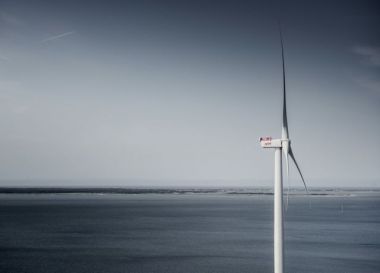
Vestas V164 wind turbine (image: MHI Vestas)
¶ Armed factions are fighting for control of oil terminals in the east of Libya. Four oil terminals in the area provide much of the country’s export income. Libya remains regionally split, with two opposing centers of power, but there are also numerous rival armed groups that neither of the country’s rival governments controls. [BBC]
¶ India’s Central Electricity Authority expects coal-fired power generation to grow 4.05% in 2017-2018. The authority advised, however, that all coal-based thermal power plants need to brace for drastic fall in capacity utilization, to as low as 48% by 2022, as additional non-thermal electricity generation capacities come on stream. [ETEnergyworld.com]
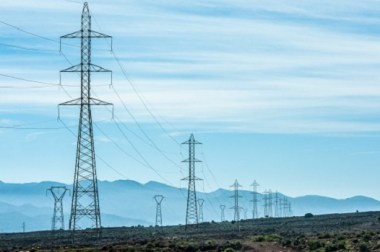
Transmission lines
¶ More than 4.5 million solar home systems have been installed in the rural areas of Bangladesh, bringing energy to the homes of 20 million people who live in the off-grid areas of the country. Since 2009, the access to electricity have been increased from 47% to 80%, and per capita power generation has increased by 85%. [Dhaka Tribune]
¶ Russia began the commercial operation of the world’s first third generation plus nuclear power reactor. It is the same one that would be installed in Bangladesh’s Rooppur Nuclear Power Plant in the near future. After being tied to the grid last August, the plant has been tested, and commercial operation begin on February 27. [The Daily Star]
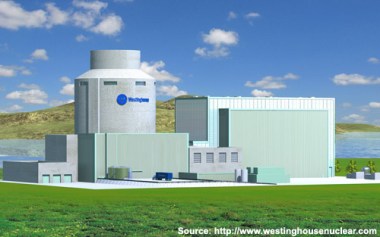
Westinghouse AP1000 generation 3+ nuclear plant
US:
¶ The seemingly insatiable appetite for natural gas at the nation’s power plants could be on the verge of an abrupt hiatus. Energy analysts are forecasting gas demand from the US power sector will at best flat-line and possibly fall off significantly over the next five years as federal energy policies and market dynamics collide. [Longview News-Journal]
¶ Ta’u, one of the five main islands in the South Pacific that make up American Samoa, is very isolated, boasting just under 600 residents. The island has historically shipped in everything they can’t grow, including the diesel fuel that powers the generators for their electric system. But now, SolarCity and Tesla are setting it free. [Collective Evolution]
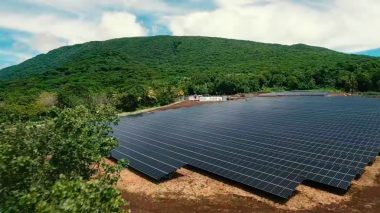
Solar power in American Samoa
¶ Environmentally conscious investors are protesting President Donald Trump’s plans to slash environmental regulations by using their pocketbooks. This is fueling a rally in funds that only invest in companies meeting sustainability criteria. Funds without environmental or social mandates have seen outflows of $133 billion. [The Gazette]
¶ The Trump administration is seeking major cuts to NOAA, one of the government’s climate science agencies, reducing its budget by 17% overall, with a 26% reduction for its research budget. Proposed cuts include reducing the climate protection budget by almost 70% and the Great Lakes Restoration Initiative by 97%. [Normangee Star]

Maybe Sandy would have gone away if NOAA’s GOES-13
satellite had not taken this photo. (NASA image, public domain)
¶ The Catholic Church has been a surprising player in a local effort to create what could become the largest independent energy consortium in California. The church’s idea would be to purchase power from Pacific Gas & Electric Co and use the profits to develop renewable sources of energy. [Monterey County Herald]
¶ The Village of Glen Carbon, Illinois, and the Madison County Sustainability Program have partnered to introduce a bulk solar group purchase program for residents and businesses in Madison County. Organizers say the program will reduce carbon emissions while providing opportunities to invest in solar power. [The Edwardsville Intelligencer]
geoharvey is free and without ads.
geoharvey is not tax-deductible.
Posted in nuclear power, renewable power, solar, wind | 1 Comment »
Tags: nuclear, nuclear power, renewable power, solar power, wind power
March 4, 2017
Opinion:
¶ “California’s Wild Climate Will Only Get More Volatile As Temperatures Rise” • The record rains soaking California this winter seemed an impossible reprieve: The state’s driest years on record was followed by a possible record amount of rain and snow. But that precipitation may just be the beginning of new water woes. [Huffington Post]
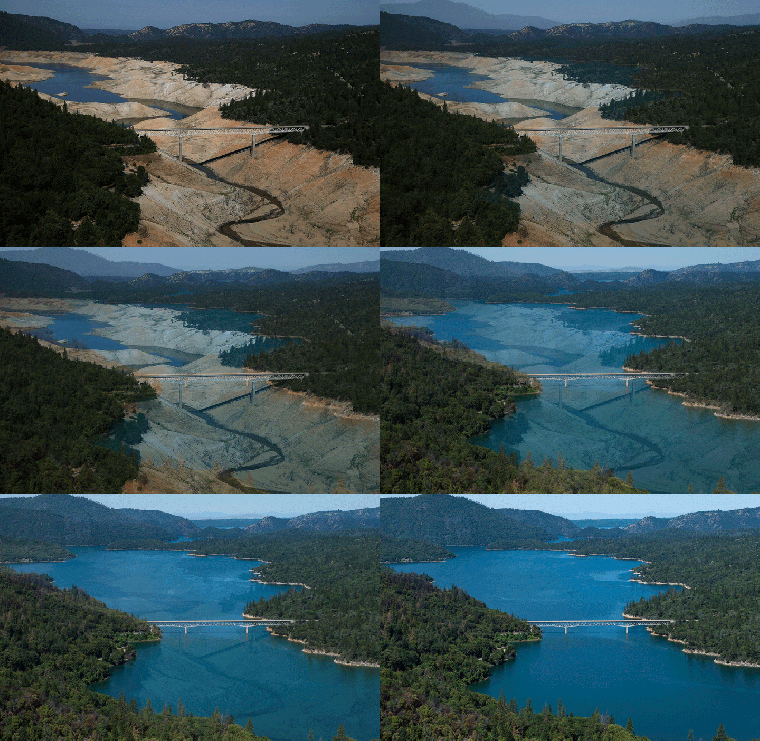
Lake Oroville went from drought in 2014, to overflow
in 2016. (California Department of Water Resources)
Science and Technology:
¶ The University of Leicester’s College of Medicine has done research indicating that common forms of air pollution directly increase the potential for bacterial respiratory infection and alter the effectiveness of antibiotic treatment. Outdoor air pollution causes loss of 7 million lives each year and costs $500 billion per year in the US alone. [CleanTechnica]
World:
¶ Businesses in the Scottish renewable energy sector expect a sixth of their workforce to be lost within a year, an industry survey showed. The Director of Policy at Scottish Renewables said, “Onshore wind and solar are the two cheapest forms of electricity, but ministers are refusing to allow them to access long term contracts for power …” [Your Project News]

PNE Wind offshore project (PNE Wind image)
¶ Australia is set to become the first country in the world to offer its citizens a chance to participate in a program providing a network of “virtual” power stations. The Distributed Energy Exchange will create an open marketplace for trading the value of energy generated by solar panels and stored in battery pack. [Renewable Energy Magazine]
¶ Australia is following the crowdsourcing trend, pioneering the movement into a new industry: solar energy. Beginning this week, approximately 10,000 Australian homeowners can engage in a program testing an open market designed to monetize rooftop renewable energy and storage – the first program of its type in the world. [Breaking Energy]

Concentrating solar system (Photo: Dennis Schroeder)
¶ A tanker docking in the UK is transporting a controversial cargo of gas from the Peruvian Amazon. It is thought to be the first shipment to the UK from the Camisea project in rainforest 60 miles from Machu Picchu. The gas project at Camisea field has been hugely contentious for reasons including effects on previously uncontacted tribes. [BBC News]
¶ Jack-up vessel MPI Enterprise has departed the Dutch port of Eemshaven to start turbine installation at the 332-MW Nordsee 1 wind farm in the German North Sea. The project, which is being developed by Innogy and Northland Power, will feature 54 Senvion 6.2M126 machines. Rotor stars are pre-assembled at a facility on land. [reNews]

MPI Enterprise (MPI image)
US:
¶ New York State Governor Andrew M Cuomo has announced that three New York ski resorts have pledged to be powered by 100% renewable energy by 2030. The three state-owned ski areas are joining the I AM PRO SNOW 100% Committed campaign of The Climate Reality Project founded by former Vice President and climate activist Al Gore. [First Tracks]
¶ The EIA’s Electric Power Monthly shows that the portion of electricity that the nation gets from solar grew nearly 40% in 2016, from around 1% of total generation to 1.4%. Wind is likewise growing, with the share of electricity from wind rising from 4.7% in 2015 to 5.5%. Renewable energy provided 15.3% of US electricity. [pv magazine]

Please click on the image to enlarge it.
¶ Lexington, Massachusetts could be in line to get all its power from renewable sources in the coming years. The Board of Selectmen approved a plan to pursue a contract with energy producers allowing all of Lexington’s energy to be sourced from renewable sources under Community Choice Aggregation. [Wicked Local Lexington]
¶ As one of her first official acts as Secretary of Transportation, Elaine Chao has pulled the rug out from under a proposal to fund electrification of the rail line between San Jose and San Francisco. The decision also puts the kibosh on California’s plan to build a high-speed rail line between Los Angeles and San Francisco. [CleanTechnica]

High speed rail (Photo: ZF Chen / Shutterstock)
¶ As his first move as administrator of the EPA, Scott Pruitt has ended an Obama-era request for oil and gas companies to provide the agency with information on greenhouse gas emissions. Pruitt said that he would assess the need for gathering such information, but the Information Collection Request would be withdrawn immediately. [Oil & Gas 360]
¶ Georgia Power is suspending its study of a site near Columbus for a new nuclear power plant. In a letter to the Georgia Public Service Commission, the utility told officials that the proposed nuclear plant in Stewart County would not be needed as soon as previously expected. There is also uncertainty about other Georgia nuclear projects. [WABE 90.1 FM]
geoharvey is free and without ads.
geoharvey is not tax-deductible.
Posted in nuclear power, renewable power, solar, wind | 1 Comment »
Tags: nuclear, nuclear power, renewable power, solar power, wind power
March 3, 2017
Opinion:
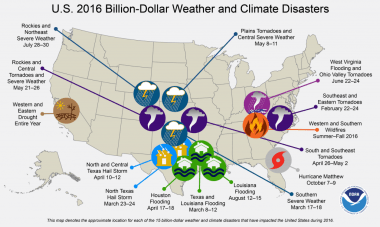
Please click on the image to enlarge it.
¶ “Note To Congress: Climate Change Is Real, And It’s Expensive” In 2016 alone there were 15 extreme weather and climate-related disasters that cost more than a billion dollars apiece. Climate change is contributing to worsening risks of loss from many of these types of events. And those risks are expensive to all of us. [Ecosystem Marketplace]
World:
¶ Community Energy Social Enterprises Limited, a Nigerian company, and Renewvia Energy Corporation, an American firm, signed a Memorandum of Understanding to power to 25 Nigerian communities using local solar microgrids. They are expected to be operational by the end of this year and to have a total capacity of 10 MW. [CleanTechnica]
¶ Using the Intergovernmental Panel on Climate Change’s “worst case” scenario as the baseline, new research has determined that Europe’s coastal cities may be facing as much as $40 billion a year in associated economic losses by 2100. Their economic losses related to climate change may rise to $1.2 billion a year by 2030. [CleanTechnica]

Copenhagen
¶ Acciona has started building the 168-MW El Cortijo wind farm in Mexico’s Tamaulipas state. The project will require an investment of $221 million and is expected to come online in August 2018, the company said. It will feature 56 AW125/3000 turbines with a rotor diameter of 125 meters and a 120-meter-high concrete tower. [reNews]
¶ In perhaps little more than a dozen years, Bavaria and the rest of southern Germany will be reliant on millions of solar PV panels and wind turbines for power. Inverters will be used to provide vital grid control. Gas fired plants will be available but not running most of the time as they can’t make enough money. [The Australian Financial Review]
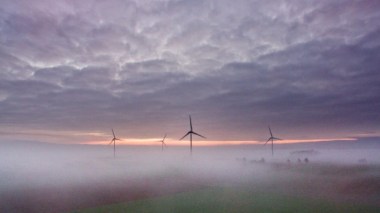
German wind turbines (Julian Stratenschulte / AP)
¶ Victoria’s Labor government launched its first tender for a series of large-scale solar farms, a plan it hopes will attract $150 million of new investment, create 300 jobs and, ultimately, power Melbourne’s trams. The tender calls for up to 75 MW of solar farms, 35 MW of which are expected to provide power for Melbourne’s trams. [RenewEconomy]
¶ A waste-to-energy project undertaken by the world’s largest integrated pineapple operation, Del Monte Philippines Inc, has exceeded even the high effluent quality targets originally set for the job. The wastewater treatment installation achieved 93% organic pollution removal in its anaerobic reactors, while fueling two 1.4-MW generators. [WaterWorld]

Generators powered by biogas from wastewater at Del Monte
Philippines turn a waste disposal problem into to a profit.
¶ The head of decommissioning for the Fukushima Daiichi nuclear plant said robots to assess the condition of melted fuel rods have to be more creatively developed. After earlier robotic probes failed, he wants another sent in before deciding how to remove the reactor’s debris. TEPCO still does not know the melted fuel’s exact location. [Japan Today]
US:
¶ AES Distributed Energy held a ribbon-cutting ceremony Wednesday for its largest solar project so far, a 16-MW farm in Effingham County, Georgia. The solar PV project will produce an average of 32,000 MWh annually, powering the equivalent of 2,820 homes. The 287-acre solar array is on the site of an old timber farm. [Savannah Morning News]

AES solar farm
¶ Former Texas Governor Rick Perry made his official return to government Thursday when the US Senate confirmed his nomination as secretary of energy. After taking earlier positions that climate change was contrived, he has taken a more centrist approach and has received the backing of a number of Democrat senators. [Houston Chronicle]
¶ It’s cheaper and cleaner to replace retiring coal-fired power plants with wind and solar power and energy efficiency upgrades rather than more costly and climate-polluting natural gas plants, according to a report by the Natural Resources Defense Council. Renewable power also shields consumers from natural gas price increases. [AltEnergyMag]
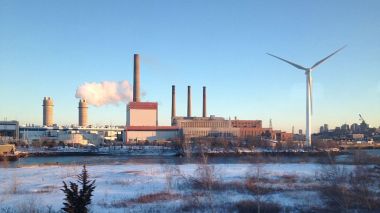
Mystic Generating Station, Everett, Massachusetts
(Photo: Fletcher6, Wikimedia Commons)
¶ The governor of Rhode Island, home to the first US offshore wind farm, has set forth an ambitious goal to grow renewable energy in the state. According to local coverage from Providence Business News, the goal calls for 1 GW of renewable energy by 2020 – a tenfold increase over Rhode Island’s current levels. [North American Windpower]
¶ Amazon has launched a new initiative to install solar panels on its fulfillment facilities around the world. The company initially plans to deploy large-scale solar systems on rooftops of more than 15 fulfillment centers in the US this year and is planning to deploy solar systems on 50 fulfillment centers globally by 2020. [Solar Industry]

Amazon fulfillment center
¶ For the third straight year, Efficiency Vermont and Burlington Electric Department are running a grant program for non-profit organizations to help low-income Vermonters reduce their energy bills. The grant program has successfully delivered measurable energy savings while receiving positive feedback from program participants. [Vermont Biz]
¶ Analysts now warn that the outlook for natural gas may remain weak over the long term. The Houston Chronicle reports one as saying renewable energy, particularly rising solar power usage and better yields from wind power, are fundamental headwinds to natural gas demand that will limit the commodity’s upside in the future. [Investopedia]
geoharvey is free and without ads.
geoharvey is not tax-deductible.
Posted in nuclear power, renewable power, solar, wind | 1 Comment »
Tags: nuclear, nuclear power, renewable power, solar power, wind power
March 2, 2017
Opinion:
¶ “Will Autocracies Fall As The Oil Age Ends?” • The connection between reliance on a fossil fuel economy and corruption is well documented as the Resource Curse. Many of the petro-states have autocratic rule, with only Norway being democratic. With the failing profitability of fossil fuels, petro-chemical autocracies may also fail. [CleanTechnica]
¶ “Why coal companies want to be seen as clean-energy players even amid new support for fossil fuels” • The coal feels the need for more than a friendly administration in Washington to survive. Electric utilities continue to switch to lower-cost natural gas and renewable sources, so coal is looking for a new public image. [Christian Science Monitor]
Science and Technology:
¶ There’s no mistaking it now. Even though we don’t have the final numbers, it is abundantly clear that the sea ice ringing the Antarctic continent has fallen precipitously, reaching a record low just a few short years after it reached a record high. In 38 years of records, the sea ice lows seen this year are without precedent. [Washington Post]
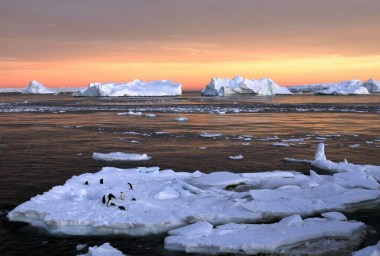
Adelie penguins standing on ice (Pauline Askin / Reuters)
World:
¶ The Canadian Commercial Corporation and the government of Khyber Pakhtunkhwa province of Pakistan have signed a memorandum of understanding to set up 1,000 MW of solar capacity. The capacity is expected to be installed over a period of three years, but size and location within the province has not yet been disclosed. [CleanTechnica]
¶ Beijing has nearly 70,000 taxis. It also has an intractable problem with smog. While it has embarked on an aggressive program to encourage private citizens to buy low emissions cars, that push has not made much of an impact on its taxi fleet. Now it has announced a plan to replace all 67,000 fossil fueled taxis in the city with electric cars. [CleanTechnica]

Tiananmen Square
¶ Energy companies are bailing on Canadian tar sands oil. The latest to pull back is Royal Dutch Shell, which just let word slip that it will probably not expand its operations in Canada. ExxonMobil and Chevron recently went a step farther and wrote down their tar sands reserves, as did Norway’s Statoil last year. [CleanTechnica]
¶ Nova Innovation has been awarded a €4.4 million grant from the European Union’s Horizon 2020 R&D program to develop a direct drive power take-off subsystem for tidal turbines. It will build the subsystem and conduct accelerated onshore testing in Germany followed by in-sea testing in Scotland with third party validation. [reNews]

M100 tidal turbine (Nova Innovation image)
¶ Banks Renewables secured £210 million in finance to support construction of three UK wind farms totaling 151 MW. The projects are the 88-MW Kype Muir and 51-MW Middle Muir projects in South Lanarkshire and the 12-MW Moor House wind farm near Darlington in northeast England. All three will feature Senvion hardware. [reNews]
¶ The Mugga Lane solar farm, the third solar farm funded by the Australian Capital Territory, opened this week, bringing the ACT to 35% renewable energy. Wind accounts for the vast bulk of the ACT’s planned renewable energy, with 600 MW being built. The three solar farms between them have just 40 MW of capacity. [The Canberra Times]

Solemnities opening Mugga Lane solar farm (Photo: Jay Cronan)
¶ Japan is set to add 300 MW of wind capacity – enough to power more than 100,000 average homes – in the 12 months through March, Japan’s Wind Power Association said in a study. Some 157 MW of wind power were installed in the previous year. The association has hopes of seeing 10 GW of wind capacity installed in the early 2020s. [Japan Today]
¶ A major renewable energy project near Kingaroy, Queensland, is a step closer after the co-ordinator-general approved its environmental impact statement. The State Development Minister said AGL proposed to construct and operate up to 115 wind turbines with agreements secured with all affected landowners. [Courier Mail]
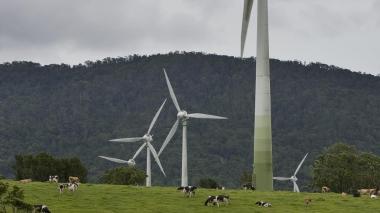
Environmental Impact Statement approved (File picture)
¶ In March, housing subsidies run out for those who fled the Fukushima nuclear disaster from areas other than the government-designated evacuation zones. Many of these so-called voluntary evacuees are mothers concerned to avoid any risk to their children’s health, with the fathers remaining back in Fukushima Prefecture. [Japan Today]
US:
¶ Westar Energy’s new Western Plains Wind Farm in Spearville, Kansas, is in full operation. Westar, the state’s largest electric utility, can now boast it can now provide over half the annual electricity needs of its customers without carbon emissions. The 280-MW wind farm’s Siemens Wind turbines were made in Hutchinson. [Hutchinson News]

Spearville Wind Energy Facility in Kansas
(Photo: Jennifer L. Sovanski, Wikimedia Commons)
¶ Lancaster, California, has been requiring builders to install solar panels on all new homes since 2014. Its policies have served as a model for other California communities. Now, the city seeks to raise the bar by requiring each new home to have a rooftop solar system large enough to meet all of its energy needs. [CleanTechnica]
¶ Florida Power & Light Company announced the names and locations of its 2017 and 2018 universal solar projects, consisting of eight new 74.5-MW solar power plants to be built over the next 12 months. The plants are cost-effective, and should save millions of dollars for customers over their operational lifetimes. [Your Renewable News]
geoharvey is free and without ads.
geoharvey is not tax-deductible.
Posted in nuclear power, renewable power, solar, wind | 1 Comment »
Tags: nuclear, nuclear power, renewable power, solar power, wind power
March 1, 2017
Opinion:
¶ “The trials and triumphs of offshore wind” • When it comes to renewable energy, there’s a new kid on the block and he’s making lots of new friends quickly. We’re talking of course, about offshore wind. While once resisted as too expensive and too unsightly, the technology finally has found its sea legs and is really making a splash. [GreenBiz]

Offshore wind farm under construction off the coast
of Britain (ShutterstockNuttawut / Uttamaharad)
¶ “Will US Solar Growth Continue To Shock, Explode, & Demolish Under Trump/Bannon/Pence?” • Solar power growth was more dramatic than almost anyone expected during the Obama administration. That was largely due to global factors, incentives in other countries and the dramatic drop in solar panel costs. [CleanTechnica]
Science and Technology:
¶ A US Geological Survey study combines climate change and invasive species research by examining how native Brook Trout interact with non-native Brown Trout under rising stream temperatures. Researchers found that non-native Brown Trout limited the ability of Brook Trout to live in warmer stream temperatures. [Satellite PR News]

Brown Trout (Photo: US Fish and Wildlife Service)
World:
¶ A study published by the Australian National University claims that pumped hydro storage could be used to help build a secure and cheap Australian electricity grid with 100% renewable energy sources. The 100% renewable energy grid would rely primarily on wind and solar PVs supported by off-river pumped hydro storage. [CleanTechnica]
¶ The Spanish government said it will pay €600 million ($633 million) annually to renewable and cogeneration power plants as it seeks to reassure investors and revive its comatose clean energy industry. The country guarantees a “reasonable yield of 7.4 percent,” the Ministry of Industry, Energy and Tourism said in an e-mailed statement. [RenewEconomy]
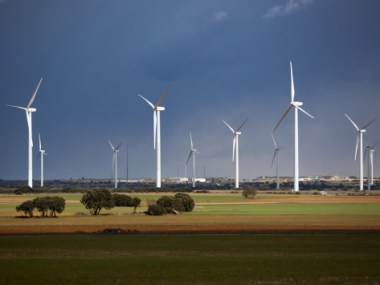
Spanish wind turbines
¶ China has managed to reduce its coal consumption for a third straight year as the energy-hungry country struggles to reduce its dependency on the heavily polluting fuel. According to a report from the National Bureau of Statistics, coal consumption fell by an annual rate of 4.7% in 2016. Coal production fell even more, by 9%. [Press TV]
¶ French renewable energy group Neoen expects the cost of wind power to continue falling in South Australia. The managing director said the Hornsdale wind farm’s owners will seek a rule change from the Australian Energy Market Operator if a trial of frequency control and grid stability services is successful. [The Australian Financial Review]
Wind power costs declining (Sean Gallup)
¶ The impasse between South African utility Eskom and the country’s renewable energy sector will soon be a thing of the past as the power utility will sign the outstanding power purchase agreements (PPAs) in the near future. This was reportedly said by energy minister Tina Joemat-Pettersson, during a briefing in Cape Town. [ITWeb]
¶ Despite another banner year for renewables growth in China, the country’s grid still struggles to get clean electricity to users. The problem is so serious in China’s north and west that turbines were forced to sit idle for much of 2016. In response, China’s policymakers are now turning to energy storage for wind and solar power. [eco-business.com]

Inspecting a Chinese wind turbine (Image: The
Danish Wind Industry Association, CC BY-NC-ND 2.0)
¶ Coal-truck drivers brought traffic to a standstill on roads surrounding South Africa’s capital on Wednesday as the state-owned power utility said it won’t renew their contracts because of an electricity surplus. The blockade disrupted business in the city, with the nation’s Competition Tribunal canceling hearings because of the congestion. [Moneyweb.co.za]
US:
¶ The Hawaiian Electric Co and technology service company Stem Inc have successfully tested nearly 1 MW of energy storage systems at 29 commercial sites on Oahu, the companies said. The system is a “virtual power plant,” controlled by computer. It is providing better real-time grid operations, according to HECO. [POWER magazine]

Yes, this is a power plant. (Courtesy: Stem Inc)
¶ Construction has commenced on a 56-MW solar plant in Oregon. The Gala Solar Power Plant, in Crook County, is expected to be the largest operating facility in the state, sustainable energy company SunPower said. The plant is set to be completed by the end of the year, and is expected to generate around 300 jobs for construction. [CNBC]
¶ Vermont Electric Power Co and IBM announced a new venture that will have the computing giant analyzing weather and electric meter data to anticipate conditions on the grid as increasing reliance on wind and solar energy makes that important. The effort is predicted to save Vermonters money, possibly through smart grid technology. [vtdigger.org]
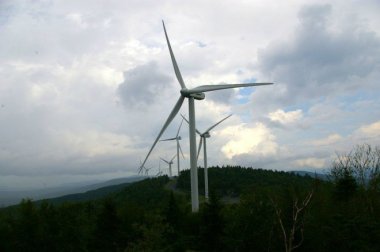
Lowell Mountain (Photo: Andrew Stein / VTDigger)
¶ Younicos will build a 3-MW lithium-ion battery system for the Kodiak Electric Association in Alaska with completion expected by August, ready for high wind season. The installation replaces a lead acid array installed in 2012. KEA has already achieved its goal of having 95% of its power from renewable sources by 2020. [pv magazine USA]
¶ The New York Legislature will meet on Tuesday at a public hearing on the impact of the shutdown of the Indian Point Nuclear Power Plant in April, 2021. Tuesday’s hearing is slated to evaluate the shutdown’s impact on electrical grid reliability, jobs and local tax revenue, and the details on how the site will be decommissioned. [WABC-TV]
geoharvey is free and without ads.
geoharvey is not tax-deductible.
Posted in nuclear power, renewable power, solar, wind | 1 Comment »
Tags: nuclear, nuclear power, renewable power, solar power, wind power
February 28, 2017
Opinion:
¶ “Energy security from “clean coal”, CCS & CSG. What could possibly go wrong?” • Every few years the fossil fuel industry, via supporting politicians, have another go at forcing “clean coal”, carbon capture and storage, and more recently coal seam gas, on an increasingly sceptical community. What could go wrong? Pretty much everything. [RenewEconomy]

Coal Plant (AAP Image / Mick Tsikas)
Science and Technology:
¶ Science educator Bill Nye and Vermont Senator Bernie Sanders held a Facebook Live conversation on Monday morning about climate change. In the two hours after it aired, the interview has already been viewed about 2 million times, drawn about 100,000 “Reactions” and 52,000 “shares.” You can watch the video here. [EcoWatch]
¶ Oil giant Shell’s farsighted 1991 film, titled Climate of Concern, set out with crystal clarity how the world was warming and that serious consequences could well result. It said climate change was happening “at a rate faster than at any time since the end of the ice age – change too fast perhaps for life to adapt, without severe dislocation.” [The Guardian]

Severe dislocation in a flood in Bangladesh
(Photo: Mufti Munir / AFP/Getty Images)
World:
¶ Competitive power contract auctions around the world are helping to drive down the cost of wind power, according to a new report from Navigant Research. The report, “Global Wind Energy Policy and Market Risk Assessment,” examines the strengths and weaknesses of the policies promoting development of wind energy in 28 countries. [reNews]
¶ Russia has used oil dependence as a weapon to subvert democracies that border it. Estonia, however, has countered this. The country had been importing all of its natural gas for heating and hot water from Russia, but that ended last year. It has shifted its fossil fuel buying to Norway’s Statoil, and is developing offshore wind power. [CleanTechnica]
¶ A joint venture by JFE Engineering; Mitsui Oil Exploration; the government-backed Japan Oil, Gas, and Metals National Corp; and Japan Metals & Chemicals will break ground on a roughly 7-MW geothermal plant in Iwate Prefecture in March. The facility is expected to begin operation in 2018, at a cost ¥8.5 billion ($75.8 million). [ThinkGeoEnergy]
¶ Pattern Energy has completed the 184.6-MW Meikle wind farm in British Columbia. The project has 61 GE turbines in a mix of 3.2-MW and 2.75-MW machines. It has a 25-year power purchase agreement with BC Hydro. It is expected to generate $70 million in payments for property taxes and other benefits over its first 25 operating years. [reNews]

Meikle wind farm (Pattern Energy image)
¶ Airex Energy has opened a biomass torrefaction plant in Bécancour, Quebec. It showcases the latest biomass torrefaction technology, CarbonFX™. The torrefaction process transforms biomass residues into biocoal pellets, a clean and renewable fuel that can replace coal and oil, without major changes to existing systems. [Your Renewable News]
US:
¶ Minnesota’s renewable energy standard would increase to 50% by 2030 under a bipartisan plan unveiled Monday by Lieutenant Governor Tina Smith. The state’s current renewable energy standard, or RES, stands at 25% by 2025 for all utilities, with a more aggressive target for the state’s largest investor owned utility, Xcel Energy. [Midwest Energy News]
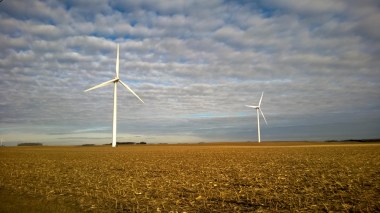
Minnesota wind turbines (photo: Michael Janke)
¶ Tesla will end up hiring around 54% more workers for the Gigafactory project than was initially supposed, according to the executive director of the Nevada Governor’s Office of Economic Development. Initial estimates were that 6,500 jobs would be created by the Gigafactory project. Now, the forecast is for more than 10,000. [CleanTechnica]
¶ Tampa Tank Inc-Florida Structural Steel, a large industrial manufacturing facility in the Tampa bay area, flipped the switch last Friday on its new, 507-kilowatt solar system. As the largest industrial PV system of its kind in Hillsborough County, it will enable TTI-FSS to meet 60% of its on-site power needs with solar energy. [83degreesmedia]
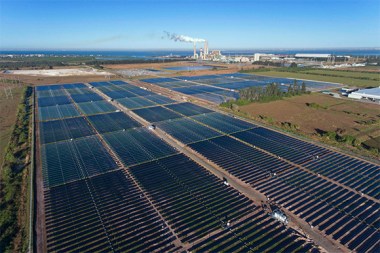
Tampa solar facility
¶ Legislation to require all California electricity providers to supply power generated 100% from renewable resources such as wind and solar by 2045 has been introduced by Senate President Kevin de Leon as Senate Bill 584. Current standards require 33% renewable power by 2020 and 50% by 2030. [Natural Resources Defense Council]
¶ Pacific Gas & Electric announced modifications planned for the Diablo Canyon joint proposal, based on impute from energy industry stakeholders or parties, who participated in the California Public Utilities Commission review of the joint proposal. PG&E still plans to replace the plant with resources that are free of greenhouse gasses. [KEYT]

Diablo Canyon Nuclear Power Plant (file photo)
¶ Renewable energy company Soltage LLC and independent power producer Tenaska have completed a 3.68 MW ground-mounted solar project in Billerica, Massachusetts. The project is on a brownfield site and will generate 4,445 MWh annually for four school systems and one local government through virtual net-metering. [Solar Industry]
¶ Duke Energy Indiana has begun commercial service at its first large-scale solar power plant at Naval Support Activity Crane. The $41-million facility consists of about 76,000 solar panels and can generate up to 17 MW of power. The plant sits on about 145 acres of land leads to Duke Energy by the Department of the Navy. [Inside INdiana Business]
geoharvey is free and without ads.
geoharvey is not tax-deductible.
Posted in nuclear power, renewable power, solar, wind | 1 Comment »
Tags: nuclear, nuclear power, renewable power, solar power, wind power
February 27, 2017
Opinion:
¶ “Even Trump Can’t Stop the Tide of Green Jobs” • With a policy of climate denial, Trump promised to boost coal and oil jobs and dismantle the Clean Power Plan. But green jobs are a key hope for revitalizing communities, and experts say he isn’t to stop the growth of clean energy jobs entirely (or efforts by unions to organize its workers). [Truth-Out]

Green jobs are rising. (Photo: alfre32 / Flickr)
¶ “Man Who Moved Oil With His Words Won’t Talk About It Anymore” • Now that he’s done with his near 21-year stint as Saudi Arabia’s oil minister, during which his utterances could move markets worldwide, al-Naimi says he doesn’t want to talk about the oil market anymore. Now, he is focused on solar power and solar panels. [Bloomberg]
World:
¶ Enthused by the world’s biggest solar power project in Rewa, which is set to produce India’s least costly power, the Union government wrote to all states to have them incorporate initiatives taken by Madhya Pradesh, so the target of generating 100 GW of solar power is achieved quickly and at affordable rates. [ETEnergyworld.com]

Solar array
¶ Renewable energy will fill the demand for power in India in the next seven to eight years. According to an estimate by The Energy and Resource Institute, power produced by renewable energy sources will increase from 5.6% to 34% by 2030 whereas production share of coal based energy will decrease from present 73% to 56%. [Web India]
¶ In 2019, a program designed to buy back solar power flowing from rooftop panels at above-market rates will start becoming less enticing, potentially leaving homeowners who signed up with excess power on their hands. Osaka-based Panasonic is anticipating that installations of energy storage systems for solar panels will rise. [The Japan Times]

House in the Fujisawa Sustainable Smart Town (Bloomberg)
¶ The Australian Government says Labor’s renewable energy policy is increasing power prices. Power prices for Queensland small businesses have doubled over the past decade, but despite Queensland having about 4.4% of its power supply coming from renewables, it has the highest average wholesale electricity prices in the country. [Courier Mail]
¶ A new study by energy experts from the Australian National University suggests that a 100% renewable energy electricity grid, with 90% of power coming from wind and solar, will be a less expensive future option than a coal or gas-fired network in Australia. Most of the current fleet of coal generators are due to retire before 2030. [RenewEconomy]
¶ Buoyed by drop in tariff to record low of ₹3.46 per unit (5.2¢/kWh) in the first auction of wind power, the Indian government is mulling putting on the block more such projects next fiscal year. The auction assumes significance because India has set an ambitious target of having 60 GW of wind power capacity by 2022. [ETEnergyworld.com]
US:
¶ Tesla announced that its SolarCity solar panel factory in Buffalo is expected to begin production of the solar roofing tiles soon so that the flagship products can hit the market by the end of the year. The solar roof will be offered in four styles: Textured Glass Tile, Slate Glass Tile, Tuscan Glass Tile, and Smooth Glass Tile. [The Urban Developer]

House with solar roof tiles
¶ In Apple Valley, California, the town will become its residents’ default energy provider on April 1, a move officials say will result in lower rates and an approximate $21 million revenue surplus by 2026. In the lead-up to implementation, the Town Council has made several approvals related to the Apple Valley Choice Energy program. [Hesperia Star]
¶ With electricity prices depressed, Public Service Enterprise Group, based in Newark, New Jersey, has been quietly lobbying policymakers to help its nuclear plants, much the way New York has approved subsidies to keep reactors in the state operating. PSEG, which owns three units in South Jersey, is in discussions with policymakers. [NJ Spotlight]
geoharvey is free and without ads.
geoharvey is not tax-deductible.
Posted in nuclear power, renewable power, solar, wind | 1 Comment »
Tags: nuclear, nuclear power, renewable power, solar power, wind power
February 26, 2017
Opinion:
¶ “How to Support Renewable Energy (and Why You Really Should)” • Even with the divided US political climate, most people agree on public support for increasing our use of renewable energy sources. Some are concerned about pollution, others about the national security. But many are attracted to benefits of renewable energy. [Scientific American]
¶ “Conservative group’s carbon plan gives us hope for climate change action” • The Climate Leadership Council, a conservative panel including former Secretaries of State George Schultz and James Baker and former Treasury Secretary Henry Paulson, is challenging climate skeptics in their party with a market-based approach. [Hawaii Tribune Herald]
¶ “Wind Energy Boom Hits The US” • It’s free, plentiful, carbon neutral and in the right hands could have a radical impact on the future. Installed wind capacity was greater than hydroelectric, according to the American Wind Energy Association. The AWEA points out that, with a new site in North Carolina, there are now wind farms in 41 states. [Yahoo Finance]
Science and Technology:
¶ Digging for blood and sand worms along the Maine coast can pay well, particularly in areas of the state where it can be hard to make a living. Maine’s annual harvest of these popular bait worms, however, continues to decline, posing a quandary for marine biologists who cite climate change and predation as possible factors. [Bangor Daily News]
¶ A study by a British and French team of climate scientists has challenged the previously held notion that any significant change in temperatures here was unlikely before the end of the century. Writing in Nature Communications journal the team judged the chance of a significant change in the region as being as high as 50%. [MyBroadband]
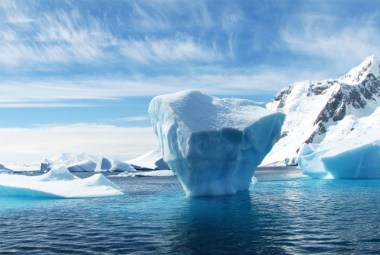
Ocean Ice
World:
¶ After earthquake, tsunami, and nuclear meltdowns devastated Fukushima communities, local people took power generation into their own hands, creating a co-operative, Aizu Power. Now it operates a dozen small-scale solar power facilities across inner Fukushima. They demonstrate that even in a snowy region, solar is a viable option. [Truth-Out]
¶ Work has begun on Genex’s $126 million Kidston Solar Project in North Queensland, the first solar farm to be built under the state government’s Solar 150 program. Visiting the site of the former Kidston Gold Mine, the Energy Minister said the project was a sign of investor confidence in Queensland’s renewable credentials. [The North West Star]

Genex Kidston solar farm
¶ According to the chairman and managing director of Suzlon Group, wind and solar energy do not compete but rather complement each other. Solar in India is in addition to wind and not a substitute. In India, wind power is at grid parity, solar power is getting there, and development of conventional power has stalled. [Telangana Today]
¶ The number of electricity users who voluntarily purchased green power in Taiwan has grown from 531 to more than 7,000 in three years. Consumption of green power has grown from less than 5 million kWh to more than 270 million kWh since 2014 when the Green Power Pilot Program, a three-year promotional scheme, was initialed. [Taiwan News]
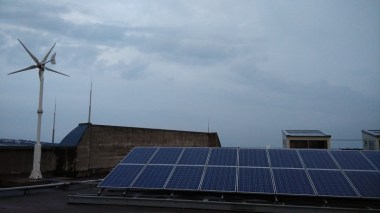
Green power in Taiwan (Photo from Wikipedia)
US:
¶ In late 2015, Houston agreed to a 20-year deal to buy 30 MW of power from the Solaire Holman plant. Last week, the City Council ramped up that purchase to accept all 50 MW the plant will produce, at $44.68 per MWh over 20 years. That will cover 10.5% of the city’s annual electricity needs, replacing coal-generated power. [Houston Chronicle]
¶ Manchester, Ohio is a mass of closed storefronts, with a couple of restaurants and one bar. Its 2,000 residents rely on two coal-burning power plants to provide jobs and keep the local economy afloat. Both are closing in 2018, and the closest town with available work is an hour away. They are looking to Donald Trump to save them. [CNN]

In the distance, the coal-burning Stuart station, near Manchester
¶ For 40 years the National Renewable Energy Laboratory has conducted unique scientific research and worked with industry to make sources such as solar, wind and biofuels increasingly big parts of America’s energy supply. But the Trump administration has roughly 1,700 NREL employees wondering what’s ahead. [Colorado Public Radio]
¶ In filings this week, Duke Energy said its actual avoided costs for solar power have dropped, largely because of falling fuel prices for natural gas, to $35 per megawatt-hour of energy. But it’s paying solar developers $55 to $85 under long-term contracts based on avoided costs the commission previously set. [Winston-Salem Journal]
geoharvey is free and without ads.
geoharvey is not tax-deductible.
Posted in nuclear power, renewable power, solar, wind | 1 Comment »
Tags: nuclear, nuclear power, renewable power, solar power, wind power
February 25, 2017
Opinion:
¶ “Trump’s draconian budget proposals will destroy US clean energy innovation” • Voters who expected Trump to prioritize revitalized manufacturing may be disappointed, as his opening budget proposals will stymie progress toward the critical jobs of the 21st century: developing, manufacturing, and installing renewable energy. [Quartz]

Hey Trump: Europe is beating you on clean
energy – bigly. (Reuters / Denis Balibouse)
¶ “Here’s Why the US Nuclear Industry Is in Jeopardy” • The Spiraling construction costs at new facilities and planned closures of decades-old plants highlight why the nuclear industry in the United States remains in trouble, even as the quest for zero-carbon energy sources grows. Nuclear plants are facing financial meltdowns. [Seeker]
¶ “The Economist embraces renewables” • In this week’s cover story, The Economist thoughtfully argues for expanded use of renewable energy, noting, “It is no longer far-fetched to think that the world is entering an era of clean, unlimited and cheap power. About time, too.” But some issues require clarification. [Into the Wind – The AWEA Blog]

Rolling Hills wind turbines (Credit: IA Ashley)
Science and Technology:
¶ As the US basks in some of the warmest February weather it’s seen in decades, the US Geological Survey has been quick to point out that the early spring conditions are just another symptom of climate change. Analysis from the USA-National Phenology Network shows that an early spring is working its way across the country. [Chicago Tribune]
¶ Scientists at Duke University have used rhodium for a solar powered system that converts carbon dioxide into methane, which can be used as a replacement for natural gas. The idea could enable capturing waste gas from industrial operations and converting it to fuel. Rhodium is a rare element used in the jewelry trade. [CleanTechnica]

Rhodium nanoparticles (Photo: Chad Scales)
World:
¶ The UN’s new climate chief says she’s worried about President Trump but confident that action to curb climate change cannot be stopped. Former Mexican diplomat Patricia Espinosa said China’s stated willingness to lead the world in curbing emissions might cause American diplomats to ponder the implications of giving up its leadership role. [BBC]
¶ According to WindEurope, Denmark generated a total of 70 GWh from onshore wind and another 27 GWh from offshore wind on February 22. This is enough wind energy to power the entire country’s electricity needs. By the end of 2015, Denmark had a total of just over 5 GW of wind energy installed, a number that increased during 2016. [CleanTechnica]
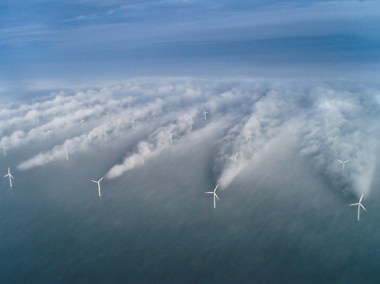
Horns Rev wind farm of Danish coast
¶ ElecLink Limited has awarded Siemens an order to supply a link between the French and British power grids through the Channel Tunnel. The high-voltage direct-current (HVDC) link will enhance power supply reliability in both countries and promote the integration of renewable energy sources into the grid. [Environmental Expert]
US:
¶ GE Renewable Energy is to supply wind and solar components for the first US commercial integrated solar-wind hybrid project, a 4.6-MW community project set for Red Lake Falls, Minnesota. GE Renewable Energy has been contracted to supply two 2.3-116 onshore wind turbines and 1 MW of solar power conversion equipment. [CleanTechnica]

GE Renewable Energy 2-MW wind turbine
¶ A bill introduced to the Georgia House of Representatives promises to touch off a tug of war over renewable energy. If it is made law, the Public Service Commission could no longer recommend changes to the plan for the energy mix. One commissioner warned that it would shut down an ability to push for solar power. [Atlanta Business Chronicle]
¶ California utility San Diego Gas & Electric put into service the largest lithium-ion storage battery in the world, wrapping up a fast-track procurement process that began less than a year ago. The 30-MW, 120-MWh system is part of an expedited response by the state to the loss of the Aliso Canyon natural gas storage facility last year. [POWER magazine]
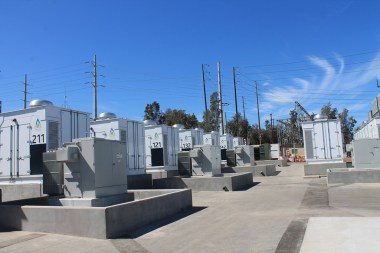
San Diego Gas & Electric’s new 30-MW, 120-MWh
battery storage system (Source: POWER / Tom Overton)
¶ New York State Comptroller Thomas DiNapoli is again pushing for ExxonMobil to disclose how climate change will impact its corporate bottom line. He voice a concern that Exxon has not ensured its resilience in a lower carbon future. The state pension fund has investment in ExxonMobil valued at $973.6 million. [Albany Times Union]
¶ The union that once represented hundreds of employees at the Vermont Yankee nuclear power plant now represents a mere 13 workers. Even so, Local 300 of the International Brotherhood of Electrical Workers wants to have a say in upcoming hearings about the proposed sale of Vermont Yankee to an industrial demolition company. [Recorder]
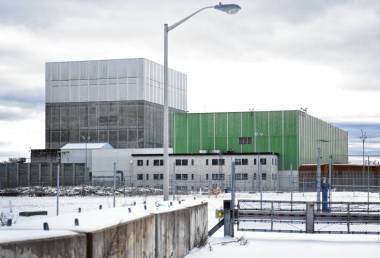
Vermont Yankee (Recorder File Photo)
¶ The Florida Supreme Court on Friday turned down an appeal by Florida Power & Light in a case about whether the utility could be required to install underground transmission lines as part of a nuclear-power project in Miami-Dade County. The dispute relates to FPL’s proposal to build two new nuclear reactors at Turkey Point. [News Chief]
¶ Nuclear energy startup Transatomic Power has backed away from bold claims for its advanced reactor technology after an informal review by MIT professors highlighted serious errors in the company’s calculations, MIT Technology Review has learned. The company has admitted the error and is working to correct it. [MIT Technology Review]
geoharvey is free and without ads.
geoharvey is not tax-deductible.
Posted in nuclear power, renewable power, solar, wind | 1 Comment »
Tags: nuclear, nuclear power, renewable power, solar power, wind power
February 24, 2017
Opinion:
¶ “Will fossil fuels and conventional cars be obsolete by 2030?” In 2016, solar power became the cheapest form of energy in 58 lower-income countries, including China, India, and Brazil, and the cost is still dropping. In Europe, in 2016, 86% of the newly installed energy capacity was from renewable sources. Is it all over for fossil fuels? [Huffington Post]

Solar power rising
World:
¶ London has air pollution levels that sometimes exceed those of Beijing. NOx levels have gone well beyond EU legal limits; over a 5 day period in January, their levels exceeded the EU’s legal limit for a full year. The Mayor announced that central London will institute a £10 charge for entering vehicles that don’t meet Euro 4 standards. [CleanTechnica]
¶ The government of France is reportedly now offering a state subsidy of €200 to buyers of certain electrically powered bicycles. This state subsidy will be on the table until January 31, 2018, though there possibly may be an extension. The new state subsidy does not apply to electric bikes relying on lead-acid batteries. [CleanTechnica]

Wave e-bike (Image of Wave Electric Bike)
¶ The UK’s energy policy is beset by failures, according to a report from the House of Lords economic affairs committee. The report says the UK should put energy security, ahead of climate policy. Energy experts say the report is “confused”, the summary is “very misleading” and the auction it proposes “doesn’t really make sense.” [Carbon Brief]
¶ A new report by Australia’s Climate Council, State of Solar 2016: Globally and in Australia, talks of a “huge” year ahead for the country’s large-scale solar sector, with more than twenty utility-scale solar plants totaling more than 1 GW set to come online in 2017, and with a further 3.7 GW of new capacity in the pipeline. [pv magazine]

Kidston solar farm in Australia
¶ Indian wind power tariffs fell to a record low in an auction, just a few days after solar power rates also hit an all-time low. In the auction, which was conducted by state-controlled Solar Energy Corporation of India for various wind projects totaling 1 GW, five companies separately quoted ₹3.46 per unit (5.2¢/kWh) for the tariff. [BW Businessworld]
¶ Swedish developer Minesto struck a deal with shipping outfit Stena Line to use a new assembly hall in the Welsh port of Holyhead for the commercial roll out of the Deep Green tidal kite. Minesto is planning a first commercial array at Holyhead Deep and is currently also seeking to up top power at the site from 10 MW to 80 MW. [reNews]

Deep Green tidal kite (Minesto image)
¶ Renewable energy companies from three EU member nations, Finland, Germany and the Netherlands have just announced they will finance and build a total of 735 MW of wind power in Russia. All three have been victims of Putin-backed campaigns boosting anti-democratic candidates in an attempt to split and weaken the European Union. [CleanTechnica]
US:
¶ A solar project in Kearney, Nebraska will be the largest solar array in the state when its panels go online in the fall. It will have a capacity of 5.8 MW, at a cost of $11 million. Consumers will be allowed to buy shares in the array, for up to 80% of their usage, at a slight premium above regular rates, 86¢ per month for a 150-kWh share. [Kearney Hub]
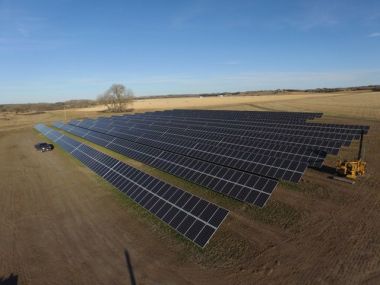
Solar array in Nebraska (Courtesy photo)
¶ The main Standing Rock protest camp near the Dakota Access Pipeline was cleared Thursday, a day after a deadline to leave the area expired, authorities said. There were arrests, but no major conflict after police did not enter the camp. About 100 protesters left voluntarily. Protesters chanted, waved flags, and played drums as they left. [CNN]
¶ In the years of 2000 to 2014, Colorado River flows declined to around 81% of the 20th-century average. Researchers found that the higher temperatures in the region since 2000 are responsible for between one-sixth to one-half of the river flow reductions seen since 2000. Forty million people rely on the river for their survival. [CleanTechnica]
¶ California’s building standards mandate all new residential homes and commercial buildings under 10 stories to have a “solar ready” roof. The proposed California bill SB 71 would shift the focus from “solar ready” to “solar installed”. California would be the first US to requiring renewable energy installations by law. [Sun & Wind Energy]
¶ A bill aimed at classifying nuclear power as a renewable energy source in New Mexico stalled Thursday afternoon in committee on a tie vote. House Bill 406 would have amended the state’s Renewable Energy Act, which requires energy companies provide a certain amount of electricity from renewable sources. [New Mexico Political Report]
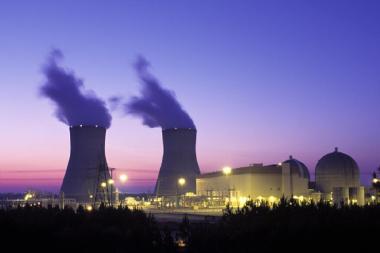
Vogtle Nuclear Power Plant (NRC photo
Public domain, via Wikimedia Commons)
¶ The Township Council of Willingboro, New Jersey voted to award a power purchase agreement to Eznergy of Toms River. The PPA calls for the company to install solar panels on certain township rooftops at no cost to the municipality, which will buy the power produced at 7¢/kWh, about half of what it currently pays, for 15 years. [Burlington County Times]
¶ Riverkeeper and the Natural Resources Defense Council claim a new study it commissioned puts to rest any lingering doubts over replacement power and shows that the closure of the Indian Point nuclear power plant can be done clean and green, without big increases in electric bills. Indian Points power units will be offline by 2021. [Mid-Hudson News]
geoharvey is free and without ads.
geoharvey is not tax-deductible.
Posted in nuclear power, renewable power, solar, wind | 1 Comment »
Tags: nuclear, nuclear power, renewable power, solar power, wind power
February 23, 2017
World:
¶ For the first time ever, a study by climate research institute Climate Analytics calculated what a cost-effective fossil fuel exit strategy would look like. The study focused on keeping global warming at 1.5° C until the end of this century. All coal-fired power plants in the EU need to be shut down by 2030, but that is just a start. [Deutsche Welle]
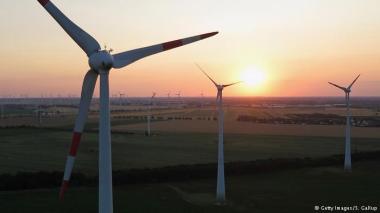
The cheapest way to reduce fossil fuel emissions
is to phase out coal and replace it with renewables.
¶ The German city of Stuttgart will have occasional selective bans of diesel cars during periods of high pollution beginning in 2018, state officials in Baden-Württemberg say. The intent of the selective-bans is to limit diesel pollution within the state’s capital city during periods when air pollution levels are already quite high. [CleanTechnica]
¶ A ComRes survey has found 85% of British adults are in favor of price support for renewables including onshore wind and solar. The survey for the Energy and Climate Intelligence Unit showed less than 30% think gas power should be subsidised, the same proportion as for nuclear, with 19% wanting support for coal. [reNews]
Goole Fields (Image: Innogy UK Renewables)
¶ Countries in the EU, including the UK, are throwing away money by subsidizing the burning of wood for energy, according to an independent report. While burning some forms of wood waste can indeed reduce greenhouse gas emissions, in practice the growing use of wood energy in the EU is actually increasing emissions. [New Scientist]
¶ In a direct challenge to the Australian Coalition’s coal-based political campaign, Labor would put fossil fuels in a secondary place. It is calling on Prime Minister Malcolm Turnbull to join a major promotion of wind and solar investment. The objective is to get a slice of the worldwide investment in renewables over the next 20 years. [NEWS.com.au]
Toora Wind Farm in South Gippsland, Victoria
¶ The Indian government has approved a plan to double the capacity of solar parks and ultra-mega solar power projects to 40,000 MW from 20,000 MW. The power minister told news reporters a roadmap would be finalized shortly to set up at least 50 solar parks, each with a capacity of 500 MW except in hilly areas. [Times of India]
¶ In Nepal, some communities are looking to harness the energy water produces with micro-hydropower systems. According to the Nepal Micro Hydropower Development Association, over 3,300 micro hydro plants are providing energy to villages around the country. In many places, impact has been significant for villagers. [CNBC]
¶ Pakistan’s Ministry of Petroleum and Natural Resources has opposed a proposed ban on setting up new power plants using natural gas, which is being considered as part of a plan of capping consumption of different fuel sources for power generation. It supports restrictions on the installation of power plants using imported coal or oil. [The Express Tribune]
¶ The Indian government approved a 900-MW hydro power project to be set up in Sankhuwasabha district of Nepal at a cost of ₹5,723.72 crore ($860 million). The decision to approve the Arun-III project was taken in New Delhi at a meeting of the Cabinet Committee on Economic Affairs headed by Prime Minister Narendra Modi. [News Nation]
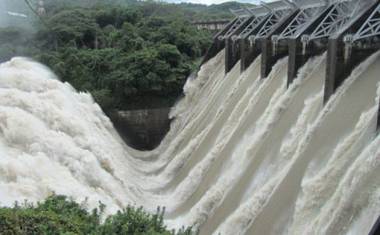
Hydro dam (Image: PTI)
US:
¶ Over 7,500 pages of emails from the Oklahoma attorney general’s office shed light on EPA Administrator Scott Pruitt’s relationship with Devon Energy, including allowing its top lobbyists to draft and edit letters sent to top federal officials on his behalf. They were obtained by the Center for Media and Democracy through an open records request. [CNN]
¶ The future of ethanol, which critics deride as a boondoggle and backers laud as crucial to the nation’s energy mix, was thought to be in jeopardy, given some of the Trump administration appointments. But the new president sent a message to the ethanol industry that delighted its members. [The San Diego Union-Tribune]
Pumping ethanol into a truck (Anne Cusack / Los Angeles Times)
¶ In the years from 2005 to 2014, there were at least 6,648 spills at hydraulically fractured oil and gas wells in just four of the states where fracking is done, according to analysis published in the journal Environmental Science & Technology. The states that were in the study were New Mexico, Colorado, North Dakota, and Pennsylvania. [CleanTechnica]
¶ The historic St Patrick’s Cathedral in Manhattan has activated a geothermal heating plant, part of a series of environmentally friendly upgrades. The Archdiocese of New York said that the geothermal plant is comprised of ten wells, up to 2,200 feet deep, that were drilled along the north and south sides of the cathedral. [PennEnergy]
¶ Madison Gas and Electric announced plans to build and operate a 66-MW wind farm near Saratoga, Iowa. The project would consist of 33 turbines at a site in Howard County and serve MGE customers in Wisconsin. Construction would be complete by the end 2018, the company said. The project would cost about $107 million. [reNews]
¶ FirstEnergy, based in Akron, Ohio, made it clear that it is leaving the competitive power plant business, closing or selling all of its plants, including its nuclear plants, by the middle of next year. Closing the plants, which would probably take several years, would also have little impact on customer bills or power supplies. [cleveland.com]
geoharvey is free and without ads.
geoharvey is not tax-deductible.
Posted in nuclear power, renewable power, solar, wind | 1 Comment »
Tags: nuclear, nuclear power, renewable power, solar power, wind power
February 22, 2017
Opinion:
¶ “How South Australia can function reliably while moving to 100% renewable power” • Despite the criticism leveled at South Australia over its renewable energy ambitions, the state is aiming to be carbon neutral by mid-century, which will mean moving to 100% renewable electricity over the next 15-20 years. It can do that. [The Conversation AU]

Australian wind farm
World:
¶ Almost every railway station in India will soon be fed with solar power if the plans in India’s new union budget are implemented. The Indian Finance Minister announced that the 7,000 railway stations across the country will be fed with solar power as per the Indian Railways mission to implement 1,000 MW of solar power capacity. [CleanTechnica]
¶ Energy company RWE has cancelled its dividend for the second successive year, after writedowns of €4.3 billion ($4.5 billion) on its power plants and a surprise net loss of €5.7 billion euros ($6 billion) during 2016. RWE faces competition from renewables at the very time that Germany is moving away from nuclear power. [BBC]

RWE’s Niederaussem power plant in Bergheim, Germany (EPA)
¶ Canadian Prime Minister Justin Trudeau pledged to enact a national carbon tax by 2018. After meeting with US president Donald Trump, he said that Canada would aggressively pursue its climate change goals. But according to a study by four leading environmental groups, Canadian fossil fuel subsidies totaled $3.3 billion last year. [CleanTechnica]
¶ Iberdrola announced it has completed the installation of the first of 70 5-MW Adwen wind turbines at the 350-MW Wikinger offshore wind farm off the coast of Germany. The turbines are being installed by Fred Olsen’s Brave Tern, one of two self-elevating, self-propelled jack-up vessels dedicated to installing offshore wind turbines. [CleanTechnica]

Brave Tern
¶ As the world’s number one exporter of crude oil, renewable energy may be the last thing that comes to mind when thinking of Saudi Arabia. But it is now turning to solar and wind power in a SGD 71 billion ($50 billion) bid to cut dependency on oil amid growing energy demands domestically, according to the Saudi energy minister. [VR-Zone]
¶ A new report on Australia’s rising power prices over the past decade, from the Australian National University, has undermined claims that South Australia’s high electricity prices have been driven by the state’s uptake wind and solar. It shows that its rises have been less in SA than in the states that are dependent on coal. [RenewEconomy]
¶ China’s Plans to green-light eight nuclear reactors this year, in the world’s fastest-growing nuclear market, could depend on whether it’s able to complete some of the world’s most-advanced facilities, including Westinghouse Electric Co’s AP1000 and Areva SA’s EPR, neither of which has an operational track record. [BloombergQuint]
¶ Faced with the choice of replacing the ageing undersea electricity cable that powers South Australia’s Kangaroo Island or building a renewable grid on the island itself, mayor Peter Clements wants both. And he’s backing a radical “community ownership” model from Denmark’s Samsø Island to help pay for it. [InDaily]
Kangaroo Island
US:
¶ In a speech to the National Press Club in Canberra, a former conservative Republican congressman said President Trump would be forced to change his mind on climate change. Bob Inglis changed his position on global warming after extensive briefings with scientists. He founded a conservative movement lobbying for action. [Perth Now]
¶ Caterpillar announced that Cat dealer Altorfer commissioned a 1000-kW solar PV system in Rantoul, Illinois. The system fulfills a 20-year power purchase agreement with the Illinois Municipal Electric Agency. It was built on an 8.5-acre site near Heritage Lake Park and the University of Illinois Transportation Lab. [Decentralized Energy]

Caterpillar Tucson Regional Offices
¶ Iberdrola Renewables announced a 15-year contract to supply Southern California Edison with renewable energy from the planned Tule Wind Power Project in eastern San Diego County. SCE will purchase the entire output of the 132-MW wind farm. The project is expected to be completed and operational in late 2017. [Windpower Engineering]
¶ A new study says Pacific Northwest utility ratepayers could save hundreds of millions of dollars if the region’s only commercial nuclear power plant is closed and its output replaced with renewable energy. The Portland-based McCullough Research consulting firm estimated savings from $261.2 million to $530.7 million over 10 years. [The Columbian]
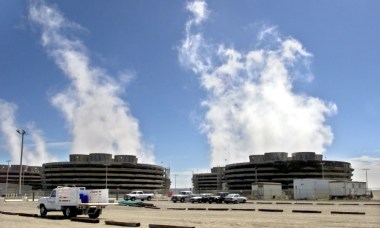
Columbia Generating Station
¶ New York Governor Andrew M Cuomo announced state-supported solar power in New York increased nearly 800% in five years, leveraging nearly $1.5 billion in private investment. Solar growth is critical to the Governor’s Clean Energy Standard that 50% of New York’s electricity come from renewable sources by 2030. [Eagle News Online]
¶ Injecting large amounts of offshore wind power into the grid is manageable, will cut costs, and will reduce pollution compared to current fossil fuel sources, according to researchers from the University of Delaware and Princeton University who completed a first-of-its-kind simulation with the electric power industry. [Science Daily]
geoharvey is free and without ads.
geoharvey is not tax-deductible.
Posted in nuclear power, renewable power, solar, wind | 1 Comment »
Tags: nuclear, nuclear power, renewable power, solar power, wind power
February 21, 2017
Science and Technology:
¶ Scientists have built a better flow battery. Using a predictive model of molecules and their properties, University of Utah and University of Michigan chemists developed a charge-storing molecule around 1,000 times more stable than current compounds. Their results are reported in the Journal of the American Chemical Society. [Phys.Org]

Flow battery in operation – color represents charge
¶ Research from the Colorado School of Public Health at CU Anschutz found a strong association between the diagnosis of acute lymphocytic leukemia among children and levels of nearby oil and natural gas development. Children living near oil and gas wells are far more likely to develop the leukemia than those that aren’t. [CleanTechnica]
¶ Researchers from the University of California Irvine studied data collected from 1991 to 2015 on glaciers found in the Queen Elizabeth Islands in the Arctic. They found that, from 2005 to 2015, surface melt off of these glaciers rose by 900% – something they say is attributable to warming air temperatures in the region. [CBC.ca]

Petermann Glacier in Greenland (NASA / NOAA / Aqua – MODIS)
World:
¶ The 497-MW EnBW Hohe See offshore wind farm off the coast of Germany is set to proceed, as Canadian energy infrastructure company Enbridge has decided to invest in the project, and German engineering company Siemens is committing for the first time to provide complete the project’s construction work. [CleanTechnica]
¶ Tocardo Tidal Power is preparing to deploy the InToTidal project at the European Marine Energy Centre in Orkney. The company said the Universal Foundation System is the start of Tocardo’s planned 20-year commercial demonstration project at the site. The semi-submersible platform features five 300-kW devices. [reNews]
Tocardo turbines (Tocardo image)
¶ South African utility Eskom is defying an “injunction” of president Jacob Zuma by attempting to negotiate tariffs with preferred bidders instead of signing existing PPAs, according to the South African Renewable Energy Council. The council says Eskom will “drag its feet wherever possible to resist signing … with renewable producers.” [PV-Tech]
¶ Wind energy developer Gamesa has reinforced its position in India with seven new orders totalling 278 MW. Gamesa has been ranked as the leading original equipment manufacturer in India for the last three years. The projects are scheduled for commissioning between March and October 2017. [Renewable Energy Magazine]
Gamesa wind turbines (Gamesa image)
¶ A survey by Essential on energy policy found that Australia’s Turnbull government is failing to persuade people of either its performance or its arguments on energy security. More than seven in ten (71%) said the government was not doing enough to ensure “affordable, reliable and clean energy” for households and businesses. [The Conversation AU]
¶ The additional costs intermittent renewables impose on the electricity system are “modest” according to a report published by the UK Energy Research Council. The UKERC said studies which found significantly higher costs are usually related to particularly inflexible systems, or where very little system re-optimisation was assumed. [reNews]
Kirkby Moor wind farm in Cumbria (Innogy UK Renewables)
¶ Saudi Arabia has launched the first stage of its ambitious renewables tenders, including 400 MW of wind projects and 300 MW of solar. The kingdom plans to have 3.45 GW of renewables by 2020 and 9.5 GW by 2023. The projects will be backed by power purchase agreements of 25 years for solar and 20 years for wind. [Power Engineering International]
¶ In Gujarat, subdued demand and surplus electricity availability reduced additions of new capacity for generating power from conventional power sources such as coal and gas. The installed generating capacity of non-renewable energy sources grew by just 0.7% in 2015-16, compared with 6.2% in 2013-14 and 5.2% in 2013-14. [ETEnergyworld.com]
Solar and wind power
¶ The prolonged closure of a major French atomic reactor after an explosion this month probably costs EDF at least £1 million a day, according to experts. The nuclear plant operator, which will spend £18 billion building the UK’s first new nuclear power station in a generation, shut unit 1 at its Flamanville plant after a fire in the turbine hall. [The Guardian]
US:
¶ Wind energy has become the largest renewable power sector in the United States, but its adoption has lagged in the Southeast. One of the reasons is that wind currents in the area are relatively weak. Wind turbines are becoming more efficient, however, and this may help bring new wind energy projects to the Southeast. [Hydrogen Fuel News]

Wind turbines at sunset
¶ The president of the University of Iowa announced that the UI will be coal-free by 2025. The university has already taken steps to reduce its dependence on coal; in 2008, it established seven “sustainability targets” to be achieved by 2020. Since the 2020 vision’s inception, the UI has managed to reduce its use of coal by 60%. [The Daily Iowan]
¶ Kevin de León has promised to lead the resistance to President Trump, and a new bill could make good on that promise. The California Senate leader has introduced legislation that would have the Golden State get 100% of its electricity from climate-friendly energy sources by 2045. The current renewable energy mandate is 50% by 2030. [KHOU.com]
geoharvey is free and without ads.
geoharvey is not tax-deductible.
Posted in nuclear power, renewable power, solar, wind | 1 Comment »
Tags: nuclear, nuclear power, renewable power, solar power, wind power
February 20, 2017
Opinion:
¶ “Easy as Two Plus Two: How to Regain our Democracy” • We can get our democracy back, and improve our lives as we do. If those who disapprove of the Washington establishment we have turn down residential thermostats by 2° F and drive two miles fewer per day, it will cost those who bought this government $10 billion per year. [Green Energy Times]
¶ “Expect to see more emergencies like Oroville Dam in a hotter world” • Like many extreme events, the Oroville emergency is a combination of natural weather likely intensified by climate change. California regularly sees “atmospheric rivers” that deluge the state with rainfall, but a hotter world will make them worse, scientists say. [The Guardian]
¶ “Jobs and Prosperity Are in Clean Energy, Not Destroying the Planet” • The Republican Party is almost entirely united in their claims that defunding, crushing, and abolishing the EPA as well as other regulatory measures will benefit the American people and the prosperity of the country overall. This could not be further from the truth. [Paste Magazine]
Destroying the planet
World:
¶ Africa will see a “solar revolution” comparable in scale to the rapid surge in mobile phone use there two decades ago, the head of the International Renewable Energy Agency predicts. Fast-dropping costs, plenty of sun, and a huge need for electricity where many are still without it, means solar has huge potential in Africa. [ETEnergyworld.com]
¶ Local Aboriginal tribes – the Ngadjuri and Nukunu – have both recognized and celebrated the abundance of South Australian wind and solar power resources. They added huge artworks to the base of two of the 105 massive wind turbines that will form the Hornsdale wind project outside Jamestown, near Port Pirie. [Aboriginal Art Directory News]
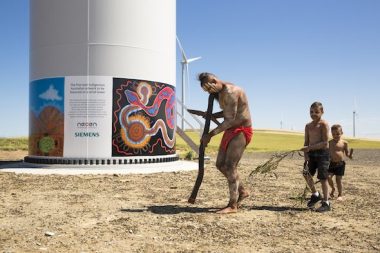
Celebrating wind power
¶ The number of applications for large-scale solar power projects to be connected to the Irish grid before 2020 has doubled over the last five months, as market confidence that the government is poised to subsidize the industry continues to grow. The projects range in size between 25 MW and 95 MW and now total almost 1.2 GW in capacity. [ICIS]
¶ One of the Australia’s biggest and most recent wind farms will conduct a major trail in South Australia in June to try to dispel one of the biggest myths about wind energy – that wind farms are unable to add to energy security. The intention is to show that wind farms can provide frequency control and ancillary services. [RenewEconomy]
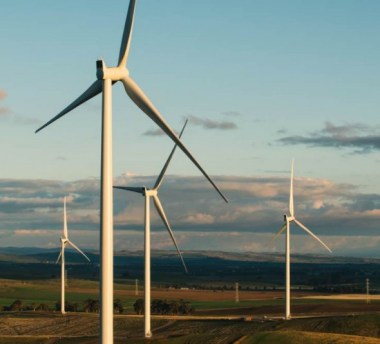
Hornsdale wind farm
¶ Three PV power plants with a combined capacity of 320 MW have begun construction in the southeastern Australian state of Victoria. A joint venture between Overland Sun Farming and the UK’s Island Green Power is behind the A$500 million ($384 million) project, which is going ahead despite the its not having yet signed PPAs. [pv magazine]
US:
¶ Hundreds of scientists, some in lab coats, held a rally in Boston Sunday to draw attention to their concerns about the Trump administration’s policies. Speakers and signs criticized those in the administration who deny that climate change is real, who question the collection and distribution of data on science, and other policies. [Inside Higher Ed]

Scientists Protest
¶ The Governors’ Wind & Solar Energy Coalition, a bipartisan group of the country’s governors, currently representing twenty states, sent an open letter to President Donald Trump, calling on him to support development of wind and solar energy. The letter was written by the governors of Rhode Island and Kansas, on behalf of the Coalition. [Windpower Engineering]
¶ Conservation advocates are celebrating Presidents Day at rallies in Las Vegas and in Carson City. They’re calling on the Nevada Legislature to pass Assembly Bill 206. The bill would raise the renewable portfolio standard to require utilities to generate 50% of their power from renewables by the year 2030, and 80% by 2040. [Public News Service]
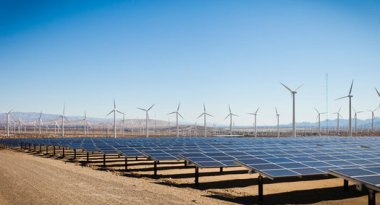
Nevada wind and solar (adamkaz / iStockphoto)
¶ Nebraska’s Net Metering laws are currently very restrictive. As they stand, the laws only allow for the development of 25 kW of solar and place a cap on each respective utility at 1% for the amount of renewables that can be developed. Senator Carol Blood hopes to address this issue with LB 87 and raise the net metering limit. [1011now]
¶ Business is booming for solar companies in Maryland, as sun-sourced energy becomes more affordable and accessible. The state added 1,160 solar jobs in 2016. This is a 27% jump from the previous year, bringing the industry’s employment to more than 5,400, according to an annual solar jobs census by the Solar Foundation. [Baltimore Sun]
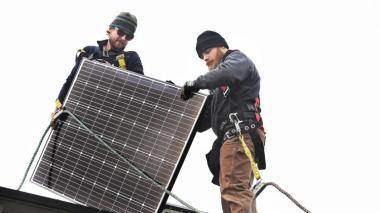
Installing solar panels (Kenneth K. Lam / Baltimore Sun)
¶ Nevada lawmakers will debate a number of energy-related issues soon, including the state’s renewable portfolio standards and efficiency programs. NV Energy, a major utility in the area, is asking regulators to boost incentives for rooftop solar customers, arguing that it would make solar economically advantageous for customers. [Las Vegas Sun]
¶ Toshiba had been contracted to build the third and fourth reactors for US utility NRG Energy’s South Texas Project, taking the Japanese manufacturer’s advanced boiling water reactors abroad for the first time. Toshiba looks to pull out of the project, and will decide later what to do with its developing stake in the joint venture. [Nikkei Asian Review]
geoharvey is free and without ads.
geoharvey is not tax-deductible.
Posted in nuclear power, renewable power, solar, wind | 1 Comment »
Tags: nuclear, nuclear power, renewable power, solar power, wind power
February 19, 2017
Science and Technology:
¶ Scientists revealed that the extent of the Antarctic sea ice has shrunk and is getting increasingly erratic. According to the British Antarctic Survey, this year’s minimum sea ice level in the region is the smallest so far. Meanwhile, another report disclosed that the latest recorded sea ice extent had been the lowest in the last 38 years. [Telegiz News]

Record minimum Antarctic sea ice (Robert Woods, US Navy)
World:
¶ A competitive auction for the 750-MW solar power park in Rewa, Madhya Pradesh, has yielded the lowest-ever tariff for a solar power project in India. The three units of the solar power park have been awarded at tariffs of ₹2.970 to ₹2.979 per kWh (4.4¢/kWh). The lowest bid was placed by ACME Cleantech Solutions. [CleanTechnica]
¶ Hundreds of protesters have gathered outside government offices in Bangkok since Friday to demonstrate against a decision to green-light a 800-MW coal plant on the coast of Krabi, a region known for its beaches and natural beauty. The three protest leaders were detained by police on and handed over to the military. [ETEnergyworld.com]

Loading coal
¶ As coal’s future in Australia continues to dominate the national political debate, returns lodged by “third party campaigners” to the Australian Electoral Commission show a little-known group called ACA Low Emissions Technologies Limited, which is a promoter of coal mining interests, was one of the top spenders. [Bombala Times]
¶ An Australian company says it will build solar and battery facilities in South Australia this year with enough storage capacity to meet the power shortfall that caused blackouts in the state 10 days ago. A partner of Lyon Group said he was “very confident” his firm would install two 50-MW battery storage facilities this year. [The Australian Financial Review]
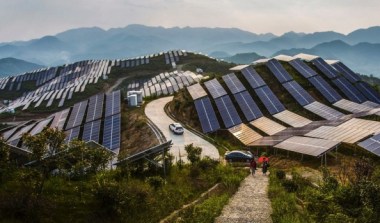
Solar PV panels in China’s Fujian province (AP)
¶ Australia is considering altering legislation to enable funds for clean energy developments to be used to bankroll construction of new low emission, coal-fired power plants. This comes after a major power outage during a heat wave in South Australia state worsened a row with the national government over energy security and renewable power. [AsiaOne]
¶ The air Indians breathe is turning more toxic by the day and an average of two deaths happen each minute due to air pollution, says a new study based on 2010 data. According to medical journal The Lancet, over a million Indians die every year due to air pollution and some of the worst polluted cities of the world are in India. [thenortheasttoday.com]

Air pollution in India (Internet sources)
¶ Before a robot investigating the state of a reactor at Fukushima Daiichi became stuck in deposits and other debris that are believed to have interfered with its drive system, it took radiation measurements that indicate TEPCO, operator of the plant, was too optimistic about the state and location of the melted fuel within the reactor. [Asahi Shimbun]
¶ Strong winds and stormy seas have helped the Shetland Islands produce more power than it knows what to do with. The tidal power underwater turbines that were completed last month are only the latest green energy project. Even homeowners are acting, putting in small wind turbines in their gardens and solar panels on their roofs. [ETEnergyworld.com]
US:
¶ The threat of a catastrophe at California’s Oroville Dam may be over. California’s Department of Water Resources lifted the evacuation order. But the dam’s troubles have also temporarily brought down one of the state’s major renewable energy assets, likely replacing 819-MW of hydro capacity with natural gas for a time. [POWER magazine]
¶ An energy trade association that includes Apple supports a proposal that would make it easier to participate in wholesale markets for energy storage and distributed energy resources. Advanced Energy Economy hopes that the removal of barriers on energy storage at the regulatory level will make it easier and cheaper to store energy. [9 to 5 Mac]
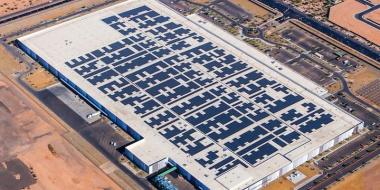
Apple facility in Mesa, Arizona
¶ The Iowa Lakes Regional Water board of directors hopes renewable energy will a great fit for a water and wastewater treatment plant. The district is trying to offset rising electrical costs. They hope teaming with Trusted Energy will lead to status as a net producer of clean energy, putting excess production on the power grid. [Dickinson County News]
¶ A 3.9-MW solar array is being installed by GenPro Energy Solutions in Lexington, Nebraska on a site owned by the city. Once operational, the power generated by the system of nearly 12,600 panels will meet about 3% of the city’s annual needs. The city also purchases power from Nebraska Public Power District. [Lexington Clipper Herald]

Lexington’s solar array (C-H photo, Malena Ward)
¶ Earlier this month, the Massachusetts Department of Energy Resources accepted 30 new cities and towns into the state’s Green Communities program, an initiative that provides grants to municipalities that adopt a series of energy efficiency policies and set a goal of reducing their energy consumption by 20% within five years. [SouthCoastToday.com]
¶ Nevada lost over 2,500 rooftop solar installation jobs in 2016 after less generous net metering rates were approved by the state Public Utilities Commission. Both the Assembly and the Senate have created special subcommittees on energy to focus on ways to make rooftop solar financially attractive for homeowners again. [Las Vegas Review-Journal]
geoharvey is free and without ads.
geoharvey is not tax-deductible.
Posted in nuclear power, renewable power, solar, wind | 2 Comments »
Tags: nuclear, nuclear power, renewable power, solar power, wind power
February 18, 2017
Opinion:
¶ “Americans rally to support wind power” • Hundreds of Americans from across the country traveled to Washington, DC to show their support for wind energy. AWEA CEO Tom Kiernan penned an op-ed in The Hill looking at why they decided to make the trek. Here are a few highlights and a link to the original article. [Into the Wind – The AWEA Blog]

Wind power
¶ “Australian Conservatives Attack Chief Scientist For Failing To Toe Fossil Fuel Party Line” • Australia’s conservative media commentators have found a new target for their anti-renewables angst, this week launching what was regarded as an almost inevitable attack, on Alan Finkel – Australia’s chief scientist. [CleanTechnica]
¶ “Is peak oil demand coming faster than expected?” • The expansion of electric vehicles and solar power could curtail growth in the world’s demand for fossil fuels by 2020, putting the future of the some of the world’s leading energy companies into jeopardy, according to a study released by a British climate change research center. [Houston Chronicle]

Charging stations (Photo: Paul Chinn, Staff)
¶ “Edsels of energy? Duke Energy may find new AP1000 nuclear plants are already outdated” • Duke Energy won long-pursued federal operating licenses for cutting edge nuclear power plants at sites in Florida and South Carolina. Duke has no current plans to proceed on either project. But the AP1000 is starting to look outmoded. [TBO.com]
World:
¶ The first phase of a solar array on the Caribbean island of St Eustatius, which has been operational since April 2016, already generates 23% of the island’s electricity, and this increases to even 90% at peak moments during clear, sunny days. The second phase of the solar panel field in St. Eustatius should be ready by this September. [The Daily Herald]

Saint Eustatius solar array
¶ Coal and gas dependent Queensland (it has just one large scale solar plant and no big wind farms) recorded over 40 more high-priced events than renewables-rich South Australia so far this year. Electricity from rooftop solar systems helped reduce grid stress and keep power prices down, but their owners were paid a pittance. [CleanTechnica]
¶ The Hibiki consortium, led by utility Kyuden Mirai, has won a tender to develop an offshore wind farm in southern Japan for about ¥175 billion ($1.5 billion). The group will build and operate the Hibikinada wind farm near the Port of Kitakyushu City in Kyushu island. The scheme is expected to have up to 44 turbines. [reNews]

Offshore wind turbines (reNews image)
¶ New South Wales is one of the most coal-dependent states in Australia, with renewable energy contributing less than 10% to its electricity mix on average. Over the weekend, however, wind and solar may just have helped keep the lights on. Solar power systems contributed more than 1 GW to the grid during much of the day. [CleanTechnica]
¶ The Victoria Labor government is calling for expressions of interest to build a 20-MW battery storage array, in what would likely be Australia’s first grid scale battery storage facility. The facility is earmarked for western Victoria, where the Australian Energy Market Operator has identified opportunities to improve grid stability. [RenewEconomy]
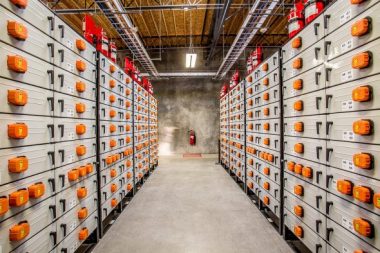
Battery storage array
¶ Institutions in Hamburg are proposing to build a large underground thermal heat storage system that could supply roughly a quarter of the city’s heating needs with waste heat from industrial and power plants. If successful, it could make Vattenfall’s plans to realise a CO2-neutral district heating network superfluous. [CleanTechnica]
¶ For the first time, the total installed capacity of wind energy in Europe now exceeds that of electric power plants fueled with coal. That imbalance is likely to grow as more wind generation comes online over the next decade, both on land and offshore. The statistics, collated by WindEurope, were posted by Navigant Research. [Green Car Reports]
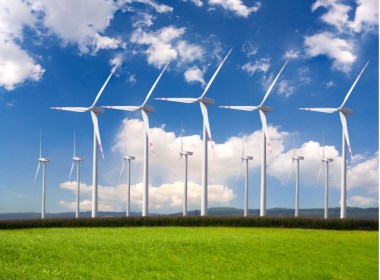
Wind farm
¶ EU member states have approved a €90 million grant for a compressed air energy storage project in Larne in Northern Ireland. The Larne project converts excess energy from renewable generation into compressed air to be stored in geological caverns within salt layers underground for later release to generate electricity. [reNews]
US:
¶ A coalition of dozens of local lawmakers, environmental groups, and businesses is urging the New York state Public Service Commission to maintain fair rates for power sold from so-called “community solar” projects. Larger than the typical rooftop system, such systems can have many owners, rather than just one. [Albany Times Union]

Solar panels in Halfmoon, NY (Skip Dickstein/Times Union)
¶ The GM plant in Arlington, Texas makes more than 1,000 SUVs a day. While these vehicles tend to burn more gas, the plant where they’re made will be entirely powered by wind energy by the end of 2018. The Arlington facility already gets about half of its power from wind, and reaching 100% sets GM on its path to the larger goal. [Yale Climate Connections]
¶ EPB has started construction on Solar Share, Chattanooga’s first community solar installation through a partnership with the Tennessee Valley Authority. By summer, Solar Share is expected to begin generating 1.35 MW of solar power, which is enough to meet the needs of about 200 average households in the area. [WDEF News 12]
geoharvey is free and without ads.
geoharvey is not tax-deductible.
Posted in nuclear power, renewable power, solar, wind | Leave a Comment »
Tags: nuclear, nuclear power, renewable power, solar power, wind power
February 17, 2017
Science and Technology:
¶ The future is expected to hold more deadly heat waves, the fast spread of certain infectious diseases and catastrophic food shortages. These causes of premature deaths are all related to climate change, according to a panel of experts who gathered at the Carter Center in Atlanta on Thursday for the Climate & Health Meeting. [CNN]

Climate change is driving drought.
World:
¶ First Solar, Inc announced that Photosol, a French PV company, has selected its thin-film modules to power 14 utility-scale solar power plants with a total capacity of 106.5 MW DC. The projects, developed and owned by Photosol, are part of the third procurement round initiated by France’s Commission de Régulation de l’Energie. [Your Industry News]
¶ In scoring the sustainable energy policies of 111 countries, the World Bank finds Mexico, China, India and Brazil are emerging as leaders in the field, delivering robust policies to support energy access. However, there is vast room for improvement, particularly in sub-Saharan Africa where 600 million people have no electricity. [pv magazine]
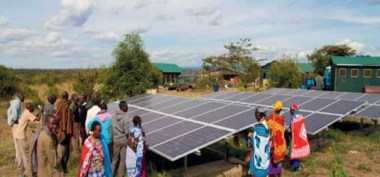
Many developing nations have proactive energy policies.
¶ The first phase of Gannawarra, which has been approved for 300 MW and is being co-developed by Solar Choice and Edify Energy, is set for construction in north-western Victoria. The solar farm’s first phase is slated for completion in early 2018. Its capacity will be about 60 MW, enough to power more than 25,000 Victorian homes. [RenewEconomy]
¶ It sounds like renewable energy might be going from a pipe dream to an investment theme. A new report from the McKinsey Global Institute estimates that renewables, primarily solar and wind, could jump from 4% of global power generation to as much as 36% by 2035, reshaping global electricity markets in the process. [Barron’s]

Wind farm (Photo: Sean Gallup / Getty Images)
¶ Federal and state energy ministers will today be told by the South Australia’s Weatherill Labor government that it will “retake control” of the state’s fragile power network so blackouts “do not happen again.” The Energy Minister said, “We are going to use every inch of our authority, everything we can, to retake our sovereignty.” [The Australian]
¶ The latest robot attempting to find the 600 tons of nuclear fuel and debris that melted down six years ago in the wrecked Fukushima Daiichi nuclear power plant met its end in less than a day. Scientists still don’t have all the information they need for a cleanup that the government estimates will take four decades and cost ¥8 trillion. [The Japan Times]
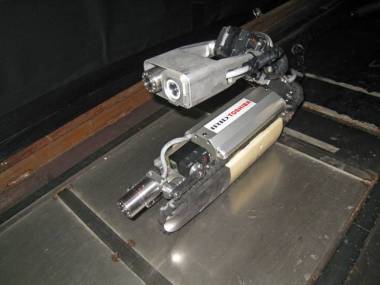
Robot developed by Toshiba Corp and the International Research Institute for Nuclear Decommissioning (Image: AFP-JIJI)
¶ Australia’s financial regulator has warned that climate change poses a material risk to the entire financial system, and has urged companies to start adapting. Geoff Summerhayes, from the Australian Prudential Regulation Authority, says it is unsafe for companies to ignore the potential physical risks of climate change. [The Guardian]
US:
¶ The San Diego County Board of Supervisors voted to accept a Comprehensive Renewable Energy Plan unanimously. The plan will give industries and communities an idea of where renewable energy projects would be best suited, reduce costs and alleviate some of the conflicts between property owners and developers. [Patch.com]
¶ The Minnesota Legislature sidestepped utility regulators and approved a new Xcel Energy power plant in central Minnesota. The Minnesota Public Utilities Commission had sidelined Xcel’s proposal, but the Legislature passed bills saying the plant can move forward without researching renewable energy options. [Bristol Herald Courier]
¶ Consolidated Edison Development is continuing a fight to force a South Dakota utility to buy the output from three wind projects. Under the Public Utilities Regulatory Policies Act, a federal program designed to stimulate markets for small alternative energy generators, Northwestern Energy is required to buy the output at “avoided cost” rates. [reNews]
Wind farm (Morgue File)
¶ Nearly 800 former EPA officials urged the US Senate to reject President Donald Trump’s nominee, Scott Pruitt, to run the agency, as the chamber moved closer to approving his pick. The 773 former officials signed a letter that said Pruitt’s record and public statements suggest he does not agree with underlying principles of environmental laws. [AOL News]
¶ The state that gave us Scott Pruitt and James Inhofe just saw temperatures near 100° in the dead of winter. Climate change is loading the dice for record-breaking heat in Oklahoma. Here, the human fingerprint is clear. Carbon pollution traps heat, warming the planet. This, in turn, shifts the entire distribution of temperatures. [CleanTechnica]
¶ TransCanada Corp has rebooted its effort to build the Keystone XL oil pipeline across Nebraska, where it had met with opposition before it withdrew its application when the Obama administration denied the company a federal permit in late 2015. TransCanada’s latest move had been expected since Donald Trump was elected. [MarketWatch]
¶ President Donald Trump’s pick to head the EPA, Oklahoma Attorney General Scott Pruitt, will be forced to hand over more than 3,000 emails to the Center for Media and Democracy, a watchdog group, after a district judge ordered their release. The state’s Attorney General’s Office has until Tuesday, February 21 to turn over the emails. [DeSmog]
geoharvey is free and without ads.
geoharvey is not tax-deductible.
Posted in nuclear power, renewable power, solar, wind | Leave a Comment »
Tags: nuclear, nuclear power, renewable power, solar power, wind power
February 16, 2017
Opinion:
¶ “Solar vs Nuclear: Is this the Last Chapter?” • Last year’s solar deployment numbers just came in, and they are, in a word, phenomenal. Utilities bought more new solar capacity than they did natural gas capacity. At the same time, there is grim news about delays in construction and associated cost over-runs for US nuclear plant projects. [The Equation]

Neighbors with solar (Courtesy of Grid Alternatives)
Science and Technology:
¶ A study published this week in the science journal Nature found that the ocean’s worldwide oxygen content declined by more than 2% between 1960 and 2010. Scientists have long warned about the potentially deadly consequences of the ocean’s declining oxygen levels on marine life, and its resulting impact on humans. [CNN]
¶ Delivery vans get between 5 and 8 miles per gallon. Vans powered by Workhorse’s hybrid electric E-GEN powertrain have now completed 250,000 miles of service and have achieved an astounding 30 MPGe rating in daily, real life, stop and go operation. Workhorse calculates each van will save the owner $165,000 during its lifetime. [CleanTechnica]
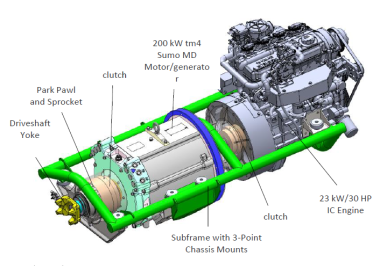
Workhorse E-GEN powertrain (Workhorse image)
World:
¶ The Indian government announced plans to double the energy output of its solar power parks. Their goal is to reach 100 GW of solar capacity by 2022. India believes it is more economical and effective to use solar parks to gather energy rather than rooftop solar panels. Comparatively speaking, the response to rooftop solar has been weak. [Sputnik International]
¶ A research paper examined the future of UK wind power. A simulation of changing wind resources by 2100 found that the UK’s capacity for generating wind power will become more changeable, with some regions benefiting and others losing out. The year-on-year variation of wind power capacity will increase, the authors say. [eco-business.com]

Greater Gabbard offshore wind farm, Suffolk, England (Image: Department of Energy and Climate Change, CC BY-NC-ND 2.0)
¶ China plans to develop floating nuclear power plants to ensure a stable power supply for its offshore projects and boost ocean gas exploration, according to a high-rank government official. The development of the floating power facility is an important part of China’s five-year economic development plan, running through 2020. [Chinatopix]
US:
¶ The latest US Solar Market Insight report from GTM Research and the Solar Energy Industries Association showed that 2016 almost doubled the installations of 2015, itself a record-breaking year. Solar installations grew 95%, for a total of 14,625 MW. With 39% of new capacity across all fields, with wind placing second at 25%. [CleanTechnica]

Growth in solar installations
¶ Maine Republican Senator Susan Collins said she will vote against President Donald Trump’s pick for EPA administrator, Scott Pruitt. Collins is the first Republican to break ranks over Pruitt. “The fact is, Mr. Pruitt and I have fundamentally different views of the role and mission of the EPA,” Collins said in a statement. [CNN]
¶ In 2015, Kansas City Power & Light decided to pony up $20 million to install 1,000 EV charging stations in and around the city. They are being installed in places people often visit in their daily lives. That program is now nearly complete and it has turned Kansas City into one of the fastest growing EV markets in America. [CleanTechnica]

KCPL Clean Charge (Image: Kansas Public Radio)
¶ All electric service providers in Michigan met their renewable energy targets, with wind providing most, a public commission found. Michigan’s governor had been criticized last year for suspending state efforts for the Clean Power Plan. The state standard had each utility get 10% of its electricity from renewable sources in 2015. [UPI.com]
¶ Avangrid Renewables has agreed a power purchase agreement with Dairyland Power Cooperative for electricity from the 160-MW Barton wind farm in Iowa. Under the terms of the deal, Dairyland, which provides wholesale electricity to 24 members and 17 municipal utilities, will buy 80 MW of power from the project. [reNews]
Wind turbine (credit: SXC)
¶ The city council of Pueblo, Colorado committed the city to 100% renewable energy by 2035. Pueblo is now the third city in Colorado and the 22nd in the nation to make the promise. The city doesn’t yet have a route for its destination, partly because it doesn’t have ownership of its electricity provider. It is looking at its options. [The Coloradoan]
¶ Moab, Utah officials say they have taken a major step toward creating a more sustainable city. The Moab City Council passed a resolution, committing to using 100% renewable electricity by 2032. The mayor said the move is driven by the community’s passion for Moab’s natural environment and a sustainable future. [RadioWest]
Moab, Utah (Saro17 via istockphoto.com)
¶ UPS will invest around $18 million in new onsite solar PV projects in the US, expected to be completed by the end of the year. The 26,000 solar panels will increase the company’s total onsite solar capacity almost five-fold. Altogether, the new projects will generate 10 MW, enough to power around 1,200 homes. [Climate Action Programme]
¶ Competitors of Chicago-based Exelon Corp filed a federal lawsuit opposing legislation that provides billions of dollars in subsidies to the power giant. The legislation approved in December provides as much as $235 million per year to Exelon to keep unprofitable nuclear plants running in Clinton and the Quad Cities. [PennEnergy]
geoharvey is free and without ads.
geoharvey is not tax-deductible.
Posted in nuclear power, renewable power, solar, wind | Leave a Comment »
Tags: nuclear, nuclear power, renewable power, solar power, wind power
February 15, 2017
Opinion:
¶ “An Oroville message: As climate shifts, so will water strategies” Even when everything is going right, managing a large dam is a juggling act. What the flooding this week at California’s Oroville Dam may be demonstrating is how that juggling act is growing even more complicated due to climate change. [Christian Science Monitor]

Oroville dam (Randy Pench / The Sacramento Bee via AP)
¶ “Local energy groups do a power of good” • Remember the outcry against wind farms? These days commercial wind harvesters are a lot more strategic when planning wind farms. They involve nearby communities from the get-go, opening up limited shareholdings to some rural communities in Australian wind farm companies. [Weekly Times Now]
Science and Technology:
¶ A study conducted by the University of Queensland found that climate change has greater impact on lives of animals than reported. The team led by Associate Professor James Watson has found concerning evidence showing that nearly 700 birds and mammals have responded to the climatic changes in a negative way. [Tech Times]

Mountain gorillas are among the most
affected (Brent Stirton / Getty images)
World:
¶ Saudi Arabia plans to develop almost 10 GW of renewable energy by 2023, starting with wind and solar plants in its vast northwestern desert. The effort could replace the equivalent of 80,000 barrels of oil a day now burned for power. With growth in industry, Saudi peak demand increased 10% last year. [Hellenic Shipping News Worldwide]
¶ Carbridge, the onsite provider of airport ground transportation services for the Sydney Airport, announced that it has placed orders for 40 more pure electric buses from BYD. The contract was finalized at the end of January – just 3 months after the first BYD Electric Blu bus was first put to use at the Sydney Airport. [CleanTechnica]

BYD electric bus at Sydney harbor
¶ In a move that further illustrates the company’s commitment to being a socially responsible corporation, French multinational electric utility Engie announced that it will join Watts of Love in a critical initiative to bring sustainable solar lighting to remote villages in Guatemala without any access to electric power. [Your Renewable News]
¶ The construction value of UK offshore wind farms reached a record £4.1 billion in 2016, up from £2.45 billion the previous year, according to construction industry analysts Barbour ABI. The trend is likely to continue for offshore wind developments, with £23.2 billion worth of construction contract value now in planning. [reNews]
London Array (Credit: reNews)
¶ Taiwan’s President Tsai Ing-wen (蔡英文) announced plans to use renewable power sources to provide 20% of the nation’s energy by 2025. The government intends to phase out all nuclear power plants by 2025 and announced last October plans to shut down Nuclear Power Plant No 1 in New Taipei City by 2019. [Taiwan News]
¶ Genex Power Limited achieved financial close for the Kidston Phase One Solar Project in Queensland, Australia, on land next to the proposed Kidston pumped storage project. First Solar will supply 63 MW of advanced thin-film PV modules. The project will produce about 145,000 MWh of electricity in its first year of operation. [Electric Light & Power]

Australian solar array
¶ In the UK, MPs have urged the Secretary of the Department for Business, Energy and Industrial Strategy to open price support negotiations for Tidal Lagoon Power’s 320-MW Swansea Bay project. 107 MPs have signed a letter to Clark following the publication last month of the Hendry Review commissioned last year by the then DECC. [reNews]
US:
¶ Coal power is no longer the best energy bargain. And on Monday, the four private utility owners of the Navajo Generating Station, led by the Salt River Project, voted to shut down the plant at the end of 2019, some 25 years ahead of schedule. The closure will deeply hurt the employees, 90% of whom are Native American. [Grist]
Navajo Generating Station (Shutterstock image)
¶ While the Trump administration appears to have affection for the fossil fuels industry, some states are moving in a different direction, especially on plug-in electric vehicles (PEV). From Massachusetts and New York to California, they and are setting, and achieving, goals to put PEVs on the road, replacing those that burn fossil fuels. [CleanTechnica]
¶ Dominion Energy is ahead of schedule with its plans to build 400 MW of solar power in Virginia by 2020. The company is investing more than $800 million in solar in the state, and said additional projects are now in the planning stages. The additions of solar power would have little effects on power rates, according to a spokesman. [reNews]
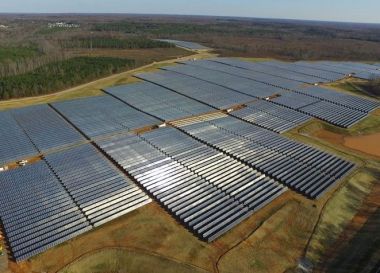
17-MW Powhattan solar array (credit: Dominion)
¶ Democratic lawmakers proposed legislation to move Nevada away from fossil fuels more quickly than planned. Democratic Assemblyman Chris Brooks of Las Vegas introduced a bill this week that would double the amount of renewable energy Nevada will mandate by 2025, raising the goal to 50%. [U.S. News & World Report]
¶ Cost overruns at Georgia’s Plant Vogtle nuclear power plant are threatening a financial tsunami at Toshiba Corp. The company projected a $6.3 billion write-down, postponed its earnings report because of allegations of impropriety, and announced that its chairman was resigning – all on the same day, the Wall Street Journal reported. [Atlanta Business Chronicle]
geoharvey is free and without ads.
geoharvey is not tax-deductible.
Posted in nuclear power, renewable power, solar, wind | Leave a Comment »
Tags: nuclear, nuclear power, renewable power, solar power, wind power
February 14, 2017
Opinion:
¶ “How Did the Oroville Dam Crisis Get So Dire?” • On Sunday, authorities ordered 188,000 people near the Oroville dam in California to evacuate. Extreme weather, which scientists say was exacerbated by human-caused climate change, moved from drought to saturated in just months, filling a reservoir to levels that proved dangerous. [The Atlantic]
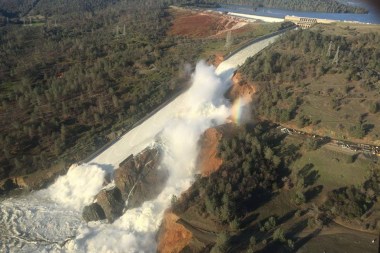
Spillway at the Oroville dam (California
Department of Water Resources via Reuters)
Science and Technology:
¶ A report in Ward’s Auto dated February 7th says EV battery prices are falling faster than expected and could be lower than the magic $100 per kWh mark by 2020. A US Department of Energy goal of achieving a price of $125 by that year is turning out to be much too conservative. Some experts are expecting $80 per kWh. [CleanTechnica]
World:
¶ Enel Green Power reported that it added a record-breaking 2,018 MW of renewable energy capacity last year, a 124% increase from around 900 MW capacity added in 2015. Understandably, a good majority of the new capacity was added in developing markets, including Brazil, Mexico, Chile, South Africa, and others. [CleanTechnica]
¶ China installed a total of 23 GW of wind energy in 2016, nearly half the total 54 GW that was brought online around the world. China continues to expand its lead over its nearest competitors, the United States and Germany. The worldwide total of 54 GW installed brings the global cumulative total up to nearly 487 GW. [CleanTechnica]
¶ Farmers across Australia are choosing to invest in on-farm renewable energy sources to cut costs and reduce reliance on electricity providers. While farm lobby groups have stepped up their campaign to reduce electricity costs, some irrigators are taking things into their own hands and have adopted solar panels to help cut expenses. [ABC Online]

Solar panels for irrigation (ABC Rural / Bridget Fitzgerald)
¶ One of Australia’s largest operators of coal-fired power plants has weighed into the national energy debate, calling for a non-partisan push to clean energy and reminding policy makers that the shift to renewables is “a reality” that must be addressed. The managing director said the way the country generated energy “had to change.” [RenewEconomy]
US:
¶ ABB is to provide an innovative microgrid, combining battery and flywheel based storage technologies, to around 300,000 people in Anchorage, Alaska. The small scale project aims to identify technologies that enable integration of renewables, such as wind power from a 17-MW wind farm on a nearby island. [Renewable Energy Magazine]

Anchorage
¶ NV Energy announced that the 50-MW Boulder Solar II power plant, which was developed, designed, and built by SunPower, achieved its commercial operation status and is now serving NV Energy customers in Nevada. Boulder Solar II is one of 43 diverse renewable energy projects providing power to NV Energy. [solarserver.com]
¶ An innovative project developed at the University of Vermont has received a $1.8 million award from the US DOE’s SunShot Initiative. It is for research aimed at improving the electric grid’s ability to accommodate power generated from renewable energy sources. The award is one of only 13 to be awarded nationally. [Vermont Biz]
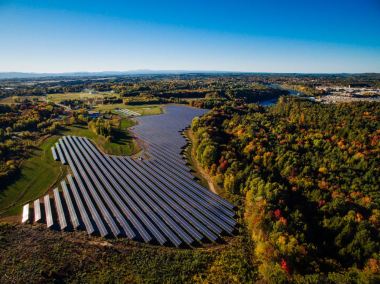
The 4.7-MW solar project in Williston, Vermont (groSolar photo)
¶ The entire supply chain of the solar and wind industries, including those who manufacture, install and run turbines and panels, now employs 476,000 workers. Meanwhile fossil fuel companies employ 187,117 people. Solar energy, which provides a small percentage of American energy needs, creates twice as many jobs as the coal industry. [OilPrice.com]
¶ Massachusetts would need to get all of its energy from renewable sources by the year 2050 under legislation filed last month. That legislation is now backed by more than a quarter of state lawmakers. The bill would make Massachusetts the first state to commit to 100% renewable energy throughout its economy. [wwlp.com]
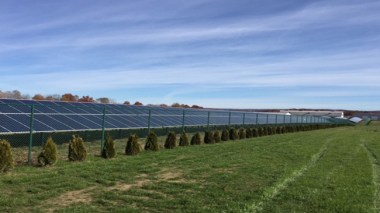
Solar array in Massachusetts
¶ A group of governors from both ends of the political spectrum is urging President Donald Trump to support renewable energy, saying it provides crucial economic engines for impoverished rural regions. The Governors’ Wind & Solar Energy Coalition is seeking to modernize local power grids and boost clean-energy research. [NorthJersey.com]
¶ Xcel Energy will spend $4 million on a test project in Colorado. The utility is installing special batteries around Stapleton, which has one of Denver’s highest concentrations of rooftop solar panels. Currently, power from those panels returns straight to Xcel’s larger electricity grid. Now the batteries will store power until it is most needed. [Denverite]

A photo simulation showing green cabinets at locations
where the batteries in Stapleton will be (Courtesy Xcel)
¶ Southwest Power Pool set a wind-penetration record of 52.1% at 4:30 a.m., Feb. 12, becoming the first regional transmission organization in North America to serve more than 50% of its load at a given time with wind energy. The milestone beats a previous North American RTO record of 49.2% that SPP set April 24, 2016. [Satellite PR News]
¶ A bill before the Connecticut Senate would presumably give Dominion Energy the ability to compete for long-term energy contracts. Dominion owns the Millstone Nuclear Power Plant in Waterford. A similar bill was introduced at the last-minute and passed by the state Senate last year without a public hearing process. [CT News Junkie]
geoharvey is free and without ads.
geoharvey is not tax-deductible.
Posted in nuclear power, renewable power, solar, wind | Leave a Comment »
Tags: nuclear, nuclear power, renewable power, solar power, wind power
February 13, 2017
World:
¶ Officials told Malcolm Turnbull a major gas plant shut down during the freak storm that sent South Australia into blackout last September. Documents obtained by the progressive think-tank the Australia Institute suggest a failure of gas power played a significant role in both the blackout and efforts to restart after the storm event. [The Guardian]

Torrens Island plant (Photo released to the
public domain by the author; Wikimedia Commons)
¶ An Australian company boasting what it claims to be cutting-edge technology is raising $12 million from wealthy investors to develop a series of 1-MW generators that convert wave energy into electric power. Australian Maritime College claims the technology is 60% more efficient than previous ocean-wave/air-turbine generators. [The Australian]
¶ India has an opportunity to shift completely to green energy, a study by The Energy and Resource Institute said. If the country can halve storage technology prices in 10 years, it can do without the need for new coal based plants. The report said capacity that is installed or under construction would be able to meet demand till about 2026. [ETEnergyworld.com]

Azure Power array in India
¶ Opposition politicians in Queensland, South Australia, and Victoria promised to axe state renewable energy targets after Prime Minister Turnbull called for a unified national approach. This comes despite revelations that he ignored confidential public service advice that renewables were not responsible for power blackouts in South Australia. [The Fifth Estate]
¶ With the end of load shedding, the South African government is now more committed to the Independent Power Producers Program, President Jacob Zuma said in his State of the Nation Address to the National Assembly and National Council of Provinces in Parliament. He said work is continuing to ensure energy security. [Bizcommunity.com]
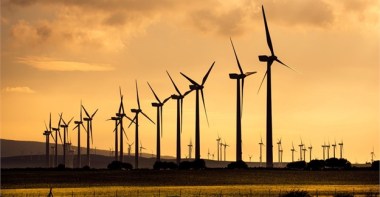
South African wind turbines (© Sandor-Jackal / za.fotolia.com)
¶ A coal price spike last year, driven by a Chinese regulation that capped local mining operations, has shown how easily markets can swing from oversupply to shortfall. While many analysts and investors see the long-term outlook for coal as bleak, the shorter-term outlook for the industry has seen a reversal of fortunes. [Hellenic Shipping News Worldwide]
US:
¶ A Hawaiian utility co-op is aiming to produce 70% of its energy from renewables by 2030. The Kauai Island Utility Cooperative had already set a target of 50% renewables by 2023 but is set to hit that goal 2018, five years earlier than expected. As recently as 2011 KIUC had a 92% dependency on fossil fuels for generation. [Co-operative News]
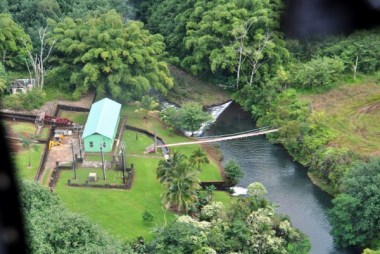
A hydro generator run by KIUC
¶ Maui Electric Co is marching toward 100% renewable energy for Maui County, Hawaii, and without an undersea interisland cable, the utility’s president said. Maui County residents have told MECO plainly that they don’t support an undersea cable to transmit electricity among islands, but she said MECO can reach 100% without it. [Maui News]
¶ A Montana solar farm would produce 80 MW of electricity, enough for 14,400 homes. It would be built on trust land, so Montana’s public schools would receive money from the lease. It would provide over $1 million taxes. But it might not happen. The Legislature is considering weakening state laws that support renewable energy. [San Francisco Chronicle]
Renewable energy in Montana is mostly wind power.
(Photo by David J Laporte, Wikimedia Commons)
¶ New Hampshire is behind most of its neighbors in use of renewable energy, and several groups are using this legislative session make sure it stays behind. Led by the Americans for Prosperity, founded by billionaire Koch brothers, they support a bill that would pull the state out of the Regional Greenhouse Gas Initiative. [Foster’s Daily Democrat]
¶ If you want to understand why Toshiba Corp is about to report a multi-billion dollar write-down on its nuclear reactor business, the story begins and ends with a onetime pipe manufacturer in Louisiana. The Shaw Group Inc, based in Baton Rouge, looms large in a story of business acquisitions and lack of experience. [The Japan Times]
geoharvey is free and without ads.
geoharvey is not tax-deductible.
Posted in nuclear power, renewable power, solar, wind | Leave a Comment »
Tags: nuclear, nuclear power, renewable power, solar power, wind power
February 12, 2017
Opinion:
¶ “Scott Pruitt’s Misleading Senate Testimony: Will ‘Alternative Science’ Replace Real Science at EPA?” • Scott Pruitt, President Trump’s pick to head the US Environmental Protection Agency, is misrepresenting the scientific data clearly showing that the earth’s atmosphere is warming. He said he believes that global warming is in a “hiatus.” [Energy Collective]

Earth, from a NOAA weather satellite (Photo: NOAA / NASA)
Science and Technology:
¶ Friday’s temperatures very near the North Pole are about 50° F warmer than normal, according to a temperature analysis by NOAA. The warmth is being funneled toward the North Pole as winds converged winds between a monster storm in the North Atlantic and a giant area of high pressure over northern Europe. [Washington Post] (Thanks to Tad Montgomery)
World:
¶ In the Philippines, the Cebu Provincial Board has urged all electric cooperatives in the province to consider the use of renewable energy as an alternative source of power. The board cited language of an act that encourages exploring the use of renewable energy such as solar, wind, hydro, geothermal, biomass, and ocean energy. [Philippine Star]
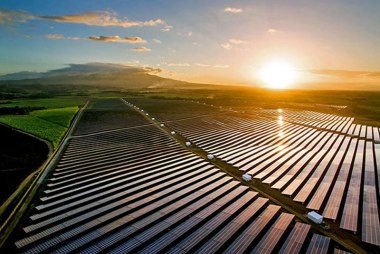
Addressing the challenge of climate change, energy
security and access to energy (Philstar.com / File)
¶ More than 20 Australian large renewable energy projects are already under construction or will start this year, delivering an unprecedented program of works. It will create almost 3000 direct jobs and generate more than $5 billion of investment, according to new analysis from the Clean Energy Council released on Sunday. [Daily Liberal]
¶ Bangladesh is betting on coal to support its quickly growing economy, even as other countries in Asia try to shift away from the dirty fuel amid a pollution crisis. The government hopes coal use will jump from 2% to over 50% of the Bangladesh’s electricity supply by 2022, with 23,000 MW of new coal powered plants in the pipeline. [Scroll.in]

Protesting coal in Bangladesh (Image: Wikimedia Commons)
¶ Higashi-Matsushima City was one of the areas worst-hit by the tsunami that killed some 18,000 people on March 11, 2011. It is moving entire neighborhoods to higher ground, maintaining peoples’ ties to each other. It has a 2-km no-build zone along the shoreline. And it is turning to renewable sources for its electric power. [Japan Today]
¶ Sri Lanka has opened its first hybrid power plant in Eluvathivu Island in Jaffna. The plant has a capacity of 60 KW and generates electricity using wind, solar and diesel. It had financial assistance from the Asian Development Bank and the Ceylon Electricity Board for the project, which cost 187 million Sri Lankan rupees ($1.87 million). [ETEnergyworld.com]

Wind and solar power
¶ The Ceylon Electricity Board secured funding from the Asian Development Bank for a 100-MW wind farm in the north-western district of Mannar. Tenders to build it are expected to be floated within two months. The Mannar location could be able to generate 375 MW of wind power, and private capital could the rest. [The Island.lk]
¶ Europe’s top utilities are planning to invest tens of billions of euros over the next three years to catch up with the green energy revolution. The rise of solar and wind power has increased the need for intelligent IT systems that can balance out demand and supply swings while meeting energy needs and carbon emissions targets. [Gulf Times]
US:
¶ Fixing leaks from natural gas lines, capping power-plant emissions, and providing incentives for switching to electric vehicles are among new aims for reducing greenhouse gas emissions in Massachusetts. New regulations target especially the energy and transportation sectors to reduce emissions by 7.2% over the next three years. [Eagle-Tribune]
¶ Recently, one of the largest construction cranes on the planet gently hoisted a 750-ton steam generator into place for a new reactor at the VC Summer Nuclear Station. The heavy lifting isn’t over. It could be just beginning for the $14 billion project, with unanswered questions about Westinghouse, the reactor designer. [Charleston Post Courier]

Huge crane at the VC Summer nuclear plant
¶ ISO New England agreed to buy only half of the electricity for 12 months of 2020 and 2021 from the proposed 900-MW Burrillville fossil-fuel power plant in Rhode Island. While some say this points to a lack of need for the plant, the developer interpreted the news to mean the power plant will be most needed after 2020. [ecoRI news]
¶ A group of American students, one as young as nine, is suing President Trump over the US government’s climate-change policy that they claim puts their future in jeopardy. His policies have his administration opposed to an overwhelming majority of scientists who say use of fossil fuels is causing destructive climate change. [The Independent]
geoharvey is free and without ads.
geoharvey is not tax-deductible.
Posted in nuclear power, renewable power, solar, wind | Leave a Comment »
Tags: nuclear, nuclear power, renewable power, solar power, wind power
February 11, 2017
Science and Technology:
¶ A new type of battery has the ability to revolutionize all the smart devices that rely on storage electricity. Harvard professors at the Engineering Faculty created a flow battery that stores the energy in primary molecules dissolved in water with a neutral pH. The new battery has a long life, losing 1% of its capacity after 1,000 charge cycles. [Stоck Nеws USА]
Flow battery in laboratory
World:
¶ According to media reports, the state government of Andhra Pradesh is considering setting up a floating solar project of 100 MW of capacity. The project could come up at Penna Ahobilam Balancing Reservoir which has a live capacity of 305 million cubic meters. The dam also has an installed capacity of 20 MW. [CleanTechnica]
¶ Enel Green Power will shortly commence construction of the largest solar power installation in South America, at 292 MW. Located in Piauí in the Brazilian state of Nova Olinda, the solar panel farm will cover 1,700 acres and will generate more than 600 GWh of electricity a year, enough to power 300,000 area homes. [CleanTechnica]

Enel solar farm in Brazil (Ciclovio image)
¶ Encouraged by Chinese and EU commitments to low carbon energy, European utilities will not reduce their renewable energy investments if US President Donald Trump lowers US climate goals, electricity lobby Eurelectric said. Trump said during the campaign he would pull the US out of the Paris agreement of 2015. [ETEnergyworld.com]
¶ The EU will need to shut all of its coal power plants in the next 15 years if it is to meet the Paris agreement’s long-term climate goals, according to a report by Climate Analytics. A stress test for coal in Europe under the Paris Agreement shows that emissions from coal in the EU’s electricity sector will need to be ended by 2031. [The Actuary]

Coal plants will have to close. (©Shutterstock)
¶ Oriental Renewable Solutions has formed a 50:50 equity partnership with GreenWish Partners to co-develop a 50-MW solar PV project in Jigawa State, Nigeria. The Jigawa solar project will have an output of around 96 GWh per year. It will create 300 jobs during construction and 25 permanent jobs during operations. [PV-Tech]
¶ The Global Wind Energy Council released its annual market statistics: the 2016 market decline somewhat from 2015. It was more than 54 GW, bringing total global installed capacity to almost 487 GW. The market was led by China, the US, Germany, and India, and it had surprisingly strong showings from France, Turkey and the Netherlands. [EU Reporter]

Wind farms continue to grow.
¶ Indian solar tariffs hit a new low of ₹2.97 per unit (4.44¢/kWh) at the completion of bidding for three 250 MW units of Madhya Pradesh’s Rewa Solar Power Plant, continuing a steady downward trend in prices. Though low tariffs are good news for consumers, experts believe that their record low levels may spell trouble for the industry. [The Hindu]
¶ Ireland is facing a bill of up to €75 million each year after official predictions that it will fall short of its EU renewable-energy targets. The country is one of only four currently in the European bloc that is expected to miss its legally binding 2020 goals, according to European Commission forecasts released this week. [thejournal.ie]
Dark times on a wind farm
¶ A remotely controlled robot sent in to inspect and clean at a damaged reactor at Japan’s Fukushima nuclear plant had to be pulled early when its onboard camera went dark, the result of excess radiation. The abbreviated mission suggests that radiation levels inside the reactor are even higher than was reported last week. [Gizmodo Australia]
US:
¶ Former President Jimmy Carter leased 10 acres of his land to Atlanta-based SolAmerica to develop a 1.3-MW solar farm in Plains, Georgia. The project is projected to produce more than
55 million kWh of energy in the next 25 years. The project will provide more than half of the power needs for the 683 residents of Plains. [EcoWatch]

The 1.3-MW solar farm in Plains (SolAmerica image)
¶ The EPA’s website has begun to transform under Trump’s leadership. Researchers found that Federal climate plans, tribal assistance programs, and references to international cooperation have been stricken. A mention of carbon pollution as a cause of climate change has also been removed and adaptation has been emphasized. [CleanTechnica]
¶ A New Mexico State Senator wants electric companies in New Mexico to go for low cost power sources, and he wants the state to use more renewable energy. He introduced a bill that would require publicly owned electric utilities to choose the least-costly alternative when proposing purchases of new energy sources. [New Mexico Political Report]

A solar array at Nellis Air Force Base (Photo: Wikicommons)
¶ Oklahoma added almost 1,200 MW of wind capacity in the last three months of 2016, as it passed California to take third place among the states for wind capacity. The American Wind Energy Association released its latest market report amid a policy discussion in Oklahoma over state incentives and taxes relating to wind power. [Public Radio Tulsa]
¶ Amazon Web Services has committed to getting 100% of the energy used for its cloud data centers from renewable energy sources. Amazon said it is on track to exceed its 2016 goal of 40% renewable energy use. AWS said it plans to be powered by 50% renewable energy by the end of 2017. [Puget Sound Business Journal (Seattle)]
geoharvey is free and without ads.
geoharvey is not tax-deductible.
Posted in nuclear power, renewable power, solar, wind | Leave a Comment »
Tags: nuclear, nuclear power, renewable power, solar power, wind power
February 10, 2017
Opinion:
¶ “An Unlikely Union With The Power To Transform The Energy Economy” • Legacy utility companies are increasingly finding themselves eclipsed by startups that are quick to experiment with new and more effective technologies. Energy leaders who gathered in Dubai are determined to turn those adversaries into allies instead. [Huffington Post]

The sun is rising
World:
¶ India has reached another major milestone in its renewable energy sector. The Ministry of New & Renewable Energy has announced that the country’s operational grid-connected clean power capacity surpassed 50 GW. More than half of this capacity comes from wind power, with solar energy coming in second. [Hydrogen Fuel News]
¶ Greenhouse gas emissions fell 38% in the UK from 1990 to 2015, the National Statistics authority said. The decline of emissions is one of the fastest by any developed country, almost surpassing the European Union target of 40% carbon pollution cuts. Widespread closure of coal power plants was a key for the reduction. [Climate Action Programme]

Tower Bridge
¶ Australia’s Clean Energy Finance Corporation has said it is “very unlikely” it would invest in new coal-fired generators and poured cold water on a federal government push to support “clean coal.” This means the government will have to change the CEFC’s investment rules or directly subsidize new coal plants if it wants to support them. [The Guardian]
¶ Energy efficiency in the Western Balkans, Albania and five countries formerly in Yugoslavia, is to get a €30 million ($31.9 million) boost. The European Bank for Reconstruction and Development and the EU are stepping up joint efforts for the next phase of the Regional Energy Efficiency Program. [Energy Live News – Energy Made Easy]
Town in Albania (Shutterstock image)
¶ This week as India was crossing the 50-GW threshold for cumulative installed renewable energy capacity (excluding large hydro), the initial bids for its first major solar auction of 2017 were announced, and came in as low as ₹3.59/kWh (5.37¢/kWh). That’s down 16% year on year against the previous record low bid. [RenewEconomy]
¶ The UK’s government was accused of trying to kill off the solar energy industry just as it is about to become one of the cheapest suppliers of electricity. The Government’s own projections say that soon only onshore windfarms would provide less costly power, but the Conservatives pledged in their election manifesto to “halt their spread.” [Belfast Telegraph]
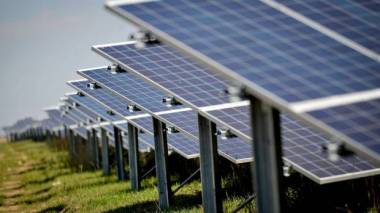
UK solar array
¶ A fire led to a blast in the machine room of a nuclear power plant on France’s northwest coast on Thursday morning but there was no radiation leak or casualties, operator EDF said. The Flamanville plant in Normandy immediately brought the fire under control. The cause of the fire, in a reactor building, was not immediately clear. [CBS News]
US:
¶ The first wind farm in North Carolina is now 100% operational even though the state’s top politicians wanted President Donald Trump to nix the $400 million project because they said it’s a national security threat. Avangrid Renewables today announced the wind farm is now generating power, enough to provide for 61,000 homes. [CIO]
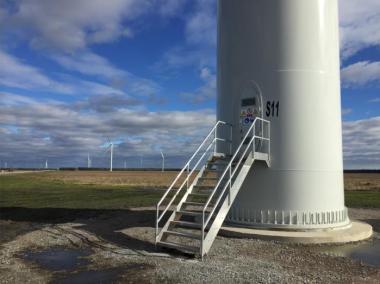
Tower base in North Carolina (Avangrid Renewables image)
¶ The troops are mobilizing for a second “deployment.” The Veterans Stand group is once again raising funds for protesters who oppose construction of the Dakota Access Pipeline. The funds will go toward supplies for the North Dakota protest camp and transportation of veterans to and from Standing Rock Indian Reservation and operations. [CNN]
¶ New figures from the American Wind Energy Association show that the United States installed a total of 8,203 MW in 2016. As a result, wind energy has now surpassed hydropower to become the largest source of renewable electric capacity in the United States, and the fourth largest source overall, with a total of 82,183 MW. [CleanTechnica]
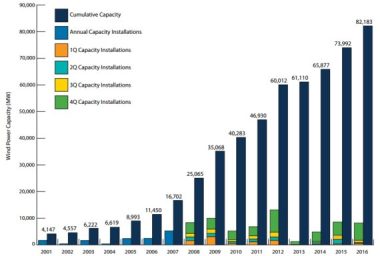
US Annual and Cumulative Wind Power Capacity Growth
¶ The Climate Reality Project will hold a Climate & Health Meeting on February 16 in Atlanta, Georgia, in partnership with the American Public Health Association and the Harvard Global Health Institute. The event will provide a crucial platform for stakeholders in the public health and climate communities to seek solutions. [CleanTechnica]
¶ A pair of proposals from a Nebraska state senator aim to help those who want renewable power but who do not have a good site for it. One would establish guidelines for shared community solar programs, and another would create a process for counties to be designated as “wind-friendly” by state agencies. [Omaha World-Herald]

GE wind turbines in Nebraska (Matt Dixon / The World-Herald)
¶ In an auction, Invenergy failed to sell the second half of the power output of its proposed power plant in Rhode Island. This is a blow to the controversial power plant, which would burn primarily natural gas, and undermines Invenergy’s claim that the region needs the facility of up to 1,000 MW as older generators retire. [The Providence Journal]
¶ Duke Energy Renewables completed its large-scale wind power plant in Oklahoma. The 200-MW Frontier Wind-power Project increases Duke Energy’s US wind capacity to 2,300 MW. Vestas supplied 61 turbines, each of 3.3 MW. Wanzek Construction was the contractor, and Amshore US Wind provided development support. [Windpower Engineering]
geoharvey is free and without ads.
geoharvey is not tax-deductible.
Posted in nuclear power, renewable power, solar, wind | Leave a Comment »
Tags: nuclear, nuclear power, renewable power, solar power, wind power
February 9, 2017
Opinion:
¶ “All The King’s Men Cannot Put King Coal Together Again” Even before the new administration took over, it had been widely argued that coal plants would continue shutting down irrespective of whether the Clean Power Plan was implemented. Old coal plants are retiring, and new ones are not being installed. [Hellenic Shipping News Worldwide]

Declining capacities of new coal plants were
going to zero before the Clean Power Plan
¶ “‘America First’ Energy Plan Challenges Free Market Realities” During President Barack Obama’s term in office, much of the focus was on addressing climate change and renewable energy. Trump is focused on coal, oil, and gas and putting the people who extract them to work. But experts say coal is simply too costly to be competitive. [KUNC]
World:
¶ Renewable energy made up nearly nine-tenths of new power added to Europe’s electricity grids last year, in a sign of the continent’s rapid shift away from fossil fuels, Euractiv’s media partner The Guardian reports. Of the 24.5 GW of new capacity built across the EU in 2016, 21.1 GW (86%) was from wind, solar, biomass and hydro. [EurActiv]
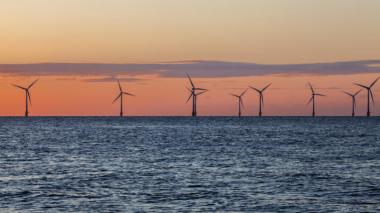
Wind farms accounted for over half
of the capacity installed. (Shutterstock)
¶ Chile’s Environmental Assessment Service has approved Mainstream Renewable Power’s 245-MW Escondido Solar PV facility, making it one of the largest approved projects in the Atacama region. It will involve an investment of $290 million to construct and is split into two solar parks located separately. [Power Engineering International]
¶ Many renewable power generation technologies are now cost competitive with fossil fuels, according to a report by Lloyd’s Register. The report examines the outlook for renewables, grid and infrastructure, nuclear, and energy storage. It found that 70% of renewables respondents felt the sector is reaching cost parity with fossil fuels. [reNews]

Onshore wind farm (credit: MorgueFile)
¶ Australian energy provider AGL Energy is looking to invest in large-scale battery storage installations as a potential alternative to new gas peaking plants, suggesting that storage will play a critical role in the changing nature of the electricity grid. AGL had an overwhelming response to market testing for large-scale battery storage. [RenewEconomy]
¶ European wind power grew 8%, to 153.7 GW, now making up 16.7% of installed capacity and overtaking coal as the continent’s second-biggest potential source of energy, according to figures published by the WindEurope trade group. Gas-fired generation retained the largest share of installed capacity, though it is not growing. [Bloomberg]
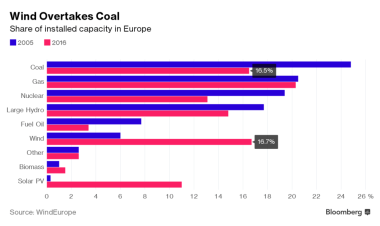
Wind and coal are moving in opposite directions.
¶ Just north of Provost, Alberta, you can see 17 wind turbines, each 80 meters tall, poking their heads above the aspen tree line. They are powering the future of Alberta’s children. In a unique agreement, the Bull Creek Wind Farm, with a 29-MW capacity, provides 500 schools around Alberta with 100% of their energy needs. [Huffington Post Canada]
¶ Vattenfall’s 54.4-MW Ray wind farm in Northumberland has generated power for the first time 18 months after construction began. The wind farm near Kirkwhelpington features 16 Senvion turbines each rated at 3.4-MW. Ray will produce enough power every year to meet the equivalent electricity needs of around 30,000 UK households. [reNews]
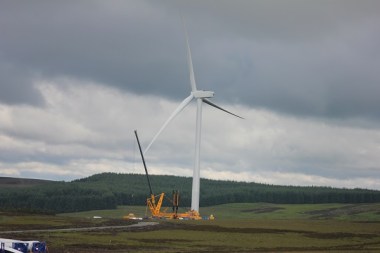
Ray wind farm (Vattenfall image)
¶ Flood-prevention measures are lacking at ten Japanese nuclear power plants, utilities’ inspections have revealed. The Nuclear Regulation Authority told nuclear power companies to inspect reactor buildings and certain other important equipment after 6.5 tons of rainwater entered a reactor building in September of 2016. [The Japan Times]
¶ The first turbine at the 402-MW Dudgeon offshore wind farm off the Norfolk coast has started supplying electricity to the UK grid. A2Sea jack-up Sea Challenger completed the installation of the first 6-MW Siemens turbine a month ago and the remaining 66 machines are expected to be installed by the fourth quarter of this year. [reNews]
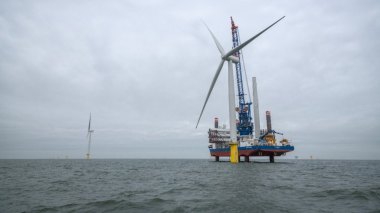
Offshore wind installation (Statoil image)
US:
¶ On February 7th, the Seattle City Council voted unanimously to stop doing business with Wells Fargo Bank. This is because Wells Fargo has investments in the companies behind the Dakota Access pipeline project. Seattle currently does about $3 billion a year in business with Wells Fargo. The pipeline has 17 investors. [CleanTechnica]
¶ The US Army Corps of Engineers has granted an easement in North Dakota for the controversial Dakota Access Pipeline, allowing the project to move toward completion despite the protests of Native Americans and environmentalists. Long against the project, the Standing Rock Sioux Tribe promised a legal fight. [CNN]

Activist at Standing Rock Sioux Reservation
¶ The city of San Diego issued permits for over 2,200 solar energy systems last year, compared to just over 1,200 the year before, according to the mayor’s office. City officials credited lower costs, technological innovations and streamlined solar permit processing services for the increase in the numbers of permits. [Times of San Diego]
Solar panels in Southern California (Courtesy LA Solar Group)
¶ The Department of Military and Veterans Affairs finalized a contract to build a solar panel farm that will provide Fort Indiantown Gap, Pennsylvania, with clean renewable solar energy for the next 20 years. This will reduce the facility’s power demand costs and is expected to provide annual power needs for 525 homes. [Proud Green Building]
geoharvey is free and without ads.
geoharvey is not tax-deductible.
Posted in nuclear power, renewable power, solar, wind | 1 Comment »
Tags: nuclear, nuclear power, renewable power, solar power, wind power
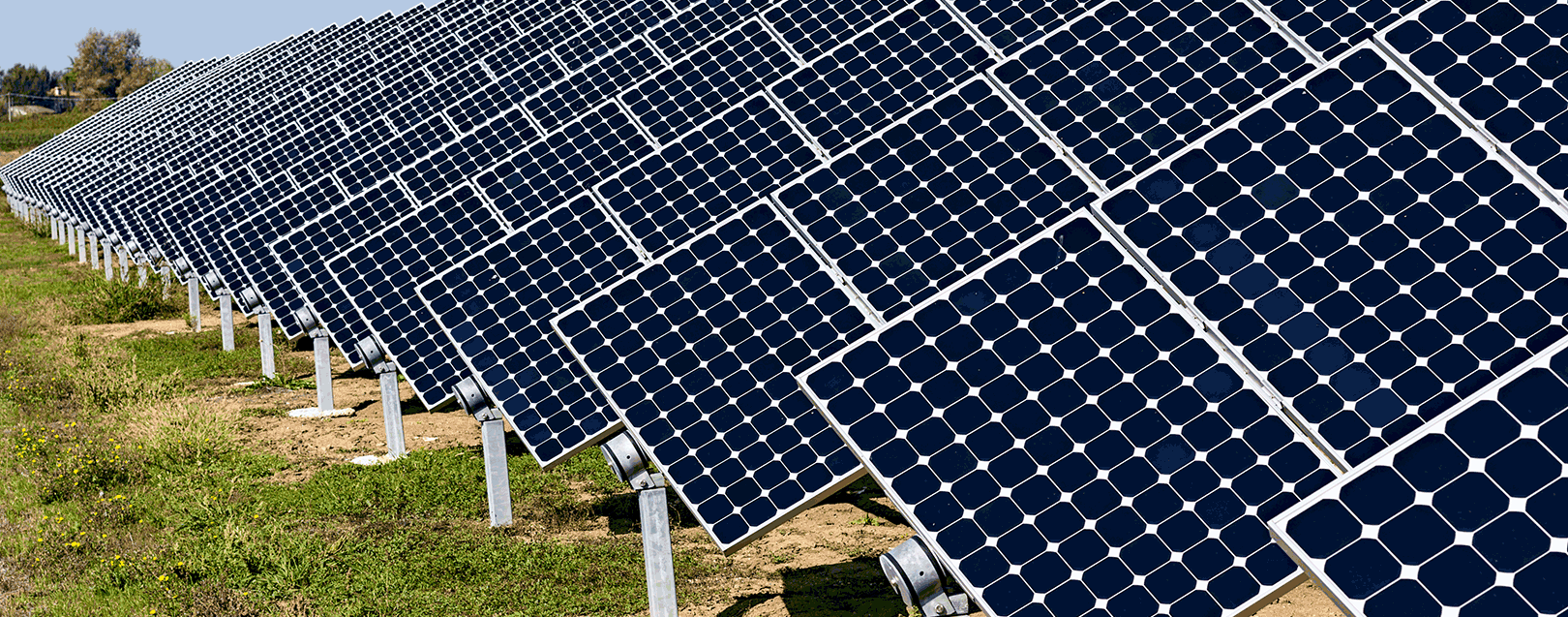


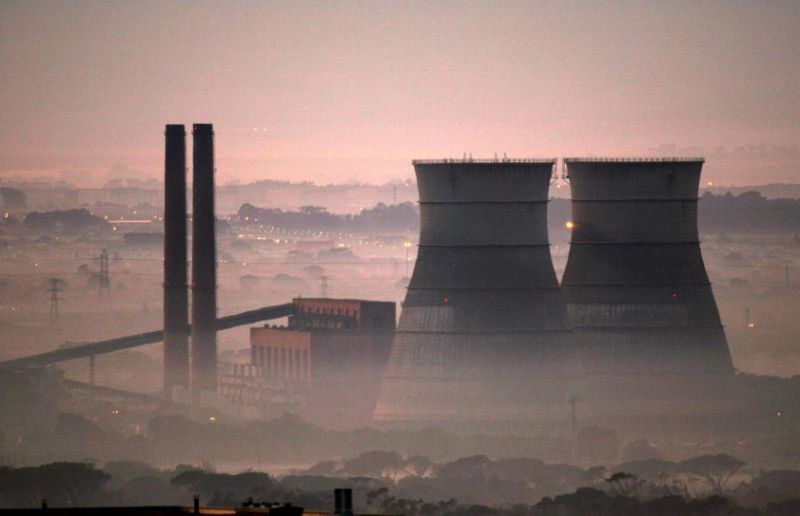


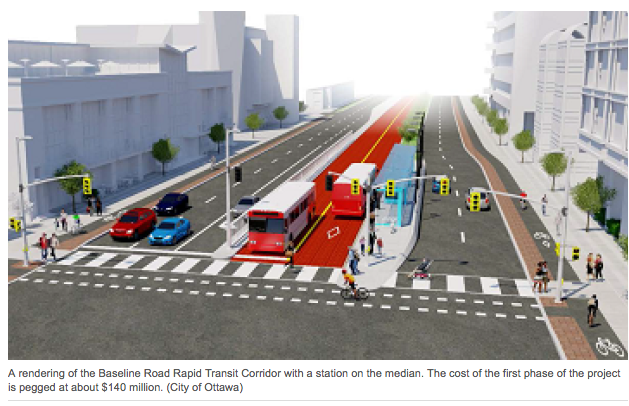

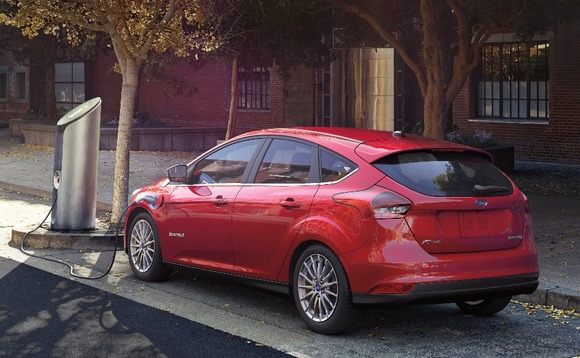
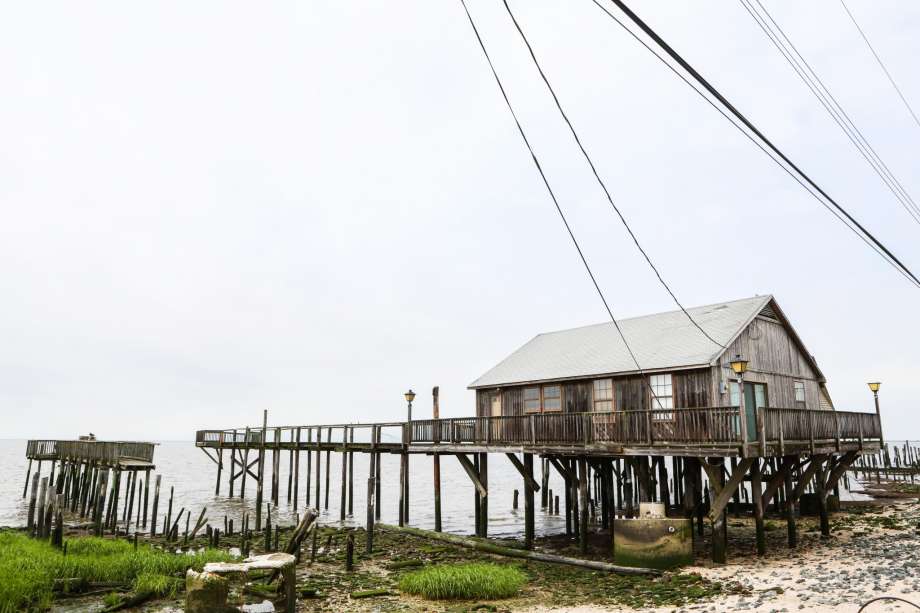
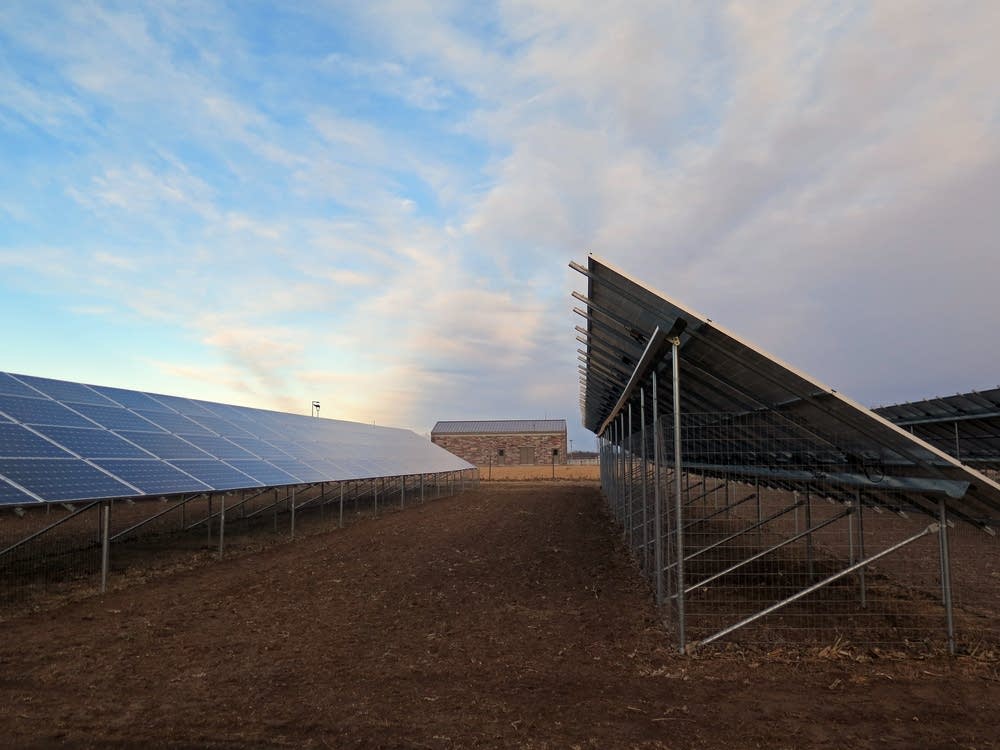






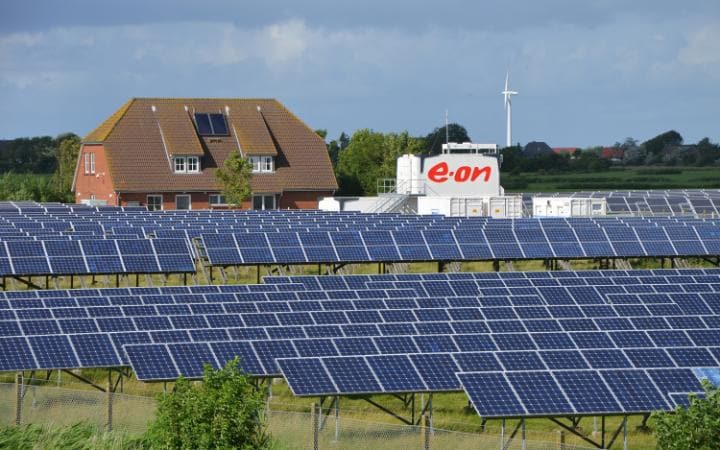


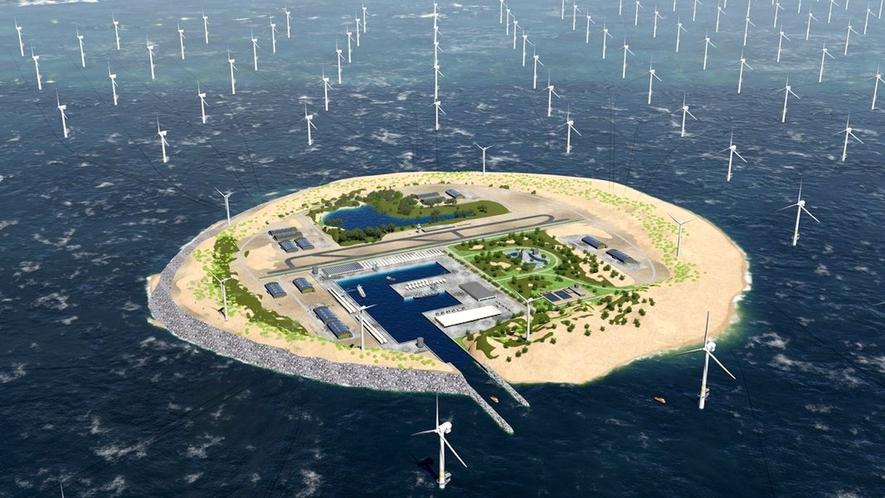

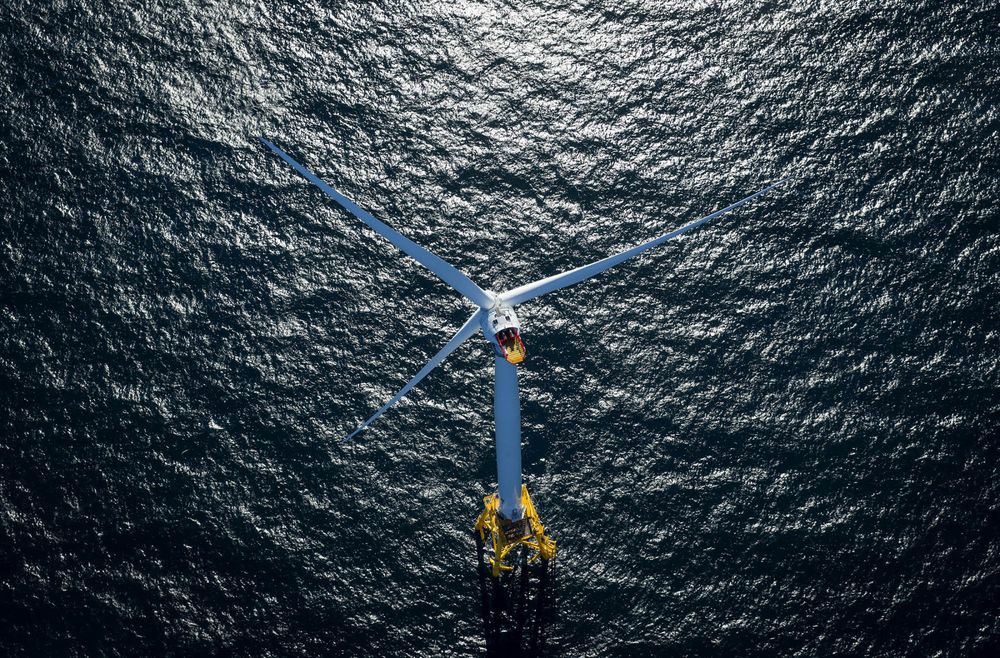


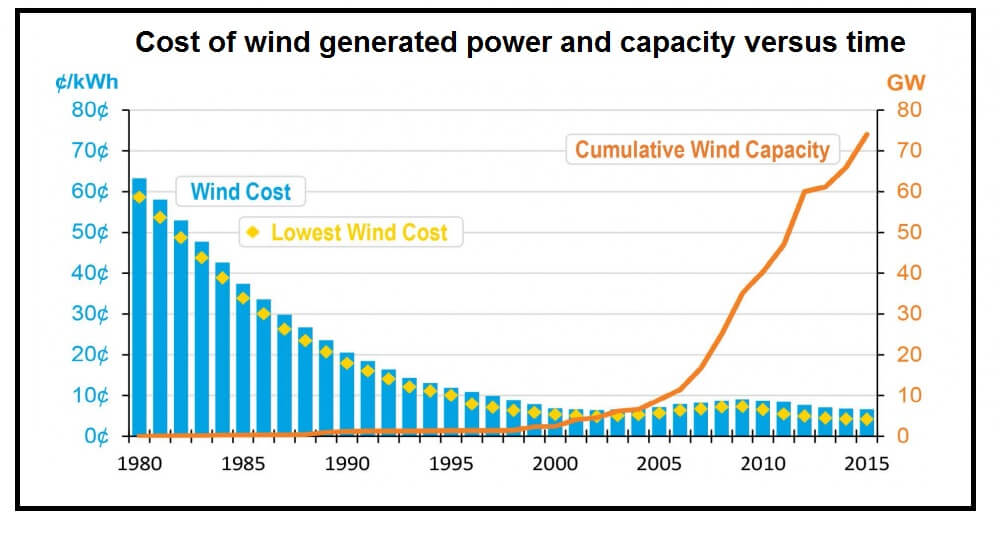


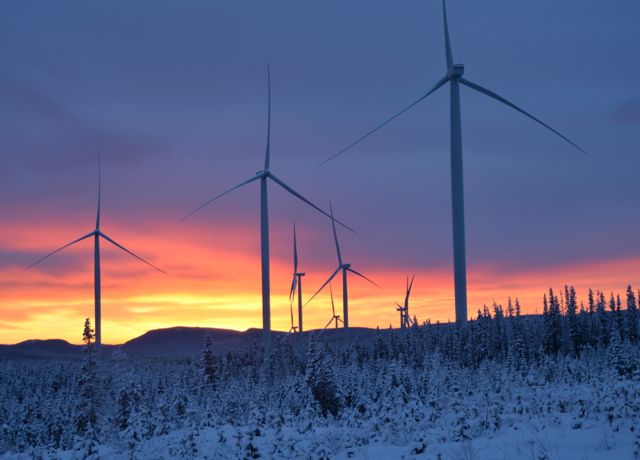

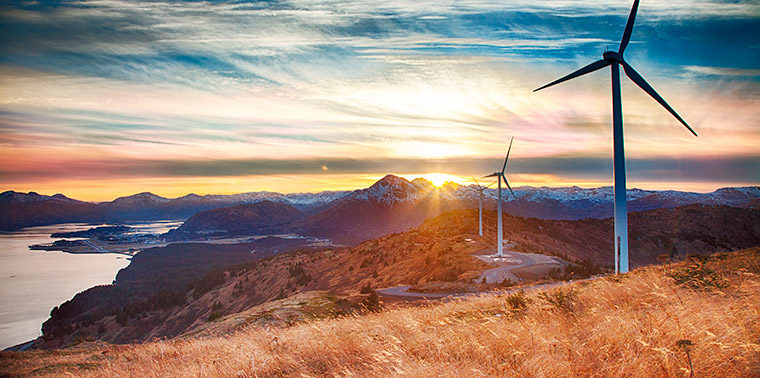
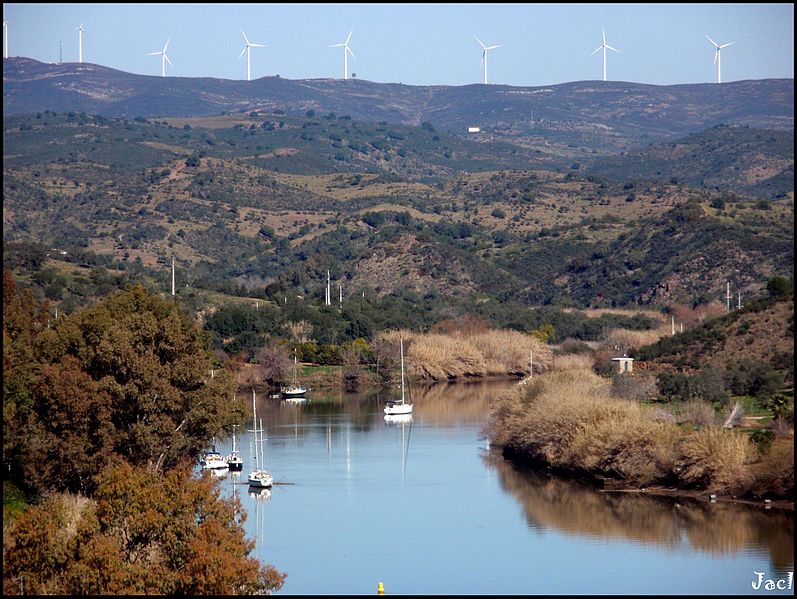


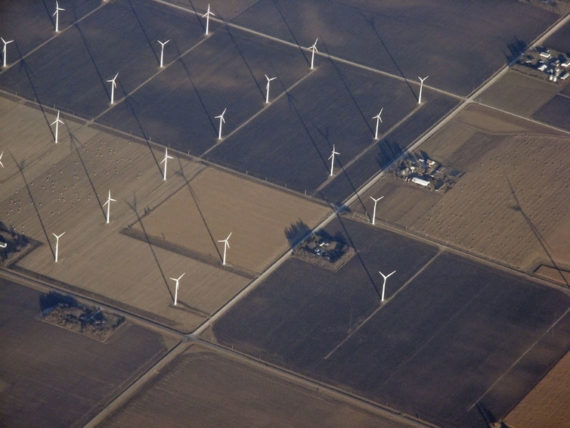

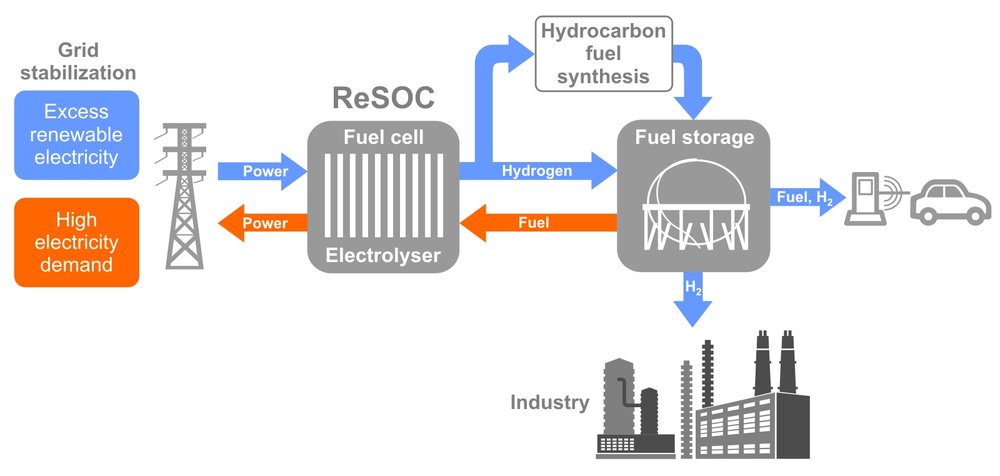
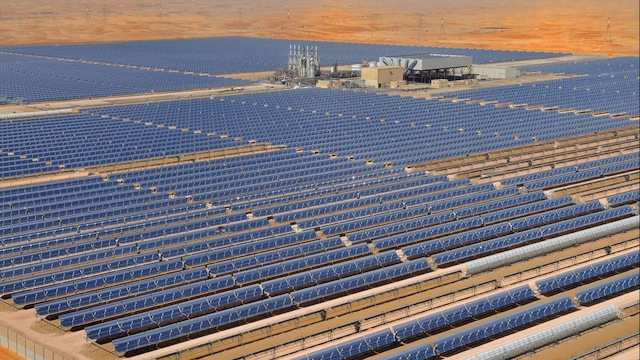
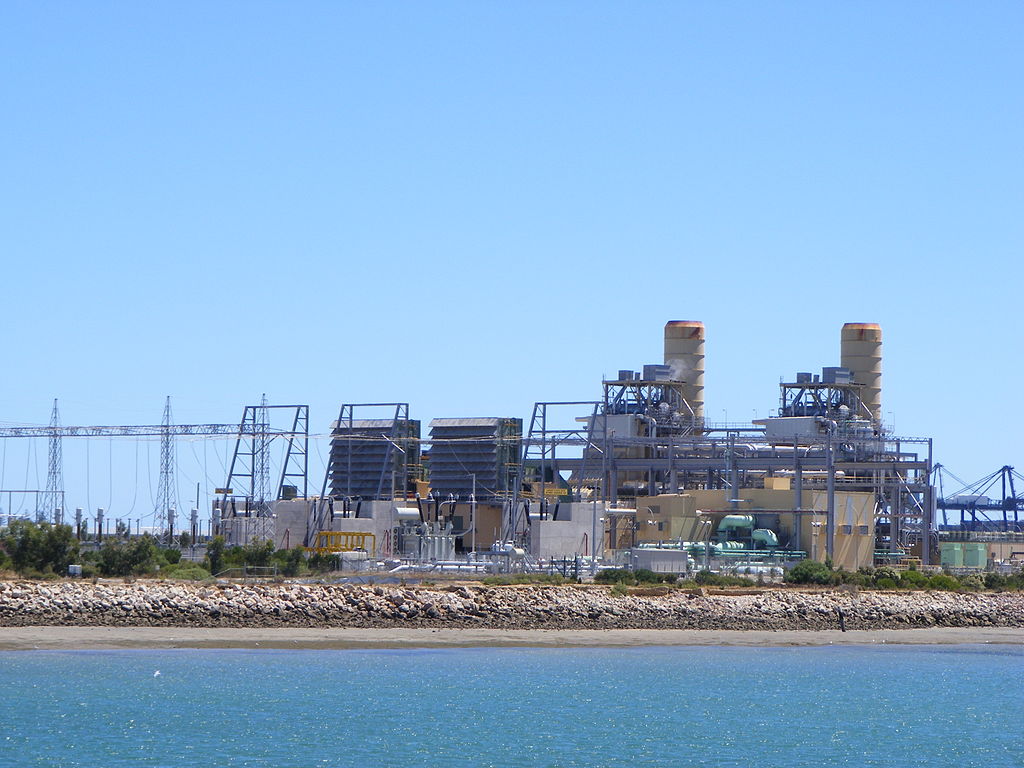


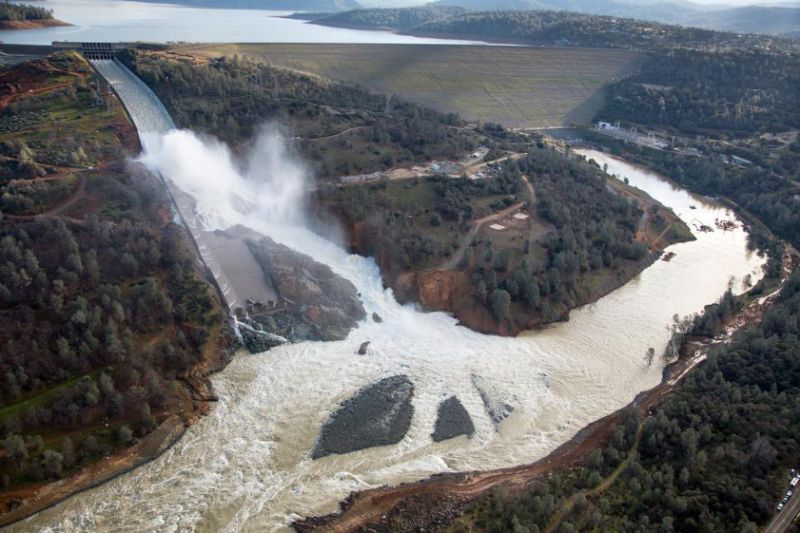
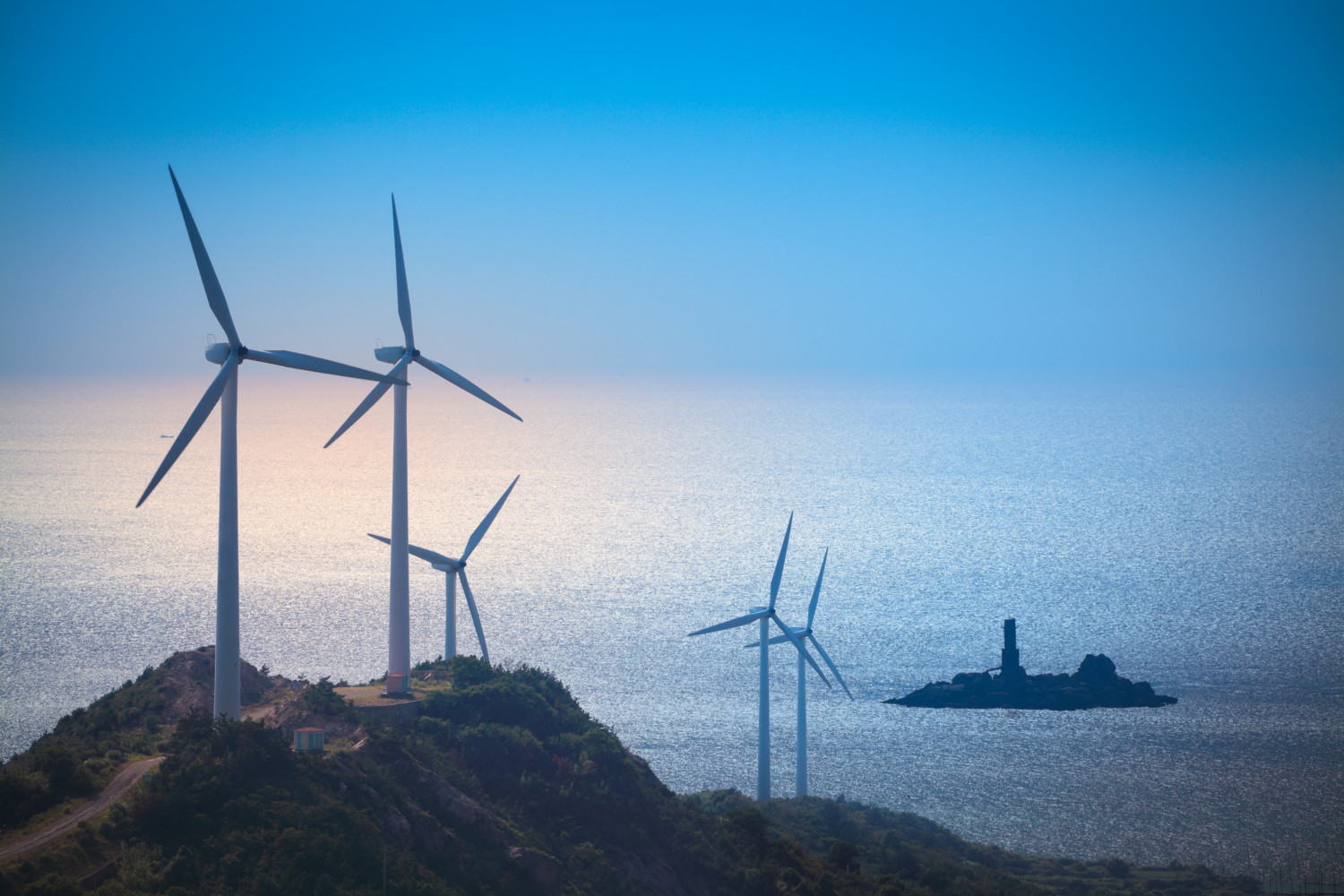

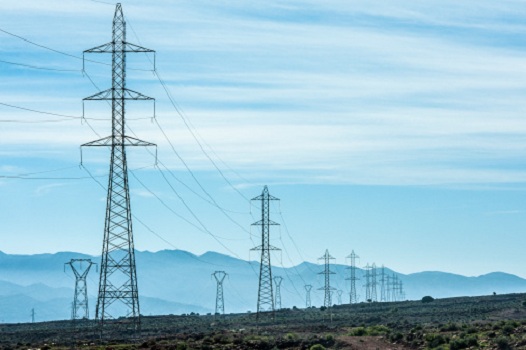


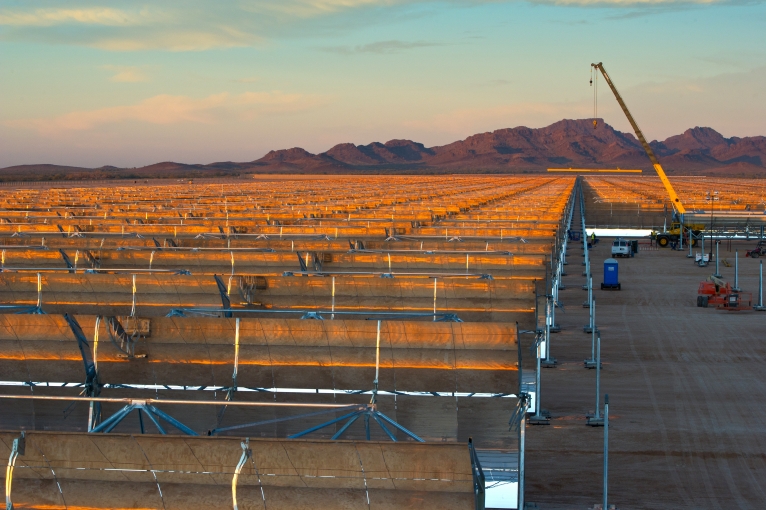

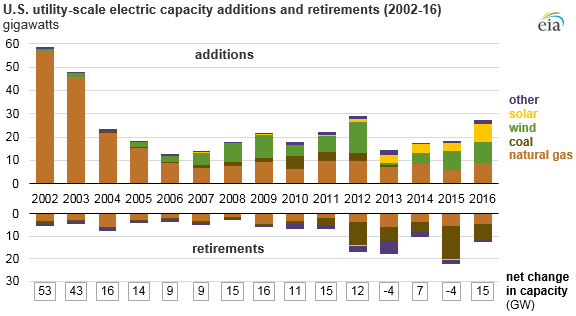



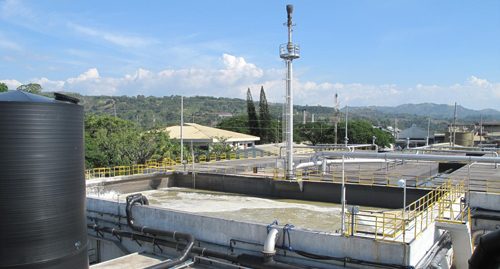

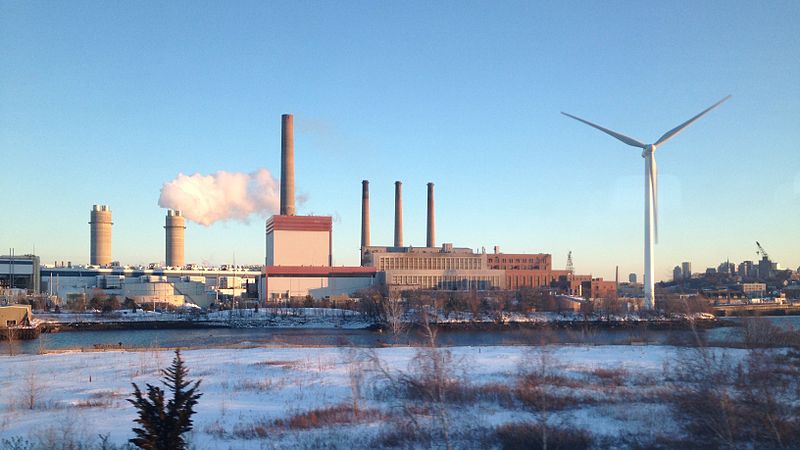
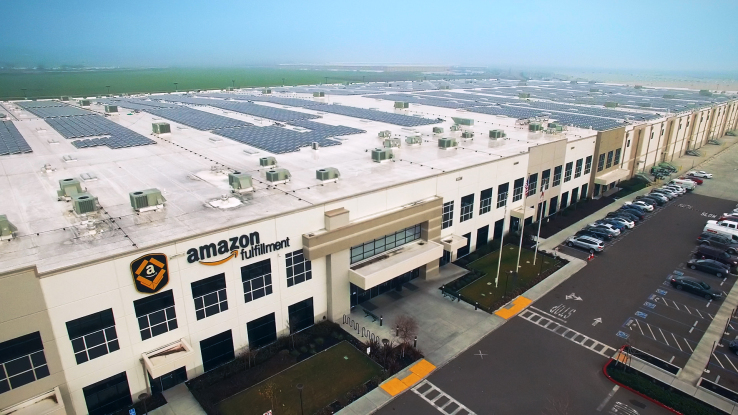
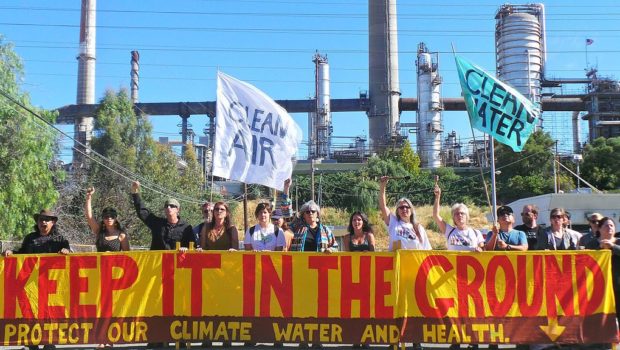
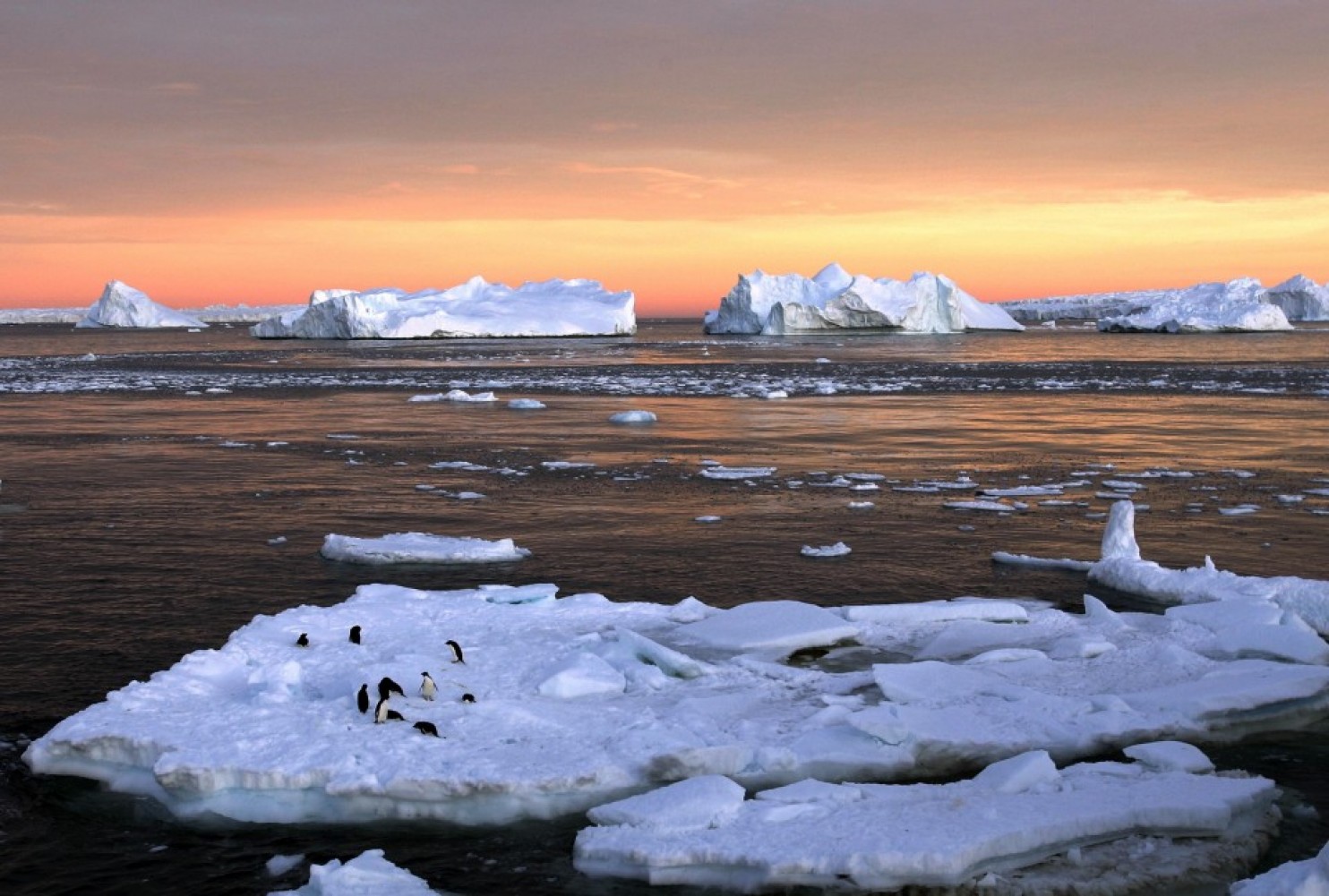


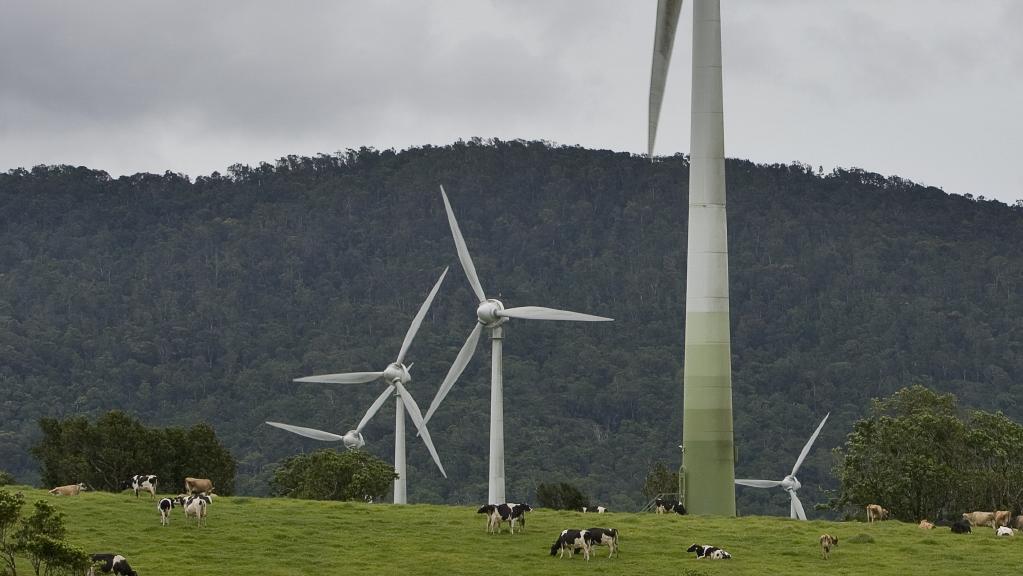

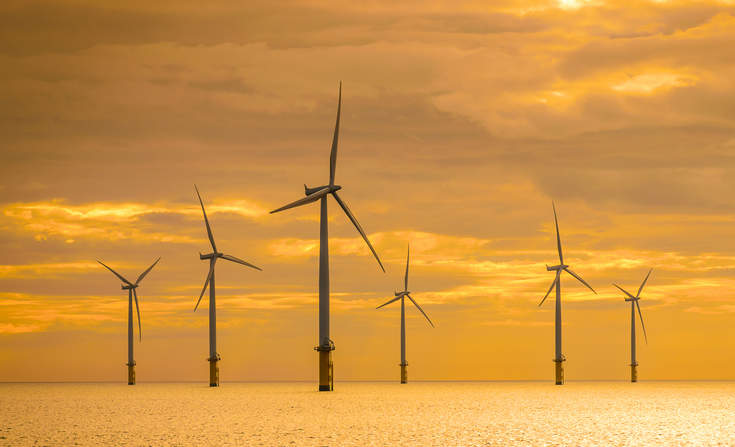



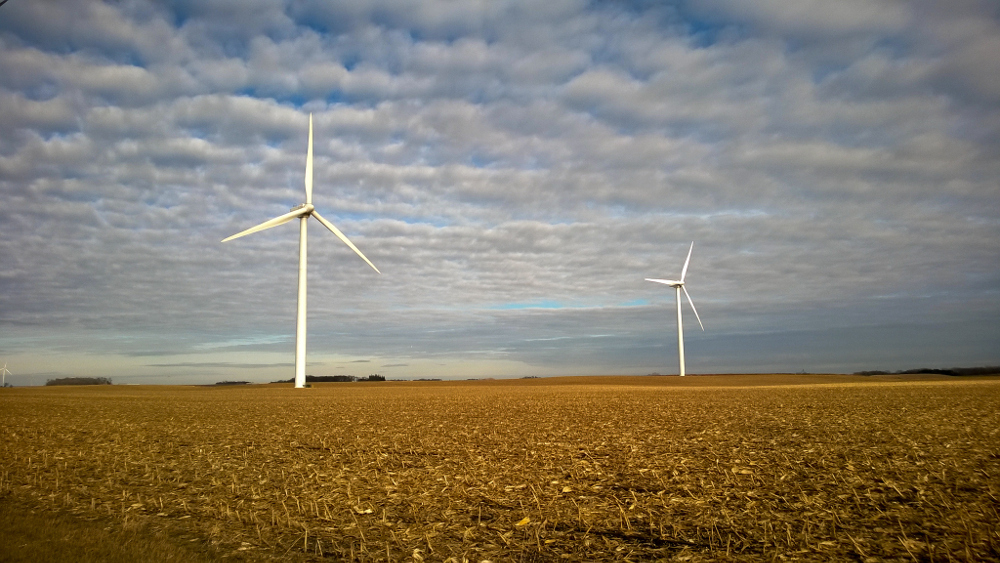

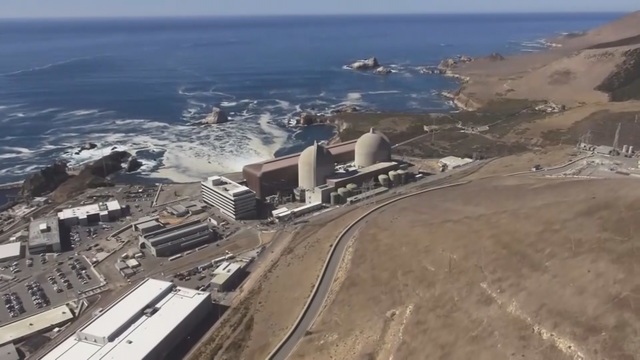
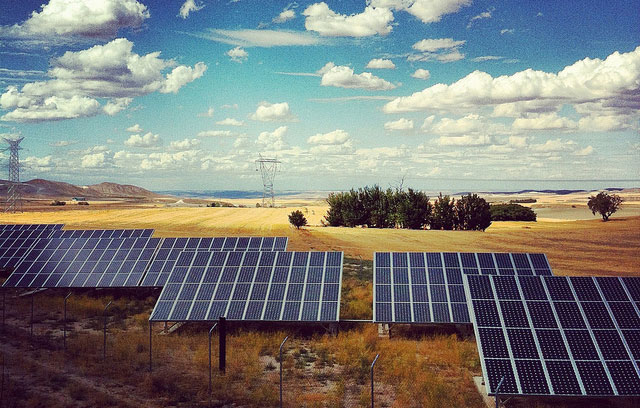

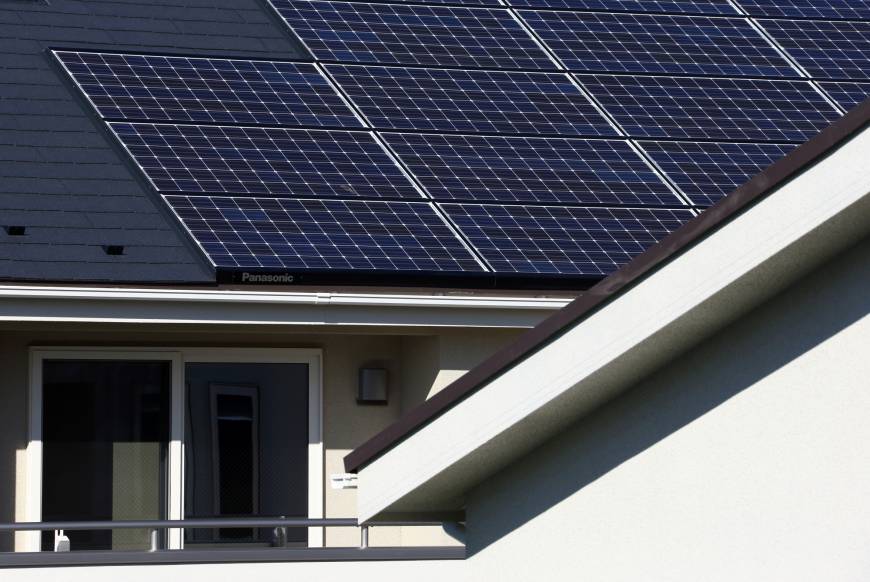
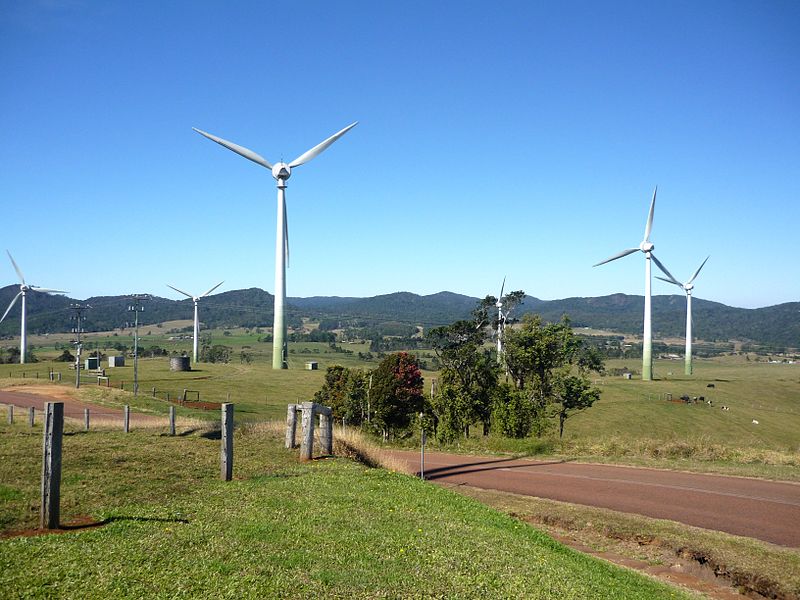

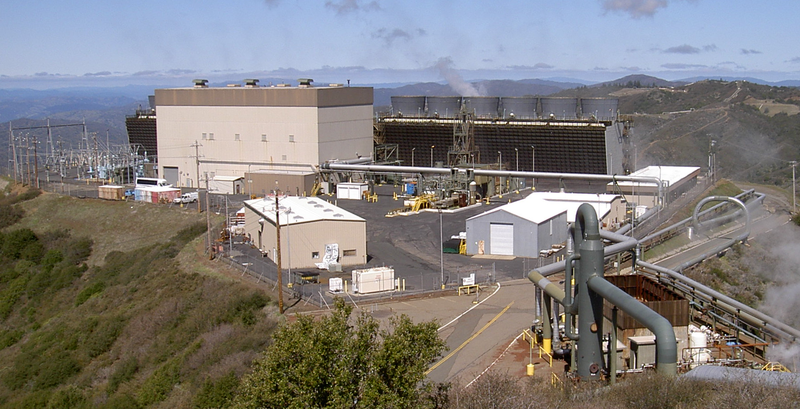


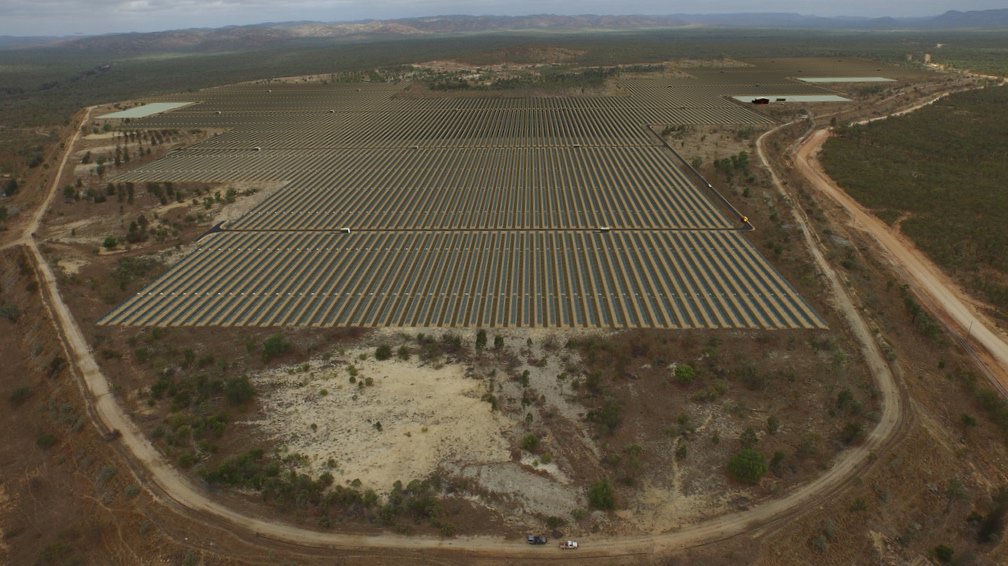
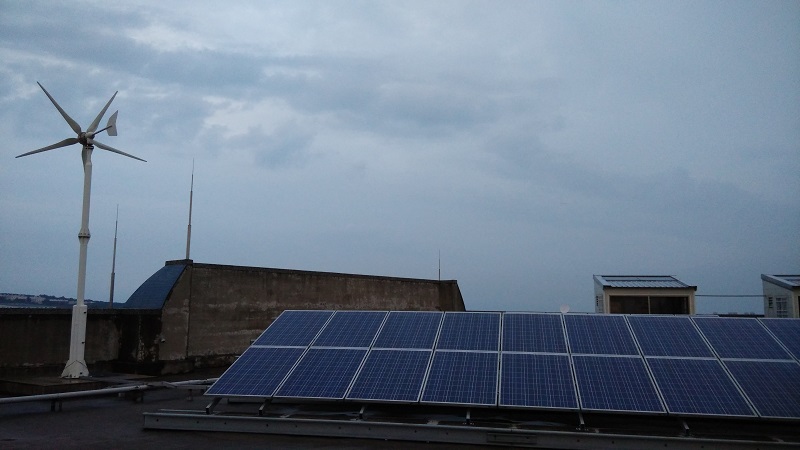




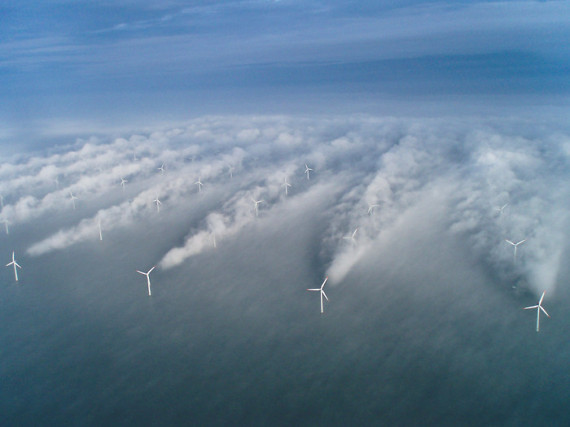

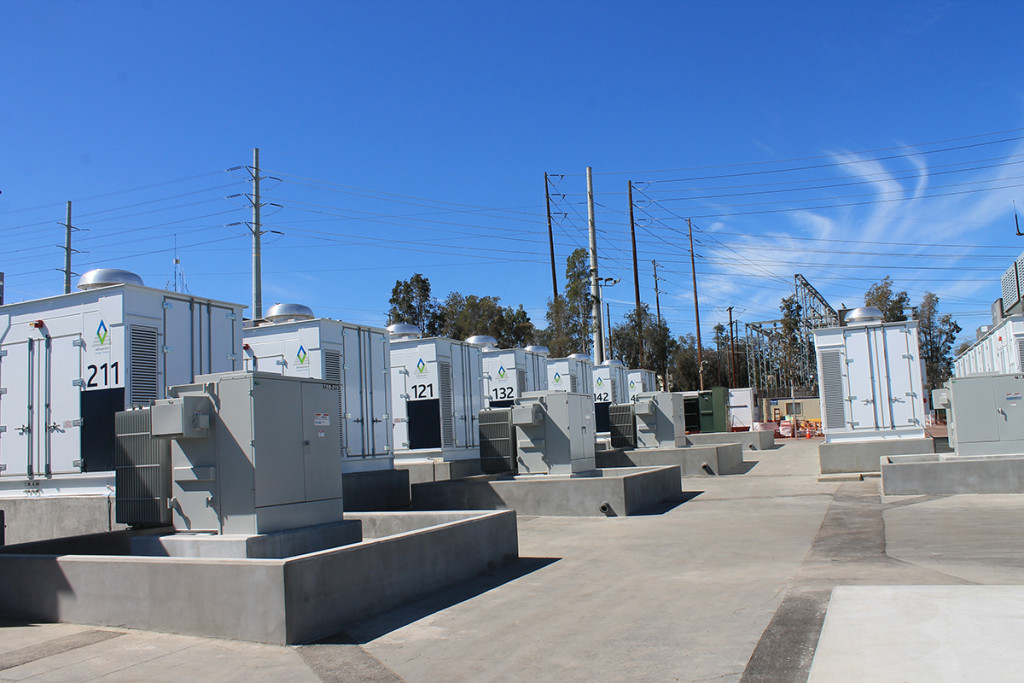
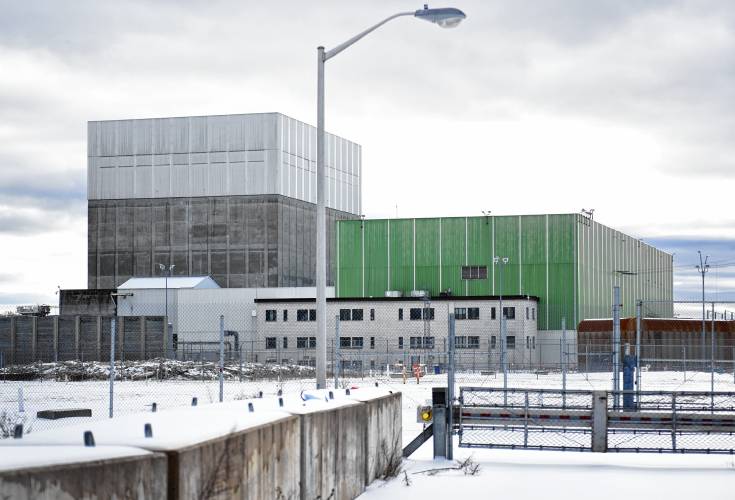


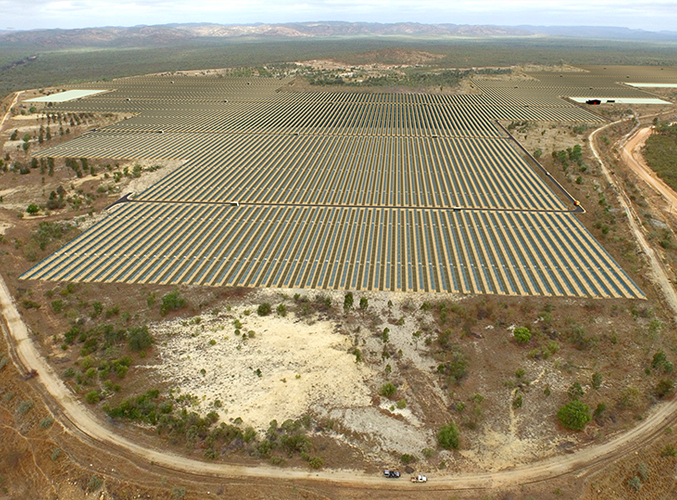

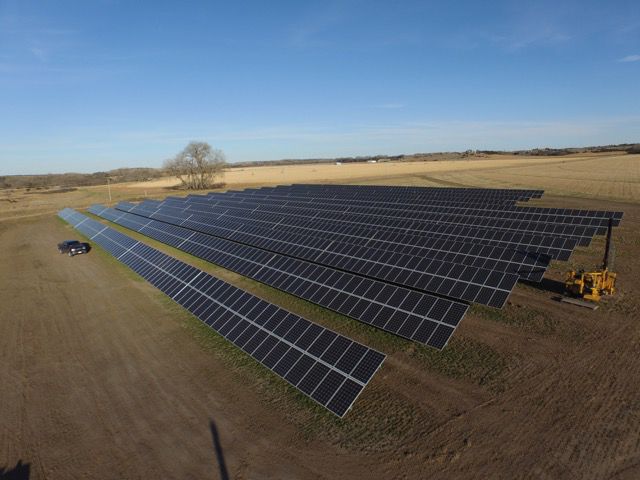



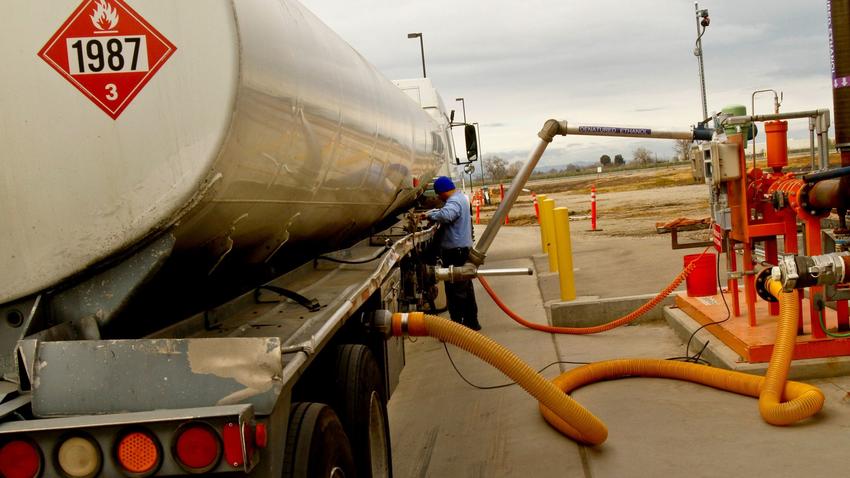


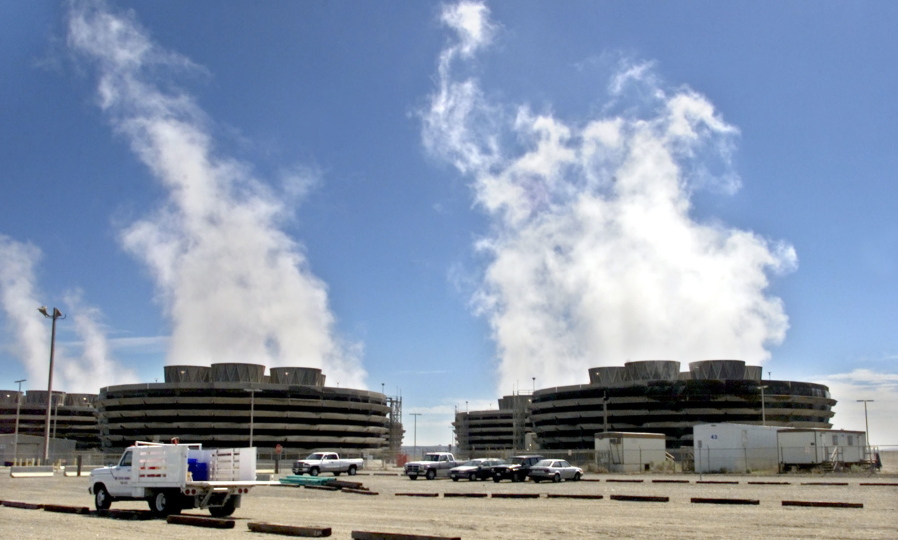
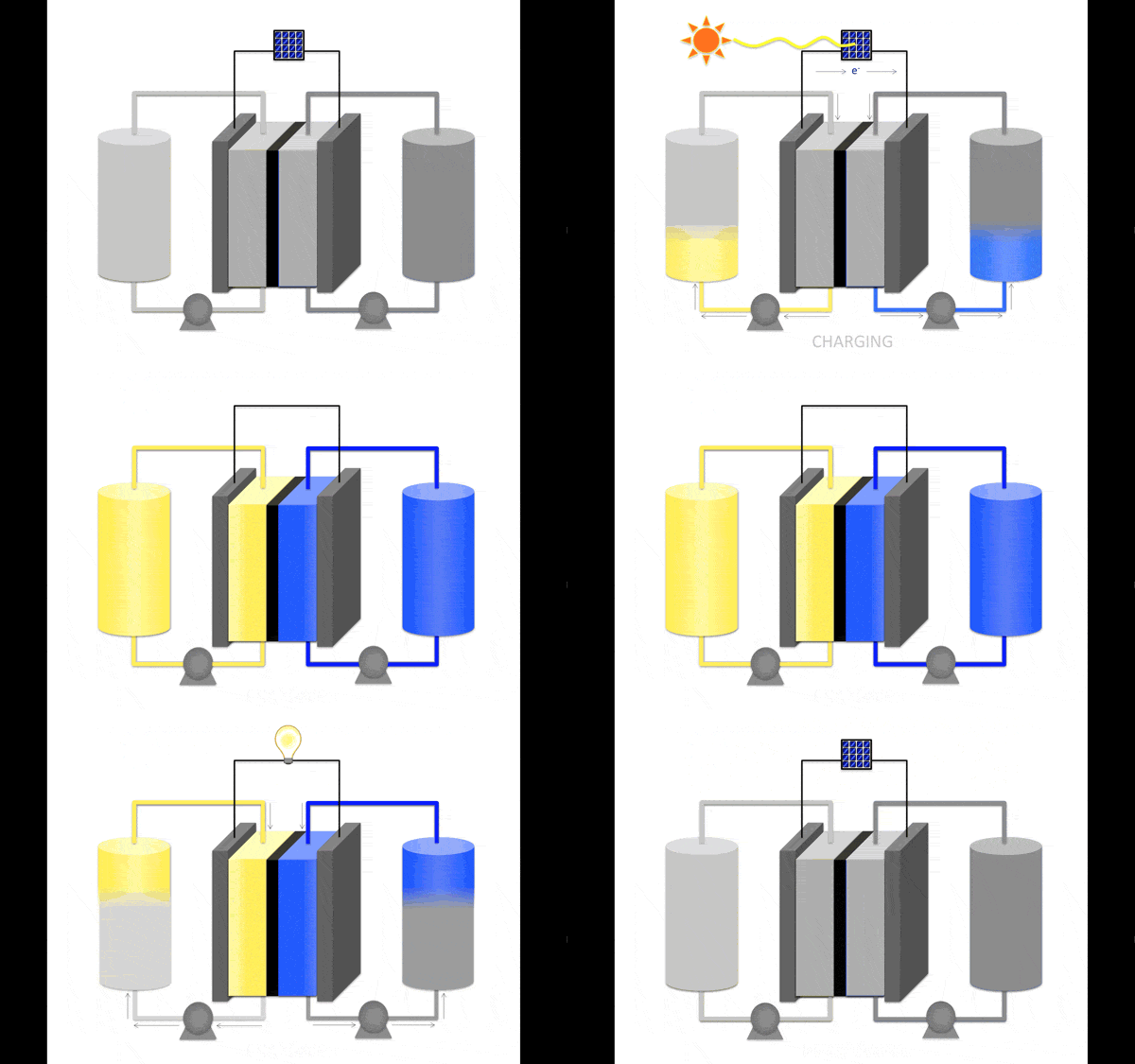


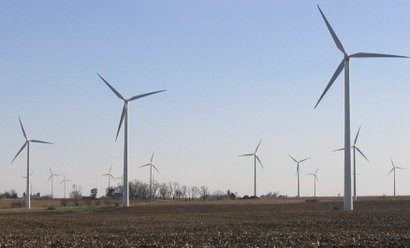



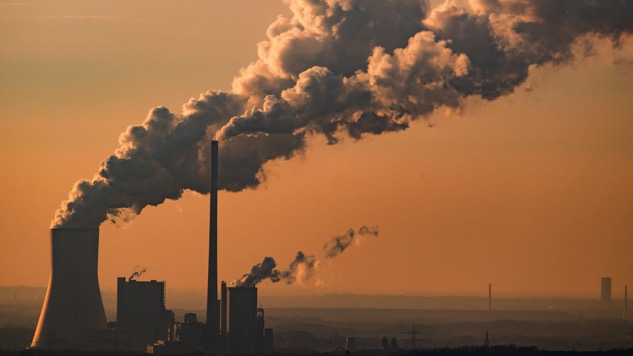
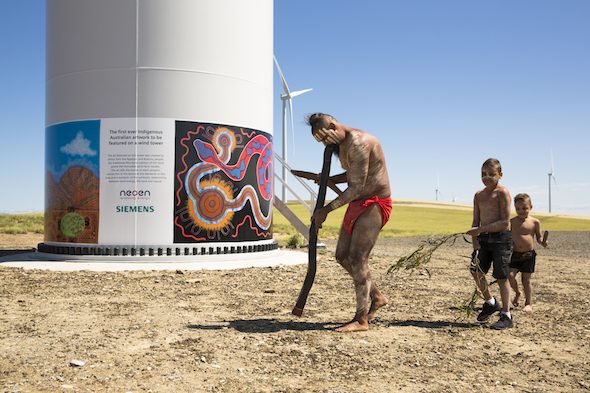


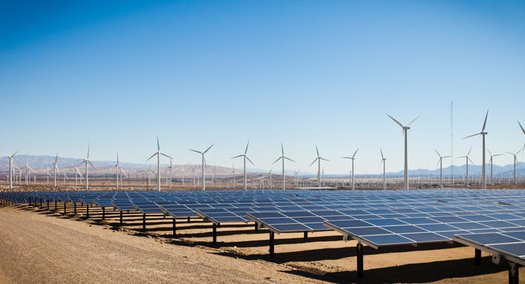







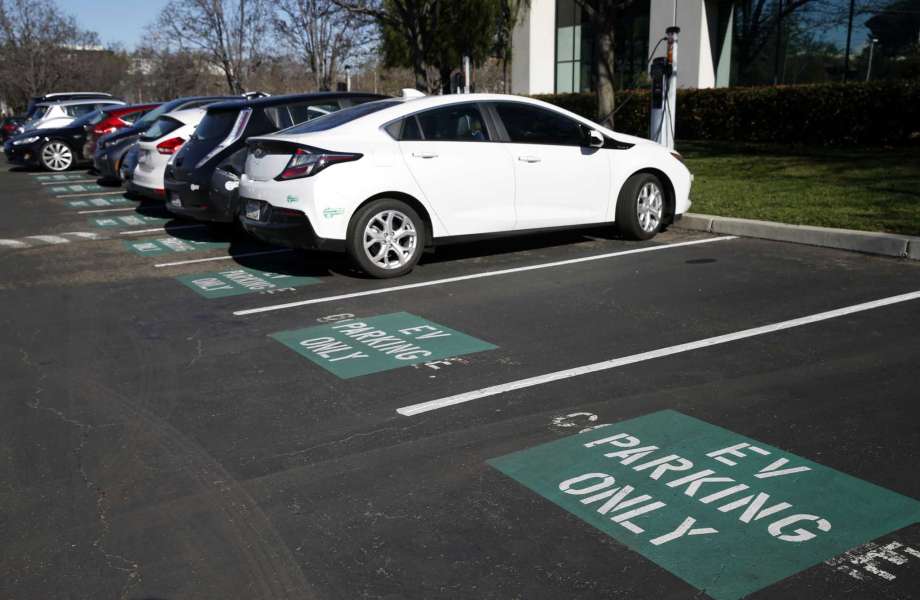
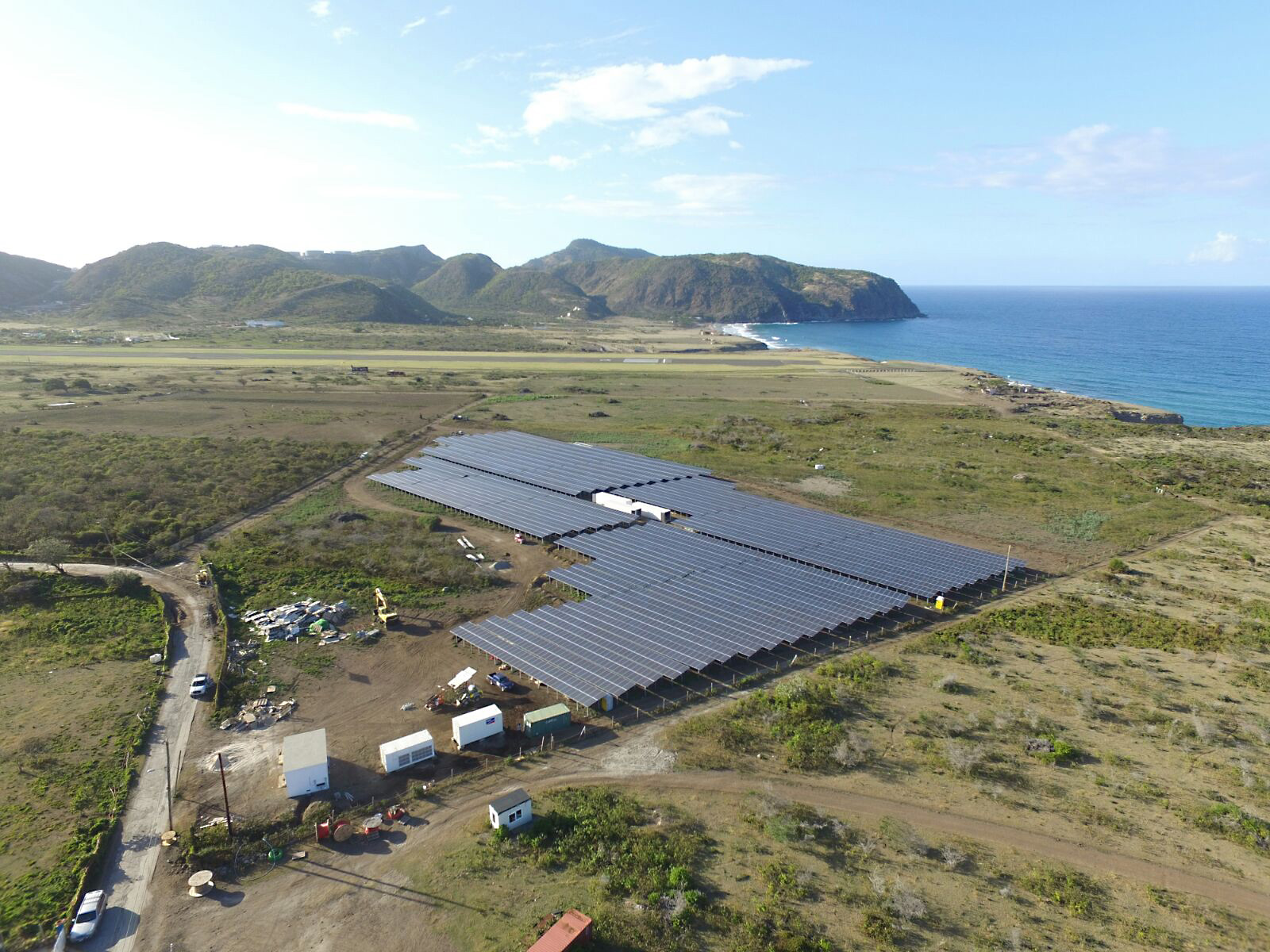




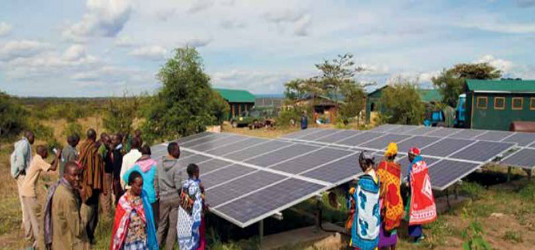


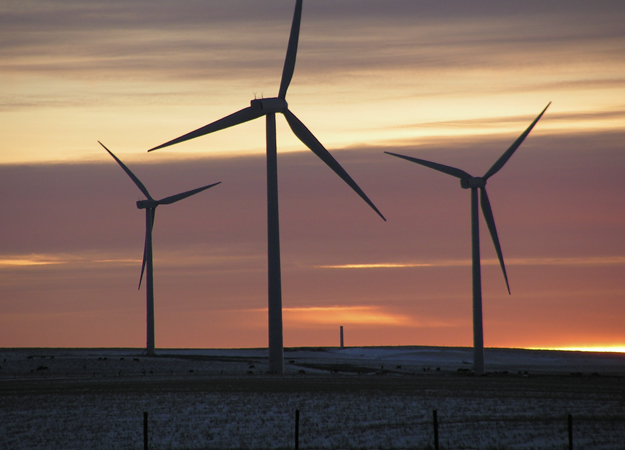


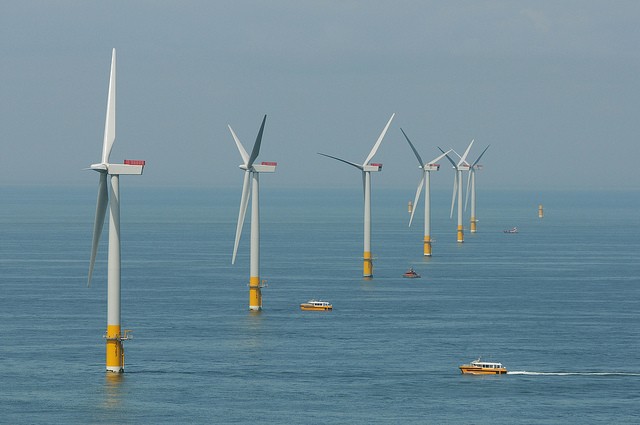
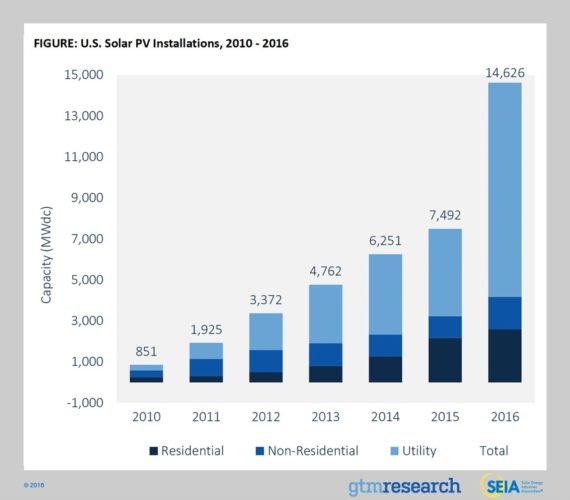
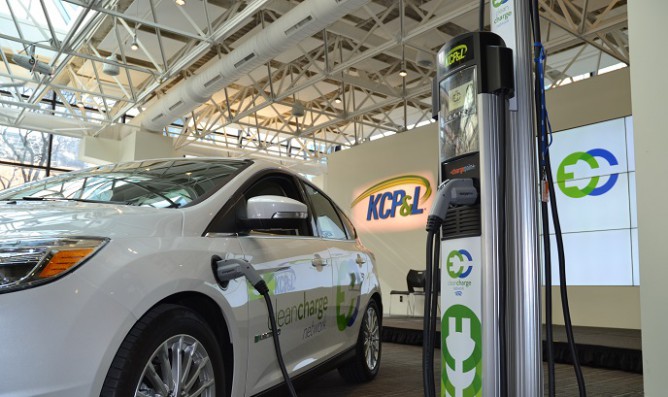




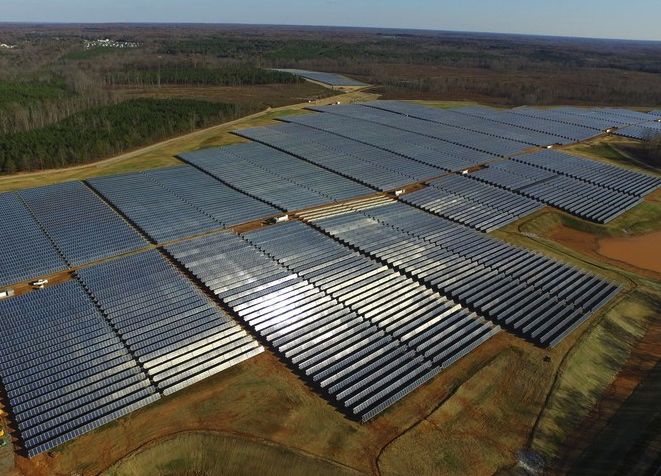


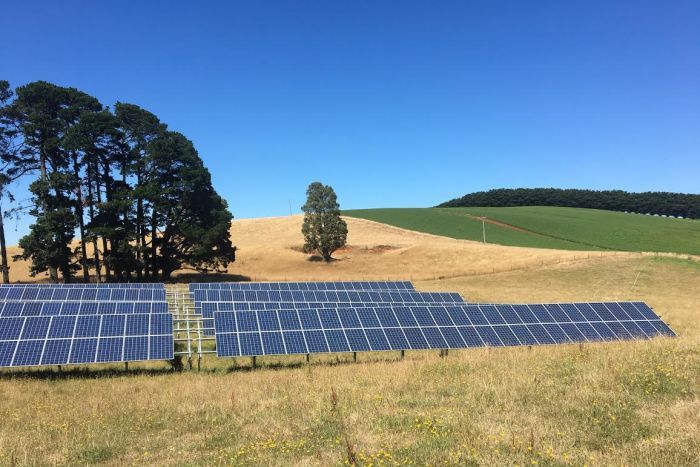


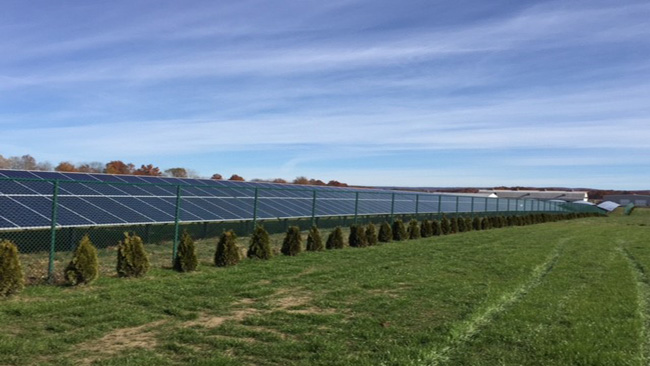






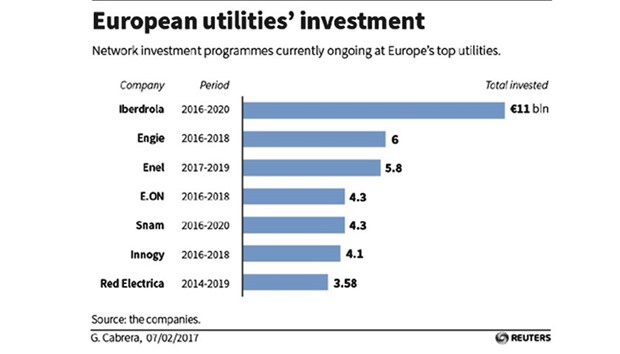
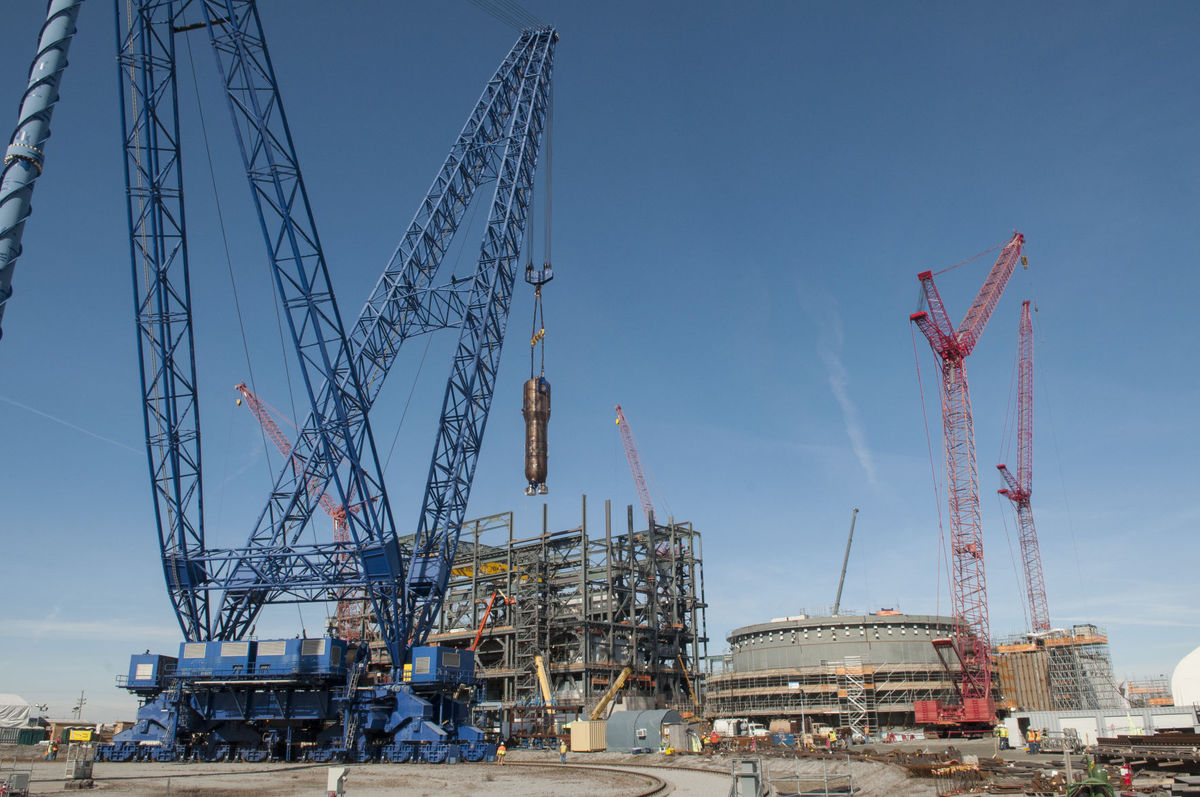


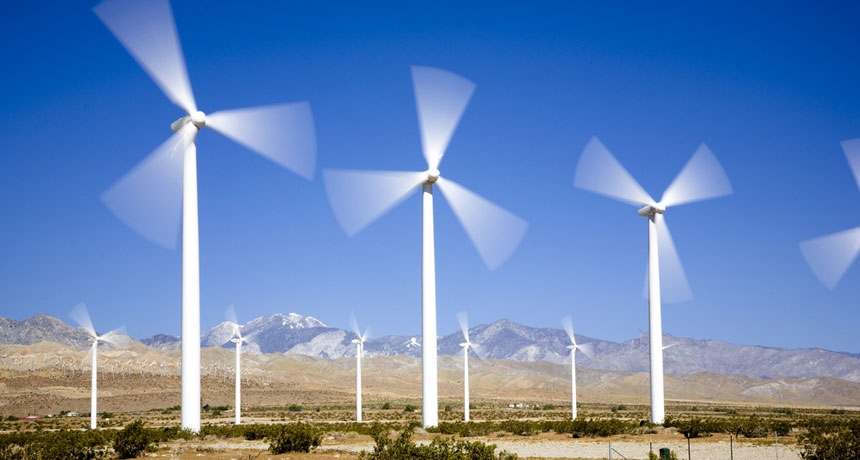

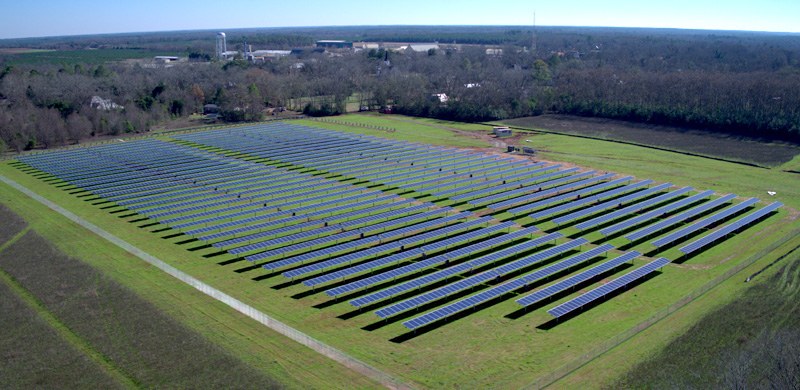
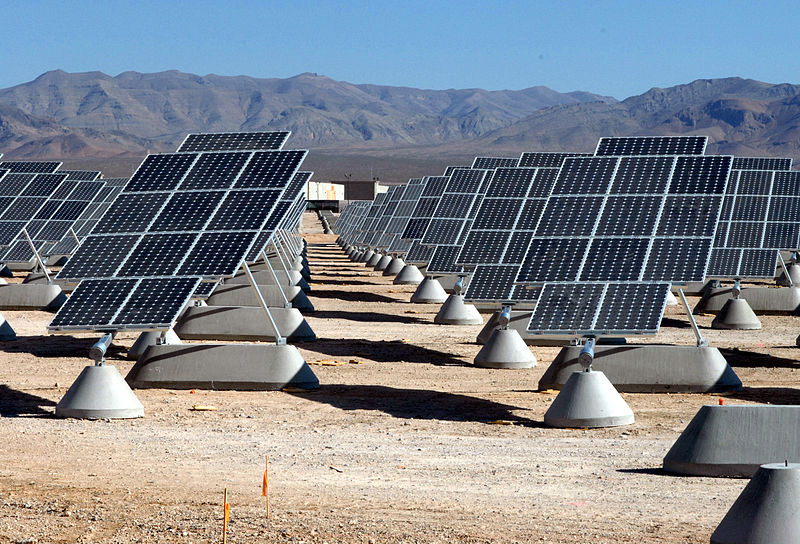


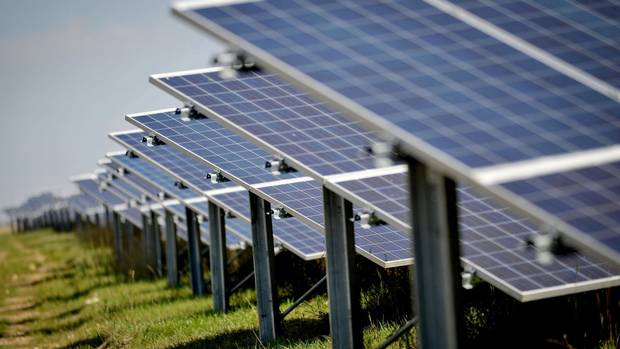
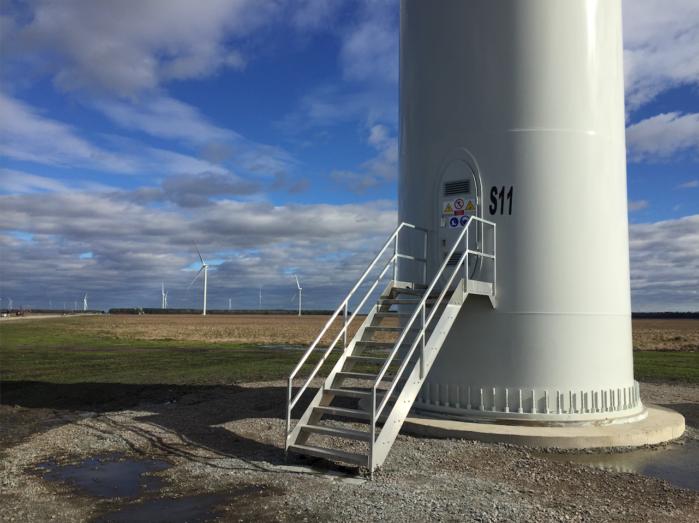

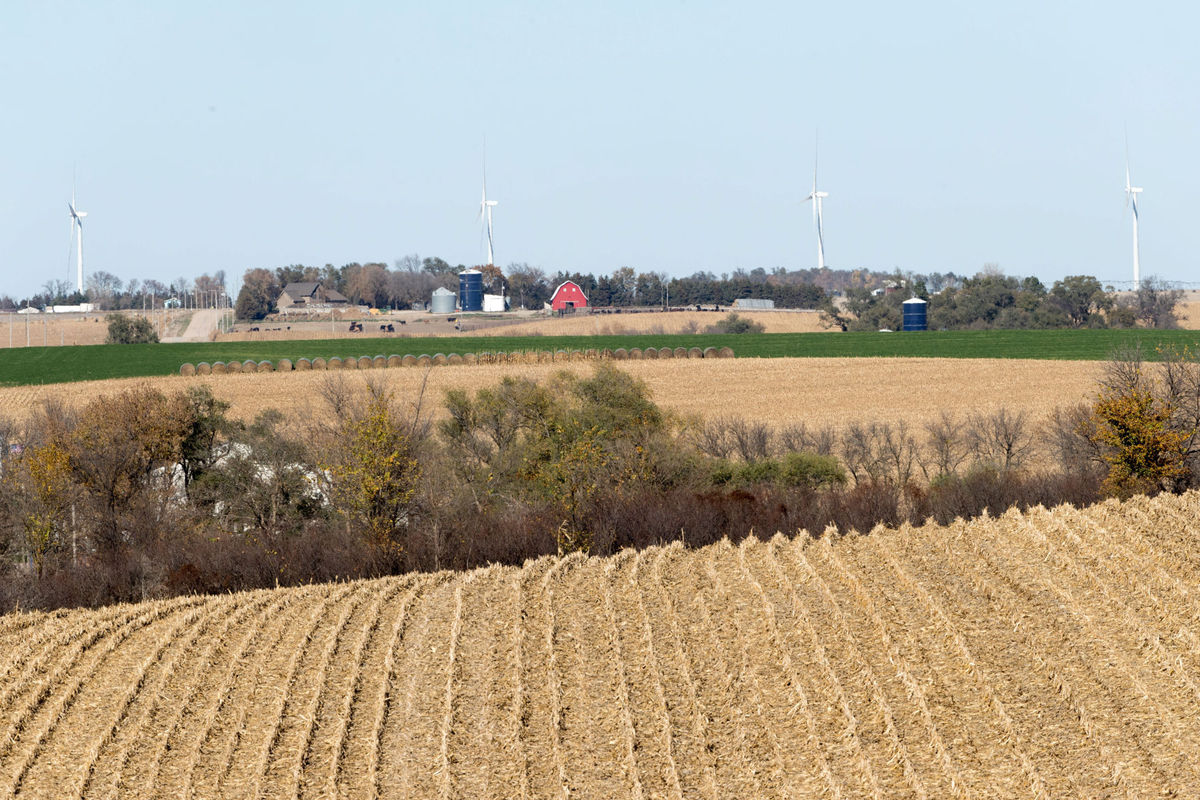


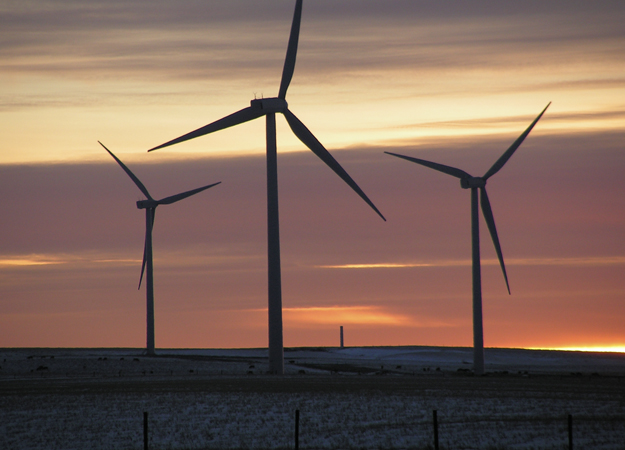
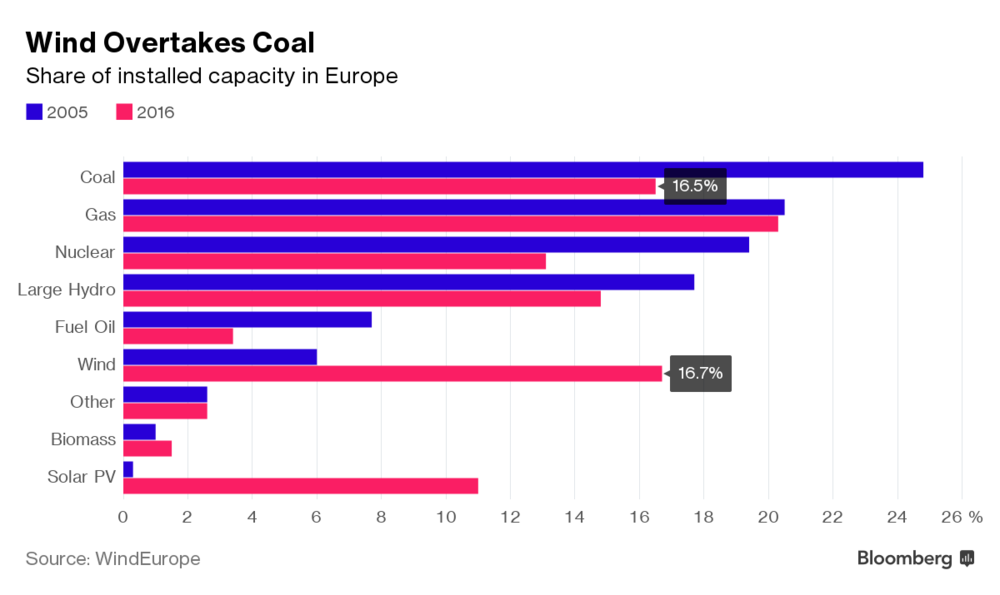

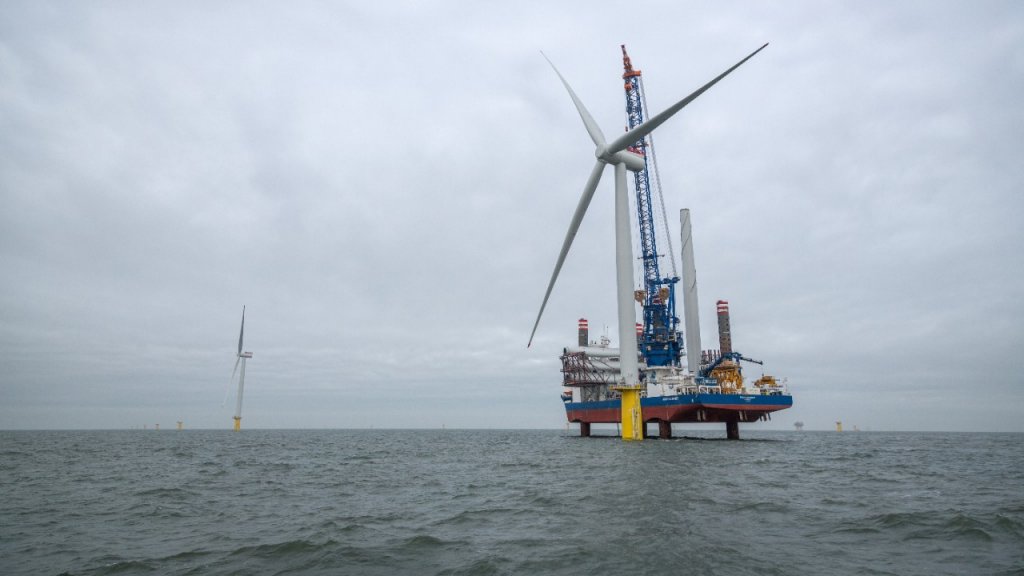

 geoharvey