
World:
¶ “How Can We Decarbonize Shipping Without Damaging The Global Economy?” • Huge amounts of goods are transported by sea, and shipping is a key part of the world economy. The UN’s International Maritime Organisation is trying to introduce a levy on carbon emissions from shipping, but is the industry ready to reduce its impact or face rising costs? [Euronews]

Ship about to sail (Nathan Cima, Unsplash)
¶ “Venezuela Accuses The US Of Wanting To ‘Take Over Its Oil Resources’ And Seeks Help From OPEC+” • The government of Venezuela says US actions seek to “destabilize” the country to affect its ability to export oil. It called on OPEC+ members to show solidarity in the face of actions it believes could endanger the stability of its oil production. [Euronews]
¶ “The Strange Time Compression Of Sodium-Ion Battery Development” • The relatively new Beijing company HiNa makes sodium-ion batteries used in JAC cars and in other areas, including utility storage. HiNa was founded in 2017, and it has already produced the world’s largest sodium-ion storage system, with a 100-MWh capacity. [CleanTechnica]
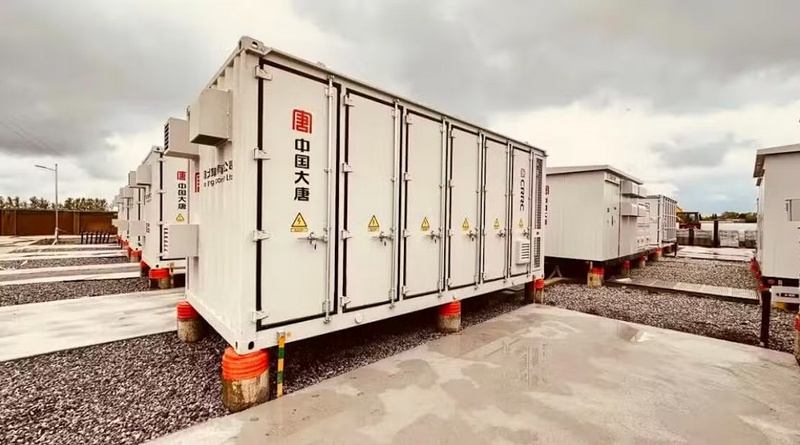
Sodium-ion battery system (HiNa image)
¶ “ACWA Power Achieves Financial Close For 15 GW Of RE Projects In Saudi Arabia” • ACWA Power, along with its partners Water and Electricity Holding Company, and Saudi Aramco Power Company, reached financial close for the development of 15 GW of solar and wind projects in Saudi Arabia. There are seven projects involved. [Asian Power]
¶ “Adani Green Energy Switches On 200 MW Of Solar Power At Khavda” • In a stock exchange filing, Adani Green Energy Ltd said it recently put into operation an aggregate 200 MW of solar power projects in Gujarat. The projects were commissioned through subsidiaries. AGEL’s operational renewable generating capacity is nearly 16,930 MW. [pv magazine India]

Solar array (Adani Green Energy Ltd)
¶ “Fortescue Delivers Big Battery To Support Pilbara Plans” • A milestone was reached with mining giant Fortescue’s delivery of a 50-MW, 250-MWh battery energy storage system at its North Star Junction site in Western Australia’s Pilbara region. The firm has plans to roll out the up to 5 GWh of storage systems over the coming years. [pv magazine Australia]
¶ “Why Heritage Buildings Need Solar Roofing” • As renewable energy and clean technology gain momentum, historic buildings face increasing pressure to reduce their carbon footprint. This is partly intensified by concerns around their typically poor energy efficiency, often a result of their age, design, and construction materials. [pv magazine International]

Westminster Abbey with BIPV Roofing (Roofit.solar rendering)
¶ “Officials Switch On Revolutionary Power Plant” • Only four hydrogen plants are currently producing low-carbon hydrogen in Europe, but a new project, HySynergy, was recently opened in Denmark, according to Tech Xplore. The plant is powered by solar and wind energy. It will produce about eight tonnes of hydrogen per day. [The Cool Down]
¶ “$27 Million Renewable Energy Pledge For Remote Aboriginal Communities” • Western Australia announced it will invest $27 million in renewable energy for remote Aboriginal communities. This will allow Horizon Power to upgrade 13 power systems and undertake the planning other initial work for upgrades in eight communities. [Inside State Government]

Children in Western Australia (Nick Dunn, Unsplash)
¶ “Officials Make Alarming Discovery Outside Of Shutdown Nuclear Facility” • The BBC reported that a radioactive fragment categorized as “significant” was discovered around the Dounreay nuclear facilit. The Dounreay facility was an experimental nuclear site. Now, the shores and seabed around Dounreay are heavily contaminated, according to the BBC. [Yahoo]
US:
¶ “Solar And Storage Surge In The US” • A review of EIA data shows utility-scale solar electricity grew 29% over the past year while battery storage expanded by 59%, according to the SUN DAY Campaign. The group said solar set records in September as utility-scale output rose 36.1% year-on-year and small-scale systems increased 12.7%. [reNews]

Solar power (Dad Hotel, Unsplash)
¶ “Solar Power Benefits Public Schools, And What’s Wrong With That?” • The “American Energy Dominance” policy is only part of the partisan political picture. Solar power has become an economic lifeline for K–12 school districts, putting it at odds with a long-standing effort to reshape the nation’s politically neutral system of public education. [CleanTechnica]
¶ “Hydropower, Energy Dominance, And Tribal Rights” • In 2024, the Federal Energy Regulatory Commission put a rule in place that allowed tribes to veto hydropower projects on their land. Last month, Energy Secretary Chris Wright asked FERC to reverse the rule, claiming it is not compatible with a grid that needs to grow as quickly as possible. [CleanTechnica]
Have an excitingly easygoing day.
 geoharvey
Leave a comment