Opinion:
¶ “Edible insects: Do insects actually taste any good?” • Edible insects are often portrayed as something of a sustainable super-food, an environmentally friendly alternative to livestock. But who is already eating them and do they actually taste any good? (Spoiler: Hornet larvae taste like sweet mussels when cooked and seasoned properly.) [BBC]

Crickets Vientiane (Getty Images)
¶ “Dumb & Dumber: Looking Beyond The Department Of Energy’s Flawed ‘Baseload’ Study” • While this study will hopefully end futile efforts to find a clean energy scapegoat for failing non-renewable power, it does not erase a longer-range issue: big, old power plants and new fossil-fuel power plants are equally ill-equipped to compete. [CleanTechnica]
¶ “Is An Oil Price Spike Inevitable?” • The oil glut is over, at least when it comes to US commercial inventories. Brent touched $70 last week, and discoveries continuing to sit at record lows, so there is a chance that $70 a barrel is only the beginning. One thing, however, is certain: The oil market is notoriously difficult to predict. [OilPrice.com]

Oil jack
Science and Technology:
¶ The latest weather reports from Alaska are alarming. In December, 2017, the average temperature in Alaska was 19.4° F according to a report from NOAA. That average is 2.1º F more than the previous high temperature record set in 1985. For the month, Alaska was 15.7º F warmer on average, compared to data going back to 1925. [CleanTechnica]
World:
¶ A massive oil tanker that sank off the coast of China could affect marine life for decades, experts say. The 900 foot-long tanker was carrying about a million barrels of ultra-light crude oil at the time of the collision. China’s State Oceanic Administration said several oil slicks have already been found, including one covering over 22 square miles. [CNN]

Rescue ship and tanker (China’s Ministry of Transport)
¶ The UAE has a target of generating 44 GW of electric power from renewables by 2050. It expects to tender at least 1 GW a year of projects as it diversifies its energy mix, its Minister of Energy said. Last year, the UAE announced its ambitions to cut carbon dioxide emissions by 70% by 2050, while improving energy efficiency by 40%. [The National]
¶ Amazon Watch and CREDO have accused several global financial institutions of having strong links to reported human rights violations and environmental degradation in the regions of the Amazon. They say they delivered over 120,000 signatures on petitions that urge BlackRock, Inc and JPMorgan Chase to stop financing violations. [Triple Pundit]
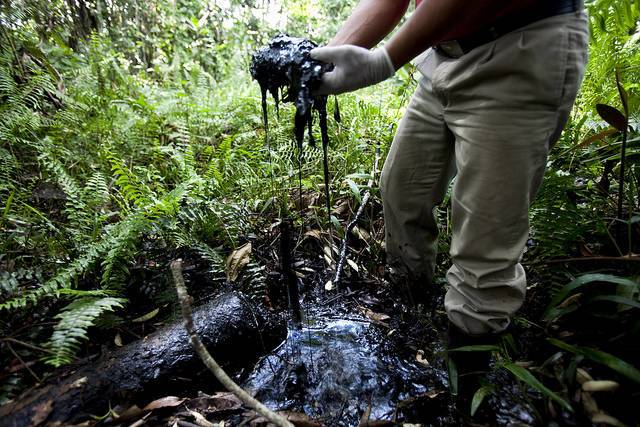
Amazon oil exploration (Rainforest Action Network | Flickr)
¶ China has played an important role in supporting the future energy mix strategy of the UAE, the UAE Minister of Energy and Industry said. The UAE, which is a major oil supplier with 99% of its domestic energy needs based on oil and gas, aims to increase the share of clean energy from near zero three years ago to 50% by 2050. [Xinhua]
¶ Up and coming corporate energy retailer Flow Power signed a new 10-year deal to supply Melbourne-based ANCA, with locally generated renewable energy sourced from the Ararat wind farm in Victoria. ANCA, which manufactures computing machinery and systems, will have long-term access to clean energy at wholesale prices. [RenewEconomy]
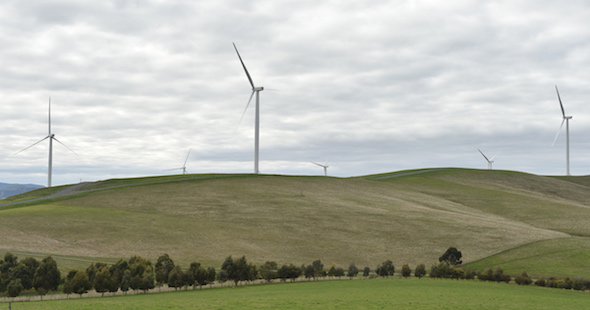
Ararat wind farm in Victoria
¶ The government of Queensland said a strong response to its 400-MW “reverse auction” for renewable energy projects showed Queensland was on track to reach its renewable energy target of 50% by 2030. Questions remain about potential subsidies and how the state policies fit with those of the federal government. [The Australian Financial Review]
¶ Over 30 years have passed since the Chernobyl nuclear disaster in the Ukraine. Now, the Ukrainian government is finishing up work on a new solar system very near the old nuclear plant. The new plant, with a capacity of 1 MW, is located just 100 metres from the sarcophagus that encases the wrecked Chernobyl Nuclear Power Plant. [Alphr]

Pripyat and the covered Chernobyl Nuclear Power Plant
US:
¶ Data from both the Energy Information Administration and Rhodium Group show that solar and wind power represented 94.7% of the US net new electricity capacity (15.8 GW out of 16.7 GW) added in 2017. However, that is mainly because fossil fuel power continued to fade away, as 11.8 GW of utility-scale fossil fuel plants closed. [Engadget]
¶ NV Energy issued requests for proposals for renewable energy projects in Nevada with a combined capacity of 330 MW. The proposed projects can include wind, solar, geothermal, biomass, and biogas as all would fit within Nevada’s renewable portfolio standards. Supplemental battery storage is also being considered. [Energy Digital – Energy News]
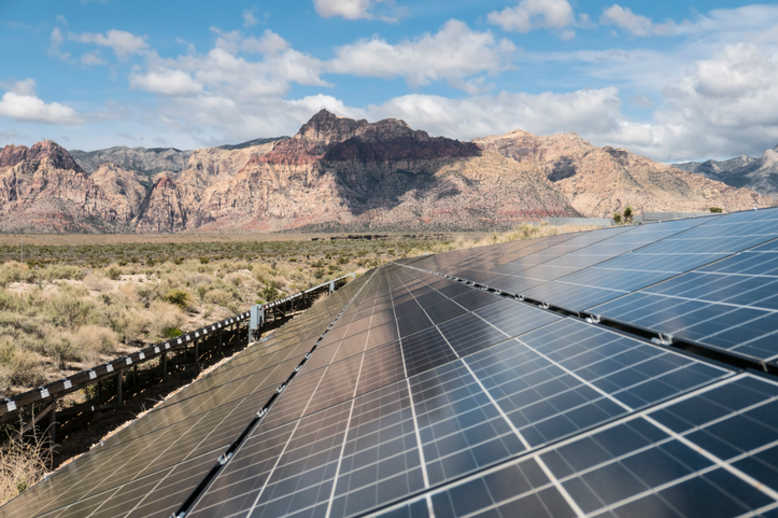
Solar power in Nevada (Photo: Getty Images)
¶ Avangrid Renewables commissioned over 500 MW of new wind farms in recent weeks. They are the 131-MW Tule Wind Farm in California, the 298-MW El Cabo Wind Farm in New Mexico, and the 75-MW Twin Buttes II Wind Farm in Colorado. The company’s US fleet now has 3,300 wind turbines in 22 states. [Electric Light & Power]
¶ Arizona utility Tucson Electric Power is launching this week a request for proposals targeting between 100 MW and 150 MW of wind power. TEP will also take into consideration proposals for the provision of ancillary services and supporting energy storage systems. TEP says it intends to add 800 MW of fresh renewables by 2030. [Renewables Now]

 geoharvey