Opinion:
¶ “Despite Efforts To Trip It Up, New Energy Economy Remains On Sound Footing” • A decade into the New Energy Economy, the country is not turning back. Falling electricity costs and continually improving technologies mean that the prospects for both solar and wind energy continue to brighten at the expense of coal. [Forbes]

California solar thermal plant (BLM, Wikimedia Commons)
Science and Technology:
¶ Over a quarter of the world’s land could become significantly drier if global warming reaches 2° C, according to new research from an international team including the University of East Anglia. But limiting global warming to under 1.5° C would dramatically reduce the fraction of the Earth’s surface that undergoes such changes. [Science Codex]
World:
¶ Shenzhen, just north of Hong Kong, has a population of a bit less than 12 million. Shenzhen also has a lot of buses, 16,359 of them, to be precise. And as of this moment, every one of them is electric. Next, the city intends to make all of its more than 17,000 taxis electric. That may not be too hard, as 12,518 of them already are. [CleanTechnica]
(Last month, there were not quite 300 electric buses in the US.)
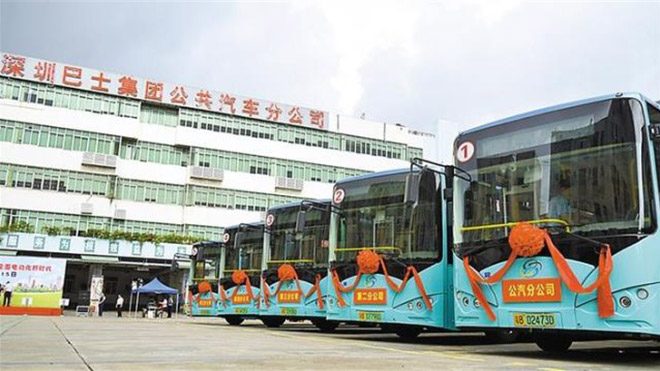
Electric buses in Shenzhen
¶ The UK’s recycling industry says it doesn’t know how to cope with a Chinese ban on imports of plastic waste. Britain has been shipping up to 500,000 tonnes of plastic for recycling in China every year, but now the trade has been stopped. At the moment the UK cannot deal with much of that waste, the UK Recycling Association says. [BBC]
¶ Chinese authorities stopped production of 553 passenger vehicle models on January 1st, 2018 because they fail to meet government fuel consumption standards, according to Xinhua, the state news agency. Beijing Benz Automotive, Chery, FAW-Volkswagen, and Dongfeng Motor Corp are among those with models banned. [CleanTechnica]

Chinese road
¶ As existing plants fail to sell all the electricity they can produce, Indian power producers have cancelled some coal-fired projects. In fact, nearly 40% of the country’s coal-based capacity is going unused. A rapid increase in renewable power following Modi’s pledge to provide clean energy is exacerbating the glut of electric power. [The Business Times]
¶ For the first time in 150 years, more of the global middle class will be in Asia rather than the West. This is largely due to China taking a lead in lifting people out of extreme poverty. As the Chinese people expect increased economic well-being, their government is turning to renewable power sources to supply their power. [The National]

Solar water heaters in China
¶ State-owned gas utility GAIL India Ltd has commissioned the country’s second largest rooftop solar power plant, it announced. The firm has installed a 5.76 MW solar plant at its petrochemical complex at Pata in Uttar Pradesh. The plant was installed over the roofs of warehouses and covers a total area of 65,000 square meters (16 acres). [ELE Times]
¶ Oakey in the Darling Downs will be the site of the next solar farm in Queensland. The 80-MW farm will receive a further A$55 million from the Clean Energy Finance Corporation. CEFC Large-Scale Solar lead Gloria Chan said that the project should deliver enough renewable energy to power around 24,000 of the state’s homes. Energy Matters]

Solar farm
¶ Tata Power Renewable Energy Ltd, a wholly-owned subsidiary of Tata Power, has commissioned a 50-MW solar plant at the Pavagada Solar Park in Karnataka. The 50-MW solar plant has been built over an area of 253 acres. With this development, TPREL’s total installed operating capacity now stands at 1,664 MW. [Hindu Business Line]
US:
¶ New England is leading the East in a transition to renewable energy. Old fossil fuel plants are being retired, and in some cases are being given severance pay to retire early. A number of proposals are on the table for renewable power and energy storage coming from within New England or to be imported from other areas. [RTO Insider]

National Grid Transmission Proposals | National Grid
¶ Massachusetts is expected to decide on a major renewable electric supply project in late January. Several entrepreneurs are touting their projects in the run-up to that decision. Some of the proposals would carry electricity produced by wind or hydro power plants in Canada across Vermont, New Hampshire or Maine. [The Recorder]
¶ Garvan Donegan, an economic development specialist for the Central Maine Growth Council, said 2017 was a “great year” for solar projects in the region. A number of large arrays came on line in the central Maine region this year while others are in the planning stage. The projects lead to job creation and further development. [Press Herald]

ReVision Energy solar array installation
¶ The Trump administration has a plan to subsidize coal and nuclear power plants, but analysts are skeptical it will do enough to prevent more of the facilities from closing down. In vowing to revive the coal industry and stop the decline of nuclear energy, President is fighting against a tide of coal and nuclear plant closures. [Kaplan Herald]
¶ This year had the second warmest December on record for Fairbanks, Alaska, and the warmest in 104 years, according to an Alaska climate science and services manager with the National Weather Service in Fairbanks. For the month of December, 2017, the average temperature in Fairbanks was close to 13° F above normal. [Fairbanks Daily News-Miner]

 geoharvey