Science and Technology:
¶ The burning of biomass in the Amazon releases particulate matter air pollution that causes oxidative stress as well as severe DNA damage in human lung cells – primarily through the actions of the polycyclic aromatic hydrocarbon known as retene – according to a new study published in the journal Scientific Reports. [CleanTechnica]

Deforestation in the Amazon (NASA image)
¶ Even when they are powered exclusively by the “dirtiest” grid-provided electricity in the world, plug-in electric vehicles are responsible for a smaller greenhouse gas footprint than that of diesel cars, according to a new lifecycle analysis from Vrije Universiteit Brussel and the nonprofit research organization Transport & Environment. [CleanTechnica]
World:
¶ As of November 1st, the sale of high-sulfur content diesel fuel – that is, diesel fuel with more than 10 ppm of sulfur – will be banned nationwide in China, the government in the capital of Beijing has revealed. High-sulfur diesel fuel is typically used in China as a relatively low-cost option for those running tractors or ships. [CleanTechnica]

Haikou Xiuying Port
¶ Egyptian outfit Orascom Construction partnered with French company Engie and Japan’s Eurus Energy Holdings to develop a 250-MW wind farm in Egypt. The $400 million project at Ras Ghareb, in the northern Red Sea Governorate, has a 20-year power purchase agreement with the Egyptian Electricity Transmission Company. [reNews]
¶ China is working on a “trackless electric train.” Developed by China’s CRRC Corporation, responsible for the country’s high-speed trains and hailed as one of the world’s largest train manufacturers, the trackless electric train concept was first unveiled by the company in June. It is now being tested in Zhuzhou, Hunan Province. [CleanTechnica]

Trackless electric train
¶ Italy saw the addition of 323 MW of new PV systems in the first nine months of 2017, based on data provided by the country’s grid operator Terna. This represents a 13% growth over the same period in 2016 and a 31% increase from the first nine months of 2015. In the third quarter of this year, new additions totaled 89.9 MW. [pv magazine International]
¶ TPREL, a subsidiary of Tata Power, commissioned a 30-MW solar plant in the Indian state of Maharashtra. It will produce over 62 million kWh annually, covering the annual energy needs of over 14,000 households. Tata Power has seen major growth in its solar engineering, procurement, and construction business. [pv magazine International]
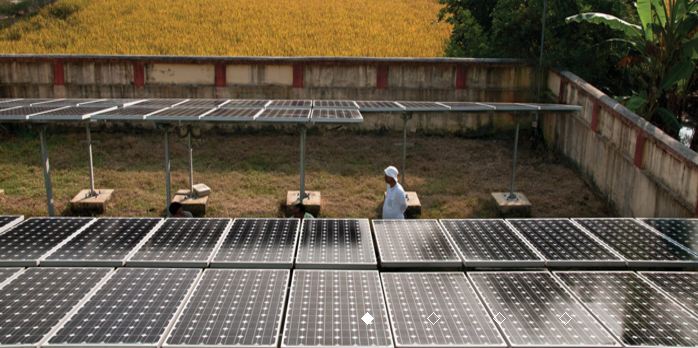
Indian solar system (Tata Power image)
¶ Pu Neng has been awarded a contract for a 3-MW/12-MWh flow battery as phase 1 of the Hubei Zaoyang 10-MW/40-MWh Storage Integration Demonstration Project. There are plans for a larger 100-MW/500-MWh energy storage project that will be the cornerstone of a new smart energy grid in Hubei Province. [GlobeNewswire]
¶ A report says at least $1 trillion are being invested globally in ways to reduce the threat of climate change, including renewable power, energy efficiency, and public transportation. Investments like these may make it possible for the world’s governments to meet their commitments under the Paris agreement on climate change. [The Guardian]

Renewable energy (Pablo Blazquez Dominguez | Getty Images)
¶ Ten years after PetroChina peaked on its first day of trading in Shanghai, the state-owned energy producer has lost about $800 billion of market value, a sum large enough to circle the Earth 31 times with $100 bills. In current dollar terms, it’s the world’s biggest-ever wipeout of shareholder wealth. And it may only get worse. [Montreal Gazette]
US:
¶ Duke Energy is seeking state permission to build a 2-MW solar farm and a power-storage system at the Indiana National Guard’s Camp Atterbury training base. If it is approved, the company says the solar farm and battery storage equipment would become the first microgrid at any National Guard facility in the state. [WISH-TV]

Camp Atterbury (WISH Photo)
¶ Sen Lisa Murkowski was unequivocal when asked recently about rising global temperatures. “Climate change is real,” the Alaska Republican told an audience in Anchorage. Yet her stance on drilling in the Arctic National Wildlife Refuge is that it must happen, for the economic prosperity of her state and the security of the country. [Seattle Times]
¶ Kentucky’s Touchstone Energy Cooperatives has dedicated Cooperative Solar Farm One, a 60-acre solar energy facility located in Clark County. Cooperative Solar Farm One has 32,300 solar panels, for a total capacity of 8.5 MW. The output will be enough to provide all the annual power needs for about 1,000 typical homes. [The Lane Report]
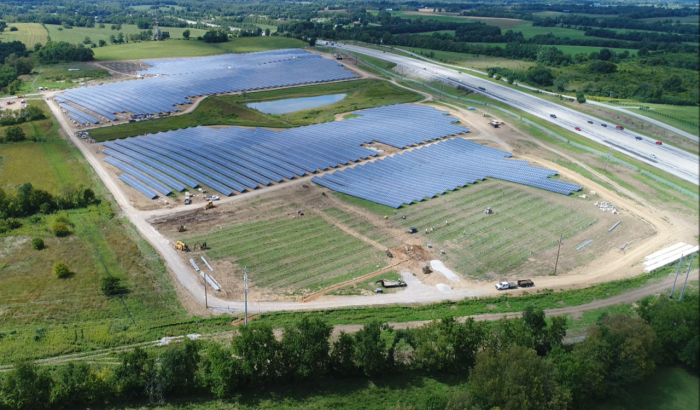
Cooperative Solar Farm One
¶ President Trump has declared an end to the “war on coal.” But coal country is grappling with powerful market force. More evidence of coal’s challenges came as Armstrong Energy, a western Kentucky coal company, filed for bankruptcy protection. Armstrong recently warned it would lay off workers at two of its facilities. [KVIA El Paso]
¶ Southern Co is seeking to raise cash as it expects about $1.4 billion in added costs to complete nuclear power units at Vogtle, which are soaring to over $25 billion. The company is also bailing out its Mississippi Power unit after regulators said they would not allow it to recover costs for a failed coal-gasification power project. [The Sun Herald]

 geoharvey