Science and Technology:
¶ Cruise lines are exploring alternative fuels, which, in addition to LNG, include battery power and fuel cells. Battery technology has been advancing rapidly over the last few years, and having improved storage capacity, such batteries could be practical for marine applications, pending the operating profile of a vessel. [Cruise Industry News]

The Viking Lady of Eidesvik Shipping has run a
testing program using a molten carbonate fuel cell.
¶ The field of “attribution science” has made immense progress in the last five years. Researchers can now tell people how climate change impacts them, and not in 50 or 100 years, but today. Scientific American interviewed Friederike Otto, deputy director of the Environmental Change Institute at the University of Oxford. [PBS NewsHour]
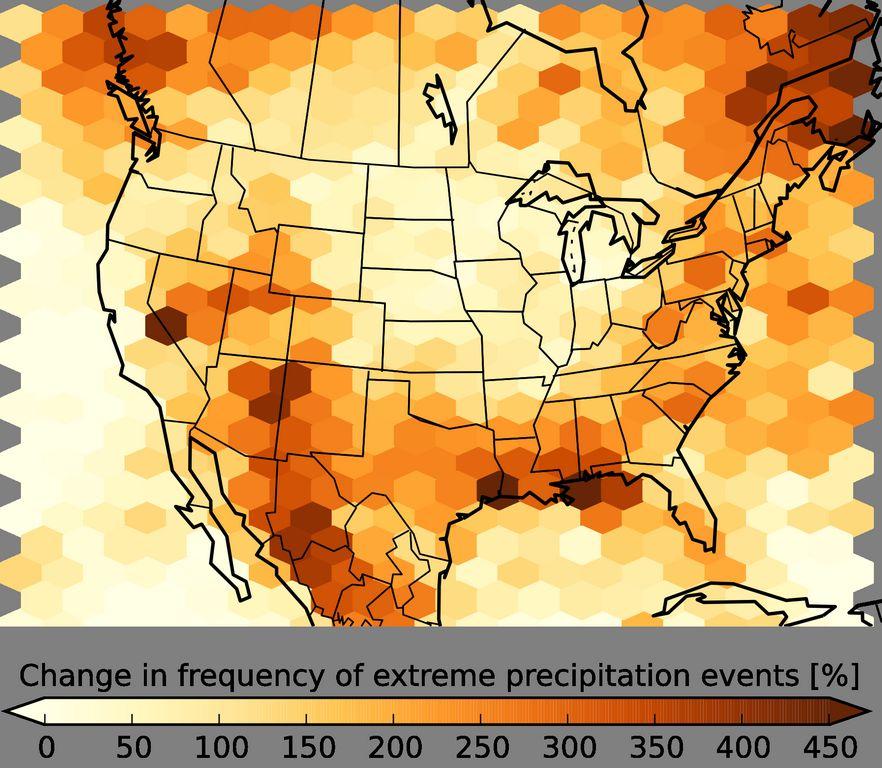
¶ By century’s end, the number of summer storms that produce extreme downpours could increase by 200% to 400% across parts of the US, a peer-reviewed study says. The study, published in Nature Climate Change, also finds that the intensity of individual extreme rainstorms could increase by as much as 70% in some areas. [Daily Comet]
(Image: National Center for Atmospheric Research)
¶ Widespread local plant and animal species extinctions are already occurring as a result of anthropogenic climate change, research from the University of Arizona has found. It showed that local extinctions have now already occurred in 47% of the 976 species analyzed in the study, as a result of climate change caused by human activity. [CleanTechnica]
World:
¶ Almost all Costa Rica’s electricity was produced by renewable energy in 2016. The Costa Rican Electricity Institute said that around 98.1% of the country’s electricity came from numerous renewable resources. These included large hydropower facilities, geothermal plants, wind turbines, solar panels, and biomass plants. [The Independent]

Reventazon River dam (Ezequiel Becerra / AFP / Getty)
¶ A solar farm scheme in Soham, a small town in the English county of Cambridgeshire, is generating power and more than a £1 million a year for County Council, once the financing is paid off. From last week the Council’s 60 acre site near Triangle Farm began producing enough energy to power around 3,500 homes. [Cambridge News]
¶ According to preliminary figures from the Power Trading Chamber, Brazil’s December wind power output rose by 30.5% on the year to 3,904 average megawatts (MWa). Among other renewable sources, hydro and solar power generation showed growth in the period also, reaching 48,018 MWa and 3 MWa, respectively. [SeeNews Renewables]

Wind turbines in Brazil (Author: josep, Creative
Commons, Attribution-ShareAlike 2.0 Generic)
¶ More than 50,000 solar power systems have been installed in Scotland. At least 49,000 homes and 1,000 business premises in Scotland now have solar panels; one, Mackies Of Scotland’s solar farm, is 1.8-MW. And there are about 200 community-led solar PV schemes, with a combined installed capacity of 2 MW. [Energy Matters]
¶ Two world-leading clean energy projects have opened in the south Indian state of Tamil Nadu. An industrial plant is capturing the CO2 emissions from a coal boiler and using it as a chemical for making baking powder. And just 100 km away is the world’s biggest solar farm, making power for 150,000 homes on a 10 sq km site. [BBC]

The world’s largest solar farm at Kamuthi in southern India
¶ India has a pipeline of around 14 GW of utility scale solar projects, about 7.7 GW is expected to be commissioned in the year. This would represent growth of around 90% over 2016. Combined with 1.1 GW of expected rooftop solar capacity, India should add a total of 8.8 GW in 2017, ranking it behind only China and the USA. [EnergyInfraPost]
¶ Swedish tidal kite developer Minesto has procured subsystems for its 500-kW Deep Green commercial device to be installed off the North Wales coast later this year. The components include the so-called microgrid system buoy, rear nacelle, tether rope and fairing. The Deep Green device is scheduled to be deployed by autumn. [reNews]

Deep Green (Image: Minesto)
US:
¶ Looking back on 2016 for the US solar industry, though final data is not yet in, 2016 was clearly boom time. While the market has grown every year in the 21st century, when final numbers are published the volume of the US market is expected nearly to have doubled, from just over 7 GW in 2015, to 13-14 GW in 2016. [pv magazine USA]
¶ New England policymakers hope to reach agreement in 2017 on revised market rules for state clean energy policies. With looming threats to federal carbon emissions action, New England is moving ahead with its plans to decarbonize through power purchase agreements and other means under the Regional Greenhouse Gas Initiative. [RTO Insider]

Daniel-Johnson Dam and Manic-5
Generating Station(Photo: Hydro-Québec)
¶ Coastal Carolina officials may not be willing to prepare for climate change until it’s too late, a new study says. A researcher from NC State University surveyed local officials in 20 coastal counties and found that knowledge of the science behind climate change didn’t make officials more willing to prepare for impacts like sea-level rise. [WUNC]
¶ This year continued the acceleration of the permanent shutdowns of US nuclear plants. Fort Calhoun closed down in 2016. Entergy announced Palisades would close in 2018. Both reactors at Diablo Canyon will close by 2025. Five reactors in Illinois and New York threatened to shut down unless they got bailouts. [OB Rag]
(Closing dates in 2019 for Pilgrim and Oyster creek had already been announced as 2016 began.)

 geoharvey