Opinion:
¶ “Changing landscape for renewable energy” • Energy experts say that, although a Trump administration could slow progress, states have actually been at the forefront in pushing for cleaner, renewable power generation, with private sector funding far outstripping federal investments over the past five years. [Nantucket Island Inquirer]
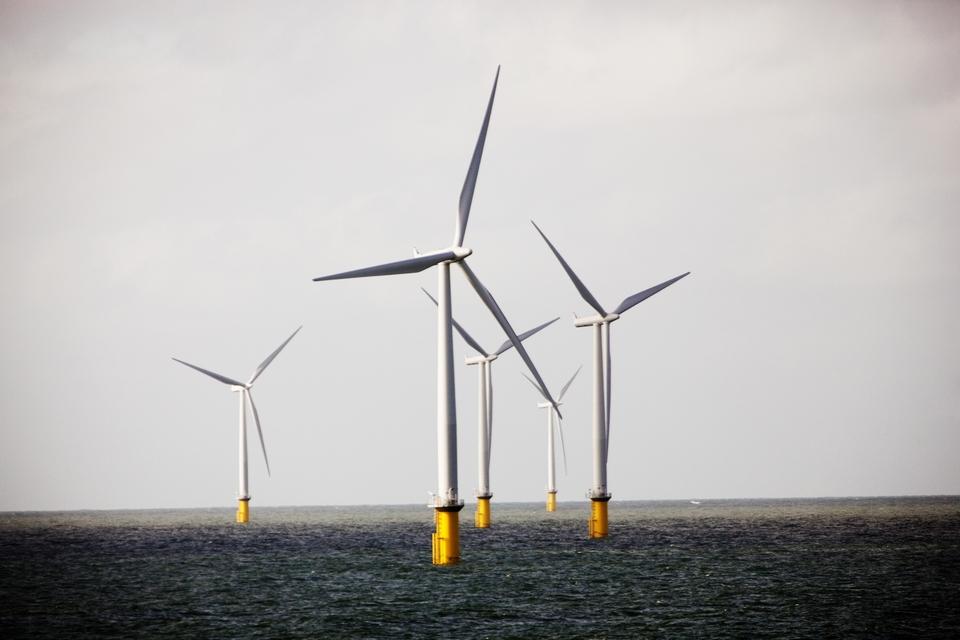
Offshore wind farm (Photo: DONG Energy A/S)
¶ “It’s time for states to lead on climate change – and on justice, too” • With the new administration in Washington, climate activists will have a lot to defend in the next four years, but defense is not enough. We don’t have time to waste in fighting climate change. We must make up the ground we are likely to lose at the federal level. [Grist]
Science and Technology:
¶ Canadian archeologists are in a race against time. They have been collecting, studying and preserving ancient artifacts – darts, bows and arrows – lost or misplaced by prehistoric hunters and protected by a covering of snow over millennia. Climate change is melting the snow now, exposing the artifacts to decay. [Radio Canada International]

NWT ice patch landscape (Photo Credit: T. Andrews / GNWT)
World:
¶ Vestas won an order from Korea Electric Power Corp to build an 89-MW wind farm in Jordan. Vestas said it will install 27 V126-3.3MW turbines at the new Fujeij wind farm in Al Shobak in the Ma’an area. Wind turbine delivery will start in the fourth quarter of next year and commissioning is expected for the third quarter of 2018. [reNews]
¶ The cost of electricity from solar and wind power has fallen
to be the same as or cheaper than fossil fuels in over 30 nations, according to a World Economic Forum report. Green energy advocates hope business and investors across the globe could shift their attention and dollars away from fossil fuel production. [Christian Science Monitor]

Wind turbines in Washington (Photo by Rick Bowmer, AP / File)
¶ China will reduce the guaranteed prices paid for electricity supplied to its national grid by newly built large-scale solar power plants and onshore wind turbines starting January 1, the National Development and Reform Commission said. The cut was due to the decreasing cost of production in the renewable energy industry. [ETEnergyworld.com]
¶ Cornwall’s Wave Hub has been called “world class” by wave energy experts. The Wave Hub, which lies on the sea bed 16 km off the coast near Hayle, and which was built with support from the European Regional Development Fund, has placed Cornwall at the cutting edge of testing renewable wave energy technology. [Falmouth Packet]

Wave Hub projects (Please click on the image to enlarge it.)
¶ French company Bardot Group has won an order to supply buoyancy modules for the power cables of Statoil’s 30-MW Hywind Scotland floating wind demonstration project, off the northeast coast of Scotland. Buoyancy modules assist flotation in the dynamic sections of power cables. The project will have five 6-MW Siemens turbines. [reNews]
¶ Renewable energy is an area that is expected to take off in India, thanks to the ambitious mission stated by the Ministry
of New and Renewable energy. It has a goal of “24×7 affordable environment friendly power for all by 2019.” The government also plans to generate around 40% of its power from non-fossil fuels by 2030. [Firstpost]

Renewable energy in India
¶ Three geothermal generating units of Pertamina Geothermal Energy are being commissioned on the Indonesian island of Sulawesi. Each of the three units has a capacity of 20 MW. The state-owned energy company Pertamina, the parent company of PGE, said the project is valued at approximately $282 million (Rp3.3 trillion). [ANTARA]
US:
¶ To remain competitive in a changing power market, North Dakota’s largest power plant is making operational changes so production can ramp up and down quicker. Now, all generation resources need to be supplemental to wind. Great River Energy is adapting operations at Coal Creek Station to run at either 1146 MW or 300 MW. [Bismarck Tribune]

Coal Creek Station (Submitted photo)
¶ As of last month, there were 1.1 million residential rooftop solar power systems in the US, keeping the televisions, refrigerators, computers, stoves, and lights on throughout the country. Two US senators introduced a resolution in the Senate earlier this month, calling for the entire country to be 100% powered by renewables by 2050. [Daily Kos]
¶ Since 2012, five nuclear power plants around the country have shut down prematurely as they became uneconomical to run. Now, to prevent the two operating reactors at Millstone from the same fate, Dominion, the plant’s owner, is urging Connecticut’s state lawmakers to approve legislation to secure the plant’s survival. [theday.com]

 geoharvey