
World:
¶ Scotrenewables is trying out a turbine that looks like a yellow submarine. The 35-meter-long device was built at the Harland and Wolff shipyards in Belfast, best known as the birthplace of the ill-fated Titanic. The device is considered to be unlikely to have effects on sea life. [Deutsche Welle]

Scotrenewables turbine
¶ Until recently, virtually the only choice available to developers looking to build under the Australian government’s renewable energy target was wind energy. That is now changing. Within a year or two, large-scale solar farms may be able to compete with wind energy on costs. [CleanTechnica]
¶ A new 767-kW solar power project was recently completed in the Pacific nation of Vanuatu, marking the latest undertaking performed by the United Arab Emirates-Pacific Partnership Fund. The fund is a $50 million initiative managed by Masdar, Abu Dhabi’s renewable energy company. [PV-Tech]
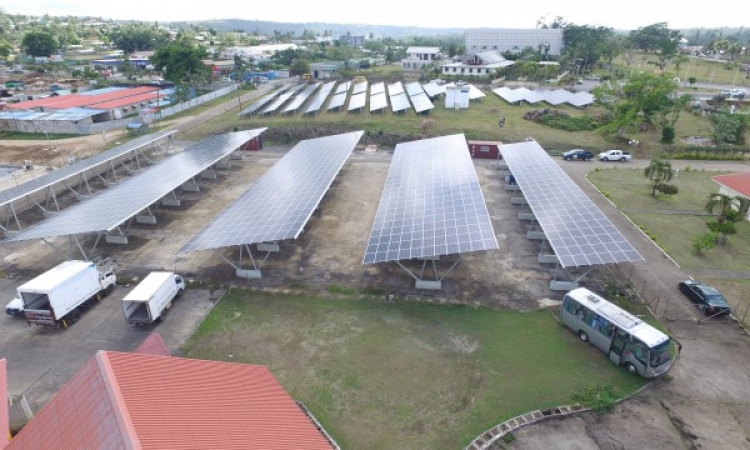
The Vanuatu project will help displace 896 tonnes of CO2 emissions. Image: Masdar
¶ Kokam Co Ltd, has announced the deployment of two Lithium Nickel Manganese Cobalt Oxide Energy Storage Systems in Korea. One of the two systems is 24-MW, and the other is 16-MW. They will provide storage capacity for grid frequency regulation. [Renewable Energy Magazine]
¶ Edinburgh tidal developer Nova Innovation deployed the first 100-kW turbine that forms part of the Shetland Tidal Array. The M100 turbine is now delivering power to the Shetland grid following operations and testing. Plans for the array include a total of five turbines. [reNews]

M100 tidal turbine (Nova Innovation image)
¶ According to estimates published by the International Hydropower Association earlier this month in its latest briefing, the world’s total installed hydropower capacity reached 1,211 GW, thanks to 2015 installation figures of 33 GW of hydropower and 3.2 GW of pumped storage. [CleanTechnica]
¶ The death rattle of coal industry grew a little louder when JPMorgan Chase announced they will no longer finance new coal operations in the developed world. The bank joins a growing list that are cutting ties with coal, including Bank of America, Citigroup, Morgan Stanley, and Wells Fargo. [Grist]

Coal plant in china. Shutterstock image.
¶ A Japanese court ordered Kansai Electric Power to shut down two nuclear reactors in Takahama, after complaints by local residents about the safety of the plant. This is the first ruling issued in Japan against an operating nuclear plant, according to media. The company says it will appeal. [BBC]
¶ Threatened wildlife including turtle doves and skylarks could benefit from a scheme which has been launched to create natural habitats at solar farm sites. Wildlife charity RSPB and clean tech company Anesco aim to boost wildlife at the firm’s solar farms across England and Wales. [Yorkshire Post]

A skylark
US:
¶ Nearly 18 GW of electric generating capacity was retired in 2015. More than 80% of the retired capacity was conventional steam coal. The coal-fired generating units retired in 2015 tended to be older and smaller in capacity than the coal generation fleet that continues to operate. [CleanTechnica]
¶ Liquid Light is a startup company pioneering a process to convert carbon dioxide into chemicals that can be used to make consumer products. The company developed a catalyst that can combine carbon dioxide with water and electricity, to make liquid fuels and chemicals to replace petroleum. [CNN]

Emily Cole, co-founder and chief science officer of Liquid Light.
¶ The developer of a planned $1.6 billion offshore wind farm in Hawaii waters is moving ahead with its project after federal regulators accepted the 400-MW project’s lease application this week. Progression Hawaii Offshore Wind Inc plans to develop the project 10 miles off West Oahu. [Pacific Business News]
¶ Renewable energy firms SolarCity and NRG Energy plan to install rooftop solar on 184 stores and distribution centers of major grocery chain Whole Foods Market. A senior solar analyst at GTM Research told PV Tech that SolarCity would likely install lat least 15-MW, while NRG will account for 13.8MW. [PV-Tech]

Whole Foods has already piloted solar projects with SunEdison. Credit: SolarCity
¶ In Schuyler County, New York, sheriff’s deputies made 57 arrests Monday morning at the gates of the Crestwood Midstream facility. Environmental activist Bill McKibben was among those arrested. They were protesting intended storage of liquid petroleum gas in a salt dome. [Finger Lakes Times]
¶ After 116 days, the Fossil Free MIT sit-in has ended with the announcement of a deal on climate action. The longest ever sit-in for fossil fuel divestment concluded when an agreement was reached between student activists from Fossil Free MIT and MIT’s Vice President for Research. [CleanTechnica]
 geoharvey
March 9, 2016 at 1:16 pm
Reblogged this on A Green Road Daily News.
March 10, 2016 at 2:54 pm
Reblogged this on nuclear-news.