
Opinion:
¶ “End the nuclear ‘safety myth’” The International Atomic Energy Agency’s final report on the March 2011 triple meltdowns at Tokyo Electric Power Co’s Fukushima No 1 nuclear power plant puts the main blame on the assumption prevailing at the time that Japan’s “nuclear power plants were so safe that an accident of this magnitude was simply unthinkable.” [The Japan Times]
Science and Technology:
¶ The next two years could be the hottest on record globally, says research from the UK’s Met Office. It warns big changes could be under way in the climate system. The research shows that a major El Nino event is in play in the Pacific, which is expected to heat the world overall. But it also reveals that summers in Europe might get cooler for a while as the rest of the globe warms. [BBC]
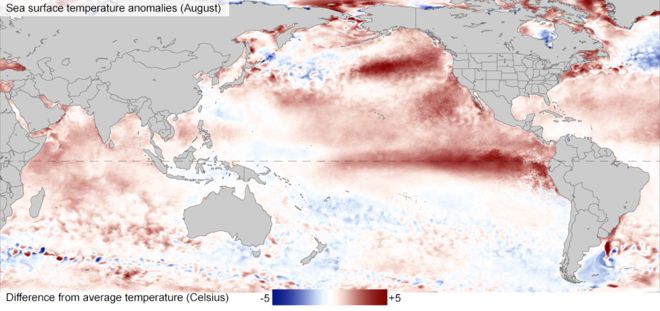
The El Nino phenomenon sees surface waters warm dramatically in the eastern Pacific.
World:
¶ Acciona Energia will soon begin construction of a 246.6 MW solar PV power plant in the Atacama Desert, Chile. The El Romero Solar power plant is expected to be operational by mid-2017, and will be the largest solar power plant in South America, costing $343 million. The project will cover 280 hectares, and will have over 777,000 crystalline solar PV modules. [CleanTechnica]
¶ Chinese industrial firm AVIC Heavy Machinery Co Ltd says it plans to construct 1,500 MW of wind farms along with 200 MW of PV parks in Inner Mongolia autonomous region. The projects will be realised through agreements with three local governments, each of which will get 500 MW of wind power. The solar capacity will be in to of those three areas. [SeeNews Renewables]
¶ A German company has designed an ingenious system to help ships become more energy efficient by using kites. SkySails’ calls its system “kite wind propulsion” for large cargo ships. It says the system provides much more power than sails, and even generates more power than traditional wind turbines. It delivers electrical power to the ship at a cost of about 6¢/kWh. [CNBC]
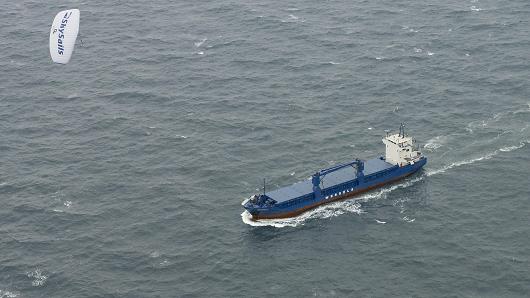
Copyright SkySails
¶ Energie Baden-Wuerttemberg AG will sell some of its assets to help transform Germany’s third-largest power supplier into a business centered on renewable energy and operating grids. Assets that may be divested include stakes in utilities in Austria, Hungary and Germany. Up until 2012, EnBW relied on nuclear reactors for more than half of its output. [Bloomberg]
¶ Global investment bank UBS has conducted the first in-depth analysis of the Labor Party’s proposed 50% renewable energy target for Australia by 2030, concluding that it will require around $80 billion in investment, but much of this would need to be spent anyway. UBS says that up to 20 GW of wind energy will need to be built by 2030, and 26 GW of solar. [RenewEconomy]
¶ EDF Energies Nouvelles subsidiary InnoWind has commissioned the 21.5-MW Chaba wind farm in Eastern Cape Province in South Africa. The project consists of seven 3.075-MW V112 Vestas turbines. Electricity generated by the wind farm will be sold through a 20-year power purchase agreement. A portion of the revenues will be used to support the local economy. [reNews]
¶ Vattenfall and Stadtwerke München have started inner-park array cabling at the 288-MW Sandbank offshore wind farm in the German North Sea. The developers said the first power cable has been installed between monopiles SB 28C and SB 29C. The inner park cables will transport electricity from the 72 wind power plants to the farm’s offshore substation. [reNews]
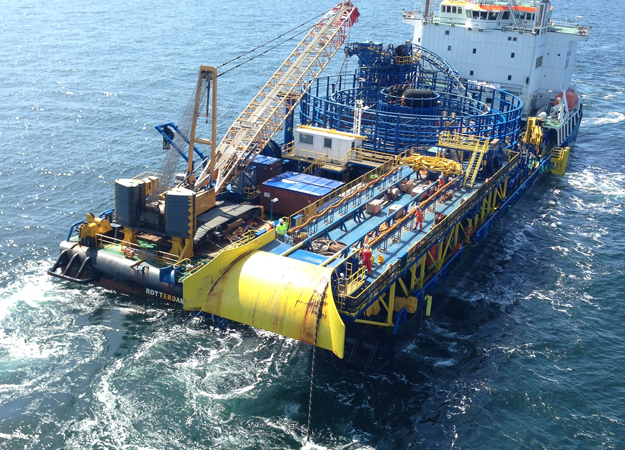
Image: VBMS’s Stemat Spirit is laying the cables at Sandbank (RWE)
US:
¶ Ohio needs to let its two-year freeze on renewable energy mandates expire to become more competitive, a report says. There are questions about what effects the freeze may have had. One question is what investments Ohio might be missing because of the state’s strict rules on wind power while companies want to use wind to power new facilities. [Toledo Blade]
¶ Community solar is growing and could account for as much as half of the small-scale solar-panel market by 2020, according to an April forecast by the Energy Department’s National Renewable Energy Laboratory in Golden, Colo. That would create a hefty new solar market in between individually owned rooftop arrays and large utility-scale projects. [Wall Street Journal]
¶ The Energy Information Administration projects lower domestic coal consumption and exports as well as a slight rise in coal imports will add to a 86 million short ton (9%) decline in production in 2015. Coal production is expected to decline in all coal-producing regions in 2015, with the largest decline (on a percentage basis) occurring in the Appalachian region. [World Coal]
 geoharvey
Leave a comment