World:
¶ The future of the UK’s popular feed-in tariff has been thrown into doubt, after the government this morning published a wide-ranging consultation on the program. The document proposes deep cuts to support for solar PV, wind and hydropower from January in a bid to cap government spending on feed-in tariffs at £75 million to £100 million. [Business Green]

Solar rooftops on residential buildings in the UK.
¶ A new Citigroup report values the fossil fuel reserves that need to be left in the ground if the world is to meet its targets of trying to limit global warming to 2° C at $100 trillion. But 2° C is a target that, according to a new Climate Council report, is actually a lot less “safe” for humankind than the science thought it was just 10 years ago. [CleanTechnica]
¶ Uzbekistan has taken its first major steps towards setting up large-scale solar power projects. The central Asian country has announced that work on three large-scale solar power projects has been initiated. The total installed capacity of these projects would be 300 MW, and will require an estimated investment of nearly $700 million. [CleanTechnica]
¶ The Canadian Medical Association will divest its holdings in fossil-fuel companies, a move doctors hope will send a powerful symbolic message that climate change is an urgent health concern. “Given the health impacts of fossil fuels, we have to take a stand,” one physician said in addressing the CMA’s general council meeting on Tuesday. [The Globe and Mail]
¶ Australia’s city of Newcastle may be the world’s biggest coal export port, but it will pull money out of fossil fuel industries, favoring sustainability. The city council, which manages a Aus$268 million (US$191 million) investment fund for the city, voted to move towards “environmentally and socially responsible investments”. [Peninsula On-line]
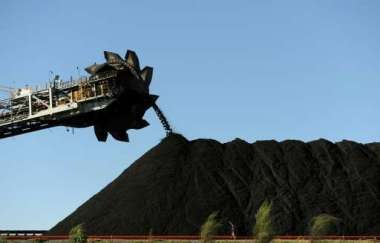
Coal storage.
¶ In the Philippines, the Energy Regulatory Commission approved a certificate of compliance for the 36-MW Nabas Phase-1 wind power project in Aklan province paving the way for feed-in-tariff eligibility. It will become the single biggest investment in Aklan province and the largest renewable energy project to date in Panay island. [Manila Standard Today]
¶ Vermont Law School senior fellow Mark Cooper called on South Australia’s Nuclear Fuel Cycle Royal Commission to reject nuclear power. His submission to the commission argues that the rapid development of renewable energy technology renders nuclear power a 20th-century “relic” that will be outdated before a new reactor could be built. [The Australian]
US:
¶ Hoosier Energy and Randolph Farms Landfill are forming a partnership that will turn landfill gas into a renewable energy resource for Randolph County, Indiana. Hoosier Energy will build the Cabin Creek renewable energy project, a 4-MW landfill gas facility, at the Randolph Farms Landfill in rural east-central Indiana. [REjournals.com]
¶ In Vermont, two long-delayed Windham County hydroelectric stations are well underway and may begin producing power by fall, producing about 3.1 MW, in combination. New Jersey-based Eagle Creek Renewable Energy LLC is building hydro projects at U.S. Army Corps of Engineers dams in Townshend and Jamaica. [vtdigger.org]
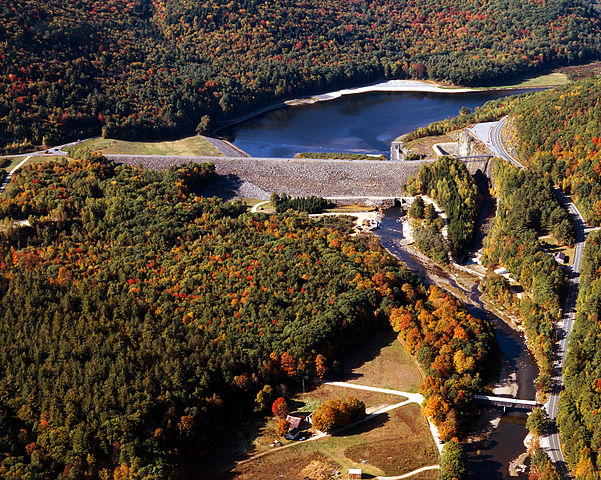
Townshend Lake and Dam. US Army Corps of Engineers photo.
¶ Nevada regulators decided to keep existing rates in place for rooftop solar customers for a few more months even though the state hit a cap on how much energy can be sold back to a utility. Rooftop solar advocates, who have decried the cap and argued that utility company NV Energy is trying to kill the industry, said they were grateful. [Mohave Valley News]
¶ The Imperial Irrigation District is preparing to build one of the largest battery storage systems in the western United States. The electricity storage unit will help the utility deal with fluctuating power. The battery could even help keep the grid operating during a big blackout. The 30-MW battery complex will use lithium-ion battery technology. [KPBS]
¶ The Rocky Mountain Institute released a report, The Economics of Demand Flexibility. It shows how simple, Internet-connected technologies can give consumers more choice and save money. It also shows how billions of dollars on grid investments can be saved, and how we can achieve a carbon-free grid faster. [Natural Resources Defense Council]

 geoharvey