Science and Technology:
¶ A new system combining lithium-iodine batteries and solar cells, an aqueous lithium−iodine solar flow battery, has been created by researchers at Ohio State University. The new battery system promises energy savings of nearly 20%, compared to conventional lithium-iodine batteries. The new work may serve as a design basis for other metal-redox flow batteries. [CleanTechnica]
Not Energy or Climate Change, but Noteworthy:
¶ Scotland is to ban the growing of genetically modified crops, the country’s rural affairs secretary has announced. Richard Lochhead said the Scottish government was not prepared to “gamble” with the future of the country’s £14 billion food and drink sector. Under European Union rules, genetically modified crops must be formally authorised before they can be cultivated. [BBC News]
World:
¶ Coal India Ltd (CIL), the largest producer of the fuel in the country, will invest over ₹62,500 crore ($9.8 billion) in the next five years with an aim to ramp up annual production to 908 million tonnes by 2019-2020, the government has said. The State-run miner in 2014-15 had produced 494 million tonnes of coal, though this was 3% lower than the targeted 507 million tonnes. [The Hindu]

CIL registered a growth of 12.3 per cent in production at 121 million tonnes — the highest growth for any quarter in its history.
¶ It is understandable that Nigeria, as a major oil producer, generates 80% of its electricity hydrocarbon powered turbines. However, it is very difficult to understand why, in the face of the failure of the fuel-powered systems to provide the needed electricity in Nigeria, other available easy-pick energy sources, especially solar power, have remained significantly unharnessed. [THISDAY Live]
¶ French Minister of Ecology, Sustainable Development, and Energy, Ségolène Royal, has called for increased investment in renewable energy. Ms Royal said in Lusaka, Zambia on Friday that to reduce deforestation, to mitigate effects of climate change, and to give access to electricity to those who do not have it, there is need to focus on alternative sources of energy. [Zambia Daily Mail]
¶ Japan’s nuclear regulator said an accident on the scale of the 2011 Fukushima disaster would not occur under new safety rules imposed on reactors such as Kyushu Electric Power’s Sendai No. 1, set to be the first to restart since Fukushima, Japan’s Nikkei business daily reported on Saturday. The Sendai No 1 reactor is may be restarted as early as next week. [The Nation]
US:
¶ Whenever the wind blows or the sun shines, a first-of-its-kind renewable power plant near Willcox, Arizona will help power thousands of Tucson homes. The project was dedicated under cloudy skies with gusty winds in the rolling grasslands about 15 miles west of Willcox, despite lingering concerns of some over the impact of its massive wind turbines on birds and other wildlife. [Arizona Daily Star]
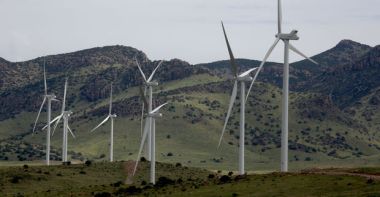
The combined wind and solar project is expected to provide enough electricity for 13,500 homes in Tucson Electric Power’s territory. A.E. Araiza / Arizona Daily Star
¶ Agriculture Secretary Tom Vilsack announced $63 million in loans and grants for 264 renewable energy and energy efficiency projects nationwide that USDA is supporting through its Rural Energy for America Program. These REAP projects are expected to generate and/or save 207.8 million kWh of energy, enough to provide power demands for more than 13,600 homes. [Imperial Valley News]
¶ Kansas had the third-highest amount of wind power capacity under construction in the country in the second quarter, with buyers including in-state utilities and an internet search company. There were over 1,070 MW of wind power capacity under construction in Kansas as of the second quarter of 2015. That will increase state’s 2,967 MW in existing capacity by over 36%. [Topeka Capital Journal]
¶ The method of manure treatment called anaerobic digestion benefits the environment because it enables capturing methane to be burned for renewable heat and electricity instead of allowing the methane to be released into the atmosphere. During the last few years, however, the price of natural gas has been low, making anaerobic digestion less economical. [Minneapolis Star Tribune]

 geoharvey