World:
¶ Denmark, a country of just 6 million people, built its first offshore wind farm in 1991. Now wind makes up to 40% of the electricity, and Danes are designing and building systems in Europe, Asia and North America. The Danes have dreamed of a fossil fuel-free future since the 1970s, and the dream is coming true. [Deutsche Welle]
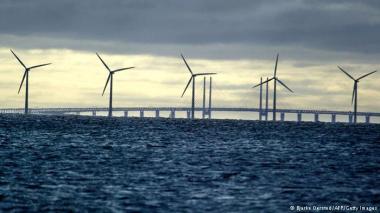
Danish wind farm
¶ Shell successfully lobbied to undermine European renewable energy targets ahead of a key agreement on emissions cuts reached in October last year. The European commission president had said the deal was very good news, but it seems that a key part of the agreement was proposed by a Shell lobbyist in 2011. [The Guardian]
¶ Siemens has handed over the North Sea grid connection SylWin1 to German-Dutch transmission grid operator TenneT and it is now in commercial operation. The cable is more than 200 kilometres long and supplies up to 864 MW of green electricity, enough to power more than a million German households. [Renewable Energy Magazine]
¶ Solar power may become profitable in Japan as early as this quarter, according to the Japan Renewable Energy Foundation, freeing it from the need for subsidies and making it the last of the G7 economies where solar technology has become economically viable. Japan is one of the four largest solar manufacturers. [The Rakyat Post]
¶ In Malaysia, the proposed Baleh hydroelectric dam, proposed by Sarawak Energy Bhd, will have an installed capacity of 1,285 MW. When commissioned, the 188 meter high concrete face rockfill dam is expected to generate 8,076 GWh of electricity per year on average. The proposed completion date is 2024. [The Star Online]
¶ Ghost hydropower plants that will never be built could cause a collapse in the industry in Scotland. Even though the plants do not exist they are still counted as producing energy by the UK’s Department of Climate Change which then cuts the subsidy for schemes planned for the future, making them unviable. [The National]
¶ Saturn Power Inc, an independent solar power producer, announced that it has completed construction of the 10 MW David Brown Solar Park Project near Ingleside, Ontario. The project went into commercial operation on March 16, and is expected to produce 16.8 GWh annually, enough to power 1800 households. [pv magazine]
¶ A2Sea A/S has been awarded a contract by Dong Energy A/S to install the turbines at the Danish state-owned utility’s 258-MW Burbo Bank Extension offshore wind farm in the UK, the companies said Friday. The Danish offshore wind installation company will erect 32 MHI Vestas 8-MW turbines at the site. [SeeNews Renewables]
¶ Kyushu Electric, the Japanese utility that last year temporarily suspended new grid applications for large-scale solar, will install a huge battery project aimed at integrating a higher capacity for renewable power. The battery, to be installed in Fukuoka Prefecture, will have capacities of 50 MW and 300 MWh. [PV-Tech]
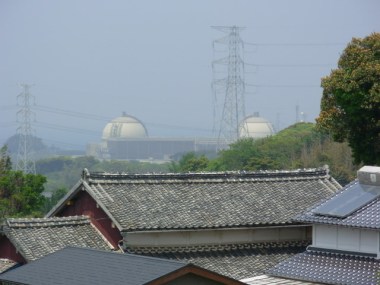
Kyushu’s Genkai nuclear power plant. Photo by KEI. Wikimedia Commons.
US:
¶ Maryland-based Fitzgerald Auto Malls is the first dealership group to become an EPA Green Power Partner Member of the EPA Green Power Leadership Club. Its power is 100% from renewable energy sources, it has the first LEED Gold certified dealership east of the Mississippi, and it recycles 81% of its solid waste. [Recycling News]
¶ The Vermont town of Norwich is now the first community in the state whose municipal buildings all get their electricity from the sun, sending excess to the grid. A local solar manufacturer, Solaflect, arranged the financing with help of solar tax credits and the guarantee the town would continue to buy the power. [Rutland Herald]
¶ As the Obama administration moves to finalize its climate rule for power plants, the nuclear industry is pushing for major changes. Part of the plan says states can credit 6% of their nuclear output toward emissions reductions. The industry says the 6% figure is arbitrary and a disincentive for nuclear power. [The Hill]

 geoharvey