Science and Technology:
¶ Tesla Motors are out to change the world – and they’re doing it fast, and in style. Like many other of their projects, this one seemed to pop up out of nowhere: Tesla have designed a battery that can power your home and even larger utility buildings. In other words, it could take your house out of the grid. [ZME Science]
World:
¶ Oil companies continue to get burned by low oil prices, but the pain is bleeding over into the financial industry. Major banks are suffering huge losses from both directly backing some struggling oil companies, but also from buying high-yield debt that is now going sour and difficult for the banks to sell on the market. [CleanTechnica]

Downtown Vancouver. Photo by Connormah, via Wikimedia Commons.
¶ The Vancouver city council voted unanimously Wednesday to support a shift toward using 100% renewable energy sources in a renewed push to meet its “greenest city” goals. Currently, 32% of Vancouver’s energy needs are met by renewable energy including electric power, heating and cooling. [MetroNews Canada]
¶ SunEdison plans to buy about 1,000 vanadium flow batteries from Imergy Power Systems. They will store more than 100 MWh of energy at SunEdison’s rural electrification and solar-powered minigrid projects in India. SunEdison intends to bring reliable energy to 20 million people globally by 2020. [Clean Technology Business Review]
¶ Government of India has agreed to provide cheap liquefied natural gas for use in power plants. The initiative is to help power industry investments that are losing money, mainly due to fuel scarcity. The companies bid for the lowest amount of subsidy they need to supply electricity at a set rate per unit. [Greentech Lead]
¶ West Australian is turning to solar power. Last year, the energy market required subsidies of $620 million, the difference between the cost of generation and delivery of its ageing coal and gas infrastructure and the price it charges to consumers. But rooftop solar and battery storage are becoming common. [RenewEconomy]
¶ Ontario’s Independent Electricity System Operator issued its 18-Month Outlook, covering April 2015 to September 2016. It says 2,300 MW of new supply will be added, including 1,700 MW of wind energy, 10 MW of hydroelectric, 300 MW of gas, 240 MW of solar, and 40 MW of biofuels. [Windpower Engineering]
¶ Renewable electricity in the UK surged 20% to 64.4 TWh in 2014 and claimed a record share of 19.2% of total generation. The latest Energy Statistics show offshore wind generation rose by 16.1% and onshore wind by 7.9% compared with 2013. Both increases were mainly due to increased capacity. [reNews]
US:
¶ Texas has become a renewable energy leader, thanks in part to a renewable energy bill introduced by Senator Troy Fraser in 2005. Now Fraser asks if the work is already done and whether incentives should be frozen. The original goals were 5,000 MW by 2015 and 10,000 MW by 2025. But Texas hit that mark in 2010. [Fierce Energy]
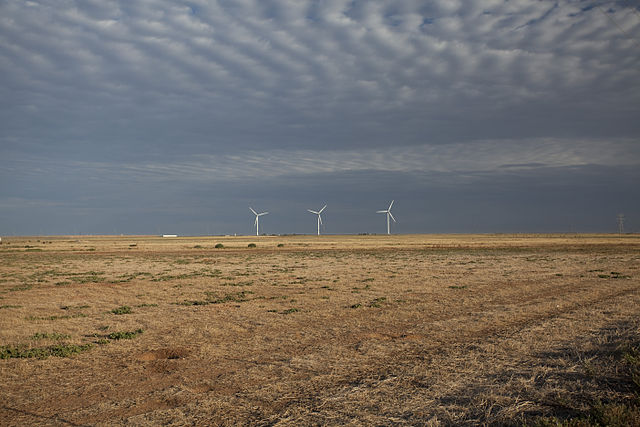
Wind turbines in Texas. Photo by Leaflet, via Wikimedia Commons.
¶ Three nuclear-related bills were passed by the Washington Senate and are being considered in a House committee. One question is whether Washington should find a place to build small modular reactors. Leaders in the Tri-Cities area of southeastern Washington envision a Boeing-style assembly plant. [Crosscut]
¶ Centennial Renewable Energy of Idaho announced that is building a 160,000-metric-ton wood pellet plant in northern Idaho and recently signed agreements to purchase land for the project. CRE has named its funding advisor as UK-based CHP Ventures, which has secured development funds for the project. [Biomass Magazine]
¶ President Obama authorized the Department of Energy to start developing a national repository for the nation’s high-level radioactive defense waste. About half of that waste is at Hanford. The previous plan had been to dispose of high-level radioactive defense waste and used commercial nuclear fuel together. [Walla Walla Union-Bulletin]

 geoharvey